
Prompt Engineering for Marketing: A Practitioner's Playbook

Most marketing teams are already using AI. The problem isn't access. It's that the work often happens in Slack threads, browser tabs, and half-remembered prompts copied from one person to another. One marketer gets a strong blog outline from ChatGPT. Another gets unusable ad copy from the same model. A growth lead asks for campaign insights and receives a generic summary with no thresholds, no context, and no next step.
That inconsistency is what CMOs feel. AI output looks promising in demos, but inside a live marketing organization it can become noisy, off-brand, and hard to measure. The gap isn't the model. The gap is the operating model around it.
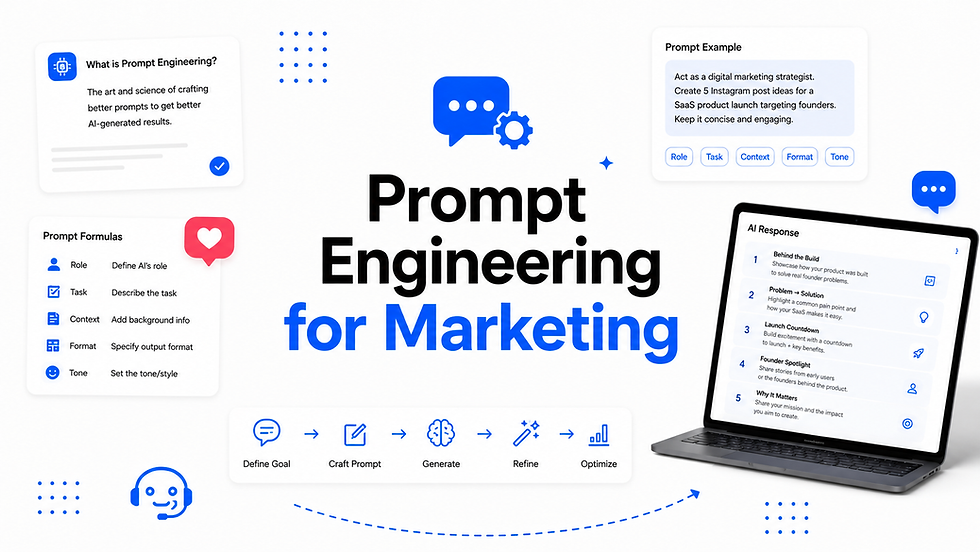
At Busylike, prompt engineering for marketing works best when it's treated like any other serious marketing system. It needs defined inputs, approved templates, testing logic, ownership, review criteria, and governance. Once teams make that shift, prompts stop behaving like clever one-off instructions and start functioning like production assets.
Table of Contents
From Ad-Hoc Queries to Strategic Architecture - Prompt architecture starts with business intent - The real unit of scale is the system - What works and what doesn't
Designing Your Core Marketing Prompt Templates - What a reusable prompt actually contains - One template across multiple channels - Where teams usually break the template
A/B Testing and Optimizing Prompt Performance - Treat prompts like performance assets - What to test inside the prompt - How to judge output before launch
Building a Scalable Prompt Library and Workflow - How to organize the library - What every prompt record should include - A workflow people will actually use
Establishing Prompt Governance and Brand Safety - Governance starts before generation - The review model for enterprise marketing - What leadership should standardize now
From Ad-Hoc Queries to Strategic Architecture
A lot of prompt usage in marketing still looks accidental. Someone asks for five email subject lines. Someone else pastes campaign notes into Claude and asks for a launch plan. Another person tries to get attribution insights from a model that has no clean access to actual performance data. The output might be decent, but the system behind it is weak.
That weakness matters more now because prompt engineering is no longer a fringe skill. One projection estimates the market will grow from USD 673.6 million in 2026 to USD 6,703.84 million by 2034, a 33.27% CAGR, according to Fortune Business Insights on the prompt engineering market. For marketing leaders, that signals a move from experimentation to operational capability.

Prompt architecture starts with business intent
The useful shift is simple. Stop asking, "What can AI write for us?" Start asking, "Which marketing decisions and workflows should AI support?"
That changes the design brief. A prompt isn't just text. It's an instruction layer between a business objective and a repeatable output.
A strategic architecture usually maps like this:
Business objective | Promptable marketing task | Expected output |
|---|---|---|
Lead generation | Draft audience-specific nurture flows | Channel-ready email sequence drafts |
Brand awareness | Turn positioning into platform-specific messaging | Social copy variants and message angles |
Market penetration | Analyze objections by segment | Messaging briefs and sales enablement inputs |
Performance optimization | Review campaign data against thresholds | Insight summaries with recommended actions |
When teams make this map explicit, AI becomes easier to govern. A demand gen prompt should serve pipeline work. A content prompt should support editorial production. A reporting prompt should produce decision-ready summaries. Mixing all of that into one generic "help me market better" prompt is where quality collapses.
Practical rule: If a prompt can't be tied to a marketing objective, owner, and downstream use case, it probably shouldn't enter your team's shared workflow.
The real unit of scale is the system
Prompt engineering for marketing overlaps with broader AI discovery strategy. Teams that are already adapting to conversational search and AI surfaces often benefit from understanding generative engine optimization, because the same discipline applies internally. Clear inputs, structured outputs, and strong contextual signals produce more reliable results.
Inside the organization, the architecture usually has four layers:
Task layer. Define the recurring work AI should support, such as outlining articles, summarizing paid media performance, or adapting product messaging by segment.
Context layer. Supply brand rules, audience definitions, campaign constraints, and approved terminology.
Output layer. Specify the format required by the next human or system in the workflow.
Control layer. Add review criteria, threshold logic, and approval rules.
A mature AI program doesn't begin with better phrasing. It begins with better system design. That's also why prompt work should sit next to analytics and automation planning, not off to the side as a copy experiment. Teams building a formal AI-driven marketing strategy usually get more value because prompts are connected to campaign operations from the start.
What works and what doesn't
What works is boring in the best way. Defined use cases. Clear owners. Reusable templates. Shared review standards.
What doesn't work is relying on prompt heroes. One person becomes "the AI person," everyone sends them requests, and none of the learning gets operationalized. That approach creates dependence, not capability.
Strategic prompt architecture gives a CMO something more useful than occasional creative wins. It creates a system the team can repeat, audit, and improve.
Designing Your Core Marketing Prompt Templates
The strongest prompt templates don't sound magical. They sound disciplined. They tell the model who it is, what context matters, what action to take, what tone to use, and what format to return. Guidance for marketers consistently recommends those structured components, paired with few-shot examples and chain-of-thought or prompt-chaining, because they make outputs more predictable and easier to QA, as outlined in Regie.ai's prompt engineering guidance for sales and marketing.
What a reusable prompt actually contains
A reusable template should answer six questions before the model starts writing.
Role Give the model a job. "Act as a B2B SaaS content strategist" is more useful than "write a blog post."
Context Include audience, offer, funnel stage, channel, campaign objective, and brand constraints.
Action Specify the exact task. Outline, rewrite, summarize, compare, classify, or generate.
Tone Define the voice plainly. Professional, direct, concise, evidence-led, technical, conversational. Pick what the brand uses.
Format Tell the model how to return the work. Table, bullet list, headline set, email sequence, JSON structure, short memo.
Validation cue Add a check. Ask it to verify alignment with the brief, note assumptions, or flag areas needing human review.
A practical starter template looks like this:
Role: Act as a lifecycle marketing strategist for a mid-market SaaS brand.Context: The audience is trial users who activated once but haven't returned. Brand voice is clear, useful, and low-hype. The goal is to increase product re-engagement.Action: Draft a three-email reactivation sequence.Tone: Direct and supportive. No exaggerated claims.Format: For each email, provide subject line, preview text, body copy, CTA, and reason for sending.Validation: Flag any claims that require product or legal review.
That structure is much easier to reuse than a chatty paragraph request. If your team wants more examples of practical prompt engineering for teams, the useful lens isn't creativity. It's repeatability.
One template across multiple channels
The best templates have a stable backbone and flexible channel modules. You don't need a completely new philosophy for every asset. You need a reliable base that adapts cleanly.
Take a core campaign message around a product update.
For SEO content, the prompt should ask for:
Search intent framing
Topic hierarchy
Audience questions
Metadata and heading structure
Areas requiring fact verification
For paid social, the same campaign prompt should shift toward:
Audience pain point
Hook variations
Primary text options
CTA styles
Platform-fit constraints
For email nurture, the emphasis changes again:
Sequence logic
Message progression
Objection handling
CTA pacing
Lifecycle context
Here's the trade-off. Teams often overfit a prompt to one great output, then can't reuse it. A better approach is to create a master framework plus channel-specific modules. That gives you consistency without forcing every deliverable into the same shape.
Where teams usually break the template
Most failures come from missing constraints, not weak wording.
Common breakdowns look like this:
Unclear audience. The model defaults to generic marketing language when the prompt doesn't define who it's speaking to.
Missing brand boundaries. Without forbidden phrases, required terminology, or tone guidance, outputs drift fast.
Loose output definitions. "Give me ideas" usually returns scattered content. "Return five LinkedIn post angles with a contrarian hook and one proof point each" is much more usable.
No examples. A few approved examples often do more than a long explanation.
No handoff logic. If the output is meant for a designer, paid media manager, or editor, the format needs to support that next step.
Good templates lower variance. They don't just improve quality. They reduce the number of ways a model can go off course.
One practical move is to create a template stack for your most frequent workflows. Blog outlines, ad variants, nurture emails, landing page rewrites, performance summaries, customer research synthesis. Start there. Don't try to template every possible prompt on day one.
If your team is already using saved prompt sets for execution, a resource like Busylike's guide to ChatGPT prompts for digital marketers is useful as a reference point for operational marketing tasks. The real leverage comes when those prompts are then normalized into your own approved format, examples, and review rules.
A/B Testing and Optimizing Prompt Performance
Many teams still treat prompts as static instructions. They write one, save it in Notion, and call it done. That's not how high-performing marketing systems work. Prompts should be handled more like ad creative, landing pages, and nurture flows. They need versions, tests, and retirement criteria.
Early in a prompt program, the difference between mediocre and strong output usually comes from iteration speed. The team that learns faster wins.

Treat prompts like performance assets
A useful benchmark from marketing-native AI guidance is that integrated systems can eliminate 90% of prompt engineering overhead, and decision-grade prompts increasingly include explicit thresholds such as a 20% ROAS decline or a 10% drop when surfacing insights, as described in Skai's guide for marketers.
The practical takeaway isn't just speed. It's that prompt optimization gets stronger when the prompt is tied to structured data and measurable triggers.
A static prompt says:"Review campaign performance and tell me what stands out."
A dynamic prompt says:"Review paid social performance by campaign. Flag any ad set with a 20% ROAS decline week over week. Separate creative fatigue signals from audience saturation signals. Return a summary with top issues, likely causes, and actions for the media buyer."
One generates commentary. The other supports action.
Later in your process, it helps to watch another practitioner's walkthrough before setting your own testing standards.
What to test inside the prompt
Don't test everything at once. Isolate one variable.
A practical prompt testing matrix might include:
Element to test | Variation A | Variation B | What you're evaluating |
|---|---|---|---|
Role framing | Content strategist | Demand gen manager | Relevance of output |
Instruction style | Direct generation | Multi-step reasoning | Completeness |
Constraint level | Light constraints | Strict constraints | Brand fit and usability |
Format | Paragraph output | Table output | Ease of handoff |
Example use | No examples | Few-shot examples | Consistency |
The goal isn't to discover one perfect prompt forever. It's to identify which structures work best for specific jobs.
A prompt for ideation should be judged differently from a prompt for regulated product messaging. Teams get into trouble when they apply one quality standard to every task.
How to judge output before launch
Marketers often skip this part. They compare outputs based on gut feel, not pre-defined criteria.
A better review scorecard asks:
Strategic fit. Did the output match the actual campaign objective?
Brand alignment. Does it sound like the company, not the model?
Operational usefulness. Can another team member use it without reworking the structure?
Factual caution. Did it avoid unsupported claims and mark assumptions clearly?
Performance potential. Does it create a plausible testable angle, CTA, or insight?
For campaign copy, your downstream test is often a live channel metric. For research synthesis or reporting, the first test is whether a human operator can act on the output quickly.
What doesn't work is optimizing prompts only for eloquence. Smooth language can hide weak strategy. Some of the most polished AI copy performs poorly because the prompt never forced specificity.
Prompt engineering for marketing gets much more valuable when your team asks, "Did this output improve the workflow?" instead of "Did this sound impressive?"
Building a Scalable Prompt Library and Workflow
A good prompt sitting in one person's chat history has almost no enterprise value. It only becomes valuable when the team can find it, trust it, and use it in the right context.
That requires a library, but not a graveyard of random snippets. The useful version is a managed repository with naming rules, ownership, and a workflow for validation. A 2025 taxonomy identified 24 prompt-engineering patterns for marketing and framed the work as a stepwise process of defining the task, specifying audience and channel, adding constraints, and validating the output, according to the SSRN paper on prompt-engineering patterns in marketing.

How to organize the library
The simplest useful structure is three-dimensional.
Organize prompts by:
Marketing function such as content, lifecycle, paid media, SEO, analytics, product marketing
Channel or asset type such as blog post, LinkedIn ad, nurture email, landing page, campaign summary
Objective such as awareness, conversion, retention, reporting, enablement
That means a team member shouldn't search for "good prompt." They should go to something like:Lifecycle marketing → Trial reactivation → Retention objective
This removes guesswork. It also helps standardize pattern reuse instead of encouraging every marketer to reinvent prompts from scratch.
What every prompt record should include
A prompt library entry needs more than the prompt body.
Each approved record should include:
Prompt name and version Keep naming predictable. Example: Paid-Social-Creative-Angles-v3.
Intended use case State when to use it and when not to use it.
Required inputs Audience, offer, channel, brand voice source, data fields, prohibited claims.
Expected output What format should come back, and who uses it next.
Review status Draft, approved, limited use, deprecated.
Owner Someone has to maintain it.
Known failure modes Generic output, repetitive hooks, weak CTA logic, messy formatting, unsupported assertions.
A short table works well here:
Field | Why it matters |
|---|---|
Required inputs | Reduces misuse and incomplete requests |
Output format | Makes handoff cleaner |
Owner | Prevents abandoned prompts |
Version | Supports testing and rollback |
Review status | Signals trust level to the team |
A workflow people will actually use
The workflow matters as much as the library itself. If contribution is too loose, quality degrades. If approval is too heavy, people ignore the system.
A workable model is:
Draft stage. A marketer submits a new prompt with sample inputs and outputs.
Validation stage. Another operator tests it against a real use case.
Approval stage. A functional lead signs off on quality and scope.
Publication stage. The prompt enters the shared library with metadata and instructions.
Review stage. Periodic checks remove stale prompts and promote stronger versions.
The library should capture team knowledge, not just team language. Save what made the prompt effective, not only the final text.
This is also where prompt engineering connects directly to workflow automation. If you're already thinking about orchestration, routing, and repeatable production, Busylike's overview of AI in marketing automation is relevant because prompt libraries become much more useful when they fit into larger campaign systems.
The trade-off is straightforward. Open libraries encourage experimentation. Governed libraries create consistency. Most enterprise teams need both. A sandbox for testing and an approved shelf for production.
Establishing Prompt Governance and Brand Safety
Most organizations don't fail with AI because the model can't generate. They fail because no one defined what safe, acceptable, reviewable output looks like in production.
That gap is getting harder to ignore. CMSWire highlights that 78% of organizations use AI, while most guidance still centers on creative generation rather than systems for evaluating prompt quality, brand safety, and consistency at scale in this analysis of prompt engineering's role in AI-driven marketing.

Governance starts before generation
A lot of teams put governance at the end. They review the output after it exists. That's necessary, but it's not enough.
Strong governance begins in the prompt itself.
That means embedding controls such as:
Approved brand language. Required tone descriptors, forbidden phrasing, product naming conventions.
Factual boundaries. Instruct the model not to invent statistics, testimonials, or product claims.
Legal and compliance rules. Define restricted topics, mandatory disclaimers, and escalation paths.
Source expectations. Require explicit marking of assumptions or unverifiable content.
Audience sensitivity. Add instructions for regulated or high-risk segments.
When those controls are absent, teams often confuse fast output with safe output. The first draft arrives quickly, but the actual work begins when legal, brand, or product marketing has to unwind unsupported language.
Governance should reduce review friction, not create more of it. The goal is to stop predictable errors before they enter the pipeline.
The review model for enterprise marketing
Human review shouldn't be uniform. Not every asset needs the same scrutiny.
A sensible review model usually separates work into tiers:
Tier | Example outputs | Review approach |
|---|---|---|
Low risk | Internal brainstorms, rough ideation, draft outlines | Team-level review |
Medium risk | Blog drafts, social copy, nurture emails | Editorial and brand review |
High risk | Product claims, regulated messaging, executive comms | Legal, product, and senior approval |
This prevents over-review on low-stakes work and under-review on sensitive content.
For teams building a broader framework to scale AI confidently, the key lesson is that governance isn't a single policy doc. It's a set of operating rules attached to real workflows, users, and content types.
What leadership should standardize now
CMOs don't need to standardize every prompt. They do need to standardize the controls around them.
Start with these:
A shared definition of approved AI use Spell out which marketing tasks can be assisted, accelerated, or automated.
A brand safety checklist Factual accuracy, tone, prohibited claims, sensitive categories, escalation path.
Prompt version control Track which approved prompt produced which asset.
Review ownership Assign accountable reviewers by asset class.
Incident handling Define what happens if off-brand or inaccurate AI content reaches publication.
The hardest cultural shift is this. Governance can feel like it slows down experimentation. In practice, it enables more of it. Teams move faster when they know the boundaries, the approval path, and the standards for production use.
Unmanaged AI creates hidden costs. Managed AI creates reusable capability.
Your Playbook for AI-Powered Marketing Success
Prompt engineering for marketing shouldn't live as a collection of tricks inside a prompt doc. It should operate as a full marketing layer with strategy, templates, testing, workflow, and governance.
The shift is from user to architect.
That means a marketing leader has to think in systems:
Architecture ties prompts to business goals and recurring workflows.
Templates turn good prompting into repeatable production.
Optimization treats prompts as assets that can be tested and improved.
Libraries distribute working knowledge across the team.
Governance makes the whole system safe enough to scale.
The trade-off is clear. Teams that stay in ad-hoc mode will keep getting occasional flashes of value mixed with rework, inconsistency, and risk. Teams that operationalize prompt engineering build something more durable. They create a reliable instruction layer for content, analysis, reporting, and campaign execution.
This is the practical opportunity for CMOs right now. Not to ask whether AI can help marketing. It already can. The core question is whether your team has a disciplined way to direct, measure, and trust that help across channels and quarters.
That is what turns AI from a novelty into infrastructure.
If your team is building toward that model, Busylike helps brands develop AI-first media and discovery systems across generative search, conversational environments, and performance content workflows. For marketing leaders trying to connect prompt design with scalable execution, governance, and visibility in AI-driven channels, that's the operational layer worth putting in place now.

