
Social Media Gen Z: The 2026 Marketer's Playbook

Your team is posting consistently. The paid social dashboard still looks active. Reach is there, impressions are there, and the brand team can point to a content calendar packed with Reels, TikToks, and creator clips.
But younger buyers aren't responding the way they used to.
That's the moment many marketing leaders are in right now. The old social playbook assumed attention was enough. Show up on the right platforms, boost what gets engagement, add influencers, and let social feed the top of funnel. That model breaks when Gen Z uses social differently. They don't just browse there. They discover, compare, validate, and decide there.
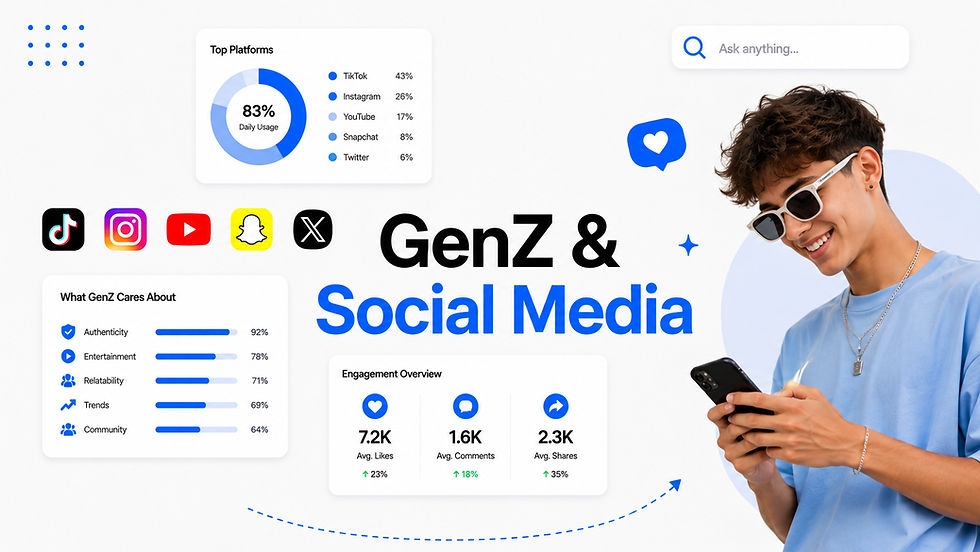
A serious social media Gen Z strategy starts with that operating reality. This audience treats platforms as discovery infrastructure, not just entertainment. That changes media planning, creative production, partnership design, and measurement. It also means “we're on TikTok” isn't a strategy. It's table stakes.
Table of Contents
Your Gen Z Strategy Is Already Outdated - What's broken in most brand programs - The new operating model
Social Is the New Search Engine - Why this changes the funnel - What to optimize for instead - The strategic consequence
Decoding Gen Z Platform Behavior - Gen Z social platform matrix 2026 - TikTok is where interest starts moving - Instagram turns interest into social proof - YouTube closes knowledge gaps - Match the platform to the job
The Creative Formats That Actually Perform - What usually works - What usually fails - Build creative as a modular system
Rethinking Your Ad and Influencer Strategy - Stop treating creators like ad placements - What better partnerships look like - Paid social should extend credibility, not override it
Measuring What Matters to Win with Gen Z - A better KPI stack - What AI should actually do in this workflow - Questions worth asking every week
Building Your Gen Z Social Media Playbook - First 30 days - Days 31 to 60 - Days 61 to 90
Your Gen Z Strategy Is Already Outdated
Most legacy social strategies were built for a different audience behavior. They assumed users would tolerate polished brand storytelling, move from social to website, and complete evaluation somewhere else. Gen Z rarely follows that clean path.
For this audience, the gap between content, conversation, and commerce is much tighter. A post isn't just a brand touchpoint. It can be the product page, the testimonial, the FAQ, the comparison review, and the trust signal all at once.
What's broken in most brand programs
The first problem is channel thinking. Teams split search, social, influencer, and content into separate workstreams even though Gen Z experiences them as one feed-level discovery journey.
The second problem is creative velocity. Brands still brief campaigns like television spots. They spend too long refining a hero asset, then cut it down for social. By the time it goes live, it feels processed, not native.
The third problem is trust design. Social media Gen Z behavior rewards brands that show proof, not polish. Younger audiences can spot performance marketing disguised as authenticity very quickly.
Practical rule: If your content looks like it was approved by too many people, Gen Z will treat it like an ad before they process the message.
The new operating model
A stronger model has four parts:
Discovery-first planning: Build social around the questions, objections, and comparison points Gen Z brings into feeds.
Platform-native creative systems: Produce modular assets with multiple hooks, edits, and captions instead of one master brand film.
Creator-shaped messaging: Let credible voices demonstrate, explain, react, and compare in their own language.
Quality measurement: Judge performance by attention depth, saves, shares, comments, and downstream action, not vanity reporting.
This is less about chasing youth trends and more about respecting how digital behavior has changed. The brands that win with Gen Z aren't louder. They're easier to trust, easier to discover, and easier to understand inside the platform where interest starts.
Social Is the New Search Engine
The biggest strategic shift is simple. Social now competes directly with search for discovery.
In an April 2024 survey, 46% of Gen Z respondents said they prefer using social media over search engines to find information online, according to Statista's U.S. Gen Z social media overview. That's not a side behavior. It's a different discovery model.

Why this changes the funnel
Traditional search usually starts with intent expressed as a query. Social discovery often starts with curiosity, recommendation, or visual proof. Gen Z may not search “best running shoe for flat feet” in a browser first. They may look for a creator testing three options on TikTok, then read comments, then save the clip, then open Instagram to see how the product shows up in real life.
That means your social presence isn't just awareness media anymore. It's part search result, part review layer, part conversion assist.
Social content now has to be citable. People should be able to use it as evidence when they decide.
Brands that still separate SEO strategy from social strategy miss how these discovery behaviors overlap. A better planning model is closer to search everywhere optimization, where visibility is built across the places people ask, browse, compare, and validate.
What to optimize for instead
If Gen Z is using feeds like answer engines, then the content needs to behave like an answer. That usually means:
Clear openings: State the problem, use case, or outcome in the first beat.
Visible proof: Show the product in action, not just the package or logo.
Specific framing: Compare versions, address objections, or explain who it's for.
Comment-ready utility: Leave room for questions, reactions, and peer validation.
A branded post that says “meet our new drop” doesn't carry much search value. A creator-style video that explains how the product fits, what surprised them, and who shouldn't buy it carries much more.
The strategic consequence
The role of social media Gen Z marketing has expanded. You're not only trying to interrupt attention. You're trying to satisfy intent inside a feed. The teams that understand this build discoverable content libraries, not just campaigns.
That also means social briefs should include the same questions a strong search brief includes. What is the user trying to solve? What proof will they trust? What language will they use? And what content can show up when that need appears in public conversation?
Decoding Gen Z Platform Behavior
A common planning mistake is treating every platform as a distribution outlet for the same message. Gen Z doesn't use platforms that way. Each one does a different job.
In the U.S., Instagram leads platform reach among Gen Z at 65%, followed by YouTube at 63% and TikTok at 58%, based on March 2025 data cited by Statista in the earlier source. That mix matters because it points to a multi-platform behavior pattern, not a winner-take-all environment.
Gen Z social platform matrix 2026
Platform | Primary Gen Z 'Job' | Dominant Content Format | Key Marketing Opportunity |
|---|---|---|---|
TikTok | Discovery and trend evaluation | Short-form vertical video | Fast education, demos, reactions, creator-led proof |
Identity, aspiration, and visual validation | Reels, Stories, carousels | Product styling, brand world building, social storefront behavior | |
YouTube | Deeper evaluation and trust building | Long-form video, Shorts | Tutorials, reviews, side-by-side comparisons, expert explainers |
Alternative or private social spaces | Closer community interaction | Casual posts, messages, private sharing | Community listening, advocacy, customer feedback, cultural signal capture |
TikTok is where interest starts moving
TikTok is the fastest environment for pattern recognition. Trends emerge there, but so do product heuristics. Users learn what to buy, what to avoid, how to use something, and what other people think in a compressed format.
That makes TikTok useful when you need demand creation and early-stage persuasion. It's less effective if your team insists on heavy brand setup before delivering value.
Instagram turns interest into social proof
Instagram still matters because it organizes taste. Someone may discover a product elsewhere, then check Instagram to see if the brand feels current, credible, and visually coherent.
That means your Instagram strategy should do more than repost campaign creative. It should answer a quiet set of buyer questions: Does this product fit my identity? Do real people use it? Does the brand understand its category?
If TikTok starts the conversation, Instagram often helps someone decide whether the brand belongs in their life.
YouTube closes knowledge gaps
YouTube plays a different role. It supports deeper consideration. People go there for reviews, tutorials, walkthroughs, commentary, and longer creator relationships.
For many brands, YouTube is underused because teams focus too narrowly on Shorts. Short-form matters, but depth matters too. If the product needs explanation, setup, comparison, or education, YouTube can carry trust farther than a quick clip can.
Match the platform to the job
A clean way to plan is to assign each campaign asset a platform job:
TikTok for discovery
Instagram for validation
YouTube for evaluation
Private or community spaces for feedback and advocacy
When teams stop asking “Where should we post this?” and start asking “What job should this asset do?”, the program gets sharper fast.
The Creative Formats That Actually Perform
Creative format is not a style preference with Gen Z. It's a performance variable.
CTAM reports that 94% of Gen Z use at least one social platform daily in 2025, with behavior strongly tied to short-form video and fast, repeated engagement, according to CTAM's State of Gen Z report. In practical terms, that means audiences are making snap judgments constantly. Slow setups, overproduced intros, and obvious ad language get filtered out fast.

What usually works
The assets that perform best with social media Gen Z campaigns tend to share a few traits:
They open with tension: a question, pain point, demo, reaction, or claim.
They feel native: captions, pacing, framing, and edits match the platform.
They show a person using or explaining the product: not just polished product shots.
They resolve quickly: viewers understand the payoff without waiting.
They can be versioned easily: hooks, thumbnails, captions, and lengths can be swapped fast.
This doesn't mean low quality. It means low friction. Good creative feels immediate.
What usually fails
Traditional brand teams still overinvest in assets that look expensive but behave poorly in-feed. Common examples include the slow brand anthem, the silent lifestyle montage, the caption-heavy static post, and the hard-sell callout that feels detached from platform culture.
When creative is built to impress internal stakeholders first, it usually loses to creator-native content built to hold attention.
For teams looking at production references, these creative TikTok visuals for brands are useful because they show how native-looking assets can still feel intentional and on-brand.
A modern production workflow should also connect concepting and iteration. That's why many teams are rebuilding their process around faster digital video production systems rather than one-off campaign shoots.
Build creative as a modular system
The strongest teams don't ask for one great ad. They ask for a testable set of components.
Try structuring briefs this way:
Hook bank: multiple openings built around objections, outcomes, comparisons, or curiosity.
Proof layer: product demo, testimonial, screen capture, before-and-after context, or creator reaction.
Edit variations: tighter cut, longer explanation, voiceover version, text-led version.
Platform pass: adapt language and pacing for TikTok, Reels, and Shorts separately.
This video captures the broader shift toward native, creator-shaped video language:
Creative test: If the same asset can run unchanged on TikTok, Instagram, YouTube, paid display, and your homepage, it probably isn't native enough for any of them.
Rethinking Your Ad and Influencer Strategy
A lot of brands still buy influencer media like they're buying digital billboards. They pick a creator based on reach, send a rigid brief, demand message control, and expect borrowed trust to transfer automatically.
That's not how Gen Z responds.
Gen Z leads all generations in using social for product discovery, but they're also skeptical of traditional marketing and respond better to transparent, conversational, platform-native communication, according to Erie Institute of Technology's summary on how Gen Z uses social media. That creates a simple rule. Trust is the scarce asset, not inventory.
Stop treating creators like ad placements
The creator's value isn't only audience access. It's interpretation. Good creators know how to translate a product into the norms of their community, their voice, and their format.
When brands over-script those partnerships, they remove the exact thing they were paying for.
A better model uses creators in tiers. Some are there to seed credibility in niche communities. Some are there to generate many creative angles. A smaller number may help scale what already has signal. The point isn't celebrity. The point is believable relevance.
What better partnerships look like
The strongest influencer programs usually include these conditions:
A clear message boundary, not a word-for-word script
Real product use before posting
Room for critique or nuance instead of forced positivity
Paid amplification only after organic fit is visible
Disclosure that feels honest, not buried
That last point matters. Sponsored content doesn't fail because it's disclosed. It fails when the sponsorship is obvious but the post pretends it isn't.
For in-house teams trying to operationalize this at scale, AI-driven creator partnership workflows can help sort creators by fit, content style, and trust alignment before budget gets committed.
The best influencer brief is a conversation. The worst one is a script pretending to be a conversation.
Paid social should extend credibility, not override it
On the ad side, platform-native formats work best when they preserve the social proof already present in the content. That means using creator-led assets, comments, reactions, demonstrations, and real language, then amplifying what already feels believable.
If the media team and creator team operate separately, the brand usually ends up paying twice. Once for content that doesn't convert, and again for ads that don't feel trusted. Gen Z punishes that disconnect quickly.
Measuring What Matters to Win with Gen Z
The measurement mistake is obvious: surface engagement is overvalued.
That's risky with Gen Z because heavy usage doesn't equal positive brand conditions. While 35% of Gen Z spend over four hours a day on social media, 60% also say the experience is more negative than positive, according to Commsroom's reporting on Gen Z social habits. A campaign can look active in-platform and still leave the brand with weak sentiment, shallow recall, or the wrong audience response.

A better KPI stack
For social media Gen Z programs, I'd structure reporting in three layers.
Measurement layer | What to look at | Why it matters |
|---|---|---|
Attention quality | Watch time, completion rate, replays, saves, shares | Shows whether the asset earned real interest |
Trust and resonance | Comment quality, DMs, creator feedback, sentiment themes | Shows whether people accepted the message |
Business effect | Conversions, sign-ups, attributed sales, retention signals, branded search movement | Shows whether attention created value |
Likes and reach still have diagnostic use. They just shouldn't drive strategy.
What AI should actually do in this workflow
AI is most useful when it helps teams process unstructured signal at scale. That includes comment clustering, creator transcript analysis, objection extraction, sentiment categorization, and pattern detection across asset variants.
Gen Z often tells you what's wrong directly in comments, stitches, replies, and duets. Therefore, manual reporting misses too much of that nuance.
If your team is also working commerce-heavy programs, these data-driven TikTok Shop profit strategies are a useful complement because they focus on indicators closer to actual revenue, not just content activity.
Questions worth asking every week
Use a standing review that forces stronger interpretation:
Which assets generated saves or shares, and what was structurally different about them?
Which creator posts led to constructive comments instead of passive likes?
Where did sentiment weaken, and was it the offer, the messenger, or the tone?
What objections appeared repeatedly in comments or DMs?
Which content themes produced downstream action, not just in-feed engagement?
Strong Gen Z measurement asks two things at once. Did the content travel, and did it leave the brand in a better position?
That dual view is what keeps teams from optimizing into noise.
Building Your Gen Z Social Media Playbook
Most brands don't need a complete reset. They need a disciplined first 90 days that forces different decisions. The goal is to replace assumptions with evidence and build a repeatable operating rhythm.

First 30 days
Start by auditing your current program as if you were an outsider.
Review asset fit: Which posts look native to TikTok, Reels, or Shorts, and which ones are repurposed brand creative with subtitles?
Map discovery questions: Pull recurring product questions from comments, search data, customer support logs, Reddit threads, and creator mentions.
Sort creators by trust style: Separate polished promotional creators from those who explain, test, compare, and answer.
The point of this phase is clarity. Many teams already have enough signals to improve. They just haven't organized them.
Days 31 to 60
This is the production and pilot window. Build a smaller but faster system.
Create a content backlog around problems, comparisons, objections, use cases, and visible proof. Then brief creators and internal teams to produce multiple versions per concept, not one asset per concept. Your editing team should be turning one core idea into several hooks and several cuts.
This is also where better tooling helps. If your team is evaluating workflow support, these best social media advertising tools can help you think through planning, automation, and optimization without defaulting to platform-native dashboards alone.
Days 61 to 90
Now tighten the loop between media, creators, and measurement.
Set up a weekly review using three lenses:
Creative signal: Which hooks, formats, and proof types held attention?
Trust signal: Which creator voices and comment patterns showed acceptance?
Business signal: Which combinations moved users toward action?
Then make budget shifts based on evidence, not preference. Put more spend behind content that already proved it can carry trust. Pull back from assets that only generate passive exposure.
A practical 90-day checklist looks like this:
Rebuild briefs around audience questions, not campaign slogans
Increase output of short-form creator-led demos and explainers
Give paid teams access to organic performance data before launch
Use comments and DMs as research inputs, not community management leftovers
Review saves, shares, sentiment, and conversion together
Keep brand standards, but relax production habits that kill native feel
Social media Gen Z marketing doesn't reward the most polished team. It rewards the team that can learn fastest, publish natively, and earn trust in public.
If your team needs help turning that operating model into a working media system, Busylike helps brands build AI-native discovery strategies across social, creators, search, and conversational platforms so Gen Z audiences can find, trust, and act on your brand faster.