
Top YouTube Influencer Agencies of 2026: How to Choose the Right Partner

Updated: Sep 28
Most influencer agency lists treat YouTube as one channel among many, next to Instagram and TikTok. That hides the platform's biggest difference.
A TikTok post peaks within days. A YouTube video can keep getting found in YouTube search, Google results, and AI-generated answers for years. In Ahrefs' September 2026 tracking of US queries, youtube.com was the most-cited domain in Google AI Overviews, with 22.9% of citations. A sponsored YouTube integration is therefore more than a media buy. It is content that can keep supporting your brand long after the campaign ends.

Because of that, YouTube needs its own buying criteria. Sponsorship formats, pricing, creator vetting, and measurement all work differently than on short-form social. This guide covers what to look for in a YouTube influencer agency, what sponsorships cost in 2026, and six agencies worth considering.
If you want a local partner who can coordinate in-person shoots and events, our guide to influencer agencies in NYC covers the New York market specifically.
Table of Contents
How to Score an Agency Before You Take the First Call - The seven factors that matter - A simple scoring rubric
1. Viral Nation - Where Viral Nation is strongest - Where it can be the wrong fit
2. Influential - Why performance teams like Influential - What to watch before signing
3. Captiv8 Platform + Agency - Best use case for Captiv8 - The operational trade-off
4. Obviously a VML company - Where Obviously earns its place - The trade-off senior marketers should examine
5. Billion Dollar Boy - Why BDB stands out - Who should think twice
6. HireInfluence - What makes HireInfluence attractive - Its practical limitation
7. Busylike - Why Busylike is different - When Busylike is the better choice than a traditional influencer agency - The trade-off to understand
What Makes YouTube Influencer Marketing Different
YouTube differs from other creator platforms in three ways, and each one changes what you should expect from an agency.
The content keeps working. Viewers find YouTube videos through search, recommendations, and increasingly through AI answers. A well-matched integration in a "best project management tools" video can keep driving signups for as long as the video ranks. An agency should choose videos and topics with that long-term search value in mind, not only launch-week views.
The formats are different. Brands usually buy one of three things:
an integration, which is a 30–90 second segment inside a creator's regular video
a dedicated video, where the whole video is about your product
YouTube Shorts
Each format has different pricing, completion rates, and conversion behavior. A good agency recommends the mix based on your goal, not on what's easiest to sell.
The platform now has its own marketplace. YouTube has combined its brand partnership tools into YouTube Creator Partnerships (formerly BrandConnect). It sits inside YouTube Studio for creators and inside Google Ads and Display & Video 360 for advertisers, and it uses Gemini to help brands search among more than 3 million creators in the YouTube Partner Program. A good agency should know how to use these native tools, and should also be clear about when an agency adds value beyond them
How to Evaluate a YouTube Influencer Agency
Score each agency from 1 to 5 on the six criteria below. Weight them according to your goal. For example, a performance brief should weight measurement and paid amplification most heavily.
Knowledge of YouTube itself. Can the team talk about audience retention curves, where an integration should sit in the video, thumbnail and title strategy, and how YouTube search works? An agency that runs the same playbook on every platform will lose value on YouTube.
Creator vetting beyond subscriber counts. Subscriber numbers are the weakest signal on YouTube. Ask how the agency checks average views over the last 90 days, audience location, comment quality, and past sponsor performance. Relevance matters more than size. One major 2026 study found almost no correlation between a video's view count and how often AI systems cite it. Kompozy
Pricing transparency. Does the agency buy on flat fees, on CPM (cost per thousand views), or with guaranteed views? Ask how it handles videos that underperform.
Paid amplification. Can the agency turn the best creator videos into ads through Google Ads? Does it secure the usage rights to do that? This is where many YouTube programs underperform.
Measurement. Look for tracked links, promo codes, and branded search lift, not just views and likes.
Search and AI visibility. Does the agency plan integrations around topics your buyers search for, and track whether those videos appear in Google results and AI Overviews?
A simple scoring rubric
Score each agency from 1 to 5 on all seven factors. Then weight the categories based on the outcome you need.
For a brand-led brief, strategic fit, creative quality, paid media integration, and operating scale usually deserve the heaviest weighting. For an AI visibility brief, technology, channel relevance, measurement, and iteration speed matter more. Many shortlists frequently err in their selections. A large social agency can be excellent for creator campaigns and still be the wrong choice for answer-engine visibility.
The market itself is getting more specialized. Analysts at TechnologyCounter noted rising demand for AI-based creator matching and estimated that the influencer sector includes 6,939 specialist agencies worldwide, with the market growing from $1.7 billion in 2015 to $32.55 billion in 2025 and 26.89% of marketers prioritizing AI creator matching for 2026. More choice does not make selection easier. It raises the cost of using the wrong rubric.
Keep your scorecard tight. Push every agency to show where its model creates an advantage, where it does not, and what trade-offs your team will own after signing. For a broader category view, review this guide to TikTok Shop influencer agencies before you start outreach.
What YouTube Sponsorships Cost in 2026
Creator rates vary widely by niche, audience location, and format. The ranges below are a reasonable starting point for budgeting.
Industry benchmarks for 2026 put integration rates at roughly $50–$500 for nano creators (1K–10K subscribers), $200–$2,000 for micro creators, $1,000–$10,000 for mid-tier channels, $5,000–$25,000 for macro creators, and $10,000–$50,000+ for channels with more than 1M subscribers. Dedicated videos cost more, and Shorts cost less.
For planning purposes:
Integrations usually price at about $20–$50 per 1,000 views depending on niche. Dedicated videos run about 2.5–3x the integration price, and Shorts about 0.3–0.5x.
Expect to pay extra for usage rights if you want to run the video as a paid ad (often 25–100% more) and for category exclusivity that blocks competitors (often 25–50% more). Committing to a multi-video package often earns a 20–30% discount.
Agency management fees come on top of creator costs. Some agencies charge a retainer. Others take a percentage of media spend or build their margin into a fixed price per sponsorship. Ask which model each agency uses before comparing proposals.
1. Viral Nation

Viral Nation is what many enterprise marketers think of when they picture a modern full-service influencer shop. It combines influencer strategy, social content production, paid and performance media, community management, and talent representation under one roof. That matters when your internal team doesn't want to coordinate three separate vendors just to launch one program.
Its value is breadth with process. Viral Nation has invested in proprietary systems like CreatorOS and Secure, which signals a serious attempt to bring workflow, measurement, vetting, and brand-safety controls into one operating model. For brands in regulated or reputation-sensitive categories, that can be more important than raw creator access.
Where Viral Nation is strongest
The best fit is a brand that needs scale, governance, and speed at the same time. If you're running a multi-market campaign, need legal and brand-safety rigor, and want paid amplification connected to creator output, Viral Nation is built for that environment.
A second strength is structural. Its in-house talent representation arm can reduce friction between strategy and execution. That often shortens timelines and gives brands more control over deliverables than they'd get from an agency that's brokering entirely external relationships. Marketers evaluating agencies in major metro markets may also want this New York influencer agency roundup as a local lens on the category.
Best for: Enterprise brands with ongoing creator programs
Standout edge: Broad in-house capabilities plus brand-safety infrastructure
What works: Multi-channel activations where paid, content, and creator management need tight coordination
Where it can be the wrong fit
Viral Nation can be too much agency for a narrow test. If you need a lightweight pilot in one market, its operating model may feel heavy. The same systems that protect brand quality can slow teams that want rapid experimentation with smaller budgets.
That doesn't make it inflexible. It means you should only buy this level of infrastructure when complexity justifies it.
Bigger isn't always better in influencer marketing. Bigger is better when failure is expensive, approvals are layered, and scale is part of the brief.
2. Influential

Influential has long positioned itself around data and AI, and that shows in how it sells the service. This isn't primarily a relationship-driven boutique story. It's an enterprise story about matching, forecasting, measurement, and attribution.
That orientation makes Influential one of the sharper options for CMOs who need to defend spend in analytical terms. It's also one of the more credible names if celebrity, sports, or high-profile talent access matters alongside performance discipline.
Why performance teams like Influential
The agency's appeal is simple. It takes influencer marketing out of the vague “awareness” bucket and places it closer to the language of media efficiency and sales impact. If your internal stakeholders ask how creator programs tie into larger measurement frameworks, Influential is speaking their language from the outset.
It's also useful for brands whose influencer mix extends beyond lifestyle creators into executives, athletes, or business-facing voices. For B2B and professional audience campaigns, this becomes relevant fast. Teams exploring that angle should also think about how creator strategy intersects with professional authority on platforms like LinkedIn, which is why this perspective on LinkedIn influencer marketing is worth considering.
What to watch before signing
The trade-off is enterprise gravity. Influential is likely to make more sense for larger brands with larger reporting requirements, more internal stakeholders, and a stronger appetite for structured onboarding. Lean teams looking for scrappy creator volume may find the model too formal.
Another practical point: premium talent access can be an advantage, but it can also distract marketers from fit. Don't overpay for stature if your real need is content throughput, niche credibility, or performance creative.
Best for: Enterprise marketers who need advanced analytics and premium talent access
Standout edge: AI-led matching plus stronger attribution orientation than many peers
Watch-out: Longer setup cycles can frustrate teams trying to move fast
3. Captiv8 Platform + Agency

Captiv8 fits a buying scenario many marketing leaders now face. The team does not want a traditional agency that owns everything end to end, but it also does not want to stitch together creator discovery, approvals, payments, reporting, and commerce data across separate tools. Captiv8 sits between those models.
That matters because the platform side of influencer marketing keeps gaining ground, as noted earlier in the article. More brands want operating infrastructure, not just campaign execution. They want a system their internal team can see, question, and improve over time.
Best use case for Captiv8
Captiv8 is a strong choice for brands building an in-house creator function with outside support around it. Discovery, creator matching, campaign management, payments, and reporting sit closer together, which cuts down on handoffs and version-control problems. For teams running recurring programs across regions or business units, that can improve speed and governance at the same time.
It also fits the 2026 decision framework better than many pure-play agencies because it forces a more specific question. Are you buying creative outsourcing, or are you buying an operating layer? Captiv8 is more compelling in the second case.
That distinction is easy to miss.
A social-first agency may be the better option if the brief is brand storytelling and the internal team wants a partner to drive concepting and talent management. A hybrid platform model becomes more attractive when procurement, legal, finance, and performance teams all want visibility into how the program runs. Leaders comparing legacy influencer firms with newer AI-native specialists should keep that difference in view. AI-driven insights can support creator partnership scaling, but only if the organization is ready to use those signals inside a defined workflow.
The operational trade-off
Captiv8 can be a poor fit for smaller teams with intermittent campaign needs. If the creator budget shows up only around launches or seasonal pushes, the platform layer may feel heavier than the problem requires. In that case, a more service-led agency often delivers better value because the team is paying for execution, not infrastructure it will barely use.
The bigger risk is internal readiness. Strong software will expose weak briefs, slow approvals, fragmented ownership, and fuzzy KPIs very quickly. That is useful, but it can also frustrate teams that expected the platform to solve operating discipline for them.
Captiv8 makes the most sense when influencer marketing is becoming an internal capability with process, measurement, and cross-functional oversight attached to it.
4. Obviously a VML company

A common enterprise brief looks like this. Ten markets, multiple product lines, regional legal review, quarterly reporting, and no tolerance for creator operations slipping. Obviously tends to perform well in that environment because its model is built around scale, process control, and repeatable execution.
Obviously has long been known for running high-volume creator programs. Under VML, that capability becomes more useful for brand leaders who want influencer work connected to broader creative, media, and communications planning. The practical value is less about agency branding and more about operating fit. Large organizations often need a partner that can handle approvals, reporting, and market coordination without rebuilding the process every quarter.
Where Obviously earns its place
Obviously is a strong option for brands that already know creator marketing matters and now need consistency. The agency is better suited to ongoing programs than to one-off experiments. That includes ambassador programs, multi-market rollouts, product seeding at scale, and campaigns where central teams want a clear view into delivery across regions.
The operational discipline is the point.
For a 2026 selection framework, this puts Obviously firmly in the traditional social-first camp, not the AI-native specialist category. That can be a strength or a limitation depending on the brief. If the goal is brand building through steady creator output, governance, and channel coverage, the model fits. If the goal is AI visibility, synthetic search presence, or faster insight loops across creator and answer-engine ecosystems, leaders may need a different type of partner alongside it.
Best for: Enterprise brands, especially consumer companies with multi-market creator programs
Standout edge: Operational control across high-volume influencer execution
Good fit scenario: Always-on programs where consistency, compliance, and reporting matter as much as creative output
The trade-off senior marketers should examine
Obviously can be more agency than a smaller team needs. A brand running a narrow niche launch or an early test often will not get full value from this level of infrastructure. In those cases, a leaner specialist may move faster and cost less.
There is also a creative risk. Standardized systems improve throughput, but they can narrow the work if the brief is too rigid or every market is forced into the same template. Strong marketing leadership usually solves that by setting clear guardrails on compliance and measurement while protecting room for local creative judgment.
In a shortlist, Obviously usually scores well on scale, governance, and operational reliability. It tends to score lower if the decision criteria prioritize experimentation, unconventional creative development, or AI-native visibility outcomes. That distinction matters more now than it did two years ago.
5. Billion Dollar Boy

Billion Dollar Boy has a strong reputation among brands that want creator work treated as a strategic communications and commerce discipline, not just a booking function. Its positioning is broader than influencer execution alone. Content, community, media, governance, and measurement all sit inside the same proposition.
That makes it particularly attractive to brands that need senior strategic framing, not only campaign management. Some agencies are good at running creator work once the company already knows what it wants. BDB is stronger when the company needs help defining the operating model.
Why BDB stands out
The differentiator is integration. The BDB Group ecosystem, including Companion and FiveTwoNine, suggests a serious attempt to connect governance, measurement, and creator intelligence rather than treating them as afterthoughts. That's useful for multinational businesses where local market flexibility has to coexist with central standards.
Its global footprint also matters. The agency operates across 60+ markets, which changes the conversation from local influencer buying to coordinated international rollout. That's a different level of planning entirely.
Who should think twice
BDB is likely to be too much for small, fast-turn campaigns. If your brief is tactical, like sourcing creators for one seasonal launch, a highly strategic multinational partner may create unnecessary overhead.
This is also a partner that rewards strong client-side leadership. The more complex the agency, the more important it is that your internal team can set priorities clearly. Otherwise, sophistication turns into drift.
Best for: Brands needing multinational creator strategy with governance
Standout edge: Strategic layer plus proprietary operational tooling
Watch-out: Smaller briefs can get swallowed by the machine
6. HireInfluence
HireInfluence takes a different position from the large network-style players. It sells high-touch execution. That's attractive for brands that want experienced hands on the work, white-glove campaign management, and less process theater.
The agency has been around since 2011, which matters in a category where many firms still feel relatively young. Longevity doesn't guarantee fit, but it often correlates with cleaner workflows around compliance, creator handling, and campaign delivery.
What makes HireInfluence attractive
HireInfluence is a strong option when you want bespoke curation and practical service. It supports concept-to-delivery campaign management, analytics, creator coordination, and experiential execution without forcing the client into a heavy enterprise framework.
Its all-inclusive pricing posture is also notable in a market where many agencies keep scopes opaque until late in the sales process. That doesn't mean it's cheap. It means the buying experience may feel more straightforward than with larger competitors.
A nimble agency with senior operators can outperform a bigger shop when the brief requires judgment more than scale.
Its practical limitation
The limit is obvious. Boutique-style service can struggle if you need simultaneous ultra-large global waves across many markets. That's where networked infrastructure and platform-heavy shops tend to win.
Still, for many brands, that's a false comparison. If your actual need is careful curation, tight communication, and a senior team that stays close to execution, HireInfluence may be the better buy.
Best for: Brands that want high-touch service and customized campaign management
Standout edge: White-glove execution with practical engagement flexibility
Watch-out: Less ideal for extremely large multinational activations
7. Busylike
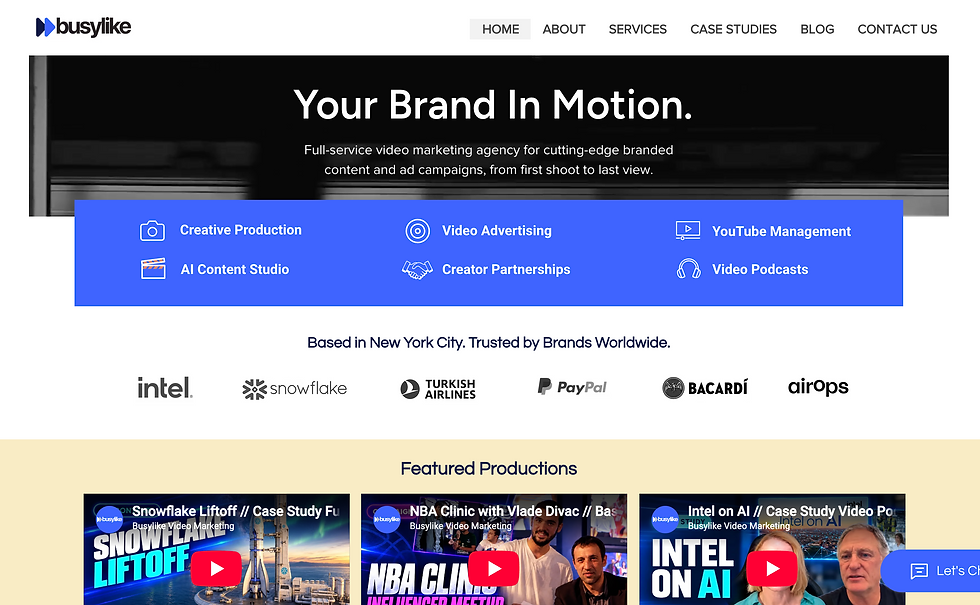
Busylike is a video-first agency based in New York. Its YouTube work covers creator sponsorships, YouTube channel management, video advertising, and video SEO and GEO, which is optimizing videos to show up in search and AI answers. That combination suits brands that want creator integrations and their own YouTube presence planned together.
Why Busylike stands out
Most influencer agencies treat a sponsored video as a finished deliverable. Busylike treats it as an asset that should rank, get cited in AI answers, and get reused in ads. In practice, that means:
choosing creators and video topics based on what your buyers search for on YouTube and Google
tracking whether sponsored videos appear in Google AI Overviews, ChatGPT, Perplexity, and Gemini
turning top-performing integrations into paid ads, using the targeting and formats in our guide to Google Ads for YouTube promotion
adapting winning videos for other markets through video localization
For an example of this approach, see the Nestea summer campaign case study, which combined YouTube storytelling with creator partnerships.
Best fit and trade-offs
Best for: SaaS, tech, consumer, and DTC brands that want YouTube creator work to also build search and AI visibility.
Standout edge: creator sponsorships, channel management, paid media, and AI visibility handled by one team.
Trade-off: Busylike focuses on video. If your plan is mainly Instagram or TikTok with YouTube as a minor part, a general social agency may be a better fit.
8. ThoughtLeaders
ThoughtLeaders is one of the few agencies built entirely around YouTube sponsorships. The company was founded in 2017, is based in Tel Aviv, and works across three areas: a YouTube sponsorship software platform, media buying for brands, and talent representation for creators. It reports more than $55 million in sponsorship deals and exclusive sponsorship sales for over 100 YouTube channels.
Where ThoughtLeaders works best
ThoughtLeaders suits performance-minded brands that want to buy YouTube integrations like media. It offers fixed-price sponsorships with guaranteed views and non-compete clauses. That structure makes it easier to forecast costs. Its published case studies include direct-to-consumer and subscription brands such as Magic Spoon, Brilliant, CuriosityStream, and Honey.
Best for: DTC, apps, and subscription brands buying integrations at scale.
Standout edge: YouTube-only focus with sponsorship data and guaranteed-view deals.
Trade-off: it concentrates on sponsorships, so brands that need heavy creative development, production, or multi-platform programs will need other partners.
9. BEN
BEN approaches YouTube from the product placement side. The company uses AI to match brands with creators for what it calls "non-disruptive integrations," meaning products appear naturally inside content the creator would make anyway rather than in a standalone ad. BEN also acquired TubeBuddy, a browser extension and app that YouTube creators use to optimize their channels.
Why BEN is different
Owning TubeBuddy gives BEN unusual insight into how creators work and how their channels perform. TubeBuddy had 14 million registered users as of 2024. BEN also runs product placement in streaming TV and music. That makes it a good fit for brands that want YouTube integrations as part of a wider entertainment placement strategy.
Best for: consumer brands that want natural product integrations rather than scripted ad reads.
Standout edge: AI-driven matching plus creator tooling data from TubeBuddy.
Trade-off: integrations are built to feel natural and low-key, which may not suit campaigns that need an explicit call to action.
10. The Goat Agency
The Goat Agency is a large global option. It is a WPP company with more than 650 social and influencer specialists across 37 markets as of 2025, and it has run campaigns for brands including Mars, Ford, and Dell. It also has its own technology platform, IBEX.
Where Goat fits
Goat makes the most sense when YouTube is one part of a multi-market creator program and you need consistent execution across regions, backed by a holding-company media network.
Best for: enterprise brands running YouTube creator campaigns in many markets.
Standout edge: global scale plus access to WPP media buying.
Trade-off: large-network processes can feel heavy for a focused YouTube test with a modest budget.
Top Influencer Agencies Comparison
Provider | Implementation complexity 🔄 | Resource requirements ⚡ | Expected outcomes 📊 ⭐ | Ideal use cases 💡 | Key advantages |
|---|---|---|---|---|---|
Viral Nation | High, enterprise end-to-end workflows and cross-team coordination | Significant, large budgets, retainer model, dedicated program management | High reach + enterprise-grade measurement and brand safety, ⭐⭐⭐⭐ | Large brands, multi-market ongoing influencer programs | In-house creator roster; CreatorOS & Secure for vetting and safety |
Influential | High, data/AI integrations and enterprise onboarding | Significant, analytics stack and celebrity talent investments | Strong sales/ROAS attribution and offline/online lift, ⭐⭐⭐⭐ | Performance-focused marketers needing attribution and celebrity access | Watson-powered insights and enterprise attribution partnerships |
Captiv8 (Platform + Agency) | Medium–High, platform setup with optional managed services | Moderate–High, annual contracts, LiveRamp/data integrations | Predictive creator insights, commerce tracking, unified payments, ⭐⭐⭐⭐ | In-house teams wanting SaaS with agency support or hybrid models | First‑party creator data, built-in payments, LiveRamp matching |
Obviously (a VML company) | High, global operations, real-time dashboards, ambassador networks | Large, global media budgets and integrated agency resources | Massive scale and consistent global activations, ⭐⭐⭐⭐ | Fortune 500, global launches, always-on ambassador programs | VML/WPP ecosystem, proprietary "Share of Influence" benchmarking |
Billion Dollar Boy | High, multi-market coordination and governance frameworks | Large, multinational delivery and cross-market teams | Integrated content-to-commerce impact across markets, ⭐⭐⭐⭐ | Brands needing global commerce + community programs across 60+ markets | Proprietary Companion & FiveTwoNine assets; IPA effectiveness accreditation |
HireInfluence | Medium, boutique, senior-led hands-on execution | Moderate, flexible/all‑inclusive pricing and bespoke proposals | Bespoke campaign performance with strong brand-safety, ⭐⭐⭐ | Mid-market brands or agencies seeking nimble, white-glove service | Senior curation, flexible pricing, experiential influencer activations |
Busylike | Medium–High, AI-native setup and ongoing LLM optimization | Moderate–High, specialized AI expertise; free audit available | Improved AI discovery, share of voice, and measurable AI-channel conversions, ⭐⭐⭐⭐ | CMOs/SEO leads in tech, SaaS, retail, healthcare aiming for AI visibility | GEO/AEO & LLM ad specialization; audit-driven, end-to-end AI discovery services |
Your Action Plan From Shortlist to Pilot Program
A leadership team narrows the field to three agencies, sits through polished pitches, and picks the one with the best chemistry. Six months later, reporting is inconsistent, the workflow is heavier than expected, and the program answers the wrong business question. That failure usually starts in procurement, not in campaign execution.
The final step is to choose for the buying environment you need to win in 2026. Some brands still need a social-first partner built for creator sourcing, approvals, paid amplification, and multi-market operations. Others need help showing up in AI-mediated discovery, where buyers ask LLMs for recommendations before they ever enter a social feed or branded search. Those are different problems. They require different tests.
Use the shortlist to run a pilot, not a beauty contest.
Start with a single decision. Is the primary goal brand building in social channels, direct response through creator content, or visibility inside AI search and conversational interfaces? If the answer is social scale, test the agencies on execution discipline and content performance. If the answer is AI visibility, test them on how they diagnose discoverability gaps, map recommendation patterns, and connect owned, earned, and paid signals.
A practical pilot framework works well:
Set one business outcome. Choose one priority such as aided awareness, creator content volume, commerce efficiency, or AI recommendation presence.
Constrain the scope. Limit the test to one market, one audience, one product line, or one high-value topic cluster.
Define the review cadence before launch. Agree on weekly signals, decision thresholds, and what would trigger expansion, revision, or exit.
The scoring model should also change by agency type. For traditional influencer partners, score creator fit, content quality, paid media readiness, approval speed, and reporting discipline. For AI-native specialists, score diagnostic depth, topic and entity strategy, citation analysis, prompt visibility, and whether the team can show measurable improvement in AI-driven discovery. That distinction matters because a strong social agency may still lack the systems to improve AI recommendation frequency. The reverse is also true.
I also recommend a few procurement rules that save time and prevent expensive mismatches:
Meet the delivery team, not only senior leadership. Strategy often sounds stronger in the pitch than in day-to-day execution.
Ask for the operating workflow. Review briefing, creator selection, legal review, approvals, optimization, and reporting.
Force measurement into plain language. If the agency cannot explain success metrics clearly, the account team will struggle once the pilot is live.
Check channel fit against the brief. A global creator operator is not automatically the right AI visibility partner. An AI-native shop is not automatically equipped for large ambassador programs.
One more filter helps. Tie your rubric to the economic value of the outcome. If the brief is a brand campaign, weight creative quality, audience fit, and paid amplification more heavily. If the brief is AI visibility, weight discoverability diagnostics, recommendation monitoring, and cross-channel reinforcement more heavily. That is the practical difference between hiring a social execution partner and hiring a specialist built for AI discovery.
Your YouTube Sponsorship Launch Plan
Pick one goal. Signups, sales, branded search lift, or AI visibility for a topic cluster. Each needs different creators and formats.
Start with integrations. They cost the least per view and let you test creators and messages quickly. Save dedicated videos for creators who have already performed well for you.
Test several creators. Run 5–10 mid-tier or micro creators in one niche rather than one expensive mega creator. You'll learn faster and spread risk.
Negotiate rights up front. Include paid usage and whitelisting (running ads through the creator's channel) in the first contract, so your best-performing video can become an ad right away.
Measure beyond the first week. YouTube videos keep collecting views. Review results at 30, 90, and 180 days, and check whether the videos appear in Google results and AI answers.
Scale what works. Book repeat integrations with the best performers, boost their videos through Google Ads, and localize them for new markets. Our YouTube advertising specs guide covers the format requirements.
As noted earlier, spending in influencer marketing continues to rise, which means the category no longer needs a defense. Partner selection is the key risk. The better decision framework is simple: score agencies against the specific discovery behavior you need to influence, run a tightly scoped pilot, and expand only after the operating model proves itself.

If your YouTube program needs to do more than run sponsorships, Busylike belongs on your shortlist. We plan creator integrations, channel management, and paid amplification together, so your best-performing sponsored videos become ads, get adapted for new markets, and keep driving results well after launch week.
Frequently Asked Questions
How much does a YouTube influencer sponsorship cost?
Integrations typically range from about $50 for nano creators to $50,000 or more for channels with over 1M subscribers, with dedicated videos priced higher. Niche, audience location, usage rights, and exclusivity all affect the final price.
What's the difference between an integration and a dedicated video?
An integration is a 30–90 second sponsored segment inside a creator's regular video. A dedicated video is entirely about your product. Integrations are cheaper and feel less like advertising. Dedicated videos allow deeper demonstrations and often rank for product-specific searches.
Are YouTube Shorts worth sponsoring?
Shorts are cheaper and good for reach and awareness. For consideration and conversion, long-form integrations usually perform better because viewers spend more time with the creator.
Do I need an agency, or can I use YouTube Creator Partnerships?
Self-serve tools work for small tests. An agency adds value when you need strategy, negotiation, rights management, paid amplification, and measurement across many creators.
Can YouTube influencer videos help my brand appear in AI search?
Yes. YouTube is one of the sources Google AI Overviews cite most often. Integrations built around the questions your buyers ask can support visibility in AI answers as well as on YouTube itself.


