
Top TikTok Advertising Agencies for 2026
Updated: Sep 30
Your team already knows TikTok matters. The harder question is which agency can make it matter to your CFO. Most TikTok advertising agencies sell a version of success that stops at reach, engagement, or a polished creator reel. That's not enough when you're the one defending budget, forecasting pipeline, and explaining why this channel deserves more investment than the paid social programs you already trust.
The stakes are too high to treat casually. According to Pew Research Center, 37% of U.S. adults now use TikTok, up from 21% in 2021, and 62% of adult users say they go there to look at product reviews or recommendations. TikTok is no longer just an entertainment feed. People search on it, compare products on it, and buy directly through it. That shift changes what a good agency partner looks like. Creative that stops the scroll still matters, but so does knowing how TikTok influences demand that shows up later in Google, on Amazon, or in an AI assistant's answer.

To build this list, we looked at the top TikTok advertising agencies through the lens a marketing leader actually uses: what each one is genuinely best at, where it tends to fall short, who it's built for, and how well it connects TikTok activity to measurable business results. Some are performance specialists, some are culture-first creative shops, and some are built around creators. None is the right choice for everyone.
Table of Contents
1. Busylike
1. Busylike
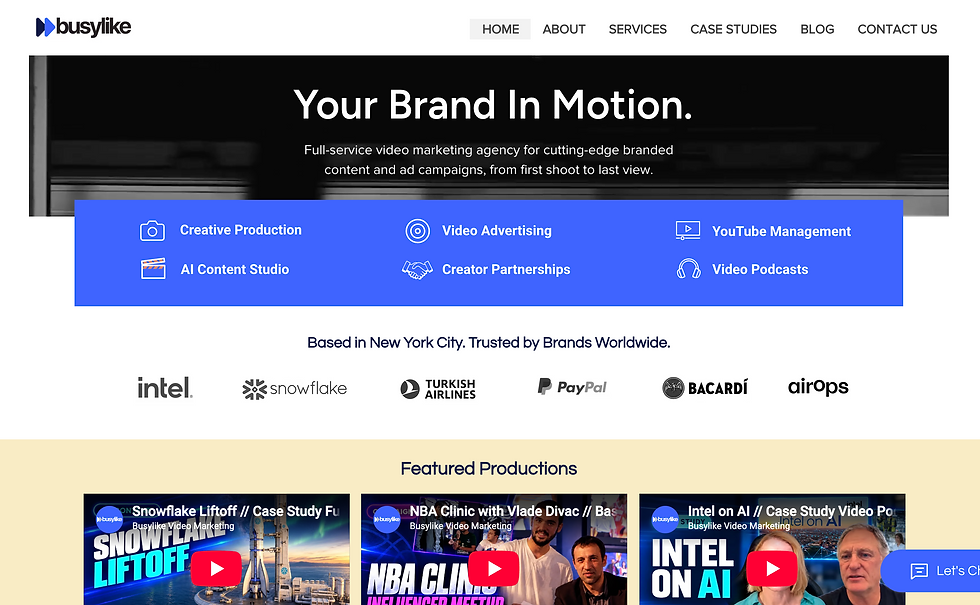
Busylike is the pick for marketing leaders who want TikTok to do more than win the feed. Most agencies on this list optimize for what happens inside the app. Busylike treats TikTok as one part of a larger discovery system, where the same creative and messaging need to show up in TikTok search, Google, YouTube, and the AI assistants buyers increasingly use to compare options.
That matters because TikTok's role has changed. People don't just scroll it for entertainment; they search it, research products on it, and carry what they learn into other channels. An agency that only reports on in-app performance will miss a real share of the value TikTok creates, and that gap is exactly what makes the channel hard to defend at budget time.
Why Busylike makes sense
TikTok agency pricing has matured enough that selection shouldn't be based on who promises the cheapest management fee. Typical retainers range from 5,000 to 50,000+, with many agencies sitting in the 5,000 to 15,000 monthly range, and pricing often includes flat fees or 10 to 20% of ad spend. Tinuiti usually makes sense when you can justify paying for stronger measurement and coordination across channels.
Busylike combines production and marketing under one roof. Its team handles vertical and mobile video, uses generative AI to produce creative faster, runs influencer programs, and connects that work to video SEO and AI search visibility. For brands, that means fewer handoffs between the people who make the content and the people responsible for results.
What works:
Creative volume without the usual slowdown: AI-assisted production makes it practical to test more hooks, formats, and variations, which is what TikTok's algorithm rewards.
Discovery beyond the app: TikTok creative is planned with GEO and AEO in mind, so winning messages can extend into search and AI-generated answers.
Production and media in one team: Useful for brands tired of coordinating a creative studio, an influencer shop, and a media buyer separately.
What doesn't:
Pure cultural moonshots: If your brief is a music-driven branded challenge built for virality, a culture-first shop like Movers+Shakers may be the more natural fit.
Massive multi-market influencer rosters: Brands running hundreds of creators across many regions may want an influencer-first operation alongside or instead.
Practical rule: Hire Busylike when you need TikTok creative that keeps working after it leaves the feed.
Visit Busylike
2. Movers+Shakers

Movers+Shakers is the agency to shortlist when you need TikTok to behave like a cultural growth lever, not just a paid acquisition channel. Their reputation comes from understanding the native mechanics of the platform. Music, participation, creator energy, and format design. That sounds obvious, but many agencies still make TikTok feel like repurposed Instagram.
For brand leaders, the trade-off is clear. You hire Movers+Shakers for breakout creative thinking, not because you want the cheapest path to tactical testing. They're strongest when a campaign needs to travel beyond a media buy and become something people want to remix, quote, or join.
Where they win
TikTok still rewards authenticity, but authenticity isn't the same thing as low production value. Agencies like Movers+Shakers understand that native-feeling work can still be highly structured and strategically engineered. If your internal team has been debating whether to pair a creative specialist with a broader video marketing agency, this is the kind of shop that clarifies the difference.
Their sweet spot usually includes:
Branded challenges and native series: Good for companies trying to create sustained attention instead of one-off ad spikes.
Original music and format invention: Useful when the campaign needs a distinct cultural hook.
Creator-led storytelling: Better for brand lift and memorability than strict direct-response efficiency.
The downside is predictable. Premium creative shops can outrun your measurement stack if you don't set accountability upfront. If your KPI is a tightly managed CPA target next quarter, you'll likely need either a strong in-house media team or a complementary performance partner.
Viral creative without a media and measurement plan often produces internal excitement, then budget skepticism.
3. VaynerMedia

VaynerMedia sits in the middle of a useful intersection. It understands platform culture, but it also knows how large brands buy media, manage approvals, and run social at scale across markets. That makes it a practical option for enterprise teams that want TikTok embedded inside a broader social operating model.
This isn't a boutique creator shop and it isn't a narrow performance agency. That can be a strength or a weakness depending on what you need. If your challenge is organizational complexity, VaynerMedia is often easier to integrate than a small specialist. If your challenge is raw efficiency in a narrow acquisition lane, the setup may feel broader than necessary.
Best fit
TikTok is no longer just a discovery feed. Search behavior is changing how agencies need to plan creative and media. Twenty-three percent of TikTok sessions now include a search interaction, and that search behavior drives 2.4x higher purchase intent than standard For You discovery. Forty-one percent of Millennials now use TikTok for search, up from 28%. VaynerMedia is well positioned for this shift because it already thinks in ecosystem terms, not just isolated ad units.
Why brands hire them:
Social-first operations: Creative, community, and paid media can work together instead of competing for control.
Global execution: Helpful for brands with regional teams, brand governance, and market-by-market rollout needs.
Creator integration: Strong when the brief requires both culture fluency and brand safety.
Where caution is warranted:
Heavyweight process: Smaller teams may feel buried in scope and workflow.
Brand-first bias: You may need extra testing discipline if your primary goal is pure direct response.
4. DEPT

A brand team wants more than in-feed ads. They want a TikTok experience people can interact with, share, and remember. That is the kind of brief where DEPT deserves serious consideration.
DEPT stands out when TikTok needs to function as a creative product, not just a paid media placement. If your roadmap includes Branded Effects, AR, interactive builds, or campaigns that require tighter coordination between creative, production, and technical execution, DEPT is better suited than agencies focused mainly on influencer sourcing or standard media buying.
That difference matters for selection. Many TikTok advertising agencies can produce UGC-style assets and run campaigns. Far fewer can handle effect production, custom builds, and the approval process that comes with larger organizations. DEPT is a stronger fit when the format itself drives attention and brand recall.
Future-proofing also matters here. TikTok programs are getting harder to run in separate silos. Creative teams are using AI-assisted workflows, commerce teams want tighter platform integration, and marketing leaders need partners that can connect production quality with execution discipline. Brands comparing specialist firms should also review broader influencer agency options for creator-led campaigns, because DEPT is usually the better choice for technical and experiential work, not pure creator volume.
Where DEPT fits best
DEPT is strongest for:
Branded Effects and AR: A serious option if interactive format execution is part of the brief.
Standout experiential work: Better for brands that want differentiated creative formats, not just more feed inventory.
Enterprise delivery: Useful when legal review, regional stakeholders, and layered approvals affect timelines.
DEPT is less ideal for:
Fast testing cycles: Complex builds usually reduce iteration speed.
Lower-budget programs: Technical production adds cost and planning overhead.
Technical creative work pays off when the format shapes the brand experience itself.
5. Ubiquitous

Ubiquitous is the most straightforward choice here if your main bottleneck is creator sourcing and UGC production. Plenty of TikTok advertising agencies say they "do influencer." Ubiquitous is better thought of as an influencer-first operating system that can source creators, manage negotiations, and produce assets that brands can often extend into paid media.
That distinction matters. A performance agency may understand bidding and attribution but still struggle to find creators who match your product and audience. Ubiquitous solves that side of the problem well.
What to verify before signing
The appeal is speed and scale. If you need a steady pipeline of creator-led assets, Ubiquitous can be efficient. That's especially useful for brands building Spark Ads, whitelisted creator campaigns, or testing multiple hooks and personas in parallel. If your team is comparing specialist partners, this broader field of top influencer agencies is worth reviewing alongside TikTok-specific options.
Still, creator-led campaigns fail for familiar reasons:
Weak brand-creator fit: Good creators aren't automatically good sellers for your category.
Thin media integration: Some influencer shops stop at content delivery and don't own downstream paid performance.
Soft attribution: If your finance team wants hard proof, you need to confirm how results will be measured beyond vanity engagement.
Ubiquitous is best when you already know that creator volume is a core input to success. It's less convincing as a standalone answer if your main need is full-funnel performance strategy with deep measurement rigor.
Ask any influencer-first agency one uncomfortable question: who owns the result after the creator posts? The answer tells you whether you're buying content, media, or growth.
6. The Goat Agency

The Goat Agency is a smart option for brands that need disciplined influencer operations across multiple markets or campaign waves. Compared with smaller creator boutiques, Goat tends to feel more operationally mature. That matters when your team needs campaign reporting, quality control, and structured execution across a larger creator roster.
Its official TikTok partnership status also helps reassure stakeholders who want evidence of platform familiarity. That doesn't guarantee results, but it does reduce some execution risk.
Who should hire them
Goat fits best when influencer marketing is no longer experimental inside your company. This is the agency to hire when the question isn't whether creators matter, but how to scale creator programs without losing consistency. Beauty, lifestyle, consumer goods, and global consumer brands often benefit from that kind of repeatable system.
A few decision notes:
Strong fit for multi-wave creator programs: Good when one creator post won't be enough.
Useful for cross-market rollout: Better than many boutiques if several regions need alignment.
Less ideal for media-led transformation: You should still confirm how paid amplification and attribution are handled.
One strategic wrinkle matters in 2026. Most coverage of TikTok agencies still centers on consumer brands, while B2B remains underserved. One review of the space notes that only 15 specialized B2B TikTok ads agencies appear among hundreds total. If you're a B2B marketing leader, Goat may still be useful for creator execution, but you'll want to test whether they can connect that work to pipeline accountability.
7. Power Digital

Your CMO asks a fair question after a TikTok test: did this channel drive revenue, or did it just create noise that another channel captured in reporting? That question usually decides whether TikTok gets more budget or stays stuck in pilot mode. Power Digital belongs on the shortlist for teams that need a credible answer.
The agency is a better fit for operators who evaluate TikTok inside a larger acquisition system, not as a standalone creative experiment. If your team already manages paid social, CRO, analytics, email, and retention against shared revenue targets, Power Digital's model will feel familiar. The value is not just campaign execution. It is connecting TikTok activity to the reporting logic finance and executive teams already trust.
Why performance leaders shortlist them
Attribution is the main reason. TikTok frequently gets undercounted in standard last-click reporting, which creates internal friction when the channel is influencing demand earlier in the journey. As noted earlier, independent analysis found a large gap between TikTok's incremental impact and what last-click reports show. Agencies like Power Digital matter when your real problem is not media buying alone, but proving channel contribution with a measurement framework leadership will accept.
That orientation shows up in the type of work they are usually hired to do:
Full-funnel integration: TikTok strategy connects with landing page testing, analytics setup, paid social planning, and lifecycle programs.
Attribution-aware planning: Useful for marketing leaders who need stronger business cases for continued spend.
Performance discipline: Creative and media are expected to support conversion goals, not just engagement metrics.
There are trade-offs. A performance-first agency can produce efficient work without building the brand distinctiveness some categories need on TikTok. Smaller companies should also confirm service levels early, because very limited test budgets do not always get the deepest strategic attention.
One more factor deserves executive review. TikTok planning now sits inside a broader platform risk discussion that includes compliance, ownership uncertainty, and cross-platform contingency planning. Many agencies still treat that as a side issue, even though industry reporting from Ad Age on TikTok agency planning and uncertainty shows why it belongs in the selection process. If you are comparing firms by specialty, Power Digital makes the most sense in the performance and measurement lane. It is less about chasing cultural moments and more about making TikTok spend defensible at the board and budget level.
8. MuteSix
MuteSix is the agency to call when TikTok needs to sell products, not just build buzz. It's one of the longest-standing names in TikTok advertising, and NoGood's 2026 review credits it as the first agency to partner with TikTok, back in 2019. That history shows in how it runs accounts: fast creative production, disciplined media buying, and a heavy focus on direct-response results.
It's also part of a much larger network. MuteSix is based in Culver City, belongs to the Dentsu network, and offers advanced measurement and incrementality testing, which gives it resources most independent performance shops can't match.
Where MuteSix wins
DTC and ecommerce growth: Built for brands that judge TikTok on revenue and return on ad spend.
High-volume native creative: Useful when your account needs a steady supply of fresh ads to fight creative fatigue.
Measurement backing: Network-level resources help when leadership asks whether TikTok is actually driving incremental sales.
Where to be careful:
Brand-building briefs: A performance-first shop may not be the best partner for long-term category storytelling.
Smaller accounts: Confirm who will actually run your account day to day, since large networks can put junior teams on smaller budgets.
9. NoGood
NoGood approaches TikTok the way a startup growth team would: test a lot, learn fast, and put budget behind what's working. It builds many creative variations, tests aggressively, and scales winning combinations quickly. For brands that don't yet know which message or format will work, that experimental approach can find answers faster than a traditional agency process.
It's a strong fit for companies that want TikTok managed inside a wider growth program rather than as a standalone channel.
Who should hire them
Startups and growth-stage brands: Good for teams that value speed and learning over polished production.
SaaS companies with paid social programs: One of the few agencies on this list comfortable outside pure consumer products.
Brands still searching for a winning angle: Sprint-based testing helps narrow down what works before scaling spend.
The trade-off: rapid testing works best when you give the agency room to try things. Brands with heavy approval processes or strict brand guidelines may find the pace frustrating.
10. inBeat
inBeat is built around micro-influencers and user-generated content. Instead of paying a few big creators, it works with many smaller ones, producing a large volume of authentic-looking content that can be tested as paid ads. Its focus areas include micro-influencer UGC pipelines, Spark Ads, and paid social attribution for CPG, DTC, and mobile app brands.
That model suits TikTok well. The platform rewards content that looks native, and a wide pool of creators gives you more hooks, faces, and angles to test.
Where inBeat fits best
UGC at scale: Good when your biggest bottleneck is creative volume.
Spark Ads programs: Creator content can be boosted directly from creators' accounts, which often performs better than brand-posted ads.
CPG and app brands: Categories where relatable, everyday content tends to convert.
What to check: ask how creators are selected for fit with your product, and who owns performance after the content is delivered. Content volume only matters if the ads are managed well afterward.
11. Sociallyin
Sociallyin is a full-service social agency that handles TikTok alongside other platforms, with video production, community management, and paid ads under one roof. It has a strong reputation on review platforms: Clutch's TikTok Advertising rankings in March 2026 placed it among the top three agencies on its Leaders Matrix.
It's based in Atlanta, and Clutch lists its minimum project size at $5,000+ with hourly rates of $100 to $149, which puts it within reach of mid-market brands priced out of enterprise agencies.
Who should hire them
Mid-market brands: Good for teams that want one partner for organic, paid, and production.
Brands needing community management: Useful if you want someone handling comments and engagement, not just ads.
Multi-platform programs: A natural fit when TikTok is one of several social channels you need managed.
Less ideal for: brands that need deep TikTok-only specialization or advanced measurement. A generalist social agency may not go as deep on attribution as a performance specialist.
12. Blue Wheel
TikTok Shop has turned the app into a real sales channel, and running it well is a different skill from running ads. Blue Wheel focuses on marketplace and commerce growth, and a 2026 buyer's ranking named it the top pick specifically for TikTok Shop.
If your brand is already selling on Amazon or other marketplaces and wants to add TikTok Shop, a commerce-focused partner understands the operational side (listings, inventory, affiliate creators, and shop ads) better than a traditional creative agency.
Where Blue Wheel wins
TikTok Shop launches and growth: A specialist option when in-app sales are the main goal.
Marketplace-experienced brands: Strong fit for companies already managing Amazon or similar channels.
Commerce operations: Helpful when the challenge is running the shop, not just making the ads.
The limitation: if your goal is brand awareness or lead generation rather than direct in-app sales, a commerce specialist is probably the wrong tool.
13. The Social Shepherd
The Social Shepherd is a boutique option for brands that want senior attention without enterprise pricing. Founded in the UK, it now operates internationally with offices in New York, Miami, and the UK, and it covers organic content, paid TikTok ads, and influencer marketing.
Its size is the main appeal. Smaller agencies can offer closer collaboration and faster turnaround, which matters on a platform where trends move in days.
Who should hire them
DTC and ecommerce brands: Its focus is direct-response work for online retailers.
Brands operating in both the UK and US: Offices in both markets help with transatlantic campaigns.
Teams that want a hands-on partner: Good for brands that prefer working closely with the people doing the work.
What to verify: confirm capacity if you're planning to scale quickly, since boutique agencies can hit limits on large, multi-market programs.
14. Viral Nation
Viral Nation is an influencer marketing heavyweight, specializing in influencer-driven TikTok advertising that uses creator partnerships for authentic reach and brand awareness. Where inBeat leans toward many smaller creators, Viral Nation is better known for larger-scale campaigns and bigger creator partnerships suited to enterprise brands.
It also offers talent management and brand safety tools, which matter to large companies worried about who represents their brand.
Where Viral Nation fits best
Enterprise creator campaigns: Built for large budgets and high-profile creator partnerships.
Brand safety needs: Useful for regulated or reputation-sensitive categories.
Awareness-driven launches: Strong when reach and cultural visibility matter more than immediate conversions.
The trade-off mirrors other influencer-first agencies: confirm how paid amplification and measurement will be handled, because creator reach alone won't satisfy a finance team.
15. Moburst
Most TikTok agencies are built around consumer products. Moburst is built around apps. It serves mobile apps and enterprise tech, combining AI-powered creative, UGC, and app store optimization, which means it can connect a TikTok ad all the way through to the app store page and the install.
For app marketers, that end-to-end view is the point. A great TikTok ad that leads to a weak app store listing wastes spend, and Moburst works on both sides.
Who should hire them
Mobile apps and games: The clearest specialist on this list for install-driven campaigns.
Tech companies: Comfortable with products that are harder to explain in a 15-second video.
Brands that need ASO too: Useful when TikTok and app store performance need to be managed together.
Less ideal for: physical products, retail, or TikTok Shop. Its strengths are specific to app growth.
Top TikTok Advertising Agencies Comparison
Provider | Implementation complexity 🔄 | Resource requirements ⚡ | Expected outcomes ⭐📊 | Ideal use cases 💡 | Key advantages ⭐ |
|---|---|---|---|---|---|
Busylike | Medium‑High 🔄, Full‑funnel setup, measurement integration | High ⚡, Enterprise budgets, analytics teams | ⭐️⭐️⭐️📊, Measurable ROI, incrementality, cross‑channel lift | 💡 Enterprise brands wanting rigorous performance + measurement on TikTok | Strong measurement & reporting; cross‑channel integration |
Movers+Shakers | Medium 🔄, Creative‑heavy workflows and music production | High ⚡, Premium creative & production budgets | ⭐️⭐📊, High brand lift and cultural reach; viral potential | 💡 Brand‑led viral campaigns, music/challenge launches | Culture‑driven creative; original music expertise |
VaynerMedia | Medium‑High 🔄, Creator programs plus media at scale | High ⚡, Multi‑market coordination and production teams | ⭐️⭐️⭐️📊, Culture-to-performance social programs with scale | 💡 Brands needing integrated creative + media across markets | Scale + platform partnerships; large creator network |
DEPT | High 🔄, AR/effects builds and technical integration | High ⚡, Specialized production and development resources | ⭐️⭐⭐📊, Innovative AR/effects and standout experiential work | 💡 Brands seeking tech‑forward activations and Branded Effects | AR/Branded Effects expertise; AI‑forward processes |
Ubiquitous | Low‑Medium 🔄, Influencer sourcing and campaign orchestration | Medium ⚡, Creator fees and coordination resources | ⭐️⭐📊, Rapid UGC generation optimized for paid amplification | 💡 Influencer‑first campaigns needing scalable creator content | Data‑driven creator selection; fast sourcing of UGC assets |
The Goat Agency | Medium 🔄, Multi‑creator programs with structured reporting | Medium‑High ⚡, Creator costs and program management | ⭐️⭐📊, Scaled creator reach with structured measurement | 💡 Large‑scale influencer programs across markets and categories | Mature operations; official TikTok partnership and playbooks |
Power Digital | Medium 🔄, Full‑funnel growth integration and attribution | Medium‑High ⚡, Multi‑channel media & analytics stack | ⭐️⭐️⭐️📊, Measurable incremental ROI and strong attribution | 💡 Brands wanting TikTok integrated into broader growth stack | Growth‑focused; emphasis on attribution and analytics |
How AI Video Creation Helps You Get More From TikTok Advertising
TikTok rewards brands that post often and refresh their ads before audiences tire of them, which makes creative volume one of the biggest challenges in TikTok advertising. AI video creation solves much of that problem. With generative AI tools, a TikTok advertising agency can turn one concept into dozens of variations, testing different hooks, voiceovers, captions, visuals, and calls to action in the time it once took to produce a single ad. That speed matters on a platform where trends move in days and the first two seconds of a video decide whether someone keeps watching. AI can also help localize TikTok ads into multiple languages, resize content for Spark Ads and in-feed placements, and quickly adapt a winning creative for TikTok Shop, YouTube Shorts, and Instagram Reels, getting more value from every production budget.
When you're comparing TikTok agencies, ask how they use AI in their creative process, and how they keep AI-generated videos feeling authentic. The best results usually come from combining AI efficiency with human judgment: real creators, a strong understanding of TikTok culture, and clear brand guidelines, with AI handling the repetitive work of editing, versioning, and testing. Also ask how the agency measures which AI-generated variations actually drive sales, leads, or app installs, not just views. Agencies that specialize in AI content production, like Busylike, can build this into a repeatable system that produces more TikTok ads, learns faster from performance data, and extends winning messages into search and AI-driven discovery.
How Marketing Directors Should Evaluate a TikTok Advertising Agency
For marketing directors, choosing a TikTok advertising agency is less about finding the most creative pitch and more about finding a partner whose results you can defend. TikTok budgets tend to face more scrutiny than established channels like Google or Meta, so the agency you hire needs to prove impact in terms your CFO and leadership team already accept: revenue, pipeline, customer acquisition cost, and incremental growth. Views, likes, and follower counts can support the story, but they won't secure next year's budget on their own.
Start with measurement. TikTok often influences buyers early in their journey, which means last-click reporting tends to undercount its contribution. A strong agency should explain how it will measure incrementality, whether through lift studies, holdout tests, or media mix modeling, and how TikTok results will be reconciled with your existing analytics. Next, look at how the agency fits your team. Clarify who owns strategy, creative production, media buying, and reporting, and how often the agency will refresh creative. TikTok ads wear out quickly, so an agency without a reliable production process will struggle to keep performance steady after launch.
Finally, think about risk and flexibility. Platform policies, ownership questions, and audience behavior on TikTok continue to change, so the best partners plan beyond a single app. Look for an agency that can repurpose winning TikTok creative for YouTube Shorts, Instagram Reels, and search, and that understands how short-form video now influences discovery on Google and AI assistants. Before signing, ask every agency on your shortlist these questions:
How will you prove TikTok's incremental impact on revenue or pipeline?
How many new creative variations will you deliver each month, and how are they tested?
What do your contract terms, fees, and minimum ad spend look like?
Who owns the ad account, creative assets, and performance data if we part ways?
How will our TikTok strategy connect with our other paid, organic, and search channels?
The answers will quickly separate agencies that sell activity from those that deliver accountable growth.
The Next Wave AI-Native TikTok Programs With Busylike
The agencies above are credible choices, but they largely reflect the current operating model for TikTok. That model is already changing. Search behavior inside TikTok is growing, AI tools are reshaping creative production, and channel strategy now has to account for discovery beyond the app itself.
Busylike stands out because it treats TikTok as part of a larger AI-native discovery system. That matters for marketing leaders who don't want a partner that only optimizes the feed. Busylike's approach connects TikTok performance with GEO, AEO, and AI search visibility so your brand can show up where buyers increasingly ask questions, compare solutions, and validate options.
The practical difference is in how the work gets built. Busylike uses GenAI to develop video creative faster, supports AI-powered creator and media programs, and aligns campaign execution with the emerging reality that discovery now happens across search, social, and conversational interfaces at the same time. For brands that want to connect paid media efficiency with broader discoverability, that's a meaningful strategic advantage.
This also helps with resilience. A future-proof TikTok strategy shouldn't depend on a single format, a single attribution view, or a single platform assumption. It should give your team adaptable creative production, stronger intent capture, and a way to extend winning messages into the channels where AI systems increasingly shape demand. If your team is already thinking about commerce outcomes, these e-commerce TikTok ad strategies pair well with that shift in thinking.
Busylike isn't just another name in a list of TikTok advertising agencies. It's a better fit for organizations that want TikTok tied to the next phase of search, content, and AI-mediated customer acquisition.

If your team needs a partner that can plan, produce, and scale TikTok video ads that actually drive results, talk to Busylike. As a video marketing agency, Busylike handles everything from concept and production to AI-powered creative testing, so your brand always has fresh, native-feeling TikTok content ready to perform. It's built for marketing leaders who want more than a few good-looking videos. They want a video strategy that keeps delivering as TikTok, and the way people discover brands, keeps changing.


