
The Top Ad Agencies in New York: 2026 Guide

Updated: Sep 27
Choosing an ad agency in New York usually starts the same way. Someone sends over a shortlist with big names, slick sites, and vague claims about being full-service. Then the real problem hits. You're not buying "marketing." You're trying to solve a specific business problem under pressure, with a budget, internal politics, and a deadline, in an agency market that has changed more in the past year than in the previous decade.
The biggest change is consolidation. Omnicom completed its acquisition of Interpublic in November 2025, creating the largest agency holding company in history. It then retired the DDB, FCB, and MullenLowe brands and consolidated its creative business into BBDO, TBWA, and McCann. Meanwhile, independent ad agencies are gaining ground: independents led the North American new-business rankings this spring, with New York-based Horizon Media at the top. For marketing directors, the choice between an independent agency and a holding-company network is now one of the first decisions on any shortlist.

What brands expect from an agency has changed just as much. Advertising budgets keep moving toward video advertising, connected TV (CTV), YouTube, and short-form social. By March 2026, YouTube alone accounted for 13.5% of all U.S. TV viewing, according to Nielsen data summarized in this CTV and programmatic video research. A single hero TV spot no longer covers the media plan. Marketing leaders need creative made for each platform, a steady flow of new versions to test, measurement tied to business results, and AI in production that speeds up the work without making it look generic.
That's why a generic ranking of the top ad agencies in New York isn't enough. A global brand launch, a performance turnaround, a digital transformation brief, and a video-led growth program should not go to the same type of partner. New York is one of the deepest agency markets in the world, as Agency Spotter's 2026 roundup of the largest marketing companies in New York shows, with firms such as BBDO, Grey, Ogilvy, Deutsch, and Droga5, and estimated annual revenues around $200 million for Deutsch and $245 million for Droga5. This guide compares 12 of the best advertising agencies in NYC by what each one actually solves, so you can build a shortlist of two or three that fit your brief.
Define Your Primary Goal
First, get brutally clear on what you need.
Brand Building: Do you need a culture-shaping idea for a global launch? Look for agencies known for iconic creative and brand platforms.
Performance and Scale: Is your goal measurable lead generation, sales, and rapid growth? Focus on agencies with deep media, social, and data expertise.
Digital Transformation: Are you connecting marketing with CX and product? Prioritize partners with strong technology and systems-thinking DNA.
AI-Native Visibility: Do you need to be discovered and recommended in ChatGPT and other AI environments? You'll need a new-breed agency specializing in GEO, AEO, and AI-first media.
Table of Contents
1. Busylike
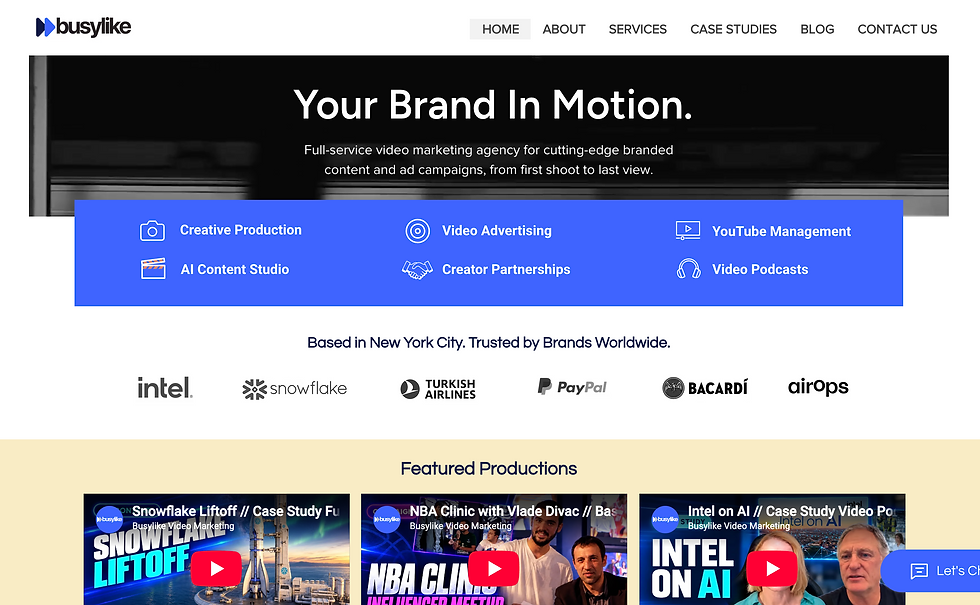
If video is where your advertising budget goes, whether YouTube, connected TV, TikTok, Instagram, or LinkedIn, Busylike belongs near the top of your list. It isn't a traditional creative agency that hands a finished commercial to a separate media buyer. It's a New York video advertising agency that builds the concept, produces the assets, runs the paid placements, and uses the performance results to shape the next round of creative.
That model fits how brands advertise now. The biggest agencies on this list were built around a single hero campaign carried by broadcast media. Most brands today need something different: a steady flow of video in many formats, versions, and lengths, each one adapted to the platform where it runs and measured against real business results. Busylike's guide to advertising in NYC reflects the same practical approach: less theater, more execution.
Why Busylike fits the video-first brief
Busylike's strength is that production and distribution sit on the same team. It combines creative production, video advertising, YouTube and social channel management, creator and influencer partnerships, and an AI Content Studio for scalable formats. One shoot can become a hero film, YouTube pre-roll, framing that works on connected TV, vertical cutdowns, and paid-social test variants, all planned before the camera rolls, not pieced together afterward.
Practical rule: If your agency can't explain how the edit changes for each placement before the shoot is approved, you're paying for a film, not an advertising program.
The engagement model is flexible too. Brands can hire Busylike for production only, media only, or an end-to-end monthly program. That suits in-house teams with strong creative direction who need execution support, as well as growth teams that want one partner handling concept, production, paid placement, and optimization. Busylike is YouTube-certified, works with both B2B and consumer brands, and offers a free audit, which makes a first conversation low-risk.
Where the trade-offs are
Busylike isn't the right lead partner for every brief. If you need a global brand platform rolled out across dozens of markets, with holding-company procurement and a large broadcast production footprint, a network agency like BBDO or McCann is the more natural choice. Busylike can still produce and run the video work that supports that kind of platform, but it isn't built to lead a multinational rebrand.
Pricing isn't published, so smaller teams should expect a scoped conversation rather than self-serve budgeting. Video performance across platforms also changes quickly, so the strongest engagements involve ongoing testing, not a one-time deliverable.
Best for:
Video-led advertising: Brands whose main ad formats are YouTube, connected TV, and paid social video.
Creative and media on one team: Marketing leaders who want production, paid placement, and optimization without separate agencies handing work back and forth.
B2B and growth brands: SaaS, tech, ecommerce, DTC, and venture-backed companies that judge video by pipeline and conversions, not just awareness.
Watch-outs:
Custom scoping: You'll need a conversation to understand engagement size and cost.
Testing mindset required: The model works best when your team treats video as an ongoing program, not a single campaign.
2. Droga5

A common shortlist problem looks like this. The company needs a brand platform strong enough to rally leadership, travel across markets, and justify a large rollout budget. That is the lane where Droga5 earns consideration.
Droga5 sits in the part of the NYC market where brand advertising meets enterprise change. Agency Spotter's 2026 review of the city's largest firms places Droga5 at an estimated about $245 million in annual revenue. For buyers, that signals bench strength, senior talent, and the ability to support large, high-stakes programs.
Accenture Song ownership changes the decision criteria. A marketer is not only buying creative development. Its value is the option to connect brand strategy with customer experience, commerce, product, and implementation if the assignment expands. That matters for companies where the campaign is only one part of a broader transformation effort.
The fit is clear. Droga5 makes sense when the business goal is to sharpen market position, reset perception, or launch at a scale that smaller shops cannot comfortably handle. It is a strong candidate for multinational brands, heavily scrutinized rebrands, and complex briefs where the CMO needs both a persuasive idea and an organization that can carry it through procurement, legal, regional teams, and executive review.
The trade-offs are just as clear.
This is not the agency I would choose for quick-turn paid social testing, channel-level efficiency work, or a scrappy growth sprint. The cost base is higher. The process is heavier. Timelines usually reflect the number of stakeholders involved. If your main objective is lower CAC next quarter, a performance-led or digital-first partner will usually fit better.
Use Droga5 when the business problem is brand stature, differentiation, or coordination across markets. Skip it when the assignment is narrow, tactical, or built around speed over organizational alignment.
Visit Droga5.
3. BBDO New York

A common CMO scenario looks like this. The company needs one campaign to work in the boardroom, on national media, across retailer channels, and in multiple regions without losing the core idea. That is the kind of assignment where BBDO New York belongs on the shortlist.
BBDO earns its place in this guide as a brand-scale agency. The firm has been around for well over a century, and that history matters less as trivia than as proof of operating discipline. Teams like this know how to build work that can survive research, procurement, legal review, and executive scrutiny without collapsing into blandness.
The strongest reason to hire BBDO is simple. You need brand advertising built for reach, recall, and organizational alignment. This is a fit for national launches, established brands trying to regain salience, and global marketers who cannot afford creative inconsistency across markets.
That same model creates trade-offs. BBDO is usually a weaker fit for a growth team that needs fast paid creative iteration, weekly testing cycles, or highly channel-specific optimization. The process is heavier, the cost base is higher, and smaller accounts may not get the most senior team in day-to-day work.
Where BBDO fits in this decision framework
BBDO makes the most sense if your primary objective is brand building at scale.
Choose BBDO if:
You need mass-market brand creative: The brief calls for broad awareness, strong production value, and work that can carry a large media investment.
Your organization is complex: Multiple business units, executives, regions, or compliance stakeholders need to approve and support the work.
You want a proven network partner: The assignment may expand across markets, channels, or supporting agencies.
Look elsewhere if:
Speed matters more than polish: You need rapid experimentation more than a fully developed brand platform.
Performance efficiency is the core KPI: CAC, conversion rate, and channel-level testing are the main job.
Your budget only supports a narrow project: In that case, an independent shop may give you more senior attention for the same spend.
BBDO is not the right agency for every brief. It is the right agency for the kind of brief where failure is expensive and internal alignment matters almost as much as the idea itself.
Visit BBDO.
4. McCann New York
You bring McCann into the conversation when the brief has real organizational weight. The campaign has to work across regions, survive legal review, satisfy multiple executives, and still feel like one brand in market. In that situation, McCann is often a better fit than a shop built around provocation alone.
Its long history matters less as trivia than as a signal of how the agency operates. McCann tends to build for durability. Strategy is usually the center of the engagement, and the work is designed to stay coherent across brand, content, social, and market-by-market execution.
Where McCann earns its place
McCann is a practical choice for marketers in regulated or operationally complex categories. Healthcare, financial services, and enterprise brands often need clear positioning, disciplined messaging, and a team that can handle layered approvals without losing the thread. That is different from hiring an agency to produce one loud campaign and move on.
The trade-off is pace and edge. If the goal is to test aggressively, chase cultural moments quickly, or push an intentionally abrasive creative point of view, McCann can feel too measured. Global network process also means more structure, which helps large organizations but can slow teams that want fast iteration.
For marketers sorting through agencies by capability, this guide to digital marketing agencies in New York is a useful comparison point. McCann sits on the side of the decision framework where brand governance, strategic consistency, and cross-market execution matter more than pure channel experimentation.
McCann is strongest when the cost of inconsistency is high. If your business needs a brand platform that can hold up across business units and approval chains, it deserves a place on the shortlist. If your real brief is category disruption, review the creative chemistry closely before you commit.
Visit McCann.
5. R/GA New York
R/GA has always made more sense for marketers who think in systems. If your problem sits between brand, product, experience, and commerce, R/GA is often more relevant than a classic ad agency. That's why it remains a distinctive option among the top ad agencies in New York.
This is the agency to call when the brief isn't just “launch a campaign,” but “make the brand work across the full customer journey.” That can include digital products, content systems, connected design, and operationally useful creative infrastructure.
Why RGA is different
R/GA's strength is that it treats brand as something people use, not just something they see. For CMOs working closely with product, CX, or e-commerce leaders, that's valuable. It creates alignment where more traditional agencies often create handoff problems.
If you're still deciding whether you need a digital specialist or a broader ad partner, this overview of digital marketing agencies in New York helps frame the distinction well. R/GA tends to sit on the side where marketing and digital experience are inseparable.
The downside is scope creep. If your actual need is a conventional above-the-line campaign, you may pay for product and systems thinking you won't use. Discovery phases can also be longer because the agency is often mapping more than communications.
Best fit signals:
Connected brand and CX work: Marketing needs to influence experience, not just media.
Digital product integration: Your site, app, or platform is part of the brand promise.
Modern operating model: You want a partner that can bridge strategy, design, and technology.
Visit R/GA.
6. Wieden+Kennedy New York (WKNY)

WKNY is for brands that need people to care. Not just notice. Care. That sounds soft, but it's one of the hardest outcomes to buy, and Wieden+Kennedy has long been one of the few agencies associated with work that creates real cultural conversation.
What makes the New York office especially useful is the combination of creative ambition with in-house media, social, and design support. That reduces the usual gap between the big idea and the channels that have to carry it.
When WKNY is the right call
WKNY is a strong match for brands that want breakthrough creative integrated with media execution. If your category is crowded and your brand is becoming invisible through sameness, that's the kind of brief where Wieden+Kennedy can justify the investment.
The trade-offs are the same ones you'd expect from a highly sought-after creative shop. They can be selective. Timing and availability matter. And if your business runs on heavy weekly experimentation, this may not be your best performance engine.
Hire WKNY when distinctiveness is the business problem. Don't hire them just because you want a famous agency on the cover slide.
This is a high-upside partner for companies that need relevance, memorability, and a sharper brand point of view. It's less suited to teams that mainly need channel efficiency.
Visit Wieden+Kennedy New York.
7. VaynerMedia

VaynerMedia is one of the clearest picks for brands that live or die by attention on modern platforms. If your business depends on social velocity, creator output, paid social iteration, and commerce-linked content, they're built for that operating model.
NoGood's 2026 NYC roundup, which ranks top digital marketing agencies in New York, places Wpromote at number two and notes more than $1.5B in media spend. That's useful context for evaluating the performance end of the market. VaynerMedia belongs in that broader conversation because it competes in the world where scaled execution, platform fluency, and media depth matter more than legacy prestige.
Where VaynerMedia wins
VaynerMedia is strongest when the brief requires volume, speed, and platform-native creative. Social-first brands, commerce-driven businesses, and companies investing heavily in creator ecosystems often get more operational value here than they would from a classic brand shop.
They're also a sensible comparison point if your team is weighing social-led growth against AI-led discovery. This look at AI visibility agencies in New York City helps show where those models diverge.
The main caution is fit. If you need polished, cinematic brand advertising with minimal ongoing social system requirements, you may be paying for machinery you won't fully use. High-demand agencies can also become top-heavy, where the senior team sells the vision but the day-to-day runs through a broader delivery structure.
Use VaynerMedia when:
Social is the growth engine: Creative and media need to move fast together.
Influencer and commerce matter: You need execution native to the platforms.
Iteration beats perfection: Your team values speed, testing, and output volume.
Visit VaynerMedia.
8. Mischief @ No Fixed Address
Mischief is the agency to call when the brand's biggest risk is being ignored. It launched in 2020, when No Fixed Address expanded from Toronto into the U.S. under former BBDO creative Greg Hahn. It has since won some of the industry's top honors: it was named Ad Age's Agency of the Year in 2022 and 2024, and it ranked No. 2 on Ad Age's 2026 A-List.
Its work is designed to earn free media coverage. Clients include Tubi, Crocs, and Molson Coors, and its campaigns are regularly among the most talked-about Super Bowl ads.
Where Mischief fits best
Choose Mischief when you need an idea people talk about, not just ads that run. Its leadership describes it as a strategy agency that happens to be known for creative, and it puts real weight on deciding what to say before deciding how.
Best for:
Challenger brands that need outsized attention on a smaller budget than the category leaders.
Launch moments where earned media matters as much as paid media.
Watch-outs:
Performance fit: Industry coverage has questioned whether its approach suits brands focused on performance and direct response. Some brands keep performance creative in-house or with specialist agencies.
Risk appetite: The work is designed to provoke. Make sure your leadership and legal teams are comfortable with that before you sign.
9. Mother New York
Mother is a strong option for brands that want creative ambition with the flexibility of an independent agency. It opened its first North American office in New York in 2003, expanding from its London headquarters, which was founded in 1996. It now works out of Brooklyn and remains independently owned. Its specialist units include Mother Design and Media by Mother.
Mother is also coming off a strong year. After losing Target, one of its largest accounts, it picked up more than 30 new clients globally, including Uber, Meta, Electronic Arts, BlackRock, and Dow Jones. Its U.S. revenue grew 20%, and Ad Age named it the 2026 Independent Agency Network of the Year. In June 2026, Intuit appointed Mother New York as a creative agency partner.
Where Mother earns its place
Mother fits brands that want advertising, design, and media under one independent roof, without the bureaucracy of a holding company. It also works well for brands with a strong New York identity: recent campaigns include StreetEasy's 20th-anniversary work and a campaign built around the Knicks championship parade.
Best for:
Brand reinvention where design and advertising need to move together.
Multi-office briefs that need global reach from an independent partner.
Watch-outs:
Selectivity: Agencies with this much momentum can be choosy about new business.
Channel depth: Media by Mother is still growing, so confirm its media capabilities against your specific channel mix.
10. Johannes Leonardo
Johannes Leonardo is built for brands that want campaigns people join in on, not just watch. Jan Jacobs and Leo Premutico founded it in New York in 2007, and its clients have included Adidas, Volkswagen, Google, Stella Artois, and Diesel.
Its recent track record is strong. Its Adidas "Oasis" campaign won a Grand Prix at Cannes Lions 2026, and recent 2026 work includes campaigns for Zillow, Oscar Mayer, and Philadelphia Cream Cheese.
When Johannes Leonardo is the right call
It suits established brands that need a sharper, more culturally engaged position without the process of a full network agency. It generally presents itself as independent, but buyers should know WPP has held a minority stake. That gives it holding-company resources when a client needs them.
Best for:
Heritage brands that need renewed cultural relevance.
Sports and lifestyle marketing, where its Adidas work sets the standard.
Watch-outs:
Scale: With 51–200 employees, it can't staff a large global brief the way a network agency can.
Channel execution: Its strength is the idea. Confirm who handles media, performance, and ongoing content production.
11. Anomaly
Anomaly is a good fit for brands that want an agency willing to go beyond advertising, including creating new products and brands. It was founded in 2004 with the goal of integrating advertising more broadly across media, and it has offices in New York, Los Angeles, Toronto, London, Berlin, and Shanghai. It was Adweek's 2022 U.S. Agency of the Year and Ad Age's 2017 Agency of the Year.
It's also consistently busy with high-profile consumer work. Recent campaigns include Popeyes, Bud Light, and Budweiser's 150th-anniversary celebration, and its clients have included AB InBev, Google, Lego, and Nike.
Where Anomaly fits best
Anomaly is a strong choice when the brief is a business problem, not just a communications problem. Its best-known example is dosist, a medicinal cannabis brand the agency created itself, which Time named one of its Best Inventions of 2016.
Best for:
Big consumer brands that need creative work at mass-market scale.
Unconventional briefs that could lead to new products or brand extensions.
Watch-outs:
Ownership: Anomaly is part of Stagwell. It's more flexible than a traditional network agency, but it isn't fully independent.
Budget: A client roster this large usually means premium pricing.
12. Horizon Media
Horizon is the media-buying counterweight to the creative agencies on this list. It describes itself as the largest independent media agency in the world, with estimated billings of $8.7 billion, more than 2,300 employees, and a ranking as the third-largest U.S. media agency.
It's also winning a lot of new business right now. Horizon topped Campaign's April 2026 North American new-business rankings with $446.8 million in new billings, including wins for Discover and E. & J. Gallo Winery.
Why teams choose Horizon
Horizon fits brands that want the scale of a big media buyer without a holding company's conflicts of interest or layers. It's also moving toward pricing based on results: it's building an AI-powered model with transparency and compensation tied directly to client outcomes.
Best for:
Large media budgets that need negotiating power and independent oversight.
Media contracts tied to results, with pay linked to business outcomes.
Watch-outs:
Creative is newer territory: Its full-service creative offer, One Horizon, is younger than its media business, so review the creative work carefully.
Minimum scale: Its model is built for major advertisers, not small test budgets.
Top NYC Ad Agencies Comparison
Agency | Implementation complexity 🔄 | Resource requirements ⚡ | Expected outcomes 📊 | Ideal use cases 💡 | Key advantages ⭐ |
|---|---|---|---|---|---|
Busylike | High, continuous LLM prompt/topic testing and optimization | Specialized AI + creative teams; scoped/custom pricing (mid‑market → enterprise) | Strong AI discovery, recall & conversions; measurable SOV/sentiment (⭐⭐⭐) | Brands needing AI‑first discovery, LLM ads, and genAI creative | End‑to‑end AI‑native studio, LLM ad programs, free visibility audit |
Droga5 (Accenture Song) | High, integrated creative + consulting workflows across global teams | Very high, premium fees, enterprise governance and resourcing | High cultural impact and large‑scale brand platforms (⭐⭐⭐) | CMOs seeking culture‑shaping creative with global rollout & activation | Award‑winning creative + Accenture strategy, data & tech depth |
BBDO New York | High, large production pipelines and global network coordination | Very high, premium retainers and production budgets | Mass awareness and fame‑driving campaigns (⭐⭐⭐) | Household‑name brands and cross‑market global campaigns | Enterprise production quality and global reach |
McCann New York | High, structured strategic planning and multi‑market orchestration | High, enterprise infrastructure and category specialists | Enduring brand platforms tied to measurable outcomes (⭐⭐) | Regulated or complex categories; multi‑market activations | Insight‑led strategy and proven processes for complex briefs |
R/GA New York | High, product/digital discovery and systems integration phases | High, digital, product and technology expertise required | Integrated brand+CX outcomes; scalable digital platforms (⭐⭐) | Brands needing marketing integrated with CX, commerce, AI ops | Brand systems thinking, deep digital/product capabilities |
Wieden+Kennedy New York (WKNY) | Medium‑High, creative‑forward with in‑house media execution | High, selective engagements, premium creative resources | Culture‑shifting, talk‑worthy work and brand love (⭐⭐⭐) | Brands seeking breakthrough creative tightly tied to media | Renowned creative pedigree with in‑house media & social |
VaynerMedia | Medium, rapid, platform‑native creative and iteration cycles | High (platform partnerships) but optimized for social scale | Fast social performance and commerce activation (⭐⭐) | Always‑on paid social, influencer, and commerce‑driven brands | Rapid iteration, broad platform certifications and scale |
Independent vs. Holding Company Agencies: What the Omnicom-IPG Merger Means for Your Shortlist
The biggest change in New York's agency market this year isn't a single campaign. It's who owns the agencies. Omnicom completed its acquisition of Interpublic on November 26, 2025, creating the largest agency holding company in history. It then retired the DDB, FCB, and MullenLowe brands, consolidated its creative business into BBDO, TBWA, and McCann, and cut roughly 4,000 jobs.
For brands, the practical question isn't which holding company is biggest. It's what the consolidation changes about your account. Mergers can bring broader data, media buying power, and global coverage. They can also bring team reshuffles, new leadership, and conflicts when competing brands end up under the same parent. If your current agency sits inside one of the merged networks, ask directly who will be on your team in 12 months and whether any of your competitors are now clients of the same group.
Independent agencies are using the moment to win business. Horizon Media led April 2026's North American new-business rankings, and Campaign reported that independent agencies continued to dominate those rankings. Mother grew its U.S. revenue 20% and was named Ad Age's 2026 Independent Agency Network of the Year.
The case for an independent agency is speed, senior attention, and no conflicts from a parent company. The case for a holding company is scale, global reach, and integrated data and media buying. Neither is better in general. Holding companies usually fit multinational brands running coordinated programs across many markets. Independents usually fit brands where the senior team's time and the speed of decisions matter more than global coverage. The smartest shortlists include both types and ask each the same question: how would your team structure, decision speed, and pricing look for our budget?
Your Next Move From Shortlist to Partnership
You have a shortlist, a budget range, and pressure from leadership to pick an agency that can move the business. The mistake at this stage is treating seven very different firms like interchangeable options. They are not. New York's top agencies solve different problems, operate at different speeds, and create different kinds of overhead once the work starts.
Use the shortlist as a matching exercise. A global brand reset points you toward brand-led agencies such as Droga5, BBDO, McCann, or WKNY. A digital product, CX, or commerce transformation usually fits R/GA better. Social velocity, creator systems, and paid content loops are closer to VaynerMedia's model. If AI discovery is affecting pipeline, branded search behavior, or how buyers find you in LLM environments, Busylike is the most directly aligned option in this group.

That framing matters because this guide is not a beauty contest. It is a decision framework.
Tips for a Winning Brief
Start with the business problem: Skip vague asks like "we need a campaign." State what changed and what has to improve. Flat demand, weak brand recall, poor conversion, declining share, fragmented positioning, or low visibility in AI search are all usable starting points.
Set the decision criteria up front: Define what success looks like in numbers and in operating terms. Revenue impact, qualified pipeline, reach, conversion rate, speed to launch, geographic coverage, or internal stakeholder load all change which agency is the right fit.
Put constraints on the table early: Budget, legal review, procurement, data access, creative approvals, and launch windows shape the recommendation. Agencies do better work when they can design around real constraints instead of discovering them halfway through the process.
The market is large and crowded. IBISWorld estimates the U.S. advertising agency industry will reach an estimated $88.7 billion in revenue in 2026, with 4.7% five-year growth, a projected 1.8% increase in 2026, and about 114,000 businesses. That scale helps explain why New York remains a high-pressure buying environment. Large holding-company agencies, digital specialists, and newer AI-native firms are competing for the same budgets, often with very different delivery models behind similar pitch language.
The practical test is simple. Can the agency show a clear point of view on your problem, a team structure that fits your pace, and a way of working your organization can support for the next 12 to 24 months?
Strong partnerships come from clarity on scope, success metrics, and trade-offs before the contract is signed.
If video is becoming your main advertising format, across YouTube, connected TV, and social, Busylike is worth a serious look. Its New York team combines creative production, paid video media, YouTube and social channel management, and creator partnerships in one operating model. That fits brands that need video to drive measurable results, not just look good on a reel.


