
What is OpenClaw? A Guide for Marketers & Brands

Your team is probably already seeing the pattern. Traffic from traditional search is less predictable. Referral paths are harder to trace. Buyers are asking better questions in ChatGPT, Claude, Perplexity, and agent-driven workflows before they ever reach your site.
OpenClaw matters because it pushes that shift one step further. It doesn't just answer questions. It can act. For brands, that makes it more than a developer curiosity. It starts to look like a new unmanaged media channel where autonomous systems can discover, evaluate, and interact with your brand assets without a human clicking through a standard funnel.
If you're asking what is OpenClaw, the useful answer isn't just technical. The useful answer is this: it's part of the infrastructure that turns AI from a chat interface into an operating layer. That changes how brands get found, how workflows get automated, and how customer decisions get shaped.
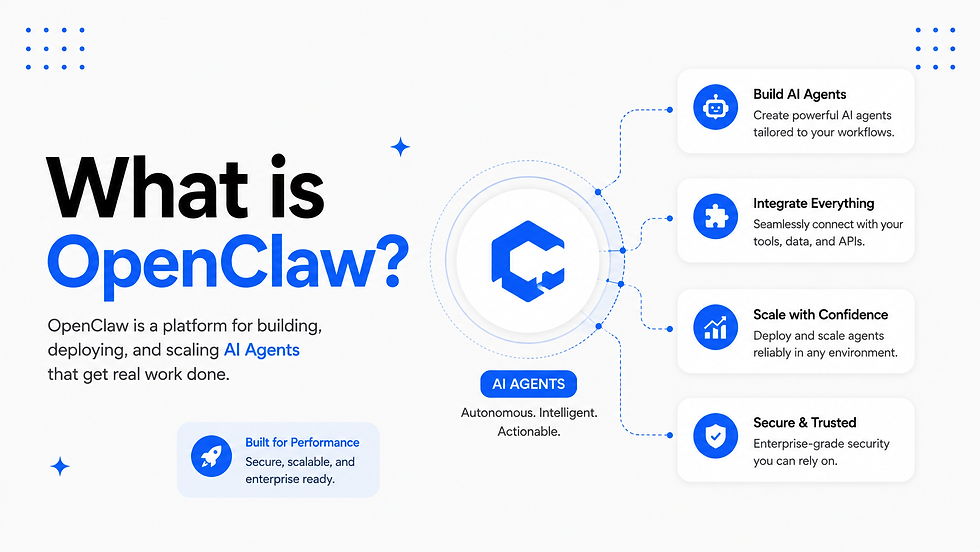
Table of Contents
What OpenClaw Is and Why It Matters Now - OpenClaw is an orchestrator, not the model - Why marketers should care now
How OpenClaw Connects AI to the Real World - What happens after a message is sent - Why self-hosting changes the risk profile
The Story Behind OpenClaw's Rapid Rise - Why the project caught fire - What that popularity signals to brands
Practical Use Cases for Marketing and Product Teams - Lead generation and sales support - Competitive monitoring and product feedback - Where teams get value and where they get stuck
Your Brand's Strategic Response to AI Agents - Monitor agent-facing brand exposure - Publish content that agents can trust and use - Choose integration points carefully
What OpenClaw Is and Why It Matters Now
OpenClaw is best understood as an AI orchestrator. It isn't another large language model competing with ChatGPT or Claude. It's the layer that lets those models take action across software, files, browsers, and messaging channels.
That distinction matters. Most executives hear "AI agent" and think of a smarter chatbot. OpenClaw is closer to a nervous system. It connects natural language input to tools, APIs, and workflows so a model can do something, not just describe what should be done.

OpenClaw is an orchestrator, not the model
The clearest description comes from Clarifai's explanation of OpenClaw, which notes that OpenClaw gives AI models "eyes, ears, and hands" through over 100 preconfigured AgentSkills for shell commands, file management, and web automation. The same source says it reached over 200,000 GitHub stars within three months of its late 2025 launch, a signal that the market quickly understood the difference between a model and a system that can operationalize one.
If you want a quick grounding in the broader category, Clepher's AI agent overview is useful because it explains the agent concept in plain business language before you get into OpenClaw specifically.
For a CMO, the practical analogy is simple:
The LLM is the brain: It interprets language and decides what to do.
OpenClaw is the operating layer: It routes requests, manages tools, and coordinates execution.
The connected systems are the limbs: Browser sessions, file systems, messaging apps, calendars, and APIs carry out the work.
Why marketers should care now
At this point, the question of "what is OpenClaw" shifts toward why marketing departments should pay attention. Once AI gains the ability to browse, inspect documents, read product pages, trigger workflows, and persist context across sessions, your brand is no longer speaking only to people. You're speaking to software acting on behalf of people.
Practical rule: Treat agent-accessible content like channel inventory. If an AI system can read it, summarize it, compare it, or route decisions from it, that content now influences pipeline.
OpenClaw also matters because it's local and open-source. That means organizations can run it on their own hardware and connect it to the models they choose, instead of relying on a closed assistant with fixed integrations. For enterprise teams, that opens up flexibility. For marketing leaders, it means agent behavior won't be limited to the interfaces you already know how to optimize.
The strategic shift is straightforward. Search taught brands to optimize for indexability. Social taught brands to optimize for engagement. Agent ecosystems require brands to optimize for machine usability, citation quality, and actionability.
How OpenClaw Connects AI to the Real World
The mechanics are what make OpenClaw commercially interesting. A user sends a plain-language request in a chat app. OpenClaw receives it, routes it, gives the model the right context, and then executes tasks through tools such as browser control, file operations, or command-line actions.
That sounds technical, but the business implication is simple. A chat thread can become a control surface for operations.

What happens after a message is sent
According to DigitalOcean's overview of OpenClaw, OpenClaw is a self-hosted, proactive AI agent runtime built on Node.js that bridges messaging platforms such as WhatsApp, Telegram, and Discord with actions like running shell commands, controlling a browser, and managing files, all through natural language.
In practice, the flow looks like this:
A user sends a request in a channel like Slack, WhatsApp, or Telegram.
The gateway normalizes the input so the system can treat messages, media, and context consistently.
The model decides on actions based on the session, tools available, and the objective.
OpenClaw executes the task in a sandboxed, self-hosted environment.
The result comes back into the same conversational thread.
That flow matters for marketers because it collapses interfaces. Instead of logging into separate tools for research, file retrieval, browser testing, and notifications, teams can route work through conversation. That can shorten coordination loops, especially for repetitive operational tasks.
A related implication for brand visibility is covered well in this piece on why being cited by AI agents can matter more than digital visibility alone. The issue isn't just ranking. It's whether autonomous systems can reliably parse and use your information.
Why self-hosting changes the risk profile
OpenClaw's architecture changes the governance conversation because it's self-hosted. Data can stay local. Teams can control integrations more directly. Security-minded organizations often prefer that model to handing operational workflows to a fully managed black-box assistant.
That doesn't make it low-risk. It makes the trade-off more explicit.
Consideration | What works | What doesn't |
|---|---|---|
Privacy | Keeping sensitive workflow data in a self-hosted environment | Assuming local deployment removes the need for controls |
Flexibility | Connecting the agent to the tools your team actually uses | Letting every team build ad hoc workflows without standards |
Reliability | Using OpenClaw for bounded, repeatable tasks | Expecting fully autonomous judgment in high-risk brand situations |
OpenClaw is most useful when the task is operationally clear, the tools are well defined, and a human still owns the outcome.
The strongest deployments use it as a supervised operator. The weakest deployments treat it like magic and give it messy instructions, weak governance, and broad permissions.
The Story Behind OpenClaw's Rapid Rise
OpenClaw didn't grow because the market needed another chatbot. It grew because the market wanted control over how AI connects to real work.
The project launched in November 2025 as Clawdbot, then moved through rebrands to Moltbot and finally OpenClaw. It was created by Peter Steinberger, founder of PSPDFKit, and later transitioned into an open-source foundation after he joined OpenAI. That history matters because it explains why the project feels different from a typical startup product. It behaves more like infrastructure the community wants to shape.
Why the project caught fire
The appeal was practical from the start. Developers and operators saw a local, open-source agent runtime that could orchestrate tasks through existing LLM APIs while keeping control closer to the user. The market responded quickly, and the community became highly engaged around its orchestration model, skills, and self-hosted flexibility.
A few factors drove the momentum:
Open deployment philosophy: Teams could run it on their own hardware instead of waiting for a vendor roadmap.
Action-oriented design: It connected language models to tasks, not just text generation.
Community contribution: Skills, adapters, and operational patterns spread fast because the project was open.
What that popularity signals to brands
For brand leaders, the rise of OpenClaw is a market signal. Buyers and operators don't just want AI answers. They want AI systems that can fetch, compare, notify, organize, and act across environments they already use.
The important shift isn't that OpenClaw became popular. It's that an open, self-hosted agent runtime became culturally legible to mainstream operators so quickly.
That suggests staying power for the broader category even if the toolset evolves. Brands should assume more customers, partners, analysts, and internal teams will use agentic systems to evaluate products and move work forward. Once that happens, your website, documentation, help center, pricing explanations, and product metadata stop being static assets. They become machine-ingested decision inputs.
Practical Use Cases for Marketing and Product Teams
The best OpenClaw use cases aren't flashy demos. They're repetitive jobs with too many tabs, too many copy-paste steps, and too much human coordination for the value they create.
Marketing and product teams already have plenty of those.

Lead generation and sales support
One of the clearest patterns in the market has been lead generation. By early 2026, OpenClaw adoption had surged among small businesses and freelancers, with many using it to automate prospect research, website auditing, and CRM integrations, as noted earlier in the Clarifai coverage. That use case translates directly into modern revenue teams.
A realistic workflow looks like this:
Inbound qualification: An agent reads a form submission, checks the prospect's website, identifies category fit, and prepares notes for SDR review.
Account research: It gathers public signals from the prospect's site, messaging, documentation, and visible product stack.
CRM preparation: It formats findings for the fields and notes structure your team already uses.
Teams looking for implementation inspiration can review these real-world uses for OpenClaw agents, which map well to outreach, research, and workflow support scenarios.
A related content issue shows up here too. If you want AI systems to surface your brand accurately during this kind of machine-led research, your owned content has to be structured for retrieval and summarization. That's why ranking in ChatGPT has become a brand operations issue, not just an SEO experiment.
Competitive monitoring and product feedback
A product marketer can use an OpenClaw workflow to monitor competitor pages, note messaging changes, and route findings into a shared workspace. A PMM or analyst can also use it to collect public evidence on packaging changes, customer-facing documentation updates, or visible shifts in onboarding flows.
That kind of work doesn't require full autonomy. It benefits from consistency.
Ask the agent to gather evidence, not declare strategy. The human still decides what the signal means.
Here's where a short demo helps frame the opportunity:
Where teams get value and where they get stuck
The high-value use cases usually share three traits:
They are rules-heavy: The agent follows a repeatable pattern.
They involve multiple tools: Browser, files, CRM, and messaging all matter.
They benefit from memory: The system improves when it retains context across tasks.
Teams get stuck when they try to hand OpenClaw ambiguous brand judgment. It can gather, sort, and route. It shouldn't be the final authority on positioning, crisis response, or nuanced customer communication without strong controls.
Your Brand's Strategic Response to AI Agents
Most brands are still treating AI agents as an internal productivity topic. That's too narrow. OpenClaw and similar systems create a distributed layer of autonomous discovery and action around your brand, whether you deploy them or not.
That means your response can't be passive. You need operating discipline across visibility, content design, and integration choices.

Monitor agent-facing brand exposure
Start by assuming agents are already reading your public materials. Product pages, comparison pages, docs, help articles, and pricing language are all inputs. If those assets are inconsistent, outdated, or vague, agent outputs will reflect that.
A useful monitoring program should track:
Brand claims in AI answers: Are core product descriptions accurate and consistent?
Citation patterns: Which pages or assets are being used as the basis for summaries?
Competitor adjacency: In what contexts does your brand appear alongside alternatives?
This becomes even more important as agentic behavior spreads across research and buying workflows. The strategic framing in this overview of agentic marketing is useful because it treats AI systems as environments that shape demand, not just tools that answer prompts.
Publish content that agents can trust and use
The next step is content adaptation. Not more content. Better structured content.
Agents prefer pages that are easy to interpret, internally consistent, and rich in specific product detail. They work better with clear entities, direct language, product comparisons, FAQs, implementation details, and tightly scoped claims. If your site is full of soft positioning language and missing operational specifics, agents will struggle to use it well.
For teams building that discipline, this guide on how to optimize content for AI search is a practical resource because it focuses on the mechanics of making content easier for AI systems to extract and reference.
A simple decision table helps here:
Brand asset | Agent-friendly version | Weak version |
|---|---|---|
Product page | Clear use cases, integrations, constraints, and terminology | Abstract copy with little product detail |
Help center | Structured answers and task-specific articles | Thin articles written only for deflection |
Comparison page | Specific differences and buyer-fit guidance | Generic competitive language |
Leadership test: If an autonomous system had to explain your product using only your public content, would it sound precise or generic?
Choose integration points carefully
OpenClaw can be cost-effective for experimentation, with basic deployments available on a $5/month VPS and production marketing use requiring more robust hardware such as 4+ vCPU and 8 to 16GB RAM. For a brand team, that isn't just an infrastructure note. It's a budgeting and ownership decision.
Before you deploy anything customer-facing, decide three things:
Which workflows are safe to automate Internal research, categorization, and routing are usually better starting points than live customer conversations.
Who owns quality control Marketing can define standards. Operations or IT usually needs to own deployment, access, and monitoring.
What failure is acceptable A missed internal note is one thing. A wrong public answer about pricing, compliance, or product capability is different.
What works is a narrow first deployment. Think campaign research support, competitor monitoring, lead enrichment, or internal knowledge retrieval. What doesn't work is pushing a broad autonomous agent into brand-sensitive workflows before your content, governance, and escalation paths are ready.
Unifying Your Strategy for the AI Ecosystem
OpenClaw is one tool, but the bigger pattern matters more than the product. AI systems are moving from passive answer engines into active operating layers that can retrieve information, compare vendors, execute workflows, and influence decisions before a human ever visits your site.
For marketers, that changes the job. You still need strong positioning, content, and media strategy. But now those assets also need to be legible to machines that summarize, recommend, and act. The brands that adapt fastest will treat AI agents as part of the discovery environment, not as a side experiment owned only by technical teams.
The practical response is disciplined and cross-functional. Clean up core brand claims. Publish more usable product detail. Monitor how AI systems describe you. Decide where agent automation helps and where human review stays mandatory. That's how you reduce risk while gaining advantage from the same technologies reshaping customer behavior.
The question isn't only what is OpenClaw. The better question is whether your brand is ready for a market where autonomous systems increasingly mediate attention, evaluation, and action.
Frequently Asked Questions
What is OpenClaw?
OpenClaw is an open-source AI agent framework designed to automate digital tasks, workflows, and interactions using autonomous AI systems that can operate across applications and environments.
How does OpenClaw work?
OpenClaw uses AI agents that can interpret instructions, interact with interfaces, and execute multi-step tasks, enabling more autonomous workflow automation compared to traditional software tools.
Why is OpenClaw relevant for marketers and brands?
For marketers and brands, OpenClaw represents the shift toward AI agents that can automate research, content workflows, campaign management, and operational tasks at scale.
How is OpenClaw different from traditional automation tools?
Traditional automation relies on predefined workflows and rules, while OpenClaw enables more adaptive and autonomous behavior through AI-driven decision-making and task execution.
What are some marketing use cases for OpenClaw?
Potential use cases include automating content workflows, gathering competitive insights, managing repetitive marketing operations, and supporting AI-driven customer engagement processes.
Can OpenClaw integrate with marketing tools and platforms?
Yes, OpenClaw is designed to interact with digital environments and applications, allowing it to support workflows across marketing and operational systems.
Is OpenClaw suitable only for enterprises?
No, both enterprises and smaller teams can explore OpenClaw, especially organizations looking to experiment with AI agents and workflow automation without relying solely on closed enterprise platforms.
What are the benefits of using AI agents like OpenClaw?
Benefits include increased efficiency, reduced manual work, faster execution, and the ability to scale workflows and processes with fewer operational bottlenecks.
What are the risks of using autonomous AI agents?
Risks include workflow errors, lack of oversight, inconsistent outputs, and security concerns if systems are not monitored and governed properly.
What is the future of AI agent frameworks like OpenClaw?
AI agent frameworks are expected to become increasingly capable, enabling businesses to automate more complex workflows and move toward AI-native operational models across marketing, sales, and customer engagement.
If your team needs help navigating that shift, Busylike helps brands build AI-native media strategies for discovery, demand, and visibility across AI search and conversational environments. That includes monitoring how LLMs and agents represent your brand, improving content for citation and retrieval, and turning AI-driven discovery into a measurable growth channel.

