B2B Video Marketing Strategy for Enterprise Growth

Your brand team has a polished hero film. Demand generation has webinar clips. Sales has recorded its own product walkthroughs, each with different messaging, visual standards, and calls to action. The assets keep arriving, but leadership still can't answer the question that matters: which videos are helping qualified buyers move toward a commercial decision?
That problem defines modern B2B video marketing. Video isn't short of attention or adoption. Wyzowl reports that 91% of businesses use video as a marketing tool, while 93% of marketers say video delivers a good ROI (Wyzowl's video marketing statistics). The competitive advantage now comes from connecting creative choices to distribution, sales conversations, and revenue evidence.

Table of Contents
Why Enterprise B2B Video Marketing Needs a System - The operating-system shift
The Strategic Core of B2B Video Marketing - Assign every video a buyer job - Resolve the strategic tensions early
Choosing Video Formats for Buyer Decisions - Match the format to the uncertainty - Design for modular reuse
Building a Scalable Video Production Workflow - Create a brief that can survive review - Capture once, plan many outputs
Distributing Video Across YouTube CTV and Social - Build a sequence, not a channel list
Measuring Video Performance and Business Impact - Use metrics as diagnostics - Separate attribution from causation
Budgeting and Resourcing Enterprise Video Programs - Choose the operating model deliberately
Enterprise Playbooks and Next Actions - Playbook one for entering new accounts - Playbook two for a major launch - Playbook three for sales enablement - A focused 90-day sequence
Why Enterprise B2B Video Marketing Needs a System
The usual enterprise failure isn't weak creative. It's fragmentation.
Brand marketing commissions a high-production-value film to establish category authority. Demand generation creates webinar excerpts to support a campaign. Product marketing records an explainer for a launch. Sales enablement asks an agency for account-specific snippets. Each team may do competent work, yet the audience experiences a disconnected brand and the revenue team inherits a library that isn't organized around buyer decisions.
The same fragmentation appears in measurement. Brand reports reach and completion. Paid media reports efficient views. Demand generation reports form fills. Sales reports whether a prospect watched a demo. Because the teams don't share a common content architecture or measurement model, no one can reliably distinguish activity from business influence.

The operating-system shift
Treating video as a list of deliverables creates predictable waste. A hero film may be difficult to adapt, a webinar clip may lack a strong brand cue, and a sales demo may explain features without addressing the buyer's risk. The production calendar fills up while the buying journey remains under-served.
An operating system works differently. It gives every asset a role, every channel a job, and every signal an owner. Creative supplies the experience, distribution puts it in front of the right audience, sales enablement carries proof into active conversations, and attribution records what happened next.
Practical rule: Don't approve a video because it sounds useful. Approve it when you can name the audience decision it supports, the distribution path it will take, and the evidence that will justify repeating it.
The market is moving in this direction financially. eMarketer projects that B2B video ad spending will reach $2.86 billion by 2027, representing 11.1% of total B2B digital ad spend (eMarketer's B2B video marketing analysis). That investment signals a shift from video as a branding accessory to video as a performance channel with dedicated governance.
Enterprise leaders should therefore build a reusable system rather than commission isolated projects. A useful starting point is to audit existing assets, identify gaps by audience and funnel stage, and document where video appears in the sales process. A structured video asset management workflow can then make ownership, permissions, versions, and reuse visible across teams.
The Strategic Core of B2B Video Marketing
Think of B2B video marketing as an operating system with four connected layers. Creative is the application layer, the part users interact with. Distribution is the network, carrying the experience to the places buyers spend time. The audience is the user layer, made up of different people with different responsibilities. Attribution is telemetry, recording behavior and commercial progression.
If one layer fails, the system becomes unreliable. Strong creative without distribution becomes an underused asset. Precise targeting without a relevant message creates efficient waste. Engagement data without CRM context produces attractive dashboards that don't explain pipeline.

Assign every video a buyer job
Start with the buying group, not the format. A financial approver needs confidence in commercial and operational risk. A technical evaluator needs evidence that the product works in the existing environment. An executive sponsor needs a clear point of view and a credible reason to prioritize change. A daily user needs practical proof that adoption won't create unnecessary friction.
Your strategy should map those jobs across the journey:
Category education gives unfamiliar audiences a useful way to frame the problem.
Consideration content explains the approach and establishes meaningful differentiation.
Evaluation content demonstrates capability through proof, product detail, and customer evidence.
Enablement content helps sales answer objections and move a live opportunity forward.
Post-sale content supports adoption, advocacy, and expansion.
The narrative spine should remain consistent even as the execution changes. Decide what the company wants buyers to understand, believe, and do after each exposure. A category film might establish the belief, a customer story might substantiate it, and a specific demo might help a buying committee act on it.
Resolve the strategic tensions early
Brand and demand shouldn't compete for entirely separate video programs. Brand creative creates memory and meaning, while demand creative translates those associations into a next step. The useful question isn't which one deserves the budget. It's how one asset family can serve both objectives without forcing every video to behave like a direct-response ad.
Before production begins, answer these questions:
Which buying committee or account segment has priority?
What decision should the viewer make next?
Which proof will reduce uncertainty?
Where will the video appear, and what context will surround it?
What sales or CRM event will indicate progress?
Which footage, interviews, or graphics can be reused?
That discipline turns video from a creative queue into governed infrastructure.
Choosing Video Formats for Buyer Decisions
A single hero asset can't carry an enterprise buying journey. It may create recognition, but it rarely answers every question raised by a technical evaluator, procurement lead, executive sponsor, and end user. Build a portfolio in which each format reduces a specific decision cost.
Format | Buyer Job | Funnel Stage | Primary Proof Signal |
|---|---|---|---|
Category point-of-view film | Understand why the problem matters | Awareness | Distinctive narrative and brand recall |
Product explainer | Understand the offer quickly | Awareness and consideration | Clear product logic |
Customer proof story | Assess credibility and relevance | Consideration | Customer experience and evidence |
Expert interview series | Learn how leaders interpret the category | Awareness and consideration | Expertise and consistency |
Demo walkthrough | Judge practical fit | Evaluation | Observable product behavior |
Comparison short | Clarify meaningful differences | Evaluation | Specific decision criteria |
Sales enablement snippet | Resolve an objection in context | Evaluation and purchase | Relevance to the live conversation |
Onboarding or tutorial video | Support adoption | Post-sale | Usability and task completion |
Match the format to the uncertainty
Use a category film when the audience hasn't accepted the problem definition. Keep it focused on the tension, the cost of inaction, and the company's distinctive perspective. Don't turn a point-of-view piece into a product tour.
Use customer stories when buyers need confidence that the solution works in circumstances similar to theirs. The strongest version includes the initial problem, the decision process, the implementation reality, and the resulting change in operating behavior. It doesn't need to sound like a scripted endorsement.
Use demos and explainers when complexity is the obstacle. A good explainer simplifies the model. A good demo makes the experience inspectable. Those are different jobs, and combining them often produces a video that's too abstract for evaluators and too detailed for new prospects.
LinkedIn's analysis of 13,000 B2B video ads found that creative factors drove 73% of completions and 49% of engagement, and reported 34% higher engagement for face-to-camera videos and 34% longer dwell time for vertical videos than square formats (Komet Media's summary of LinkedIn B2B video data). The implication isn't that every enterprise video should use a talking head or vertical framing. It is that format choices deserve strategic testing instead of being determined by habit.
Design for modular reuse
Plan the shoot around a content matrix. Capture the long-form interview, clean product demonstrations, contextual B-roll, direct-to-camera hooks, customer objections, and concise proof statements in the same production system. Then create versions for YouTube, connected TV, social feeds, landing pages, and sales follow-ups without rebuilding the story from scratch.
The decision rule is simple: start with the buyer decision, then choose the format that makes that decision easier. A portfolio beats a hero asset because buyers don't need one impressive impression. They need a sequence of credible answers.
Building a Scalable Video Production Workflow
Enterprise production usually fails at the handoffs. Briefs arrive incomplete, stakeholders join late, legal reviews the wrong version, and regional teams request adaptations after the edit is locked. A scalable workflow makes those dependencies explicit before cameras roll.

Create a brief that can survive review
Every request should state:
Audience: Name the role, account group, or buying committee.
Decision: Specify what the viewer should understand or do.
Funnel role: Mark the asset as awareness, consideration, evaluation, enablement, or post-sale.
Proof: Identify the customer evidence, product behavior, expert perspective, or demonstration required.
Distribution: Define the intended placements and aspect ratios before production.
Success signal: Select the next measurable behavior, not just a view target.
Reuse plan: List the future cuts, excerpts, language versions, and sales applications.
A weekly intake meeting should rank requests against business priorities and available capacity. Marketing, product, sales enablement, analytics, and legal don't need equal decision rights on every frame, but they do need a clear escalation path.
For teams formalizing their process, the Flexwork Podcast Studios production roadmap offers a useful reference for organizing planning, recording, editing, and delivery. The same discipline applies beyond podcasts. Your team needs a defined path from approved idea to usable, governed asset.
Capture once, plan many outputs
Pre-production should include a shot list, location plan, talent releases, accessibility requirements, product access, and a B-roll bank. An interview kit with repeatable lighting, audio, framing, and backdrop standards makes executive and subject-matter-expert capture easier across regions.
Production sprints should group related needs. Record a product story, customer interview, executive point of view, and supporting B-roll during coordinated sessions where practical. Remote-friendly setups can reduce logistical friction, but they still require controlled audio, consistent framing, and clear participant guidance.
Post-production needs a version matrix before the first cut:
Horizontal, vertical, and square compositions
Sound-on and sound-off edits
Captioned and clean-text variants
Short hooks and longer proof cuts
Regional language adaptations
Platform-specific calls to action
Use shared review tools, assign one approver for each function, and define service-level expectations for feedback. A final QA pass should check brand consistency, factual accuracy, legal clearance, captions, audio intelligibility, aspect ratio, links, and naming conventions. Teams can then store and distribute approved files through a digital video production process that preserves version control instead of recreating it in email threads.
Distributing Video Across YouTube CTV and Social
YouTube, connected TV, and paid social solve different problems. Treating them as interchangeable forces one creative and one measurement model onto three distinct environments.
YouTube combines discovery, search behavior, audience affinity, long-form viewing, and short-form reach. It works well for category education, product explainers, expert series, and retargeting viewers who have shown meaningful interest. The platform can support both demand capture and demand creation, but the creative must reflect the placement. A search-oriented explainer shouldn't be edited like a television brand film.
Connected TV provides premium, interruption-based reach in a living-room environment. It can support broad category presence and reinforce credibility during longer buying cycles, but it needs a deliberate response path. Sending a CTV viewer to a generic homepage wastes the context created by the ad. Build a landing experience that continues the same narrative and offers a low-friction next step.
Paid social provides precision around professional roles, named accounts, interests, and feed behavior. LinkedIn is useful for account and role-based distribution, while Meta, Reddit, TikTok, and Instagram can serve different communities and viewing contexts. The channel isn't the strategy. The sequence is.
Attribute | YouTube | Connected TV | Paid Social |
|---|---|---|---|
Primary role | Discovery, intent, and education | Broad premium reach and reinforcement | Audience precision and retargeting |
Creative context | Search, subscriptions, and video sessions | Lean-back viewing | Fast-moving feeds and social environments |
Engagement depth | Strong for explainers and episodic content | Limited direct interaction | Strong for comments, clicks, and response |
Intent signal | Search and viewing behavior | Exposure and household response | Role, account, and engagement behavior |
Best next step | Deeper video, guide, or demo | Dedicated landing experience | Proof asset, form, or sales conversation |
Build a sequence, not a channel list
Start with broad educational or point-of-view creative. Move engaged audiences into customer proof, product detail, or comparison content. Then retarget qualified visitors, account members, or sales-engaged contacts with a specific offer that matches their unresolved question.
Short-form is valuable for opening the journey, but it shouldn't flatten a complex buying decision. Connect a concise hook to deeper demos, testimonials, webinars, and follow-up pages. A practical repurpose content guide from Rooy Development can help teams turn a substantial recording into a structured set of channel assets, provided the original narrative remains intact.
Distribution also needs operational ownership. Channel managers should monitor creative fatigue, audience quality, landing-page behavior, and sales feedback, then send those findings back to production. That closed loop is what makes video distribution part of the operating system rather than a final publishing step.
Measuring Video Performance and Business Impact
Views measure exposure. They don't prove that a buying committee changed its priorities, entered a sales conversation, or created an opportunity.
Enterprise measurement should move through layers, with each layer answering a different question. Creative and media signals diagnose whether the asset earns attention. Engagement and intent signals show whether viewers take a meaningful next step. Pipeline metrics connect video interaction to account and opportunity progression. Revenue metrics test whether the program contributes to commercial outcomes.

Use metrics as diagnostics
At the creative layer, monitor completion rate, cost per three-second view, engaged-view rate, attention drop-off, and audience retention by opening sequence. LinkedIn's analysis of 109 real B2B ads shown to 770 users found that ads were on screen for an average of 12.3 seconds, while viewers paid attention for only 3.7 seconds on average and switched focus 2.4 times. Only 19% both remembered the ad and correctly attributed it to the brand (LinkedIn's B2B video benchmark report). Your first seconds need a recognizable brand cue and a clear value proposition.
At the intent layer, connect video viewers with website visits, content downloads, demo requests, account engagement, and marketing automation scores. At the pipeline layer, track qualified account handoffs, sales conversations, opportunity creation, and progression through stages. At the revenue layer, examine closed-won revenue and retention or expansion signals where the data model supports them.
Separate attribution from causation
Platform reporting is useful for optimization, but it mostly describes what happened among exposed users. Multi-touch attribution can organize touchpoints, yet it depends on the rules your team chooses. Neither model alone proves that video caused the commercial outcome.
Incrementality requires a counterfactual. Use ghost ads, holdout audiences, geo experiments, or matched-market tests when the audience, spend, and operational conditions allow it. Compare exposed and unexposed groups on qualified actions, not just views, and document the test design before launch.
Assign metric owners across creative, media, demand generation, sales operations, and finance. Maintain one shared dashboard, define the account and opportunity fields that count, and hold a quarterly review that reallocates investment toward formats and channels with credible pipeline evidence. The point isn't to eliminate brand metrics. It's to stop treating them as the final answer.
Budgeting and Resourcing Enterprise Video Programs
Enterprise video works better as an always-on capability than as a sequence of disconnected campaign expenses. Budget the system across strategy, creative development, production, editing, media, localization, measurement, and experimentation. Keep a protected reserve for testing rather than spending every available dollar on the first approved concept.
Separate one-time creation costs from reusable modules and recurring distribution costs. A customer interview can generate a flagship story, short proof clips, sales snippets, website excerpts, and enablement cuts. A costly asset with no reuse path may be less valuable than a simpler production designed for sustained deployment.
Operating Model | Best For | Primary Advantage | Key Trade-Off | Typical Cost Pattern |
|---|---|---|---|---|
Lean internal team | Consistent, lower-complexity content | Control and proximity to stakeholders | Limited capacity and specialist depth | Salaried capacity plus selective project support |
Specialist agency | Flagship work or complex campaigns | Senior creative and production expertise | Less internal control and higher project dependency | Project fees plus media or post-production costs |
Hybrid model | Enterprise programs needing scale | Internal strategy with flexible execution | Requires strong governance and briefs | Core team costs plus partner and freelance spend |
Choose the operating model deliberately
A lean internal team makes sense when subject-matter access is frequent and the company needs a steady flow of straightforward content. It struggles when teams need complex locations, customer storytelling, advanced motion design, or rapid channel versioning.
A specialist agency is useful when the business needs a distinctive narrative, production expertise, or capacity for a major launch. It becomes inefficient when every small adaptation requires a new statement of work. The hybrid model is usually the most practical for enterprise teams. Marketing owns audience strategy, messaging, governance, and measurement, while trusted partners extend production and post-production capacity.
Assign clear responsibilities to brand, product, legal, procurement, sales enablement, analytics, and regional teams. Review the program monthly using pipeline influence, cost per engaged account, asset utilization, approval cycle time, and experiment results. Production volume alone is a poor management metric.
Busylike is one option for teams that want a partner combining creative production, paid video advertising, and channel management across YouTube, connected TV, and social. The relevant question is whether an external partner can fit your governance model, preserve brand control, and return useful performance evidence to the internal team.
Enterprise Playbooks and Next Actions
A strong operating system becomes easier to govern when leaders can see how it behaves in real situations. These playbooks connect audience decisions, assets, channels, and measurement without treating every campaign as a custom invention.
Playbook one for entering new accounts
Audience decision: Establish that a high-priority account segment has a meaningful problem and that your company has a credible perspective.
Asset sequence: Publish a category point-of-view film and an expert interview series on YouTube. Build short cuts for professional social feeds, then retarget engaged viewers with customer proof and a practical explainer.
Measurement checkpoint: Compare audience quality, repeat engagement, qualified account activity, and progression to sales conversations. Don't optimize solely for inexpensive reach.
Next action: Send the most engaged account cohort to a focused resource or diagnostic conversation that continues the original narrative.
Playbook two for a major launch
Audience decision: Make the new offer recognizable to the market and relevant to the buying committee before asking for a conversion.
Asset sequence: Use high-impact connected TV creative for broad awareness, then pair it with professional-feed video that addresses role-specific concerns. Follow with product demonstrations and proof-led landing pages.
Measurement checkpoint: Where feasible, use holdout or matched-market analysis to estimate incremental account activity and opportunity creation. Keep platform-reported exposure separate from causal evidence.
Next action: Reallocate spend only after the launch team sees credible movement in qualified accounts and can identify which creative message produced it.
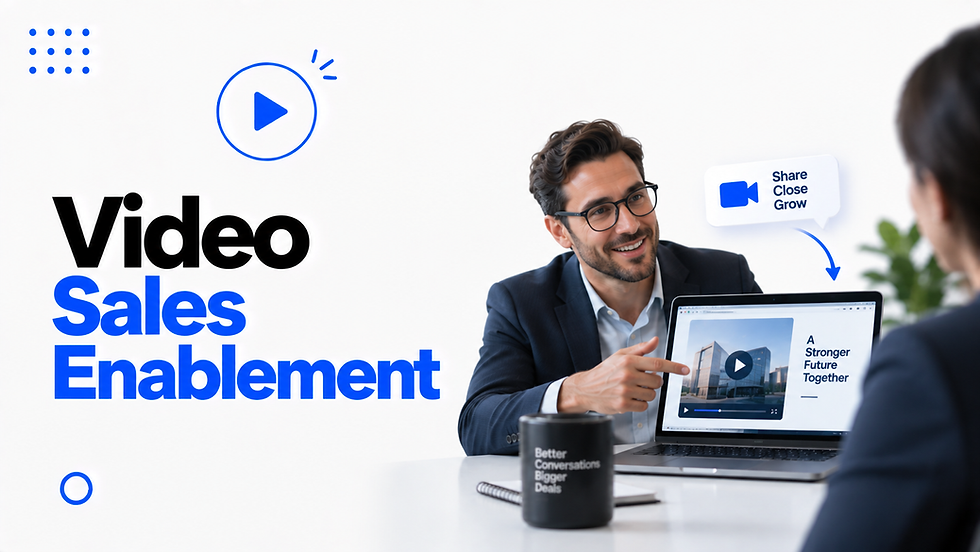
Playbook three for sales enablement
Audience decision: Help an active buying group resolve a specific objection or confirm practical fit.
Asset sequence: Record customer evidence, product demonstrations, comparison explanations, and short objection-handling clips. Store approved versions with buyer-role labels, product versions, regional requirements, and CRM links.
Measurement checkpoint: Track usage by sales representatives, viewer engagement within opportunities, stage progression, and feedback from account teams. Review whether the videos change the quality or speed of sales conversations.
Next action: Retire clips that sales doesn't use, update proof that prospects question, and create new versions only where a recurring objection justifies the investment.
A focused 90-day sequence
Audit: Inventory existing video, ownership, versions, distribution, and CRM connections.
Prioritize: Choose one revenue-critical use case instead of launching a broad content overhaul.
Systematize: Create a reusable brief, capture plan, version matrix, approval route, and measurement definition.
Test: Run one controlled channel and creative experiment with a documented comparison group where practical.
Scale: Increase investment only after pipeline and incrementality signals are credible.
The objective isn't more views. It's a repeatable influence on qualified buying journeys, with enough operational clarity to know what to make next.

Busylike helps B2B marketing teams connect strategy, branded video production, paid distribution, and channel optimization across YouTube, CTV, and social. Visit Busylike to discuss a video operating system built around your priority audience, sales motion, and pipeline evidence.