
Global Content Marketing: Build a Scalable Video Strategy

Companies with documented content marketing strategies are 313% more likely to report success. Global content marketing therefore requires systematic execution, not a scattered collection of local campaigns, translated assets, and disconnected media buys.
That conclusion is counterintuitive for teams that still treat video as the expensive expression of a strategy designed in text. The stronger operating model runs in the opposite direction: audience insight shapes a creative system, that system produces adaptable video, and paid distribution gives each market enough reach to generate useful performance data. Content becomes a managed media asset, not a finished file waiting for someone to publish it.
The commercial stakes are substantial. One industry estimate places global content marketing revenue at more than $107 billion in 2026, compared with $36.8 billion in 2018, implying a 14.3% compound annual growth rate across that period (Ringly's content marketing statistics). At that scale, global brands compete for production talent, channel attention, and investment with paid media teams. A workable program must connect creative production, localization, distribution, and measurement from the start.
Table of Contents
Why Global Content Marketing Requires a Video-First Architecture - Video changes the operating model
Building Your Global Video Strategy from Audience Insights - Phase one maps the audience - Phase two selects topics with local permission - Phase three designs the production system - Phase four gives markets authority within guardrails
Production Models for Different Market Types and Budgets - Centralized production - Regional hubs - Hyper-local production
Distributing Video Content Across YouTube CTV and Social Channels - YouTube supports the searchable library - CTV requires a media-first creative brief - Social channels reward adaptation
Measuring Global Content Performance with Actionable KPIs - Separate objectives before selecting KPIs - Build an attribution chain
Organizational Governance for Scalable Global Programs - Make the workflow visible
Budget Benchmarks and Implementation Roadmaps for Global Programs - Budget by operating layer - A staged implementation plan
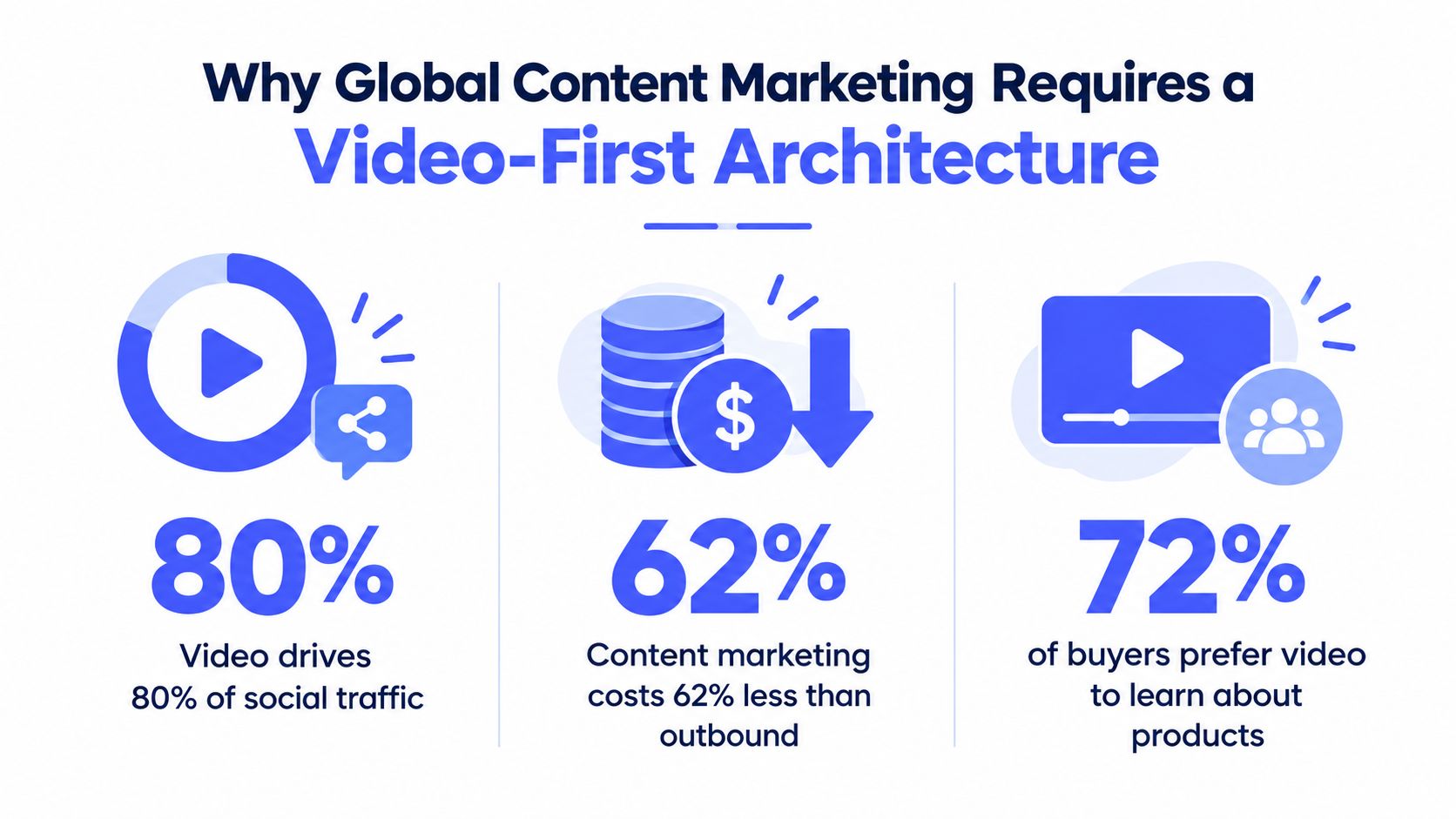
Why Global Content Marketing Requires a Video-First Architecture
Companies with documented strategies are 313% more likely to report success, according to the Content Marketing Institute's strategy benchmarks. Documentation matters because global execution creates dependencies that informal planning can't handle. A campaign brief affects scripts, casting, translations, subtitles, media placements, landing pages, approvals, and reporting across markets.
Video exposes those dependencies quickly. A translated article can often be revised without reshooting. A video may require new narration, on-screen text, talent direction, music clearance, edit versions, aspect ratios, and cultural review. If the team creates the master asset without planning those variables, local adaptation becomes a late-stage compromise.
Video changes the operating model
Short-form video is used by over 60% of companies and is reported by HubSpot as the most widely used format, while blog posts remain among the top five highest-ROI formats (HubSpot's marketing trends report). That doesn't make written content obsolete. It means the global content marketing system needs a video layer that can carry a core idea across social feeds, YouTube, connected television, product pages, email, and sales enablement.
The practical unit of production shouldn't be one finished video. It should be a creative package containing:
A central narrative: The proposition, proof, emotional direction, and intended audience action.
Modular scenes: Footage that can be reordered or removed without breaking the story.
Language-ready elements: Clean plates, separated graphics, subtitle files, and adaptable voice tracks.
Platform versions: Edits suited to feed viewing, long-form viewing, connected television, and landing-page use.
Distribution instructions: Audience, objective, placement, budget role, and measurement requirements.
John Deere's The Furrow, first published in 1895, is one of the most cited examples of useful branded publishing predating digital marketing by more than a century. HubSpot's founding in 2006 helped formalize inbound marketing, and by 2016, 88% of B2B marketers were using content marketing, as documented in this history of content marketing. The lesson is consistent across formats: brands earn attention by helping a defined audience, then build a repeatable system around that value.
Practical rule: Local teams should adapt the meaning, not merely replace the words.
A useful primer on how brands can engage audiences with branded content can help creative and marketing teams align on the role of content before production begins. The strongest global programs treat brand consistency and local relevance as design requirements that must be solved together.
Building Your Global Video Strategy from Audience Insights
Global production should begin with market evidence, not a request for “more videos.” The same product may require education in one region, reassurance in another, and a direct comparison elsewhere. A shared brand platform can support all three, but the audience problem comes first.
Phase one maps the audience
Create a market-by-market audience map before writing scripts. Include the buyer's job, category knowledge, purchase barriers, trusted sources, viewing behavior, language preferences, and the action that signals progress. Don't rely on headquarters' assumptions about local behavior. Ask market teams, salespeople, customer support staff, and local partners what buyers actually misunderstand.
Then map the journey by decision stage:
Discovery: What problem does the viewer recognize, and what language do they use to describe it?
Evaluation: What proof, demonstration, comparison, or expert perspective reduces uncertainty?
Conversion: What information does the viewer need before requesting a demo, starting a trial, or speaking with sales?
Retention: Which education or customer stories help users adopt the product and stay engaged?
Phase two selects topics with local permission
Choose topics that combine high business intent with a clear audience need. A central team can define the commercial territory, while local specialists identify the examples, objections, references, and vocabulary that make that territory credible.
Don't localize every idea equally. Prioritize durable subjects that can support several formats and markets, then reserve local production for issues that depend on culture, regulation, customer language, or market maturity. A product demonstration might travel well with new narration. A humor-led campaign may need a new concept entirely.
Phase three designs the production system
Build a content brief that separates fixed elements from adaptable ones. Fixed elements may include the product truth, visual identity, legal language, and brand promise. Adaptable elements may include the opening hook, talent, setting, examples, voice, captions, and call to action.
A production manager should maintain a version matrix covering:
Source and target languages
Voiceover, subtitles, or both
Aspect ratio and runtime requirements
Market-specific claims and approvals
Talent, music, and usage rights
Paid and owned distribution destinations
Local review owners and deadlines
This prevents the common failure mode of asking editors to discover localization requirements after the master has been approved.
Phase four gives markets authority within guardrails
Governance should define what local teams can change without central approval. Give them control over examples, casting, local references, channel selection, and opening sequences when those choices affect relevance. Keep central control over brand identity, product claims, legal risk, core visual standards, and measurement definitions.
Run a review with local stakeholders before filming, not after editing. A short pre-production decision can prevent a costly reshoot and also gives market teams ownership of the result. The strategy scales when local teams contribute intelligence early, while the central team protects the parts of the brand that must remain recognizable everywhere.
Production Models for Different Market Types and Budgets
There isn't one correct global production structure. The right model depends on how much local difference the audience requires, how quickly the brand needs to publish, and where creative expertise already exists.
Production model | Best fit | Main advantage | Main risk |
|---|---|---|---|
Centralized | A tightly controlled brand with similar market needs | Consistent creative direction and efficient reuse | Local teams may receive assets that feel imported |
Regional hub | Markets with shared language, culture, or commercial conditions | A balance between scale and local judgment | Regional priorities can conflict with central standards |
Hyper-local | Markets where trust, regulation, or cultural nuance drives response | Maximum relevance and market ownership | Fragmented identity, duplicated work, and uneven quality |
Centralized production
A centralized model keeps strategy, creative direction, filming, post-production, and asset management with one core team. It suits a brand that has a strong global identity and can create footage designed for adaptation. The production brief must anticipate localization, including clean backgrounds, flexible graphics, alternative takes, and separated audio elements.
This approach usually gives the central team better control over quality and rights. It can also slow decisions when local reviewers work across time zones or lack authority. A central producer should therefore establish clear review windows and escalation rules before the first shoot.
Regional hubs
Regional hubs place producers and creative leads closer to the audiences they serve. The central team supplies the campaign platform, brand rules, production templates, and shared assets. Regional teams interpret the concept, select local talent, and decide which parts need transcreation rather than translation.
This is often the most practical compromise for an established global program. It avoids asking one headquarters team to understand every market while preserving enough structure to reuse footage, workflows, and reporting standards. The hub still needs a shared asset library and common naming conventions. Without those, regional autonomy becomes duplicated effort.
Hyper-local production
Hyper-local teams control the creative from brief to publication. This model makes sense when the product, audience, or regulatory environment differs sharply between markets. It also works when local creators have stronger credibility than corporate talent.
The trade-off is operational complexity. Every market may choose different production partners, visual styles, approval practices, and measurement definitions. Central governance must provide brand templates, legal review, rights management, and a minimum reporting standard. Teams comparing workflows can use this practical overview of digital video production to clarify where planning, filming, editing, and delivery responsibilities sit.
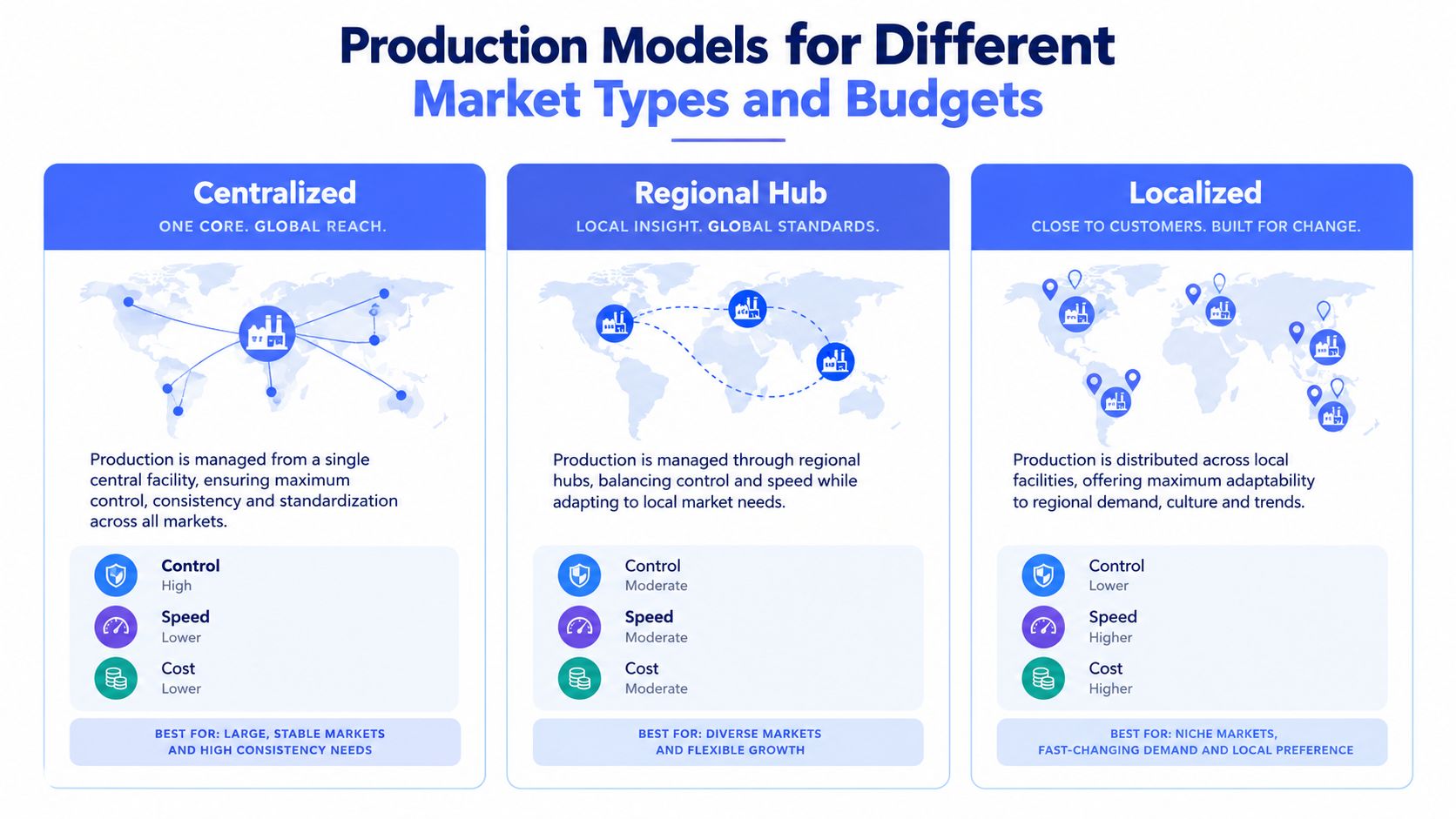
Choose the model by asset type rather than forcing the whole organization into one structure. A central brand film, regional product education, and local creator content can coexist when decision rights and handoffs are explicit.
Distributing Video Content Across YouTube CTV and Social Channels
Production doesn't create demand by itself. Distribution turns a finished asset into a controlled audience experiment, and each channel requires a different version of the creative and a different definition of success.
YouTube supports the searchable library
YouTube should function as both a channel and a content archive. Organize videos around audience problems, product categories, use cases, and buyer stages. A viewer who discovers one product explanation should find a logical next video, not an unrelated campaign.
Use descriptive titles, accurate transcripts, useful descriptions, chapters where appropriate, and thumbnail systems that distinguish series without creating visual clutter. Build playlists around decisions rather than internal departments. Paid promotion can introduce a new audience to the channel, while organic search and recommendations can extend the useful life of durable content.
Localize more than subtitles. Review search language, thumbnail conventions, presenters, examples, and calls to action in each market. A literal translation may be linguistically correct but still fail to match the way local buyers frame the problem.
CTV requires a media-first creative brief
Connected television placements demand stronger attention to the viewing environment. The viewer may be watching from a distance, sharing the screen with others, or encountering the message without immediate access to a clickable action. Creative should establish the brand and proposition clearly, then use a memorable proof point or simple next step.
Plan CTV with audience definitions, inventory quality, frequency controls, geography, and brand-safety requirements. Measure the role of the placement against the objective. A brand-building flight may prioritize qualified reach and completed viewing, while a consideration program may connect exposure with branded search, site visits, or later conversion behavior.
Social channels reward adaptation
Social distribution needs native editing, not just a resized master. Rework the opening for the feed, keep important information legible without sound, and give each platform a reason to exist in the story. One cut can establish the problem, another can demonstrate the product, and a third can answer an objection.
Paid amplification should follow evidence. Start with a controlled audience and a clear creative hypothesis, then promote the versions that earn meaningful attention or downstream action. Creator partnerships can add local credibility, but contracts should define usage rights, disclosure requirements, revision processes, and whether the brand can use the content beyond the creator's own channel.
A global campaign can share one idea without sharing one edit.
Budget allocation should follow market maturity and audience behavior rather than a fixed global split. A market with a strong owned audience may need more investment in channel programming and less in awareness distribution. A new market may need paid reach before organic signals become useful. The operational details in this guide to video distribution can help teams define those channel handoffs.
Measuring Global Content Performance with Actionable KPIs
Global measurement fails when every market reports a different version of success. One team celebrates views, another reports watch time, and a third claims credit for pipeline without showing how the content influenced the buyer. A useful measurement system starts with the business action and works backward to the creative signal.
Reported B2B practice places conversions at 73%, email engagement at 71%, website traffic at 71%, website engagement at 69%, and social analytics at 65% among commonly used content success metrics (WebFX's content marketing statistics). The hierarchy matters because it moves the conversation beyond exposure. Views can diagnose distribution, but conversions and meaningful site behavior help explain commercial value.
Separate objectives before selecting KPIs
Brand-building video and conversion-oriented video shouldn't share an identical scorecard. For brand work, review qualified reach, completed viewing, attention patterns, audience composition, search behavior, and direct feedback. For demand work, connect the asset to landing-page engagement, form activity, assisted conversions, sales conversations, and revenue influence where the data supports that connection.
Use a common global definition for each metric, then allow local teams to add market-specific signals. “Qualified view” should mean the same thing in every dashboard. “Conversion” should identify the action and the relevant time window. Without those definitions, apparent market differences may reflect reporting practices rather than audience response.
Build an attribution chain
Video rarely receives the final click after creating interest. A viewer may watch a product explanation, return through branded search, read a comparison page, and convert through an email link. Your reporting should preserve those interactions instead of assigning all value to the last touchpoint.
A practical chain connects:
Exposure: Which audience received the creative, through which channel and market?
Engagement: Did viewers watch enough to encounter the proposition or proof?
Response: Did they visit, search, subscribe, download, request contact, or return?
Commercial movement: Did the account enter a qualified process or progress toward purchase?
Reuse potential: Can the asset, scene, hook, or message serve another market or funnel stage?
Review creative and media together. A weak completion rate may reflect the opening, placement, audience, or duration. Teams refining paid social can use guidance on how to optimize Meta ad completion, but the metric should still be interpreted alongside business actions rather than treated as the outcome itself.
Organizational Governance for Scalable Global Programs
Global video programs need decision rights as much as they need creative talent. Without them, central teams approve every caption and local teams bypass the process to meet market deadlines. Both responses create waste.

A workable structure uses a central enablement team, regional market owners, and cross-functional review partners. The central group owns the brand platform, production standards, templates, rights framework, core analytics, and shared technology. Regional owners provide audience intelligence, local creative judgment, channel decisions, and market feedback. Legal, product, sales, and media specialists join at defined approval points instead of reviewing every asset without context.
Make the workflow visible
Use a content management system or digital asset management platform with one record for each asset and its variants. Store the source file, subtitles, voice tracks, thumbnail, usage rights, market status, campaign association, and performance notes together. A team considering asset taxonomy and retrieval can reference this guide to manage video assets when designing its workflow.
Set approval gates around the decisions that carry risk:
Brief approval: Audience, objective, proposition, and market scope.
Script approval: Claims, narrative, cultural references, and adaptation plan.
Rough-cut review: Story clarity, brand fit, legal concerns, and local relevance.
Final delivery: Technical specifications, rights, metadata, and distribution destinations.
Performance review: Results, learnings, reuse decisions, and retirement status.
Technology should remove handoff friction, not replace judgment. Connect the asset library with localization workflows, channel publishing tools, paid media platforms, and analytics where practical. Keep a terminology glossary and visual rule set available to every contributor. Local teams can move quickly when they know which decisions are theirs and which require escalation.
The operating principle is simple: centralize what benefits from consistency, and distribute what depends on local knowledge.
Budget Benchmarks and Implementation Roadmaps for Global Programs
A responsible global budget doesn't begin with a universal production figure. It begins with the markets, asset types, distribution role, localization depth, rights requirements, and internal capability the program needs. A brand film, a library of product explainers, and a creator-led social system have different cost structures, even when they support the same campaign.
Budget by operating layer
Build the budget in separate lines so leaders can see what the program is buying:
Strategy and research: Audience interviews, market analysis, content architecture, creative development, and measurement planning.
Production: Pre-production, crew, locations, talent, equipment, direction, and post-production.
Localization: Transcreation, voiceover, subtitles, graphics, cultural review, and market-specific legal approval.
Distribution: YouTube promotion, CTV placements, paid social, creator usage, and testing.
Operations: Asset management, workflow tools, analytics, rights tracking, and ongoing channel management.
Optimization: Editing new openings, refreshing thumbnails, adapting winners, and reallocating media based on evidence.
Don't hide distribution inside production. A beautifully produced asset without a route to its intended audience is an incomplete investment. Conversely, paid reach can't rescue a message that local buyers don't understand or trust.
A staged implementation plan
Start with an alignment phase. Select priority markets, define the audience and commercial objectives, audit existing assets, document brand guardrails, and decide which production model fits each market type. Secure local reviewers before the creative brief is approved.
Move into a pilot phase with a small set of connected assets rather than a single hero video. Produce a core narrative, modular cutdowns, platform versions, and localization-ready files. Launch through selected owned and paid channels, then collect market feedback alongside performance data.
Use the optimization phase to identify what deserves more investment. Repurpose strong scenes, hooks, demonstrations, and customer questions into new edits or formats. The practical aim is to turn one asset into many without making every adaptation feel identical.
A durable program establishes a recurring review rhythm. Creative, media, channel, sales, and local market owners should examine the same evidence, decide what to scale, and retire assets that no longer serve an audience or business objective. That discipline creates the compounding value of global content marketing. The organization learns which ideas travel, which require transcreation, and where paid distribution adds the most useful signal.
Busylike helps brands plan, produce, and manage video across YouTube, CTV, and social, combining creative production with paid video advertising and channel optimization. Visit Busylike to discuss a global video operating model built around audience insight, local adaptation, and measurable distribution.