
Commercial Video Production NYC: A Practical 2026 Guide

A director calls action outside a 6th Avenue storefront while the media buyer watches playback on a tablet. The client likes the hero shot, but the buyer is already asking for a tighter opening for YouTube, a cleaner frame for CTV, and a vertical version that leaves room for captions on Instagram and TikTok.
That scene captures the current reality of commercial video production in NYC. The shoot isn't the finished product. It's the source material for a distribution system that has to work across paid social, YouTube, connected TV, LinkedIn, and the brand's own channels.
A polished film can still underperform if it has no usable cutdowns, weak first frames, poor caption space, or a master that fails a platform's technical checks. The strongest NYC productions plan those requirements before the first setup, then capture enough deliberate coverage to create a practical library of assets.
Table of Contents
What Commercial Video Production Actually Delivers - The core asset family - Who makes the work happen
NYC Logistics, Permits, and Crew Depth - The operational checklist - Logistics at a glance
Budgets, Pricing Models, and What ROI Actually Looks Like - Three useful pricing structures - Budget tiers and outputs
Timelines, Specs, and Platform-Ready Deliverables - Build the delivery matrix early
How to Choose the Right NYC Production Partner - Questions worth asking - Red flags in a bid
Case Study Lessons and Your Next Steps - A practical launch checklist
Why NYC Commercial Shoots Are Built for Distribution First
A single hero spot rarely does every job. YouTube pre-roll needs an immediate hook, CTV often needs a broadcast-style finish, TikTok and Reels need vertical framing and fast visual movement, while LinkedIn may need a clearer business context and readable captions. The same campaign can require different openings, runtimes, aspect ratios, calls to action, and sound treatments.
That changes the producer's responsibility. The question isn't “What should we shoot?” It's “What must this shoot make possible across every channel?” A production brief should identify the hero concept, the required cutdowns, the placements, the audience action, and the footage needed to support testing.
New York is well suited to this model because it combines agency talent, experienced crews, varied locations, and post-production specialists within a dense production market. The city's film and television industry supported approximately 185,000 total jobs, $18.1 billion in wages, and $81.6 billion in economic output in 2019, according to the New York City film and television industry study. That depth gives brands access to directors, cinematographers, stylists, editors, colorists, sound teams, and production vendors without building every capability internally.
The production market is mature, but it isn't insulated from volatility. New York's broader creative economy employed an estimated 274,000 people across creative industries in 2022, and reached 326,093 people in 2024, while the film and television sector has also experienced employment declines after earlier growth, as documented in the New York City Comptroller's creative economy report.
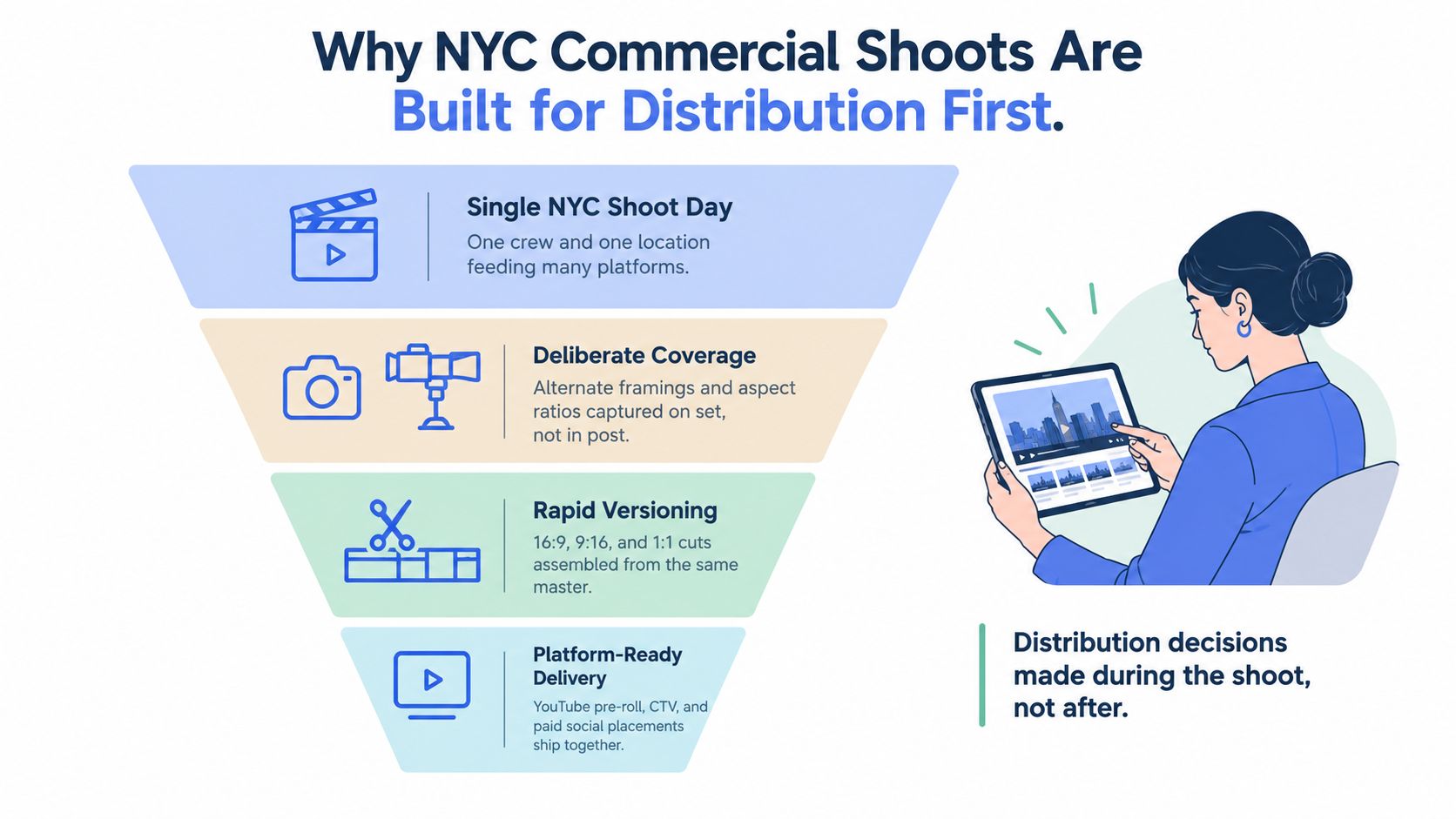
The practical implication is simple. Plan one production day as the input for a family of assets, not as the purchase of one master file. A useful distribution plan might include a hero film, several short pre-rolls, vertical edits, square product sequences, still frames, captioned versions, and clean B-roll for future campaigns.
Teams that need a deeper framework for connecting the shoot to channel planning can use this guide to build a practical video distribution system. Distribution decisions should happen while the crew is still on set, when an alternate angle or clean product shot costs far less than a reshoot.
What Commercial Video Production Actually Delivers
The deliverable stack starts with the hero spot, usually the most complete expression of the campaign idea. It carries the main narrative, strongest production value, and central brand message. But it shouldn't stand alone.
A capable production plan turns the hero into a set of purpose-built edits. A 15-second cut can carry a direct-response message. A shorter bumper can establish recognition quickly. A vertical edit can use a closer crop, different caption placement, and a faster opening. A square version can work in feeds where the viewer sees less horizontal space.
The core asset family
Deliverable | Format and length | Primary placement |
|---|---|---|
Hero spot | 16:9, long-form campaign master | YouTube, brand site, sales presentations |
Short pre-roll | 16:9, concise cutdown | YouTube and paid video |
Bumper edit | Short, single-message version | CTV and digital video placements |
Vertical cut | 9:16, caption-safe framing | TikTok, Instagram Reels, YouTube Shorts |
Square edit | 1:1 product or message-led version | Social feeds and paid placements |
Creator-style edit | Vertical or square, conversational treatment | Paid social and organic social |
B-roll library | Clean product, people, environment, and detail shots | Future edits, social posts, landing pages |
Stills and frame grabs | Selected campaign frames | Display, social, email, and web |
The exact mix depends on the media plan. A brand buying CTV needs a compliant master. A B2B company may need more interview fragments, proof points, and LinkedIn-ready edits. A consumer brand may need more product closeups, reaction shots, demonstrations, and creator-style versions.
A useful production scope also includes raw selects, project files where appropriate, sound design stems, music information, storyboards, and caption files. These materials protect the campaign's future usefulness. They let an internal team or post-production partner create new versions without reopening the entire project.
Who makes the work happen
The executive producer protects the creative and commercial scope. The line producer manages the practical reality, including crew, locations, schedules, insurance, vendors, and transport. The director shapes performance and visual storytelling, while the director of photography controls the camera, lenses, lighting, and visual consistency.
A gaffer builds and manages the lighting plan. A sound mixer protects dialogue and production audio. Stylists, hair and makeup artists, production designers, and assistants support the specific needs of the brand and location. NYC freelancers and union members may fill these roles depending on the project's scale, client requirements, and working conditions.
Practical rule: If a partner only discusses the hero film, ask who owns the cutdown plan, captions, aspect ratios, and final delivery matrix.
The production company isn't only selling crew time. Its strategic role is to design coverage that gives the editor enough options to create useful variations. Guidance on how to create marketing videos that convert is useful at this stage because the creative idea, audience action, and edit structure need to align before the shoot.
For brands considering animated extensions, the same modular logic applies to animated advertising videos. Motion graphics can clarify a product benefit, create a clean end card, or turn one live-action scene into multiple message variants.
NYC Logistics, Permits, and Crew Depth
The city rewards preparation and punishes assumptions. An exterior shoot may involve location permissions, insurance certificates, traffic considerations, parking, police coordination, property owners, and weather contingencies. A producer who treats those items as paperwork to solve later can turn a simple storefront scene into a delayed or compromised setup.
Exterior requirements vary by location and scope. Interior locations often avoid a city filming permit, but they still require written landlord or property-owner consent, production insurance, access windows, elevator coordination, and rules for power, noise, load-in, and restoration.
The operational checklist
Confirm the location authority: Determine whether the site involves city property, Parks space, a private owner, or another managing entity.
Secure insurance documentation: Make sure the production's certificate matches the venue, landlord, agency, and any public authority requirements.
Plan street impact: Account for pedestrian flow, parking, equipment footprint, base camp, cable paths, and public access.
Build a weather backup: A rain plan may mean a second location, an interior insert schedule, or a flexible shooting order.
Protect the schedule: Group nearby setups and avoid crossing the city unnecessarily between locations.
New York's crew base is one of the city's strongest practical advantages. Producers can draw from experienced grip and electric teams, drivers, directors, camera departments, sound professionals, stylists, and post-production specialists. Union requirements may affect staffing, working hours, meal arrangements, transportation, and overtime exposure, while non-union crews can offer a different cost and scheduling structure.
The right choice depends on the client, agency requirements, risk tolerance, and distribution stakes. A small product shoot may need a compact crew and controlled studio. A high-visibility street campaign may justify more thorough coordination because the cost of disruption is greater than the cost of preparation.
Logistics at a glance
Logistics item | Typical requirement | Planning lead time |
|---|---|---|
Exterior city location | Permission, insurance, location approval, public-impact planning | Start early, before the location is promised |
Private interior | Owner consent, insurance, access and restoration terms | Confirm during location negotiation |
Street production | Parking, equipment footprint, pedestrian and traffic coordination | Resolve before the call sheet |
Studio production | Stage availability, load-in rules, power, grip, art department access | Hold the stage before booking crew |
Union or mixed crew | Applicable agreements, staffing, hours, meals, transport | Confirm during budgeting |
Weather-sensitive work | Backup location or alternate shooting order | Build into the initial schedule |
New York also offers public support for qualified commercial work. The state allocates $7 million per year for incentives encouraging eligible production companies to make commercials in New York State, divided among downstate production, upstate production, and incremental commercial growth incentives, as described in the New York State commercial production incentive information.
That incentive doesn't remove the need for a detailed budget. It does show why the city remains operationally viable across lean, mid-market, and larger brand productions.
Budgets, Pricing Models, and What ROI Actually Looks Like
A NYC commercial budget is a collection of decisions, not a fixed market price. The largest variables are usually shoot duration, crew size, talent, location complexity, studio use, production design, camera and lighting requirements, visual effects, music licensing, insurance, travel, and post-production volume.
A lean digital campaign may prioritize one controlled location, a compact crew, limited talent, and efficient coverage. A larger CTV campaign may add multiple locations, union talent, art direction, higher-end finishing, motion graphics, and more extensive versioning. Neither approach is automatically better. The correct scope is the one that supports the intended distribution and business outcome.
Three useful pricing structures
Day-rate pricing works when the scope is clear and the client mainly needs a defined crew or production service. It can be efficient, but it may leave post-production, revisions, licensing, and versioning outside the initial figure.
Project-fee pricing packages pre-production, production, and post into a single scope. This makes comparison easier, provided the estimate clearly states the number of shoot days, deliverables, revision rounds, usage rights, and exclusions.
Retainer pricing suits brands producing a continuing stream of assets. It can reduce repeated onboarding and encourage a consistent content system, but only if the monthly scope defines capacity, turnaround, approvals, and unused production time.
The most common budgeting mistake is putting nearly everything into the shoot and leaving too little for distribution. Editing, captions, motion graphics, audio finishing, media versions, landing-page creative, paid placement, and performance review all affect whether the footage earns its keep.
Wistia's reporting shows a split market rather than one universal spending pattern. Forty percent of companies expected to spend more on video, while 46% planned to keep budgets flat. Fifty-three percent planned to spend $5,000 or less on projects, while 20% planned to spend $15,000 or more, according to Wistia's video marketing statistics.
Budget tiers and outputs
Tier | Budget range | Crew size | Shoot days | Typical deliverables | Best fit |
|---|---|---|---|---|---|
Lean digital production | Defined by a focused scope | Compact crew | Short, concentrated schedule | Hero edit, cutdowns, social versions | Startups, product launches, targeted paid media |
Mid-market campaign | Defined by talent, locations, and post needs | Expanded crew | One or more production days | Hero, platform versions, motion graphics, stills | Established B2B and B2C campaigns |
Fully produced campaign | Defined by scale and distribution requirements | Large production team | Multi-day or complex schedule | CTV master, hero film, extensive cutdowns, finishing assets | National campaigns and major brand launches |
ROI should be tied to the job of the asset. A hero film may support consideration and brand memory. A product demonstration may support qualified demand. A short paid edit may be judged by views, engagement, leads, clicks, or acquisition efficiency.
The latest industry reporting cited in the brief identifies views as the top KPI for 67% of video marketers, followed by engagement and leads or clicks, while also emphasizing that retention and platform fit matter more than raw impressions alone. The lesson is not to reject reach metrics. It's to pair them with the action the campaign needs.
Budget discipline: A more expensive production doesn't guarantee a stronger result. A well-structured shoot with enough versioning and distribution support can outperform a visually larger production that delivers only one difficult-to-use master.
Plan the publishing layer before approving the production scope. A team may also need to evaluate API publishing plan costs when it manages a recurring schedule across multiple channels. The production budget and publishing workflow should support each other, rather than treating distribution as an afterthought.
Timelines, Specs, and Platform-Ready Deliverables
A realistic commercial production schedule starts before the crew arrives. Pre-production covers the brief, script, storyboard, casting, location, wardrobe, production design, permits, technical tests, shot list, and delivery matrix. A compact project may move quickly, while a larger campaign needs more time for approvals and coordination.
A useful working sequence looks like this:
Pre-production: Lock the audience, message hierarchy, hero concept, cutdowns, platforms, talent, locations, and approval owners.
Shoot days: Capture the hero action, alternate framings, clean plates, product details, reaction shots, room tone, and material for vertical versions.
Rough cut and review: Review the main narrative first, then assess whether the coverage supports the required variants.
Final delivery and versioning: Complete color, sound, captions, graphics, legal checks, exports, and platform-specific files.
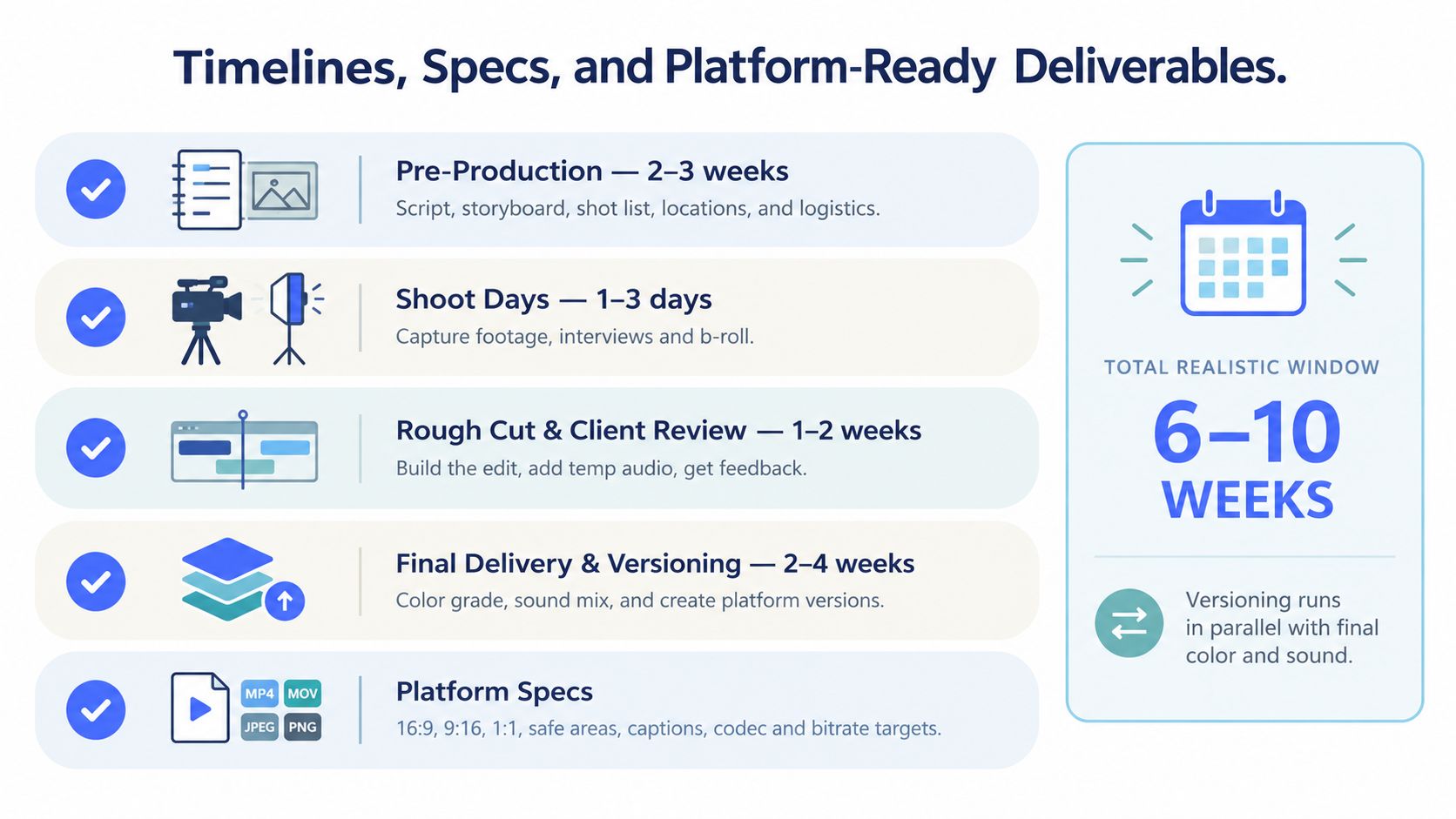
Technical compliance needs to enter the conversation during pre-production. CTV buyers commonly require 16:9 assets at 1920×1080 or 1280×720, H.264 or MP4, progressive scan, constant frame rate, and 15- or 30-second runtimes. Loudness is typically around -24 LUFS, with peak audio near -6 dB, according to Paramount's advertising technical specifications.
Those requirements aren't merely export preferences. A noncompliant master can be rejected before trafficking, which creates avoidable rework when the campaign is already under deadline.
Build the delivery matrix early
YouTube: Prepare 16:9 masters, shorter pre-roll edits, captions, clear opening frames, and end cards.
CTV: Confirm runtime, codec, frame rate, audio, bitrate, and trafficking requirements with the buyer.
LinkedIn: Prioritize readable captions, business context, and a clear opening message.
Instagram: Create vertical and feed-friendly versions with protected text and product framing.
TikTok: Use an immediate hook, native-feeling pacing, and a vertical composition that works without relying on tiny text.
Owned channels: Supply a high-quality master, caption files, thumbnails, stills, and an embed-ready version.
Higher-resolution masters can preserve detail, but delivery files still need platform-specific encoding. Adobe's advertising DSP ad specifications discusses 1080p workflows and bitrate considerations for programmatic and CTV environments. Teams comparing finishing options should also understand video bitrate settings for 4K, especially when a high-quality mezzanine master will generate several downstream files.
Don't export one 30-second file and send it everywhere. That approach ignores framing, hook structure, caption placement, audio behavior, and buyer requirements. Finish a high-quality master, then create the versions each placement needs.
How to Choose the Right NYC Production Partner
The central choice is between a strategic production partner and a crew-for-hire vendor. Both can be appropriate. A crew-for-hire team may be ideal when an agency already owns the creative, media plan, post workflow, and approvals. A strategic partner is more useful when the client needs help connecting audience insight, production, versioning, and channel performance.
The portfolio needs more scrutiny than visual polish. Ask whether the partner has made work for the channels you plan to use, whether its edits show platform awareness, and whether it can provide examples of campaigns with multiple outputs. A beautiful reel doesn't prove that the team can manage a complex delivery matrix.
Questions worth asking
How many versions are included in the proposed scope?
Which aspect ratios will the crew plan for on set?
Who owns the masters, project files, raw selects, and caption files?
How are revisions defined and priced?
Who handles permits, insurance, releases, and location agreements?
What happens if rain, illness, location access, or equipment failure disrupts the schedule?
Who leads post-production after the shoot?
Can the team deliver platform-specific audio and video exports?
How does the partner coordinate with the media buyer?
What does the estimate exclude?
The producer's tenure matters because NYC logistics reward familiarity. Ask whether the team regularly works with city permitting processes, experienced local crew, union requirements, location owners, and the practical realities of moving equipment through Manhattan or Brooklyn.
Red flags in a bid
A suspiciously low total: The estimate omits permits, insurance, location costs, post-production, licensing, or versioning.
No post lead: Nobody can explain who will manage the edit, sound, color, graphics, captions, and exports.
One creative route only: The partner can't explain how the concept will adapt to different audiences or placements.
No work-in-progress review: The client sees the project only at the final delivery stage.
Unclear ownership: The contract doesn't specify access to masters, selects, or source materials.
A boutique shop may suit a focused product film, founder-led brand, or compact content day. A mid-size partner may provide more reliable coverage across production and post without the overhead of a large commercial operation. A full-service agency makes sense when the campaign needs creative strategy, production, paid distribution, channel management, and ongoing optimization.
The best decision framework is not “Who makes the most cinematic work?” It's “Who can own the parts of the campaign we don't want to coordinate ourselves?” A team comparing options can use this guide to evaluate a video production agency against the actual demands of the brief.
Case Study Lessons and Your Next Steps
Consider a representative D2C skincare campaign planned around a Brooklyn studio. The brand develops one hero concept built around product texture, application, and a clear benefit. Instead of treating the hero as the sole deliverable, the team designs the shoot around a group of platform-specific edits.
The production captures wide product scenes, close details, hands-in-frame demonstrations, clean pack shots, creator-style reactions, and alternate openings. The editor can then build a YouTube pre-roll, a CTV bumper, vertical Reels and TikTok edits, and a square product sequence without forcing one composition into every placement.
The example is useful because the value comes from the coverage plan, not only from the studio, camera package, or finished grade. The product closeup can support a square feed asset. The demonstration can become a short vertical edit. The hero narrative can remain intact for the brand site while paid media receives faster versions with earlier product visibility.
The media and creative teams should agree on the measurement plan before launch. Views may matter for reach, but the campaign can also examine engagement, view-through behavior, leads, clicks, assisted conversions, or acquisition efficiency, depending on the funnel stage. The production team can't guarantee those outcomes, but it can make the assets easier to test.
A practical launch checklist
Define the hero and cutdowns: Put every required asset in the brief before booking the location.
Lock distribution specs: Confirm aspect ratios, runtimes, captions, codecs, audio, and safe areas early.
Capture alternate coverage: Shoot vertical-friendly angles and clean product details rather than relying on post-production crops.
Build a versioning matrix: Map each file to its channel, audience, message, call to action, and approval owner.
Review performance after launch: Schedule a structured creative review so the team can identify which hooks and formats deserve more investment.
Choose for multi-format experience: Select a partner that can show how one production became a useful set of channel assets.
A modular system also makes future content planning more efficient. The same shoot can supply short organic posts, paid tests, landing-page clips, sales enablement material, and later refreshes, provided the contract and asset ownership support those uses.
For a marketing lead planning a NYC campaign, the immediate next step is to write the distribution matrix before requesting bids. List the channels, placements, runtimes, ratios, messages, approvals, and success measures. Then ask each production partner to price the shoot around that system, not around a single hero file.
Busylike combines creative production, paid video advertising, and channel management for brands building campaigns across YouTube, CTV, and social. If you need a NYC production partner that can connect modular shoots with distribution and optimization, visit Busylike and discuss the campaign you're planning.