
Animated Advertising Videos: The Complete Guide

Most advice on animated advertising videos is lazy. It treats animation like an automatic upgrade over static and a cheaper substitute for live-action. That's the wrong decision model.
Animation is a creative variable, not a default best practice. Sometimes it sharpens the message, improves recall, and makes versioning easier. Sometimes it adds cost, visual noise, and zero measurable lift. If your team treats “make it animated” as the brief instead of a strategic choice, you'll spend production budget solving the wrong problem.
Table of Contents
Why Animated Advertising Videos Deserve a Harder Look - When animation actually earns the budget - Where animation gets overprescribed - The right operating model
The Main Animation Formats and When to Use Each - The five formats that matter - What each format does well - Two styles teams misuse constantly - A fast shortlist before the brief
Animation Versus Live-Action and Static Creative - The practical comparison - What animation actually beats - Where live-action still dominates - Build campaigns with all three
Production Workflow, Timelines, and Budget Ranges - The six stages that matter - The timeline most teams should expect - Where money typically goes
Adapting Animation for YouTube, CTV, and Paid Social - YouTube needs frame-one intent - CTV rewards restraint - Paid social is a different editing language
Measuring What Animated Creative Actually Delivers - Tier one measures delivery quality - Tier two checks whether the message stuck - The hard truth about motion and lift - Tier three ties creative to business impact
Sequencing Animation to Beat Fatigue Across a Campaign - A practical sequencing model - How to plan for fatigue before launch
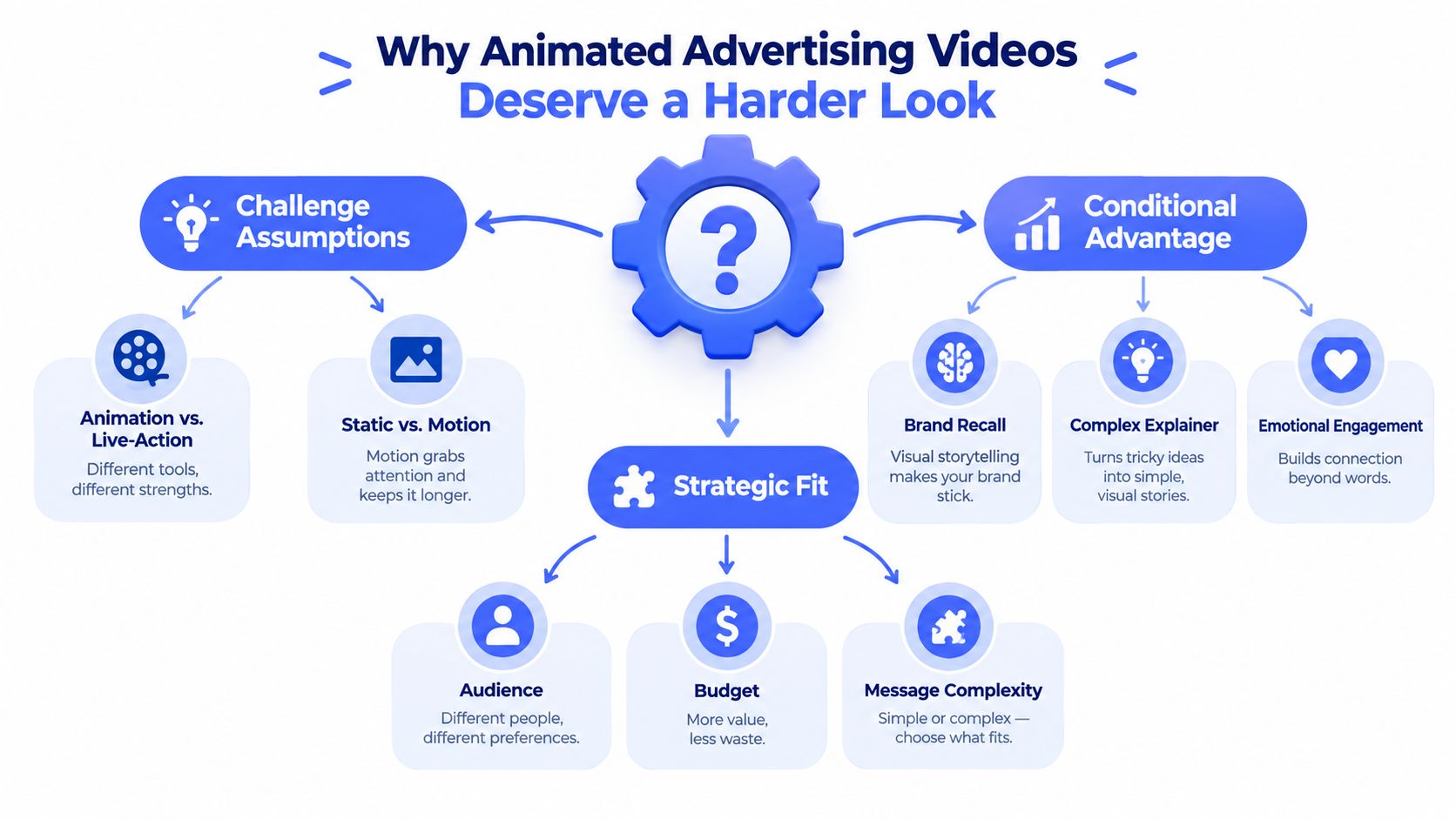
Why Animated Advertising Videos Deserve a Harder Look
Animated advertising videos are firmly mainstream. In a 2026 Wyzowl survey cited by industry reporting, 23% of marketers said animation was the video format they mostly created, compared with 51% for live-action and 19% for screen-recorded formats, which puts animation squarely in the core production mix rather than on the fringe. A separate survey-based report said 24% of video ads produced in 2024 were fully animated, up from 18% in 2022, a 6-point increase that signals growing operational confidence in the format, not novelty experimentation (Wyzowl video marketing statistics).
That adoption matters, but it doesn't settle the strategic question. A format can be common and still be misused.
When animation actually earns the budget
Animation works best when the message itself is hard to show with a camera.
Abstract products: SaaS platforms, APIs, security workflows, financial products, and healthcare processes often need visual simplification more than realism.
Unphotogenic products: If the product is a dashboard, invisible service, internal mechanism, or future-state concept, animation can make the value legible fast.
Short-window clarity: In six seconds or less, motion graphics and kinetic typography can compress a value proposition better than a talking head can.
Version-heavy campaigns: If you need rapid swaps across audience segments, product tiers, languages, and aspect ratios, animation usually scales cleaner than reshooting live footage.
Where animation gets overprescribed
There are categories where live humans carry the whole sale. Founder-led trust, patient stories, hospitality, luxury lifestyle, creator endorsements, and emotionally loaded brand work usually lose something when you replace lived experience with illustration.
That tradeoff gets ignored because animation is easy to overvalue in a pitch room. Style frames look polished. Brand teams like control. Legal likes fewer variables. None of that guarantees response.
Practical rule: Use animation when it removes confusion. Don't use it when it removes credibility.
A more useful question for CMOs is simple: what problem is animation solving that static or live-action can't solve as efficiently? If your team can't answer that in one sentence, animation is probably filling the brief by habit.
The right operating model
Treat animated advertising videos as a match between message type, channel behavior, and production economics.
Ask three things before kickoff:
Does the audience need explanation or proof? Explanation favors animation. Proof often favors live-action.
Will this campaign need many versions? Animation usually becomes more defensible as versioning demands rise.
Is the main job memorability, trust, or direct response? Animation can help memorability, but it isn't a universal performance lever.
That last point matters. Research discussed later shows motion can help in some formats and placements, but not across the board. That's why the strongest teams don't ask whether animated advertising videos “work.” They ask where they work, what they're replacing, and how they'll be measured.
The Main Animation Formats and When to Use Each
Buyers often choose style too late. They lock a script, then ask an agency what kind of animation “fits.” That reverses the process. The format should follow the message, because each style carries different strengths, limits, and production demands.
The five formats that matter
Format | Best For | Production Complexity |
|---|---|---|
2D animation | Explainers, SaaS onboarding, process clarity | Moderate |
3D animation | Product visualization, hardware, unreleased products | High |
Motion graphics | Data-heavy stories, B2B brand films, corporate messaging | Moderate |
Kinetic typography | Short value props, manifesto spots, paid social hooks | Low to moderate |
Character-driven animation | Mascots, recurring campaigns, long-arc recall | Moderate to high |
What each format does well
2D animation is the workhorse. It's ideal when your product has screens, steps, or an invisible workflow. It gives you control over pacing and hierarchy without the heavier render burden of 3D. For many teams, this is the safest starting point.
3D animation is for products people need to inspect, rotate, or understand spatially. Consumer electronics, medical devices, industrial systems, and packaging all benefit when the viewer needs to see structure or internal function. It's powerful, but it slows approvals because every visual decision has downstream complexity.
Motion graphics are often the smartest choice for B2B and enterprise campaigns. If the message relies on charts, interfaces, category language, or a sequence of claims, motion graphics can organize information without pretending to be emotional storytelling.
Motion graphics are usually better at making a complex offer understandable than making a brand feel human.
Two styles teams misuse constantly
Kinetic typography gets overused because it looks modern and performs well in silent autoplay contexts when the copy is sharp. But it falls apart fast if the script is bloated. If the message can't be reduced to a few strong phrases, this format exposes the weakness immediately.
Character-driven animation builds distinctiveness over time. It's useful when a brand wants a repeatable world, recurring mascot, or mnemonic device. It's less useful for one-off campaigns with urgent conversion goals unless the character system is already established.
A fast shortlist before the brief
Use this decision rule before you hire anyone:
If the core problem is explaining, shortlist 2D animation and motion graphics.
If the core problem is showing form, shortlist 3D animation and 2D with product overlays.
If the core problem is stopping the scroll with a headline, shortlist kinetic typography.
If the core problem is building a repeatable brand asset, consider character-driven animation.
If your internal team wants to rough out possibilities before agency scoping, a tool like the PostSyncer animation maker can help pressure-test messaging approaches early. For brands that already know they need a produced explainer, this guide to choosing an explainer video agency is a more useful next step than debating aesthetics in a vacuum.
Animation Versus Live-Action and Static Creative
The choice isn't animation or nothing. It's animation versus live-action versus static, each assigned to the job it does best. Most weak campaigns fail because teams force one format to do all three jobs.
Performance data supports animation's upside, but only in the right context. One industry summary reported that animated display ads generated 42% higher engagement than static creatives, animated social videos averaged about 1.84% engagement versus roughly 0.96% for static ads, animated video ads generated 2x the click-through rate of static image ads on Meta platforms, and animated ads were 32% more effective than live-action videos at driving viewer engagement (Cybertize Media analysis of animation ad performance). Those are strong signals for motion-led creative, especially in paid environments where attention is scarce.
They are not a license to replace everything with animation.
The practical comparison
Metric | Animation | Live-Action | Static |
|---|---|---|---|
Explainer clarity | Strong | Moderate | Weak to moderate |
Emotional credibility | Moderate | Strong | Weak |
Versioning speed | Strong | Weak to moderate | Strong |
Visual control | Strong | Moderate | Strong |
Production complexity | Moderate to high | Moderate to high | Low |
Retargeting efficiency | Moderate | Moderate | Strong |
Founder or creator trust | Weak | Strong | Weak |
What animation actually beats
Animation usually wins when your ad needs to teach quickly. Product tours, feature decomposition, process demos, comparison messaging, and benefit stacking all fit. It also helps when legal or product marketing needs precision, because every frame is controllable.
Static still matters. For lower-funnel retargeting, promo reminders, price-led messages, and simple cart or lead nudges, static often does the job more efficiently. It has fewer moving parts, lower cost, and faster turnaround.
Where live-action still dominates
Live-action remains the stronger format for trust transfer. If the message depends on a founder's face, a customer's emotion, a clinician's authority, or a creator's endorsement, animation often strips out the proof.
That doesn't make live-action universally better. It makes it better at specific things that animation can't fake convincingly.
Don't ask which format is best. Ask which format carries the proof your audience needs.
Build campaigns with all three
The strongest campaign structures usually blend formats instead of picking a winner:
Top of funnel: Live-action or high-impact animation to earn attention.
Mid-funnel: Motion graphics or 2D animation to explain the offer.
Lower funnel: Static or lightweight animated cutdowns to push action.
That's the useful heuristic. Format choice should follow funnel stage, message type, and audience expectation. A paid social ad trying to explain software isn't solving the same problem as a retargeting frame trying to recover abandoned intent.
Production Workflow, Timelines, and Budget Ranges
Animation doesn't fail because the animator missed a transition. It fails because the team rushed strategy, approved vague scripts, or treated storyboards like paperwork. Most downstream pain starts upstream.
The production flow is predictable if the buyer is disciplined.
The six stages that matter
Brief and creative strategy Teams decide the job of the ad, the audience, the offer, the channel mix, and the conversion path. If this stage is fuzzy, every later revision gets expensive.
Script and concept boards The script needs to read like ad architecture, not narration. Tight lines, visual logic, and one main idea per beat.
Style frames and storyboards Quality gets won. Strong style frames align brand, hierarchy, and motion language before expensive execution starts.
Voiceover and music Audio changes pacing decisions. Locking the wrong read too late can break edit timing and force unnecessary motion revisions.
Animation and revisions This is execution, not ideation. If your team is still debating narrative during animation, the workflow is broken.
Delivery and versioning Exports, aspect ratios, captioning, CTAs, localization, and cutdowns should be planned from the beginning, not requested after final approval.
The timeline most teams should expect
Boutique studios working with mid-market brands usually land in the 6 to 10 week range end to end. Larger enterprise campaigns with layered approvals, legal review, multiple stakeholders, and localization often sit in the 10 to 16 week range.
Those ranges are realistic because animation involves dependency chains. Delay the script, and storyboard slips. Delay the storyboard, and sound, animation, and delivery all move with it.
For teams trying to tighten pre-production and asset handoff, this piece on building an efficient content workflow for creators is useful because the bottlenecks are usually operational, not artistic. If you need a broader view of live-action and motion pipelines together, Busylike's take on digital video production is a practical reference.
Where money typically goes
Animation Format | Mid-Market Budget | Enterprise Budget | Typical Timeline |
|---|---|---|---|
Motion graphics explainer | Qualitatively lower than 3D and character systems | Qualitatively higher with localization and versioning | Short to moderate |
2D character or kinetic typography | Moderate | Moderate to high | Moderate |
3D or photoreal animation | High | Very high | Long |
The exact spend depends on script length, frame count, revision cycles, VO needs, sound design, and localization. The important point isn't a generic rate card. It's where the budget changes outcomes.
Budget priority: Spend on concept boards, storyboards, and style frames before you spend on render polish.
A mediocre concept rendered beautifully is still a mediocre ad. CMOs should push their teams to inspect three things before greenlighting full production:
Message hierarchy: Can a viewer understand the offer with the sound off?
Brand linkage: Is the brand identifiable before the end card?
Version logic: Were cutdowns and alternates designed into the board, or bolted on later?
That's where efficient animation economics come from. Not from shaving edits at the end.
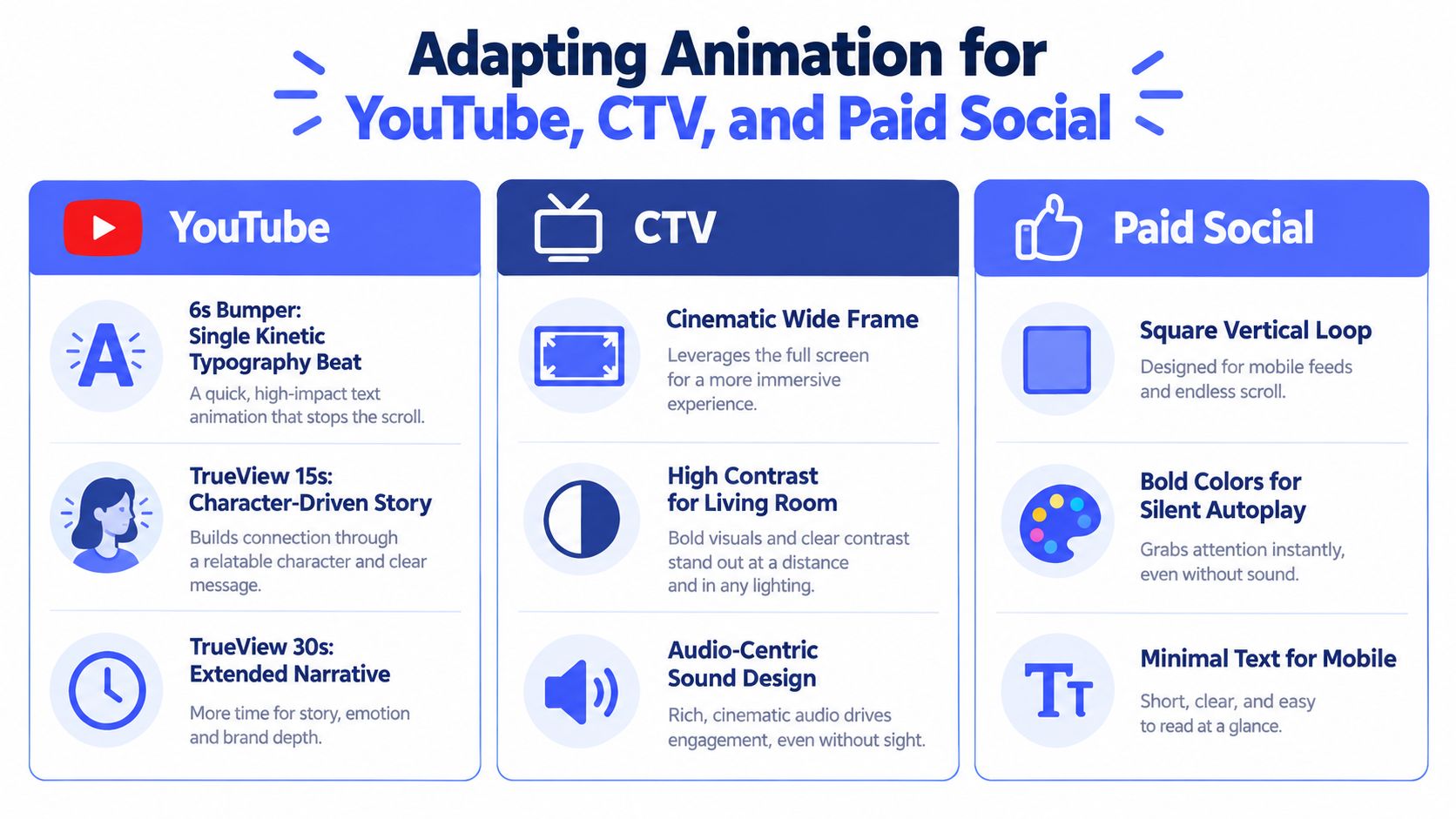
Adapting Animation for YouTube, CTV, and Paid Social
Most teams resize animated ads when they should be rebuilding them. Channel behavior changes pacing, composition, text density, and the way your CTA has to land.
YouTube needs frame-one intent
On YouTube, skip behavior punishes slow setups. Animated advertising videos need their hook in the first frame, not after a logo reveal or ambient scene-setting. For short placements, one kinetic idea usually beats a mini story with too many beats.
Use clean motion direction, early brand cues, and one dominant message path. If the ad asks the viewer to decode too much too early, they'll skip before the animation has done any useful work.
CTV rewards restraint
CTV is where many social-first animated assets look amateur. Living-room viewing punishes clutter, tiny type, and frantic transitions. The screen is larger, but the audience is farther away and less tolerant of design noise.
For CTV, simplify layouts, widen spacing, slow motion density, and mix audio for speakers instead of phones. Animation here should feel deliberate, not hyperactive.
On CTV, fewer moving elements usually improve comprehension more than more spectacle does.
Paid social is a different editing language
Paid social rewards immediacy and legibility. Vertical and near-vertical frames need big typography, strong contrast, and safe placement for UI overlays. Silent autoplay means your copy, sequencing, and visual rhythm have to carry the ad before audio helps.
That's where lightweight motion design often outperforms overbuilt animation. You don't need cinematic complexity for a thumb-stopping social unit. You need a clear problem, a visible payoff, and a CTA that survives fast scrolling.
Teams experimenting with newer generation methods can review this guide on how to create promotional videos with AI to explore concepting and iteration options. Just don't mistake generation speed for channel fit. Fast output still needs platform-native editing judgment.
Measuring What Animated Creative Actually Delivers
Animation isn't a KPI. It's an input. The job of measurement is to determine whether that input improved delivery quality, brand effect, or business outcomes.
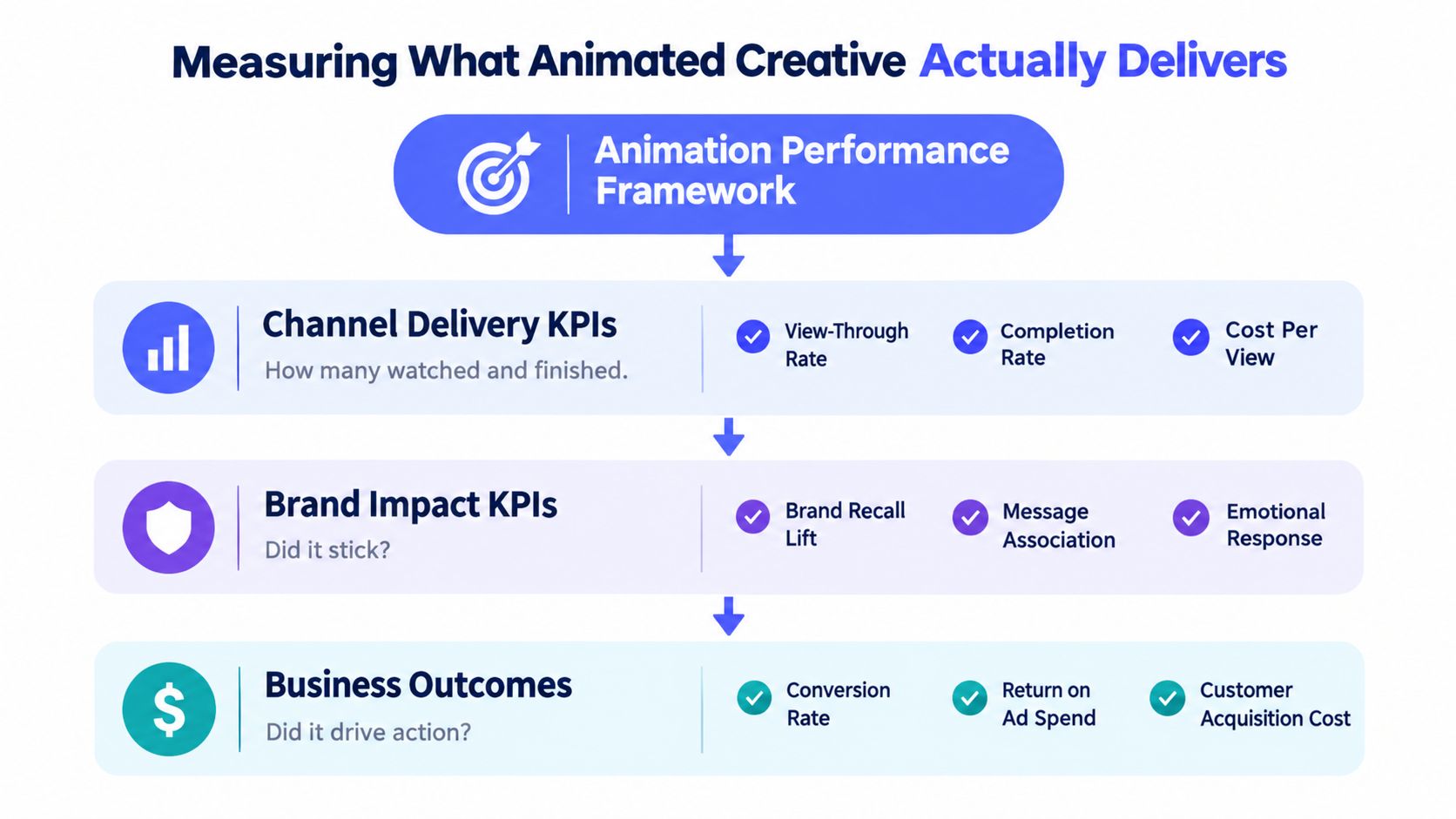
A useful framework has three layers.
Tier one measures delivery quality
Start with the platform-facing metrics:
Hook rate: Did the opening earn attention quickly enough?
View-through rate and completion rate: Did people stay with the asset?
Cost per completed view: Did the asset hold attention efficiently?
These numbers matter, but they're not proof the creative worked. A video can get watched and still fail to build memory, preference, or action.
Tier two checks whether the message stuck
Teams separate flashy motion from effective communication.
Use a quarterly creative review that scores assets on:
Review Area | What to evaluate |
|---|---|
Attention | Did the opening frame create immediate interest? |
Message clarity | Could viewers understand the offer quickly? |
Brand linkage | Was the brand clearly tied to the message? |
Action | Did the creative push a concrete next step? |
For channel-specific diagnosis, analytics discipline matters more than style preference. If your YouTube reporting is weak, this guide to YouTube video analytics is the kind of operational baseline teams need before making format calls.
The hard truth about motion and lift
Research on animation is much less absolute than most blog posts admit. One online-ad experiment found animation improved recognition mainly for banners, with weaker or inconsistent gains for other ad types, which suggests motion helps most when it reinforces a compact visual unit instead of adding complexity (SAGE-hosted study on animation and ad recognition).
A newer Instagram A/B test found animated ads did not produce significantly higher click-through rates, click-through intention, attention, recall, or recognition than static graphics in that environment (Instagram animation versus static ad study PDF). That's the corrective needed. Motion alone isn't the lever. Content architecture is.
Tier three ties creative to business impact
This is the layer that should decide future budget:
Qualified lead rate or add-to-cart rate during flight
Cost per acquisition
Return on ad spend
Incremental revenue against a holdout or comparable baseline
If animation improves watch metrics but doesn't improve these outcomes, treat it as a branding tool with a defined role, not as a direct-response breakthrough.
Sequencing Animation to Beat Fatigue Across a Campaign
The most underused role for animated advertising videos isn't winning the first impression. It's helping a campaign stay fresh after the audience has already seen the message once.
Research on repetition gives animation a more precise role than most teams assign it. One study found attention to static ads declined with repetition while animated ads stayed more stable, and memory retention for animated banner ads saturated more gradually, which suggests animation may be more useful for maintaining recall across multiple exposures than for winning the first impression (study on repetition effects and animated ads). A broader review also argues that animation's impact is conditional by format and context, not universal, which is exactly why sequencing matters more than blanket format preference (review of conditional animation effects in advertising).
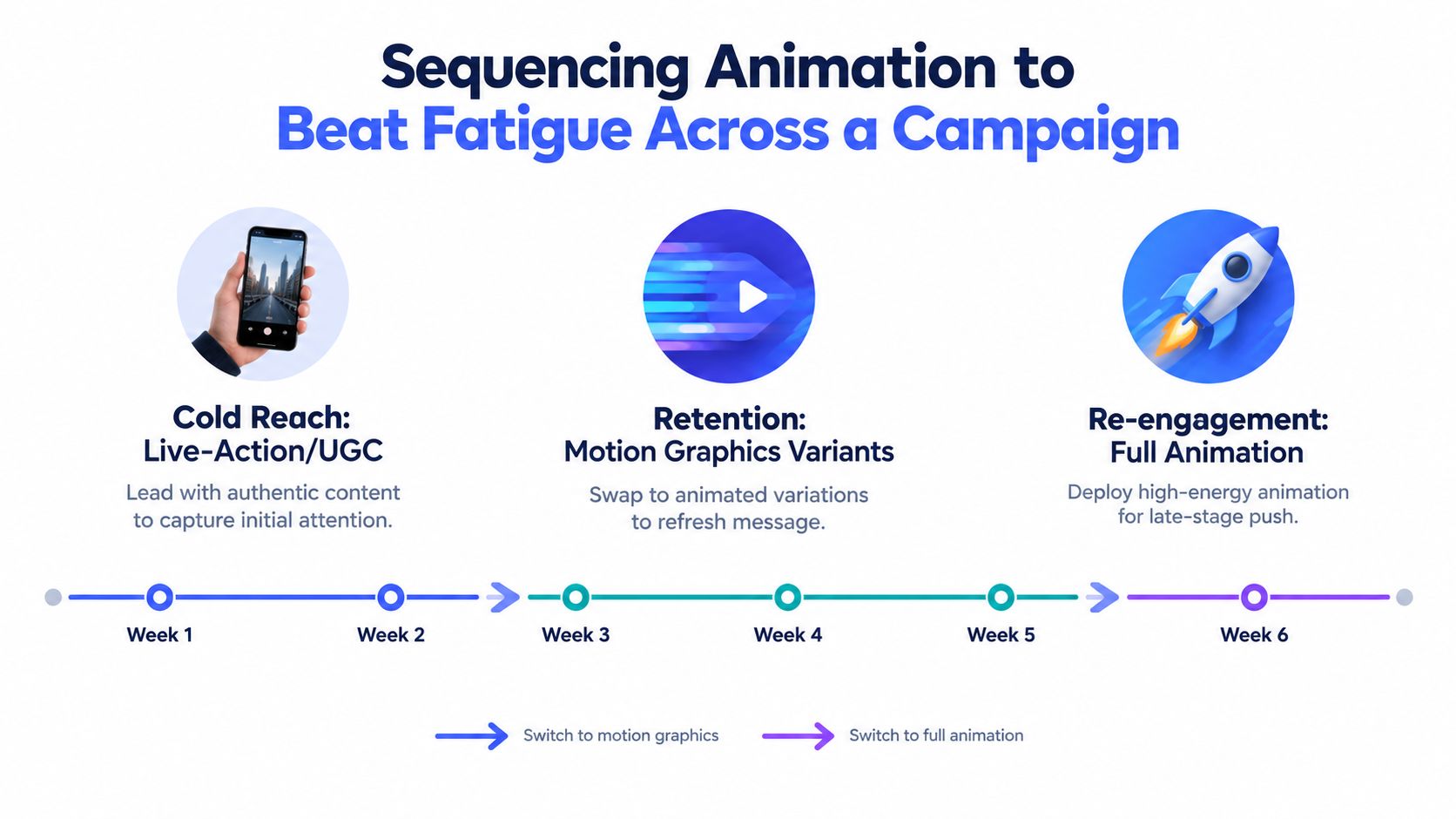
A practical sequencing model
Cold audiences usually need proof and orientation first. That often means live-action, UGC-style footage, or simple static concepts that establish relevance fast.
Then animation becomes useful as the campaign matures:
Early flight: Use trust-building creative for initial reach.
Middle flight: Introduce motion graphics variants to restate the offer with fresh visual treatment.
Later flight: Deploy richer animation for re-engagement, product depth, or higher-intent segments.
This approach is operationally smarter than leading every audience with the most expensive animated asset in the library.
How to plan for fatigue before launch
Build campaigns with rotation in mind.
Create multiple concept families: Don't produce one master and a few resized exports. Produce distinct openings, message orders, and CTA endings.
Pre-approve storyboard branches: Alternate first frames, proof points, and end cards should be approved before launch so swaps don't trigger a full revision cycle.
Match format to audience state: Colder audiences need clarity and credibility. Warmer audiences can absorb denser motion and product detail.
Animation is often more valuable as a refresh mechanism than as the opening act.
Creative teams that think this way spend less time panicking mid-flight. Media teams get replacement assets faster. CMOs get a cleaner read on what changed performance: the audience, the offer, or the creative treatment.
That's the better framing for animated advertising videos. Not “should we use them?” but when should they enter the sequence, what job should they take over, and what other format should they support?
Busylike helps brands plan, produce, and distribute video that fits the actual job of the campaign, including motion graphics, explainer videos, paid social ads, YouTube creative, and CTV spots. If you need animated advertising videos that are built around channel behavior, measurement, and versioning instead of just style, visit Busylike.
