
Instagram vs TikTok for Brands That Need Results

A CMO has two short-form video budgets, one quarterly target, and a leadership team asking which platform will deliver the result. TikTok promises attention and cultural momentum. Instagram offers a larger adult footprint, stronger commerce behavior, and a place where prospects can move from video to profile, direct message, product page, and purchase. Splitting the budget evenly may feel neutral, but it often hides the problem: the team hasn't decided which business outcome each platform should own.
The useful Instagram vs TikTok decision isn't a popularity contest. It's a funnel decision. TikTok is usually the sharper tool for discovery and raw interaction, while Instagram is often better positioned for consideration, commerce, and brand recall. The right allocation depends on audience age, market, creative capability, sales cycle, and measurement quality.
Business question | TikTok | Strategic implication | |
|---|---|---|---|
Who does it reach most broadly? | Broader adult adoption and a larger installed base | Stronger concentration among younger audiences | Use Instagram for wider adult coverage, TikTok for youth-led discovery |
Where does attention come cheaper? | Strong format and commerce flexibility | Higher benchmark engagement and ad-efficiency advantages | Test TikTok for awareness efficiency, then validate downstream quality |
Which platform supports conversion? | Stronger product-link conversion, average order value, and ad recall in one 2026 benchmark | Strong discovery and impulse-oriented interaction | Give Instagram more weight when purchase intent matters |
What should creative prioritize? | Reels, saves, shares, Stories, DMs, and product context | Hooks, watch time, sounds, trends, and rapid discovery | Adapt the same idea instead of blindly duplicating the same edit |
This guide takes a practical advisor's view. It separates reach from attention, attention from consideration, and consideration from revenue, so your team can place budget against the job each channel performs best.
Table of Contents
Audience and Scale Where Each Platform Actually Reaches - Scale and maturity tell different stories
How Discovery Works Algorithm and Distribution Compared - The distribution logic changes the creative brief
Creative Formats and What Drives Engagement on Each Platform - Instagram rewards format discipline - TikTok needs a stronger opening than a prettier edit
Advertising and Measurement Paid Products Performance and Metrics - Match the metric to the funnel job
Choosing the Right Platform by Goal and Use Case - Use TikTok when discovery is the bottleneck - Use Instagram when trust and transaction matter
Putting Your Strategy Into Action Testing Scaling and Next Steps - Build a controlled creative test - Scale the winner without multiplying production
Introduction Why Instagram vs TikTok Is the Wrong Question
The executive meeting often starts with a misleading question: “Which platform is winning?” That question encourages teams to compare headline engagement rates, follower counts, or the latest viral trend without asking whether those signals connect to the company's commercial objective.
A direct-to-consumer brand launching a new product may need broad recognition first, then product education, then retargeting. A software company may need repeated proof points and credible conversations rather than mass reach. A healthcare marketer may need careful audience qualification and trust-building. Those campaigns can all use vertical video, but they shouldn't use the same platform mix or creative logic.
TikTok and Instagram look similar on the surface. Both support vertical video, creators, paid placements, and commerce features. Their strategic roles differ because their audiences, recommendation systems, interaction patterns, and conversion paths differ.
The practical rule: assign each platform a job before assigning it a budget.
The strongest plan usually has a primary platform and a supporting platform. The primary channel gets the most original creative testing and the clearest success criteria. The supporting channel receives adapted versions, not neglected reposts. That distinction prevents a common failure mode: producing one generic video, publishing it everywhere, then blaming the platforms when results diverge.
TikTok generally earns the first chance to win attention. Instagram generally earns more responsibility when the buyer needs to remember the brand, explore the offer, or complete a purchase. That isn't a universal law, but it is a useful starting position supported by current benchmark evidence.
The question isn't whether one platform is better. The question is which platform is stronger for this audience, at this funnel stage, for this measurable business outcome.
Audience and Scale Where Each Platform Actually Reaches
A CMO planning a mixed-age campaign should start with Instagram. A launch aimed at younger consumers and cultural discovery should start with TikTok. Pew Research Center reported in 2025 that 50% of U.S. adults used Instagram, compared with 37% who used TikTok. Among adults ages 18 to 29, Instagram reached 80%, while TikTok reached 59%, according to the Pew Research Center survey of U.S. social media use.
That reach difference affects funnel design. Instagram gives brands broader access to established consumer segments, professionals, families, and older adults. It also supports repeated exposure, brand recall, product evaluation, and purchase intent. TikTok concentrates more of its advantage in discovery, especially when entertainment, cultural relevance, or creator-led storytelling drives initial demand.
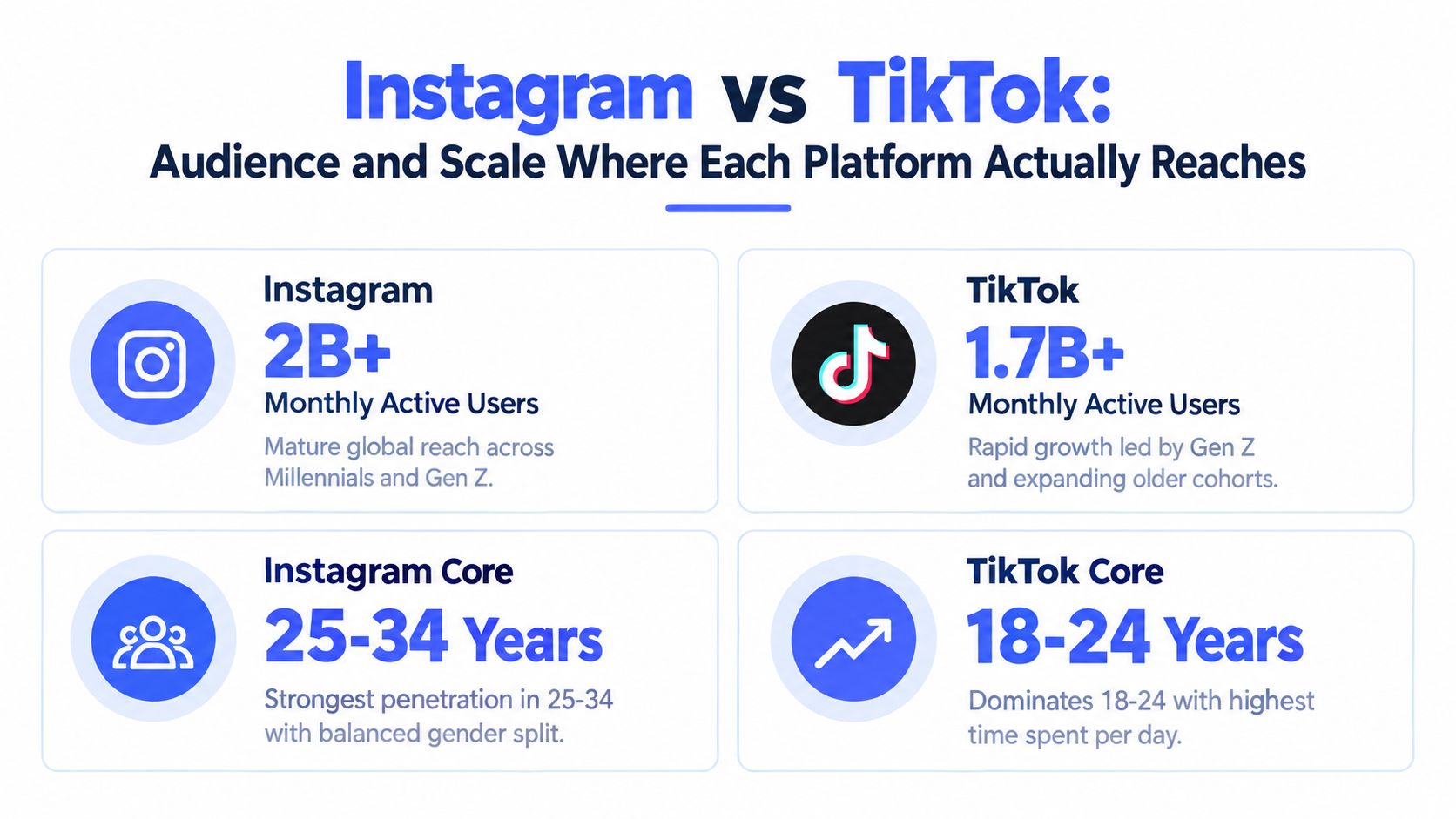
Scale and maturity tell different stories
U.S. adoption has grown on both platforms. Pew reported that TikTok usage among U.S. adults rose from 21% in 2021 to 37% in 2025, while Instagram usage increased from 40% to 50% over the same period. TikTok has grown faster, yet Instagram still reaches more adults in this market.
Global user totals do not provide enough guidance for budget allocation. Treat broad industry estimates as directional context, then validate country-level reach, audience quality, conversion rate, and average order value before scaling. Market-level evidence matters more than a global platform ranking.
Use this decision framework:
Choose Instagram for breadth and conversion: Start here when the buyer includes Millennials, older adults, families, professionals, or mixed-age households. Instagram is also the stronger home for product evaluation, repeat exposure, brand recall, and higher-value purchases.
Choose TikTok for discovery: Start here when younger consumers, entertainment, cultural discovery, or creator-native storytelling drive demand. TikTok earns the first test when the campaign must reach people who do not already know the brand.
Use both for separate funnel jobs: Put discovery budget on TikTok and conversion, retargeting, and retention budget on Instagram when the product needs both new demand and a reliable path to purchase.
Regional behavior can change that allocation. Instagram and TikTok have reportedly narrowed their performance gap in Latin America and Southeast Asia. Set budgets with country-level reach and conversion data, not assumptions imported from the U.S. market.
How Discovery Works Algorithm and Distribution Compared
Instagram and TikTok distribute content through different starting points. Instagram still gives the social graph a major role. Follows, prior interactions, close relationships, and profile behavior help determine what appears in a user's feed, while Explore and Reels extend discovery beyond existing connections.
TikTok is more strongly organized around an interest graph. The For You experience can introduce a creator or brand to people who have no prior relationship with the account. In practice, that makes TikTok more comfortable with testing unfamiliar content against behavioral signals such as watch time, completion, rewatches, shares, and sound or topic relevance.
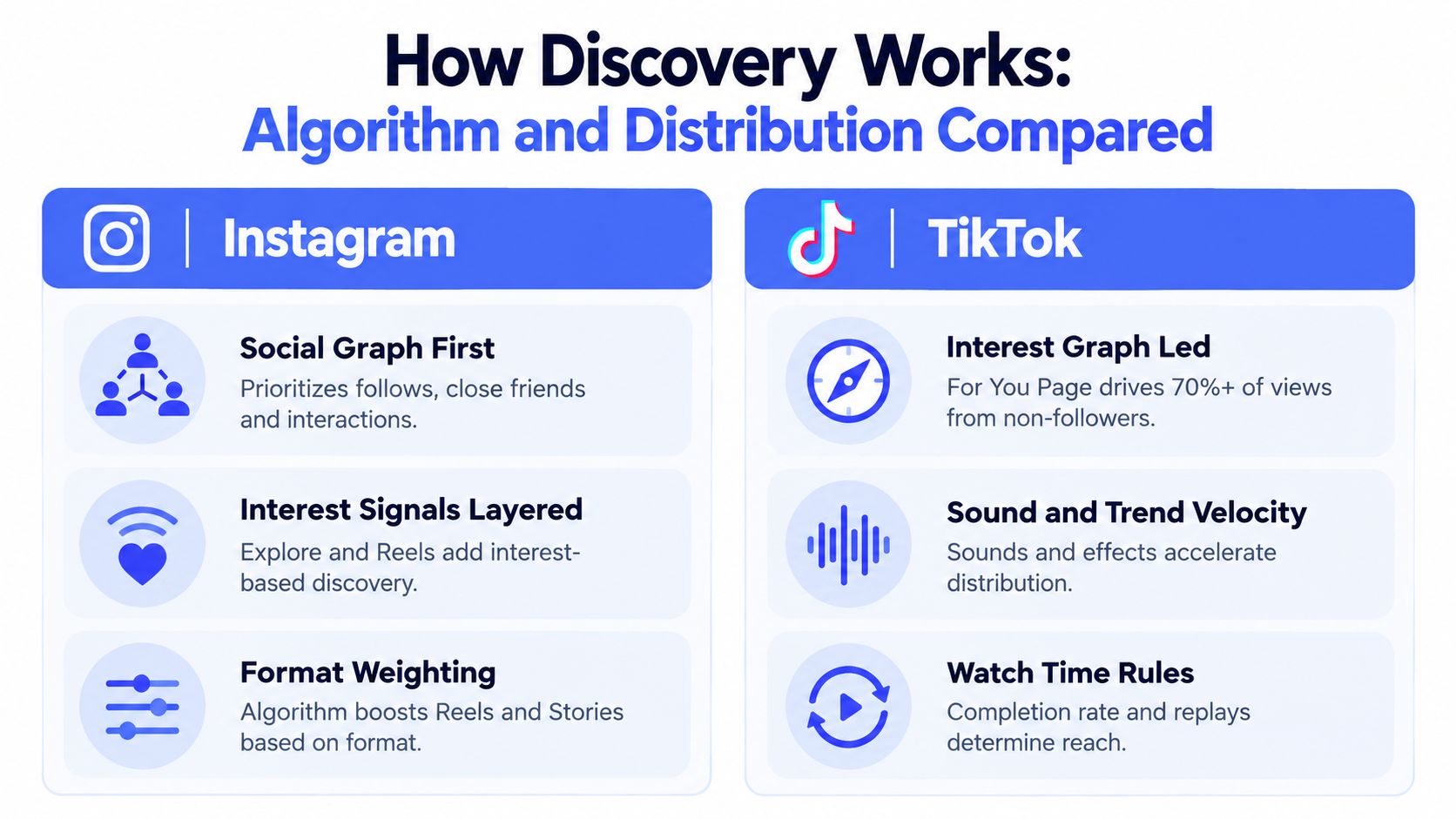
The distribution logic changes the creative brief
Instagram asks a brand to serve two audiences at once. Existing followers need a reason to stop, save, reply, or share. New viewers need enough relevance and visual clarity to continue watching. Reels can expand discovery, but Instagram's broader ecosystem also rewards relationship signals through Stories, DMs, carousels, and profile activity.
TikTok puts more pressure on the content itself. A new account can earn attention if the opening creates immediate curiosity and the video sustains viewing. That doesn't mean every post will break out. It means the platform gives brands a more direct path to testing ideas outside their current follower base.
TikTok tests the idea with strangers. Instagram often tests the relationship with people who already recognize the account.
This difference affects media planning. TikTok can be an efficient laboratory for hooks, creator voices, cultural angles, and problem-led stories. Instagram needs more deliberate packaging when the brand wants to move users from video to profile, product page, or conversation.
Organic volatility still matters on both platforms. One 2026 benchmark set reported that Instagram views and interactions rose while TikTok views, reach, and interactions fell, illustrating why a single quarter of organic performance shouldn't define a permanent channel strategy. The Metricool comparison of Instagram and TikTok performance also describes changing reach patterns and regional differences, including reported declines in Instagram organic reach across formats and an ad-efficiency advantage for TikTok in the cited study.
Build a testing system that can absorb those changes. Test the concept, opening, creator, pacing, caption, and call to action separately. Don't treat a platform's current distribution behavior as a permanent law.
Creative Formats and What Drives Engagement on Each Platform
Creative performance diverges because the platforms ask viewers to behave differently. Instagram supports a portfolio of formats, including Reels for reach, Stories for daily interaction, carousels for explanation, Live for direct participation, and commerce features for product discovery. TikTok centers the full-screen video feed, then adds sounds, effects, creator participation, Live, and shopping experiences around it.
The production implication is important. A single master video can supply the raw material, but it shouldn't become an identical upload. TikTok usually benefits from a faster, more conversational opening and a looser creator-native feel. Instagram often needs cleaner framing, stronger visual hierarchy, and a clearer reason to save, share, visit the profile, or tap through.
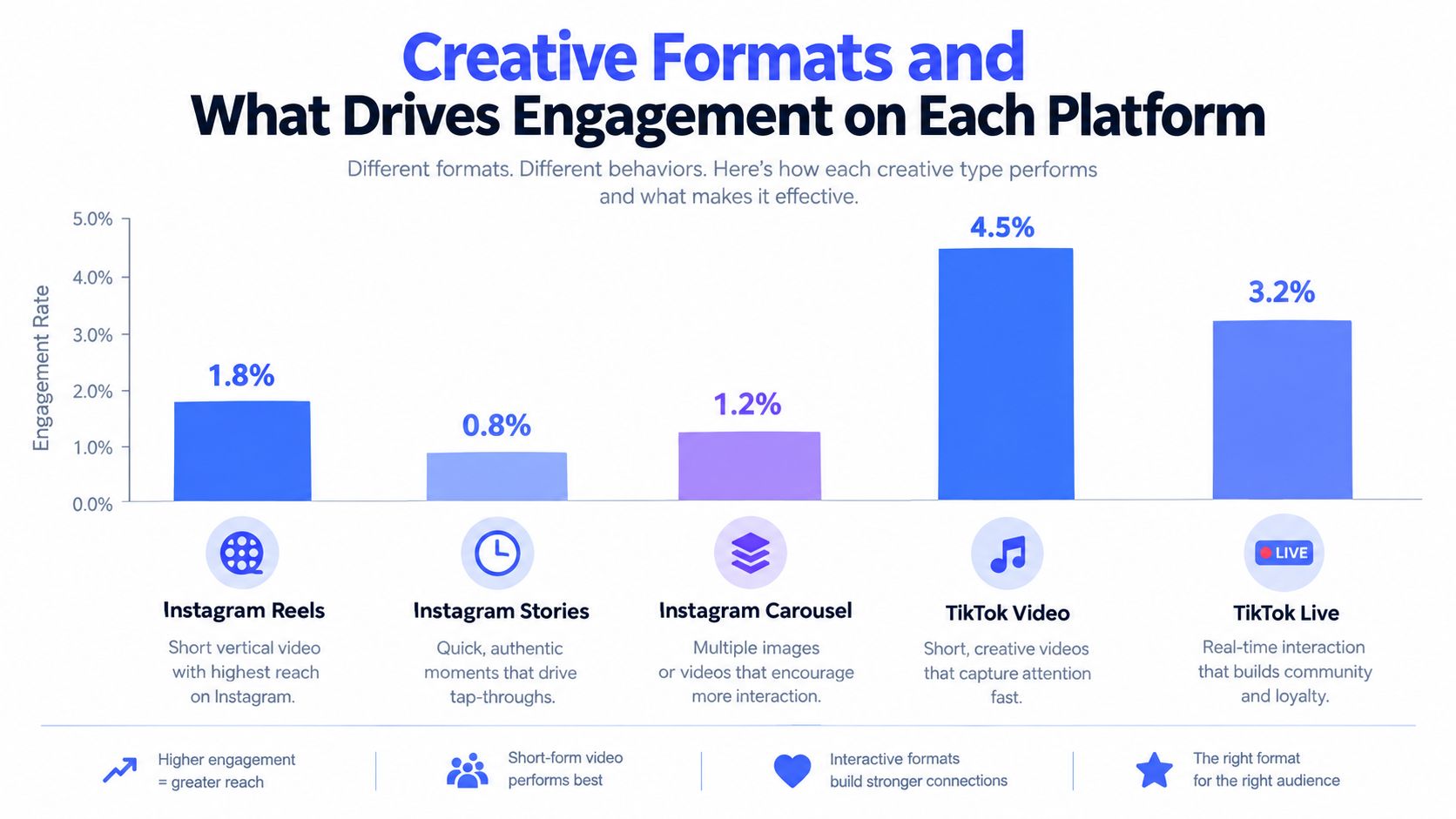
Instagram rewards format discipline
2026 benchmark reporting placed Instagram carousels at 0.55% engagement, Reels at 0.50%, and single images at 0.35%, while Reels produced a 30.81% reach rate compared with 14.45% for carousels, according to Yellow House Consulting's social trends benchmarks. The figures point to a clear distinction: carousels can support depth and saving, while Reels are the stronger discovery vehicle within Instagram's format mix.
Use Reels for a visible problem, a concise demonstration, a founder explanation, or a creator-led product moment. Use Stories to answer objections, collect questions, reveal process, and keep warm audiences active. Use carousels when the viewer needs steps, comparisons, checklists, or a visual argument that deserves a return visit.
TikTok needs a stronger opening than a prettier edit
TikTok creative should earn the first pause quickly. Open with the tension, result, unusual point of view, or customer problem. Then deliver proof through a demonstration, voiceover, reaction, tutorial, or story rather than delaying the payoff behind a long brand introduction.
Sound and trends can help, but they shouldn't replace a recognizable brand idea. A trend may generate attention, yet a clear product role, distinctive visual language, and repeated message create memory. Use native captions, platform-specific text placement, and an audio treatment that supports the story instead of burying the voice.
For a practical set of short-form structures that can be adapted across channels, TikTok Reels Shorts frameworks offers useful creative direction. Your team can also connect format choices to a wider social media for video strategy rather than treating every post as an isolated asset.
A production team should create one core narrative, then make platform-native variants:
TikTok version: Lead with tension, keep the language conversational, and let the creator carry the explanation.
Instagram version: Tighten the edit, clarify the visual payoff, and add a reason to save, share, DM, or visit the product page.
Story sequence: Break the same idea into context, proof, objection handling, and response prompts.
Advertising and Measurement Paid Products Performance and Metrics
Paid media makes the Instagram versus TikTok decision more precise, but only if the team stops using engagement as the final score. TikTok's benchmark advantage is substantial. One 2026 benchmark reported 4.25% average engagement for TikTok versus 0.98% for Instagram, implying roughly four times more interaction per post in that dataset, according to CreatiCalc's engagement rate benchmarks.
That advantage matters for attention and creative learning. It doesn't prove that TikTok will generate more revenue. A separate 2026 benchmark reported TikTok engagement around 2.65% to 4.25%, compared with 0.48% for Instagram feed and 1.48% for Reels, while Instagram recorded a 2.8% product-link conversion rate versus 1.3% for TikTok, an average order value of $68 versus $51, and ad brand recall of 67% versus 52%. Those figures appear in Digital Applied's 2026 Instagram statistics and trends analysis.
Match the metric to the funnel job
TikTok is often the better place to buy broad attention, test native-feeling creative, and identify concepts that earn strong viewing behavior. Instagram is usually more useful when the campaign depends on product context, retargeting, profile exploration, direct response, and brand memory.
Metric | TikTok | Implication for brands | |
|---|---|---|---|
Awareness | Reach, completed views, frequency, ad recall | Reach, completed views, watch time, engagement | Use platform-native creative and compare qualified attention, not likes alone |
Consideration | Saves, shares, profile visits, DMs, landing-page sessions | Watch depth, shares, comments, profile visits, landing-page sessions | TikTok can expose the idea, Instagram can deepen the relationship |
Conversion | Product-link conversion, purchases, revenue, average order value | Purchases, revenue, assisted conversions, cost per acquisition | Judge both direct and assisted outcomes across the buying path |
Brand impact | Recall, branded search, repeat exposure, sentiment | Recall, branded search, creator association, sentiment | Keep a memory metric alongside performance metrics |
The Instagram video ads resource from Busylike is relevant when your campaign needs product education and retargeting creative built specifically for Instagram placements. The broader media plan should still test TikTok against the same commercial endpoint, using consistent attribution windows and audience definitions.
Don't let TikTok's lower CPMs, where reported, become the whole decision. Cheap impressions can produce expensive growth if the audience doesn't remember the brand or move toward purchase. Conversely, Instagram's lower interaction rate can hide valuable saves, DMs, product visits, and stronger conversion behavior.
Choosing the Right Platform by Goal and Use Case
The decision becomes straightforward once the business goal is explicit. TikTok should usually lead awareness and discovery. Instagram should usually lead conversion, retention, and relationship-building. Consideration sits between them, and the strongest choice depends on whether the buyer needs entertainment, proof, conversation, or shopping convenience.
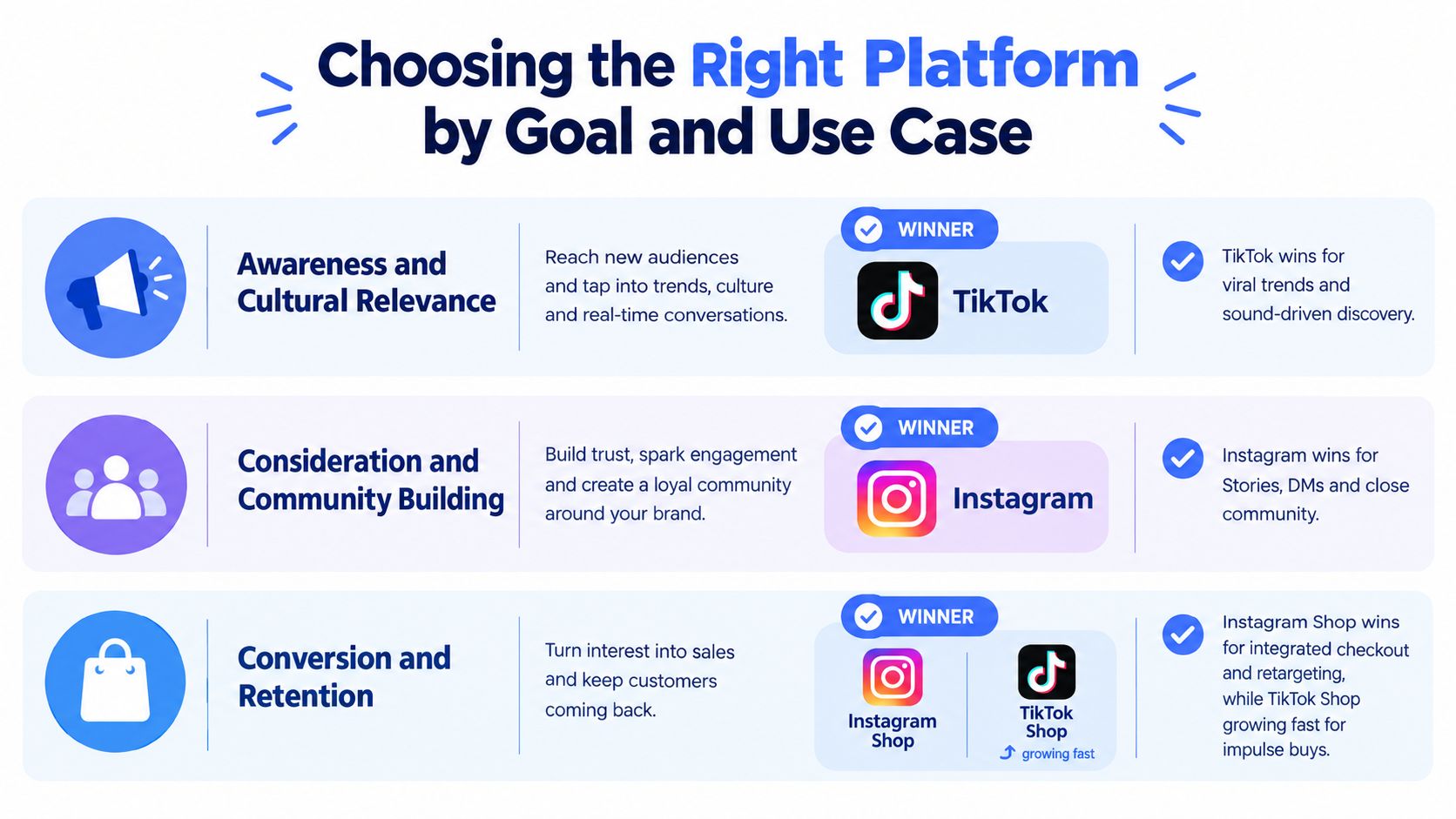
Use TikTok when discovery is the bottleneck
TikTok deserves priority when the brand needs new audiences to encounter a problem, category, or product for the first time. This is especially true for youth-oriented consumer products, entertainment, beauty, food, fashion, apps, and creator-led launches where cultural fluency drives attention.
TikTok also works well when the creative team can produce many hooks quickly. A founder story, customer reaction, product test, or opinionated explainer can feel native without extensive polish. The platform's higher interaction benchmarks make it useful for finding which messages deserve paid support or broader adaptation.
Use Instagram when trust and transaction matter
Instagram should carry more weight when the buyer needs to inspect the brand before acting. Product galleries, Reels, Stories, DMs, creator content, carousels, and retargeting can work together inside one account experience. The benchmark evidence cited earlier also favors Instagram for product-link conversion, average order value, and ad brand recall.
That makes Instagram the practical choice for retail, premium products, established consumer brands, and businesses with a considered visual identity. It's also useful for healthcare and B2B teams that need repeated exposure, clear proof, and a controlled route into conversation. For a more specific B2B application, review this guide to TikTok for B2B brands, then judge the channel against your audience and compliance requirements.
Situation | Primary platform | Supporting role |
|---|---|---|
New product needs cultural awareness | TikTok | Instagram retargeting and brand profile depth |
Mature audience needs product confidence | TikTok discovery among younger prospects | |
Creator-led growth | TikTok | Instagram portfolio, community, and conversion |
Visual commerce and repeat purchase | TikTok prospecting and creator testing | |
B2B or long consideration cycle | Instagram for proof and relationship | TikTok for category education and reach testing |
Regional campaign | Local performance data decides | Keep both available where audience overlap is strong |
A dual-platform plan pays off when each channel receives a distinct assignment. Don't publish identical creative, use identical optimization events, and expect clean learning. Let TikTok introduce the idea, then let Instagram reinforce the brand and capture intent when that sequence matches the buyer journey.
Putting Your Strategy Into Action Testing Scaling and Next Steps
Start with a decision brief, not a posting calendar. Write down the audience, funnel stage, commercial objective, primary platform, secondary platform, and one metric that would justify more investment. If the team can't agree on those fields, more production won't solve the problem.
Build a controlled creative test
Create a small set of concepts around different motivations, such as a problem demonstration, customer proof, founder explanation, product comparison, and cultural hook. Film a shared master narrative, then adapt the first seconds, captions, pacing, audio, and call to action for each platform.
Publish organically to learn which ideas earn attention and meaningful responses. Put paid support behind the concepts that meet the campaign's qualification criteria, not the posts with the most likes. For TikTok, inspect watch behavior, shares, comments, and audience quality. For Instagram, inspect saves, profile actions, DMs, product visits, and conversion signals.
Scale the winner without multiplying production
Once a concept works, expand the idea rather than repeating the same video. Change the speaker, opening, setting, proof point, or objection. Build creator variations and customer-led versions, then maintain a clean library of platform-native exports without watermarks or mismatched captions.
A coordinated channel workflow can also link the two audiences. For tactical guidance on connecting Instagram and TikTok audiences, boost audience with Sup Growth provides a useful reference, but audience transfer should support a clear journey rather than inflate follower counts.
Review results by market and format before moving budget. Reach can shift, creative fatigue can appear, and a platform that wins discovery in one region may not win conversion in another. Keep the test alive long enough to separate a weak idea from a weak channel, then reallocate toward the platform that advances the stated business goal.
Busylike helps brands plan, produce, distribute, and optimize vertical video for Instagram and TikTok, connecting creative production with paid media and channel management. If your team needs a platform-specific video system instead of duplicated content and disconnected reporting, visit Busylike to discuss the audience, funnel, and budget you need to move.

