
Social Media for Video: Strategy And Repurposing

Updated: Aug 20
Most advice about social media for video starts in the wrong place. It starts with editing, presets, and production volume, when the core constraint is distribution fit. A polished clip that lands on the wrong platform, in the wrong format, at the wrong stage of the funnel, is still a wasted asset.

The better question is where each video should go, what job it should do there, and what needs to change before it's published. Short-form clearly matters, but it isn't a universal answer. In recent marketing data, 49% of marketers say short-form video delivers the top ROI, while 29% still see strong results from long-form and 25% from live-streaming, which tells you buyers want format choice, not a one-size-fits-all publishing habit. Vidico's 2026 short-form video coverage makes that allocation problem hard to ignore.
Table of Contents
Why Most Social Video Strategies Fail - The core issue is platform allocation
Platform Fit and Audience Behavior - What each platform does best
Technical Requirements and Creative Best Practices - Export for the feed, not the edit suite - Hooks are a technical variable too
Building Content Pillars That Scale - Start from the brand core - Match the pillar to the platform
Repurposing Workflows for Maximum Reach - Build once, then cut for intent - What translates and what doesn't
Paid Amplification and Budget Allocation - Allocate by objective, not by habit - Use paid to learn, not just to scale
Measurement Frameworks That Drive Decisions - Measure by funnel stage - Use tools that connect video to outcomes
Why Most Social Video Strategies Fail
Teams still treat social media for video like a production line. They approve a content calendar, batch clips, and expect the platforms to sort out distribution. That misses the core constraint. Distribution is a strategy, not a handoff.
The usual mistake is assuming more short videos automatically means better performance. Analysts at Vidico found that short-form video is the top ROI format for 49% of marketers, but that still leaves many teams getting stronger results from long-form and live-streaming in the right context. If every asset is cut for volume, awareness, consideration, and conversion all blur together.
The core issue is platform allocation
A brand that runs the same edit everywhere is overconfident in the asset and underconfident in the audience. TikTok, Instagram Reels, YouTube Shorts, and YouTube proper reward different pacing, depth, and viewing intent. The job is to match format to purpose, then adapt the cut so it feels native to the feed.
Practical rule: If the video needs trust, nuance, or product explanation, do not force it into a format that only rewards speed.
Judging success by the wrong metric too early creates another failure. A top-of-funnel awareness clip can look weak if you expect the same engagement pattern as a product demo or customer story. Teams that align format with funnel stage waste less spend and get clearer readouts from their creative.
That makes the first decision simple: choose the video's primary job before you edit a single frame. If the goal is reach, the cut should be built for feed behavior and quick comprehension. If the goal is retention, the story needs enough depth to hold attention past the opening swipe. If the goal is response, the offer and call to action need to appear early, not buried under brand polish.
Platform Fit and Audience Behavior
Platform fit matters because social video is not consumed in one uniform way. YouTube still carries the habits of longer viewing, while TikTok and Instagram Reels are built for rapid discovery, swipe behavior, and a fast decision about whether the first few seconds deserve attention. A brand that treats every feed the same is usually optimizing the edit, not the audience.
Short-form scale makes the split harder to ignore. One industry summary noted that short-form video now takes a large share of social time, while online video viewing remains widespread across adults Marketing Tech News. That does not mean every brand should chase the same cut everywhere. It means video has to be planned for different viewing behaviors, not just different aspect ratios.
What each platform does best
YouTube works best when the content needs searchability, depth, and a clear educational arc. It rewards videos that answer questions, compare products, or build expertise over time. TikTok leans toward fast discovery, trend fluency, and sharp hooks that can stop the scroll. Instagram Reels sits between those two, where polished visual storytelling, brand aesthetics, and compact demonstrations can travel well if the opening lands immediately.
The allocation question is practical. If the audience is already looking for an answer, YouTube usually deserves more weight. If the audience needs to discover the brand through entertaining or compressed proof, TikTok and Reels usually deserve the first pass. If the message benefits from a human face, live interaction, or a product walkthrough, live-streaming belongs in the mix instead of being treated as a side channel.
Platform | Best For | Optimal Length | Primary Audience |
|---|---|---|---|
YouTube | Search-led education, demos, deeper consideration | Longer-form and Shorts depending on intent | High-intent viewers |
TikTok | Discovery, trends, quick proof, creator-style storytelling | Short-form | Broad top-of-funnel audiences |
Instagram Reels | Brand polish, lifestyle framing, native vertical storytelling | Short-form | Visual-first audiences |
YouTube Shorts | Fast discovery inside the YouTube ecosystem | Short-form | Mobile viewers already inside YouTube |
One more data point reinforces the need to adapt by platform. Analysts at Amra & Elma report that YouTube Shorts sees massive daily viewing, while short-form video remains central to how audiences consume content across social. The takeaway is simple. Growth is concentrated, but behavior is not identical. Brands need format adaptation, not a single master export.
Technical Requirements and Creative Best Practices
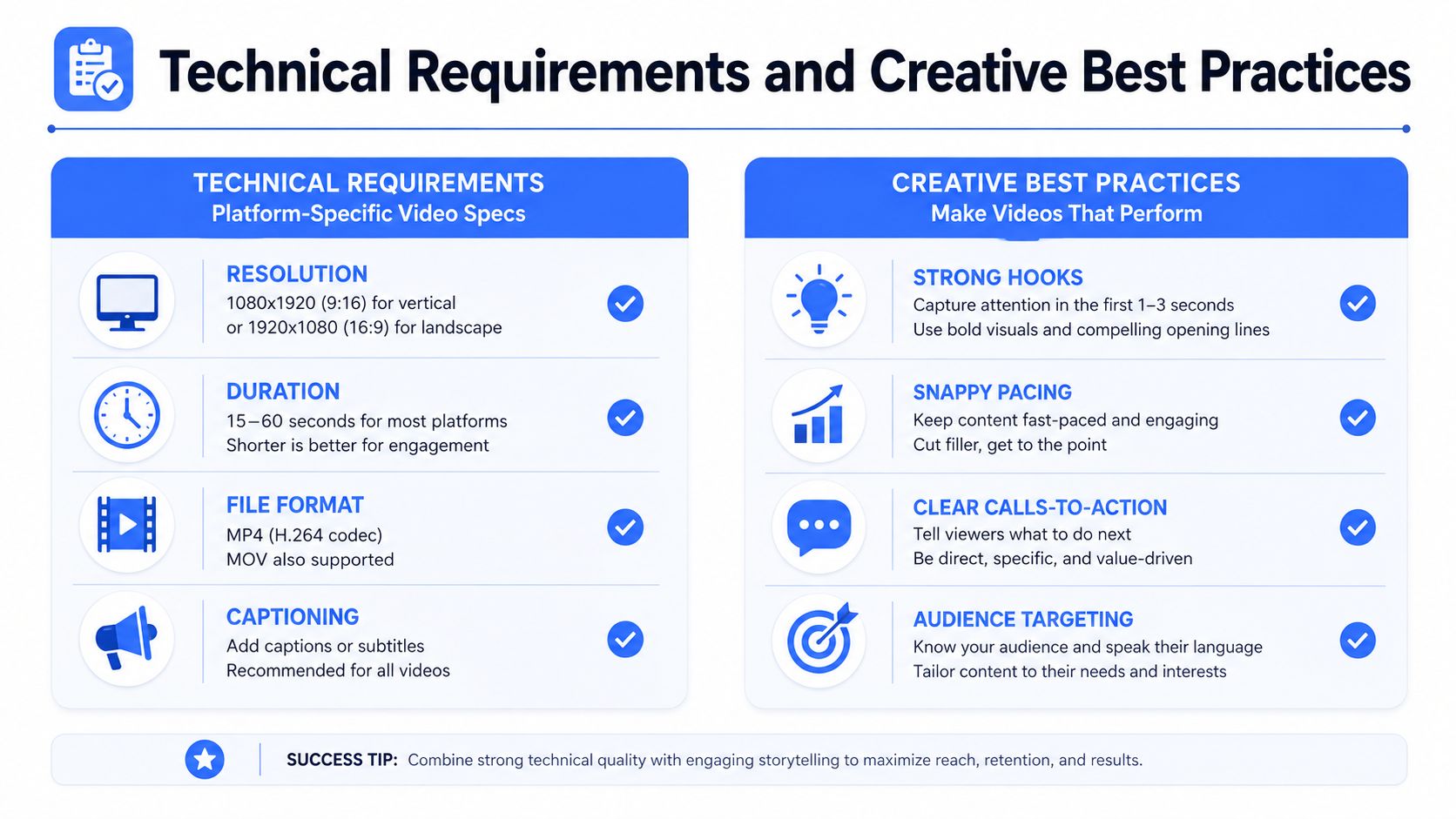
Creative choices fail fast when the file is built for the wrong frame. For mobile-first social distribution, 9:16 at 1080 × 1920 remains the safest default across TikTok, Instagram Reels, YouTube Shorts, Snapchat, and Stories Faceless. That vertical frame uses the full screen, protects clarity, and avoids the cropping problems that horizontal masters create once they hit feed surfaces.
Export for the feed, not the edit suite
Bitrate still matters because platform compression will expose a weak master. Typical 1080p bitrate targets sit around 8 to 12 Mbps for 24 to 30 fps and 12 to 20 Mbps for 50 to 60 fps Faceless. Too little bitrate makes text shimmer and motion edges break apart. Too much, and the platform often recompresses the file anyway, flattening detail you meant to preserve.
Protected UI-safe margins matter for the same reason. Captions, logos, and calls to action need room around buttons, app chrome, and overlays. Use a practical check like the safe zones and export settings guide before launch so cropping errors do not show up after the post is live.
Hooks are a technical variable too
Short-form video under 90 seconds tends to retain about 50% of viewers on average, which makes the first 2 to 3 seconds the key filter TechRT. That is a distribution problem as much as a creative one. If the opening does not signal relevance immediately, the platform has too little watch time to push the asset further.
Front-load the value proposition. Show the result first when the result is the point. Use the opening motion, audio cue, or visual payoff to answer one question quickly, why should this viewer keep going?
Creative rule: Open with proof, tension, or a visible outcome, then earn the explanation.
Teams that manage social production centrally also need a clean workflow for review, asset storage, and versioning. A structured process, like the one described in Busylike's video production and marketing resource, keeps technical requirements tied to the campaign plan instead of leaving them to individual editors.
Building Content Pillars That Scale
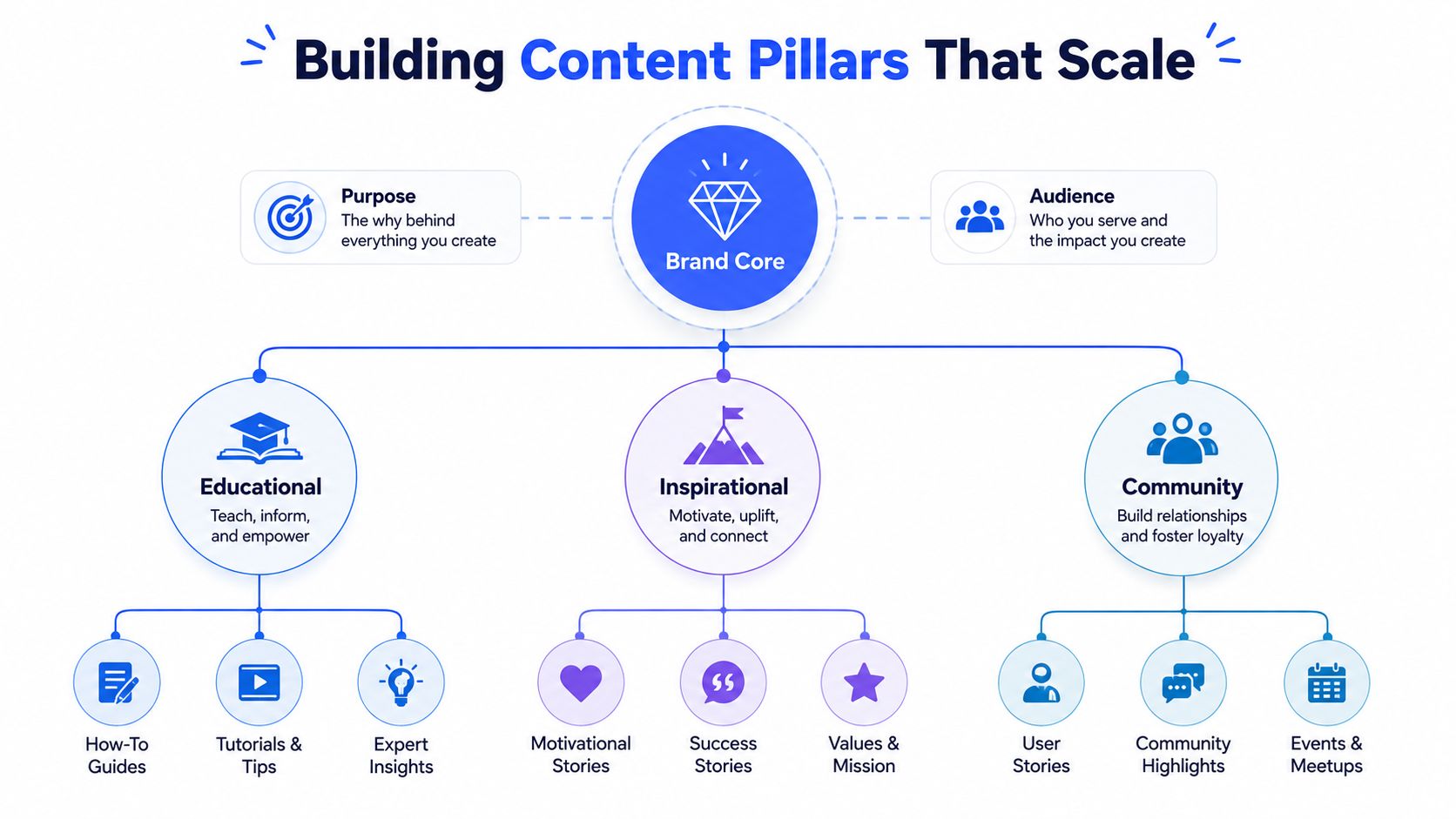
Strong social media for video programs don't start with random ideas. They start with a few content pillars that reflect what the brand knows, what the audience cares about, and what each platform rewards. The goal isn't rigidity, it's repeatability.
Start from the brand core
A useful pillar system usually has 3 to 5 core themes. For many brands, that mix includes education, product proof, behind-the-scenes material, customer stories, and timely trend participation. The point is not to force every post into one mold. The point is to make sure every asset can be traced back to a business objective.
Educational content works well when the brand needs to teach, de-risk, or build authority. Customer stories help move people from interest to trust because they show real-world use instead of claims. Behind-the-scenes footage often works best when the brand needs to feel human, especially in crowded categories where polish alone doesn't differentiate.
Match the pillar to the platform
YouTube is the natural home for deeper educational content and product explainers. TikTok and Reels are better for short demonstrations, story fragments, and trend-native variations that broaden reach. Community-driven content, including user stories and creator collaborations, can travel across all three when the format stays native to the feed.
The key is consistency without repetition. A single product launch can yield an explainer on YouTube, a customer outcome clip on Reels, a short myth-busting cut on TikTok, and a behind-the-scenes build story for the brand channel. Same core message, different job, different expression.
Use this filter: if a pillar can't survive multiple angles, it's not a pillar, it's a post idea.
This is also where teams avoid burnout. Pillars give creative teams a decision framework, so they aren't reinventing strategy every week. The result is a steadier cadence, cleaner review cycles, and a content library that can be repurposed instead of constantly rebuilt.
Repurposing Workflows for Maximum Reach
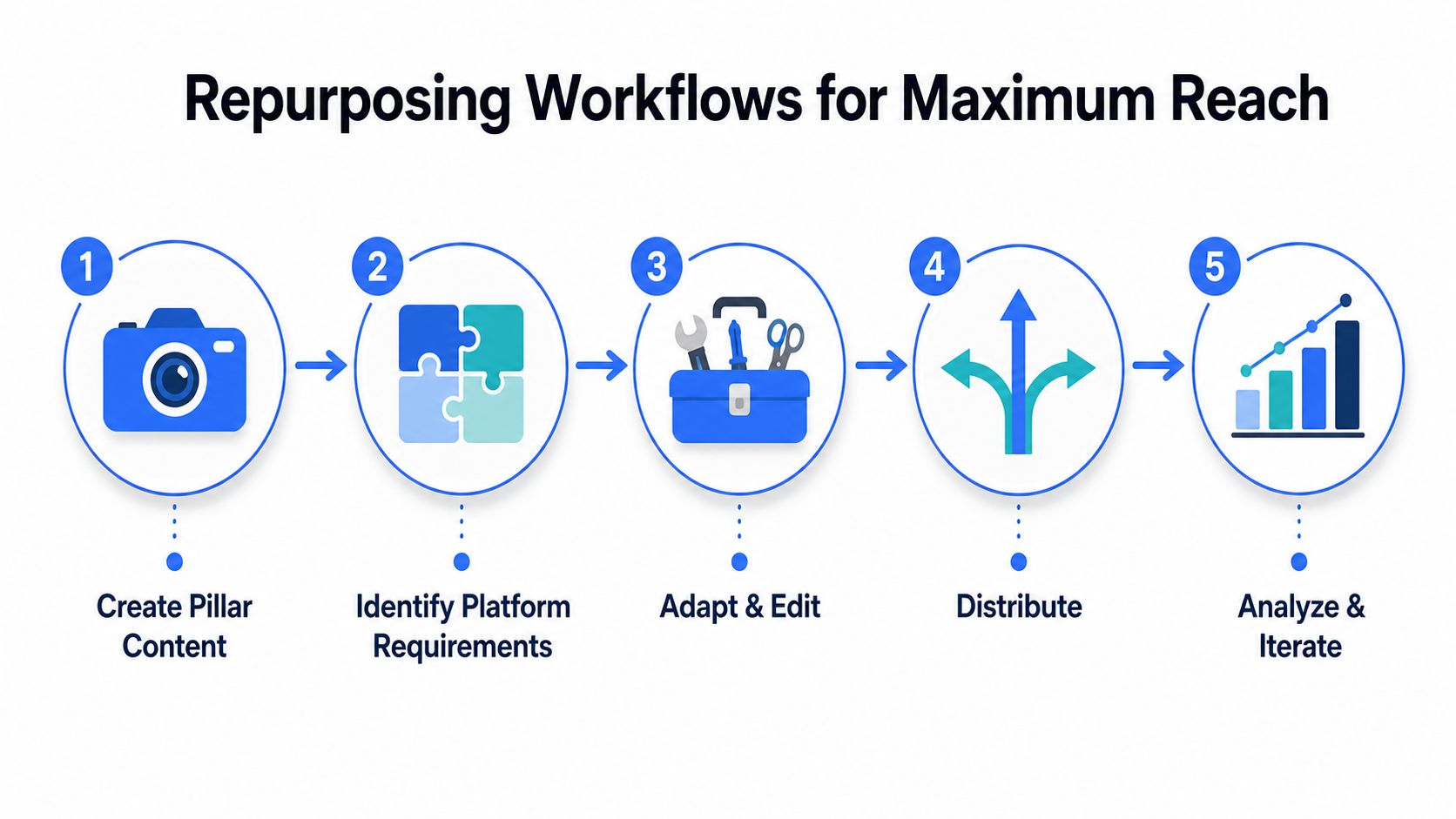
Repurposing works when you design for it from the start. If the original shoot is too narrow, every cut feels forced. If the source footage is built around a clear narrative spine, one production day can support a much wider distribution plan.
Build once, then cut for intent
Start with a pillar asset that can hold up in more than one format. That could be a brand film, a customer interview, a webinar, a product demo, or a founder-led explanation. From there, isolate the moments that carry proof, emotion, objection handling, or visual payoff.
Then adapt by platform rather than duplicating the same file. A long-form interview can become multiple short clips, but each one needs its own opening and its own reason to exist. A horizontal video can be reframed into vertical, but only if the shot composition and text placement were planned with that in mind.
The system by Narrareach is a useful reference point for teams that want a more operational view of repurposing across channels without losing platform-native feel. The main lesson is that repurposing is not compression, it's translation.
What translates and what doesn't
Some elements carry across platforms cleanly. A strong customer quote, a visual proof point, and a clear offer can usually survive adaptation. Other elements are platform-specific, especially pacing, caption style, on-screen text density, and how much context the viewer needs before the point lands.
If you're managing assets at scale, keep the source footage organized by theme, not just by shoot date. That's where a disciplined video asset management workflow pays off, because editors can find usable fragments without digging through unstructured drives and old exports.
The internal logic is simple. One shoot should produce a small number of primary assets, then a larger number of cuts with distinct platform jobs. A product demo can become a short awareness cut, a deeper explainer, a testimonial snippet, and a retargeting version with a stronger call to action.
Here's the discipline many teams skip, don't repurpose everything. Some moments are worth leaving in the long-form version because they build context there and nowhere else. A repurposing system gets stronger when editors protect the original narrative instead of trying to atomize every scene.
Paid Amplification and Budget Allocation
Organic reach helps, but it rarely carries the full plan. Paid amplification turns a decent clip into a distribution test, then turns the strongest performers into a repeatable system. The error is treating paid social as a late add-on instead of part of video planning from the start.
That matters because distribution patterns are shifting fast. Analysts at Marketing Tech News noted that short-form publishing climbed sharply, with different momentum on TikTok and Instagram. If the volume mix keeps changing, media support should follow platform behavior, not instinct.
Allocate by objective, not by habit
Awareness work belongs where discovery is strongest and the opening hook can do the heavy lifting. Consideration work needs more room for proof, which often means longer edits, clearer product context, or creator-led explanation. Conversion work usually needs the shortest path from message to action, with less clutter and fewer competing claims.
The budget conversation should start with the job of the creative. A sharp 15-second hook and a detailed product walkthrough should not receive the same media treatment. The hook may deserve broad prospecting spend. The walkthrough may perform better in retargeting or mid-funnel placement, where intent is already warmer.
Use paid to learn, not just to scale
Boosting every organic winner is a weak habit if the asset was never built for paid delivery. Some posts win organically because they feel native in feed, yet they lack the clarity or offer structure needed for efficient paid performance. Others underperform organically and still work in paid because targeting and sequencing change the context.
Busylike, for example, combines production, paid video advertising, and channel management across YouTube and social, which is the kind of setup many teams need when creative and media buying have to follow the same plan. Paid media should feed creative iteration, not sit in a separate workflow.
Live-streaming can also play a role if the funnel needs more direct interaction. It will not replace short-form, but it can add a different trust signal when the objective is to create a more immediate response.
Measurement Frameworks That Drive Decisions
Views tell you that something was played. They don't tell you whether the video helped the business. That gap is why so many teams feel busy and still can't defend the budget.
Measure by funnel stage
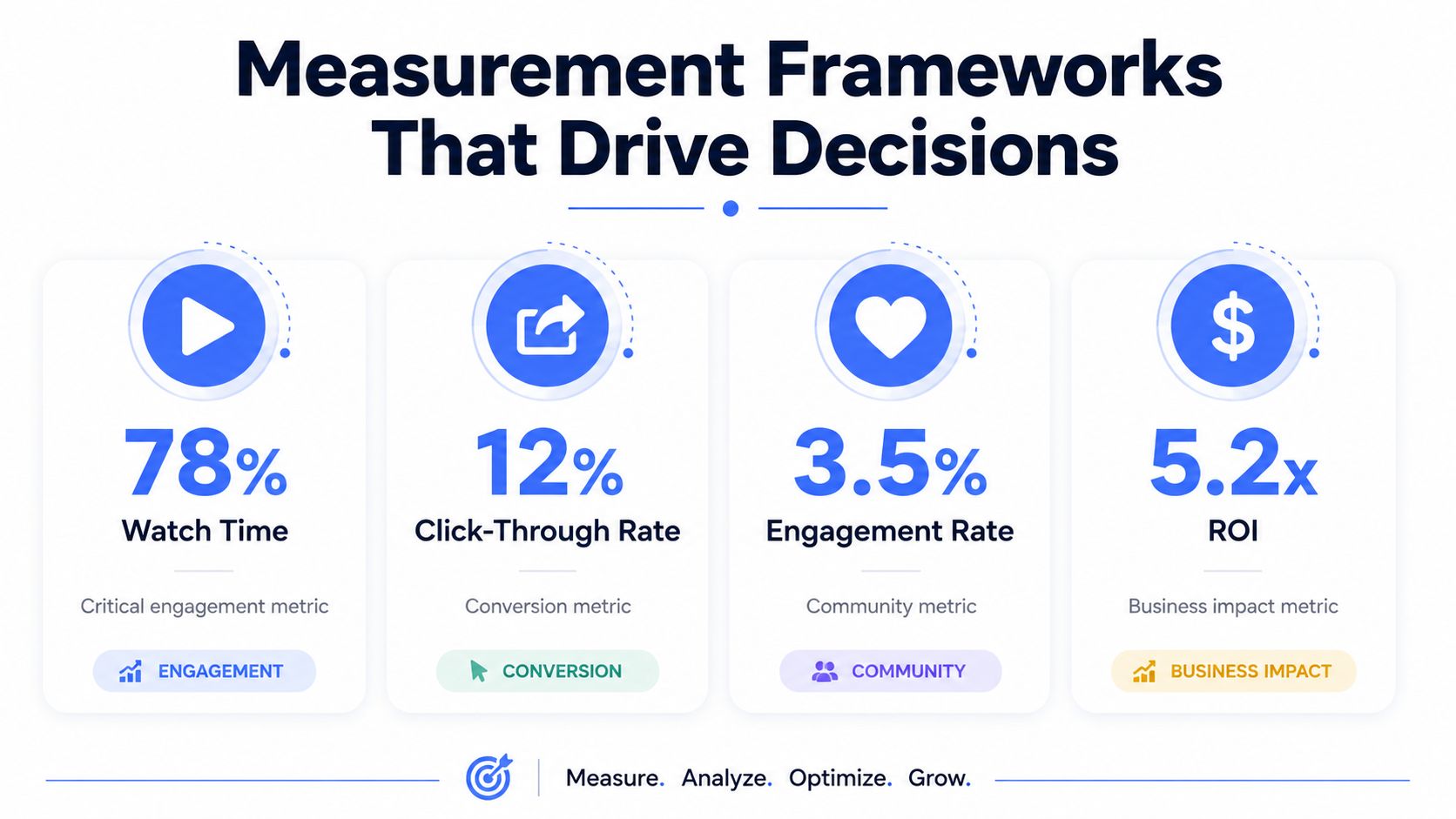
At the top of the funnel, watch behavior matters more than clicks because you're testing whether the creative can earn attention. Mid-funnel, click-through and engaged viewing tell you whether the audience wants more detail. At the bottom of the funnel, attribution quality matters because the question shifts from interest to incremental revenue.
That's where cross-platform measurement gets messy. A viewer may see a TikTok clip, watch a YouTube explainer later, and convert after a retargeting ad on Instagram. Without a structured attribution model, the last touch gets too much credit and the earlier video assets look less valuable than they really are.
Use tools that connect video to outcomes
If the team is serious about proving impact, the measurement stack needs more than native analytics screenshots. A practical setup usually combines platform reporting, CRM tracking, and campaign-level attribution. For a deeper operational view, Cometly's video attribution resource is a useful reference for teams trying to map video exposure to downstream activity without overcounting last-click behavior.
The internal reporting layer should answer four questions clearly. Which formats held attention? Which clips drove clicks? Which channels assisted conversions? Which assets deserve a larger share of budget next month?
Decision rule: keep optimizing for engagement only when the goal is reach or education. Once the goal is pipeline, the dashboard has to show movement beyond vanity metrics.
The cleanest teams also separate reporting by objective. Awareness content should not be judged by the same standard as a direct-response cut. If stakeholders can see the logic from format to funnel stage to metric, they make better budget decisions and less destructive creative requests.
Video SEO guidance can help teams add another layer of discoverability to that reporting stack, especially when YouTube is part of the mix and organic search remains relevant. The point is to treat measurement as a planning tool, not a postmortem.
Busylike helps marketing teams plan, produce, and manage video across YouTube, CTV, and social, with strategy that connects creative, paid media, and channel optimization. If you need a clearer platform allocation model, better repurposing workflows, and video that's built to perform across the funnel, visit Busylike and see how their team approaches video from concept through distribution.

