
Google AI Mode Advertising Campaigns: Stats and Trends in 2026

Updated: Aug 11
Advertising is evolving rapidly, and Google AI Mode is at the forefront of this transformation. By 2026, this technology has reshaped how advertisers create, manage, and optimize campaigns. This post explores how Google AI Mode works, key statistics from 2026, examples of brands using it successfully, tips for building effective campaigns, real-world case studies, and what lies ahead for this technology.
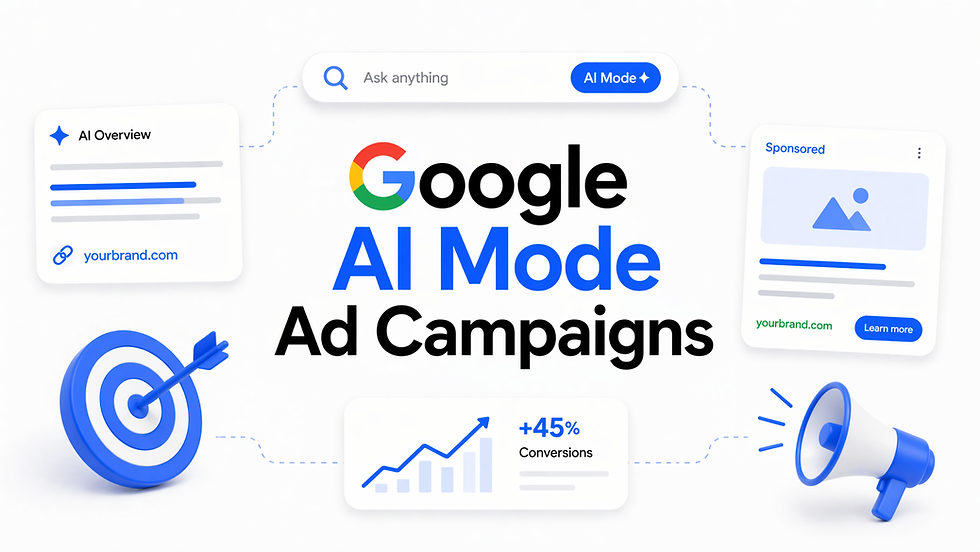
How Google AI Mode Advertising Actually Works
At Google Marketing Live on May 20, 2026, Google introduced two Gemini-powered ad formats built specifically for AI Mode: Conversational Discovery ads and Highlighted Answers. Both place paid placements directly inside AI Mode's conversational responses rather than alongside a traditional results list, and both are clearly labeled "Sponsored."
The shift that matters most is in creative generation. With Conversational Discovery ads, Gemini builds tailored ad creative in real time for the specific question a person asked, rather than serving a static asset an advertiser pre-built. Google's own example: someone asks how to make their home smell like "fancy spas or a rainy forest" using low-maintenance solutions, and Gemini generates creative and surfaces product features tied directly to that query.
Each ad also pairs with an independent AI explainer — a separate Gemini-written summary that synthesizes information about the product or service alongside the advertiser's creative.
As of publication, both formats are in testing in the U.S. market, with no confirmed public rollout date.
General Statistics on Google AI Mode in 2026
By 2026, Google AI Mode has become a standard tool for advertisers worldwide. Some notable stats include:
AI Mode has crossed 1 billion monthly users.
Per Google's own research, 75% of shoppers say AI Mode in Search helps them make faster, more confident purchasing decisions.
Independent research from SISTRIX (100 million German keywords) found position-1 organic CTR drops from 27% to 11% when an AI Overview is present — a 59% reduction. A separate Ahrefs study (300,000 global keywords) found roughly 58% lower CTR with an AI Overview present.
Google also announced Asset Studio with Gemini Omni, a creative tool that generates images, video, and copy from a single brief.
Note: performance figures (conversion lift, CPA reduction, adoption rate) specific to the new AI Mode ad formats are not yet public, since the formats are still in testing.
How to Create a Great Campaign Using Google AI Mode
Building a successful campaign with Google AI Mode involves several key steps:
Set clear goals
Define what success looks like, whether it’s sales, leads, or brand awareness.
Provide quality data
Feed the AI with accurate conversion tracking and audience insights to improve learning.
Use diverse creative assets
Upload multiple headlines, descriptions, and images so AI can test combinations.
Choose the right campaign type
Google AI Mode works well with Search, Display, and Video campaigns, but pick the one that fits your objectives.
Monitor and adjust
While AI handles optimization, review performance regularly to tweak budgets or goals.
Leverage AI search ads
These ads use AI to match user queries with the most relevant ad copy dynamically, increasing relevance and engagement.
Following these steps helps advertisers get the most from Google AI Mode’s capabilities.
Early Real-World Signal: The Direct Offers Pilot
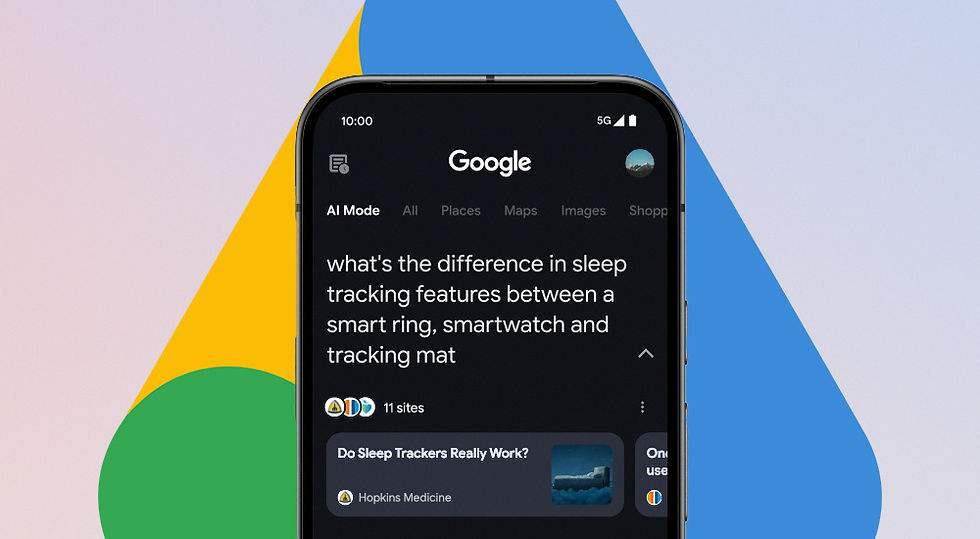
While Conversational Discovery ads and Highlighted Answers are still in testing, Google has been running a related pilot called Direct Offers since January 2026. Brands including Chewy, Gap, and L'Oréal have used it to surface relevant deals directly as shoppers explore options inside AI-powered search experiences. This is the most concrete real-world signal available right now.
What the Future Holds for Google AI Mode in Advertising
Looking ahead, Google AI Mode is poised to undergo significant evolution in tandem with ongoing advances in artificial intelligence and the increasing availability of data. As we navigate this ever-changing landscape, several expected trends are likely to emerge, shaping the future of digital advertising and marketing strategies. These trends will not only enhance the effectiveness of campaigns but also redefine how advertisers interact with consumers in a more dynamic and engaging manner.
Greater integration with voice and visual search
As technology continues to advance, artificial intelligence will play a pivotal role in optimizing advertisements for emerging search formats, particularly voice and visual search. This evolution means that campaigns will become increasingly interactive, allowing users to engage with content in a more natural and intuitive way. Voice search, powered by AI, will enable advertisers to create ads that respond to spoken queries, providing immediate and relevant information. Meanwhile, visual search capabilities will allow users to find products and services by uploading images, prompting AI to generate tailored ads that resonate with the user's visual preferences. This shift toward more immersive and responsive advertising experiences will create a more seamless connection between consumers and brands, ultimately enhancing user engagement and conversion rates.
Improved cross-channel coordination
Another significant trend on the horizon is the enhanced coordination of advertising campaigns across various Google platforms and partner sites. AI will take on a crucial role in managing these campaigns, ensuring that messaging remains consistent and cohesive across different channels. This unified approach will allow advertisers to deliver a more holistic brand experience to consumers, regardless of where they encounter the brand. By leveraging AI's capabilities, advertisers can optimize their messaging in real time, tailoring content to fit the specific context of each platform while maintaining a strong brand identity. This strategic cross-channel coordination will not only streamline marketing efforts but also improve overall campaign effectiveness, leading to better results and increased return on investment.
More transparent AI decision-making
In an era where trust and transparency are paramount, Google is committed to enhancing the transparency of its AI decision-making processes. Advertisers can expect to receive clearer explanations of the choices made by AI algorithms, fostering a deeper understanding of how their campaigns are being optimized. This transparency is crucial for building trust between advertisers and the platforms they use, as it demystifies the often-complex workings of AI technology. By providing insights into the rationale behind AI-driven decisions, Google aims to empower advertisers with the knowledge they need to make informed adjustments to their strategies, ultimately leading to more effective campaigns and better alignment with business objectives.
Enhanced creative generation
Enhanced creative generation is already here, not just coming. At the same event where AI Mode ad formats were announced, Google introduced Asset Studio with Gemini Omni — a creative tool that generates images, video, and copy from a single brief. That's a meaningful shift for advertisers who previously had to produce and upload multiple static assets manually.
Stronger privacy controls
As concerns about user privacy continue to grow, AI will play a crucial role in balancing the need for personalization with the imperative of protecting user data. Google is committed to implementing stronger privacy controls that adapt to new regulations and consumer expectations. This includes ensuring that AI-driven advertising practices respect user consent and preferences while still delivering relevant content. By prioritizing privacy, Google aims to build a more sustainable advertising ecosystem that fosters trust and loyalty among consumers. Advertisers who embrace these privacy-focused strategies will not only comply with regulations but also differentiate themselves in the marketplace by demonstrating a commitment to ethical advertising practices.
In conclusion, advertisers who adopt Google AI Mode early and remain informed about ongoing updates and trends will gain a significant competitive edge in the digital advertising landscape. By leveraging the advancements in AI technology, they can create more engaging, effective, and responsible advertising campaigns that resonate with consumers and drive meaningful results.

Frequently Asked Questions (FAQ)
What is Google AI Mode in advertising?
Google AI Mode refers to AI-driven search and discovery experiences—such as AI-generated overviews and conversational results—where users receive direct answers instead of traditional link-based results. In this environment, advertising becomes more contextual, integrated, and intent-driven.
How does Google AI Mode impact advertising strategies?
It shifts focus from keyword-based targeting to intent-based visibility. Brands must now optimize for inclusion within AI-generated responses, while also leveraging new ad formats that appear alongside or within these experiences.
What are the key advertising trends in Google AI Mode for 2026?
Key trends include:
Increased visibility of AI-generated answers over traditional search results
Growth of contextual and native ad formats
Greater emphasis on high-quality, structured content
Two new Gemini-powered formats — Conversational Discovery ads and Highlighted Answers — placing sponsored content directly inside AI Mode's conversational responses
Real-time optimization powered by AI signals
How do ads appear in AI-powered Google experiences?
As of the May 2026 Google Marketing Live announcement, ads appear via two specific formats: Conversational Discovery ads, which generate tailored creative in real time for a person's specific question, and Highlighted Answers. Both are clearly labeled "Sponsored" and paired with an independent AI-generated explainer summarizing the product or service.
Why is content quality more important in AI Mode?
AI systems prioritize clear, authoritative, and well-structured content when generating answers. High-quality content increases the likelihood of being surfaced organically and supports better performance in paid placements.
What is the relationship between SEO, GEO, and Google AI Mode?
SEO helps you rank in traditional search, while GEO (Generative Engine Optimization) ensures your brand appears in AI-generated answers. In Google AI Mode, both strategies must work together to maximize visibility.
How should brands adjust their media budgets for AI Mode?
Brands are shifting budgets toward:
AI-optimized content creation
Testing new AI-native ad formats
Increased investment in performance-driven media
Continuous experimentation and optimization
What metrics matter in Google AI Mode advertising?
Key metrics include:
Visibility in AI-generated results
Share of voice within AI overviews
Engagement with AI-driven ad formats
Traffic and conversions from AI experiences
What are the risks of not adapting to Google AI Mode?
Brands risk losing visibility as traditional search real estate shrinks. If your brand isn’t included in AI-generated answers, you may be excluded from high-intent decision moments.
How can brands get started with Google AI Mode advertising?
Start by auditing your current AI visibility, optimizing your content for AI discovery, and testing emerging ad formats. Continuous monitoring and adaptation are key as the ecosystem evolves.
