
Amazon Prime Video Ads: Formats and Shopping

Amazon reached more than 315 million average monthly ad-supported viewers globally in 2025, measured from September 2024 through August 2025 and reported by Marketing Week. That's a larger ad audience than most free streaming services ever assemble, and it sits inside a paid subscription.
The number is a door count, not a stopwatch. It says how many people opened Prime Video in a given month, not how much television time Amazon now owns, and it tells you nothing about which of those viewers your brand can reach profitably. Amazon Prime Video ads deserve a careful plan for two reasons: the shopping formats now let a viewer act without leaving the show, and most of the proof Amazon can hand you works far better if you already sell on Amazon.
Table of Contents
How Large the Ad-Supported Audience Is - What monthly reach does not measure
Three Buys That Use the Inventory Differently - A marketplace brand with live ASINs - A non-endemic SaaS or healthcare brand - A tentpole flight around Thursday Night Football
Where Prime Video Sits in a Video Plan - The overlap question to ask before adding budget
How Large the Ad-Supported Audience Is
In January 2024, Amazon switched advertising on across Prime Video as the default experience for subscribers in the United States, then extended the same model to the United Kingdom, Germany, Austria, Canada, France, Italy, Spain, Mexico, and Australia. Viewers who wanted the uninterrupted version paid an extra $2.99 a month. Campaign Asia's account of Amazon's ad business records that by May 2024 fewer than 10% of Prime subscribers had paid that fee.
That opt-out rate is the detail worth remembering. Amazon didn't ask viewers to pick an ad-supported plan the way rivals did. It moved the entire subscription base into the ad experience and turned ad-free into an upgrade, so most of the audience stayed reachable without doing anything at all.
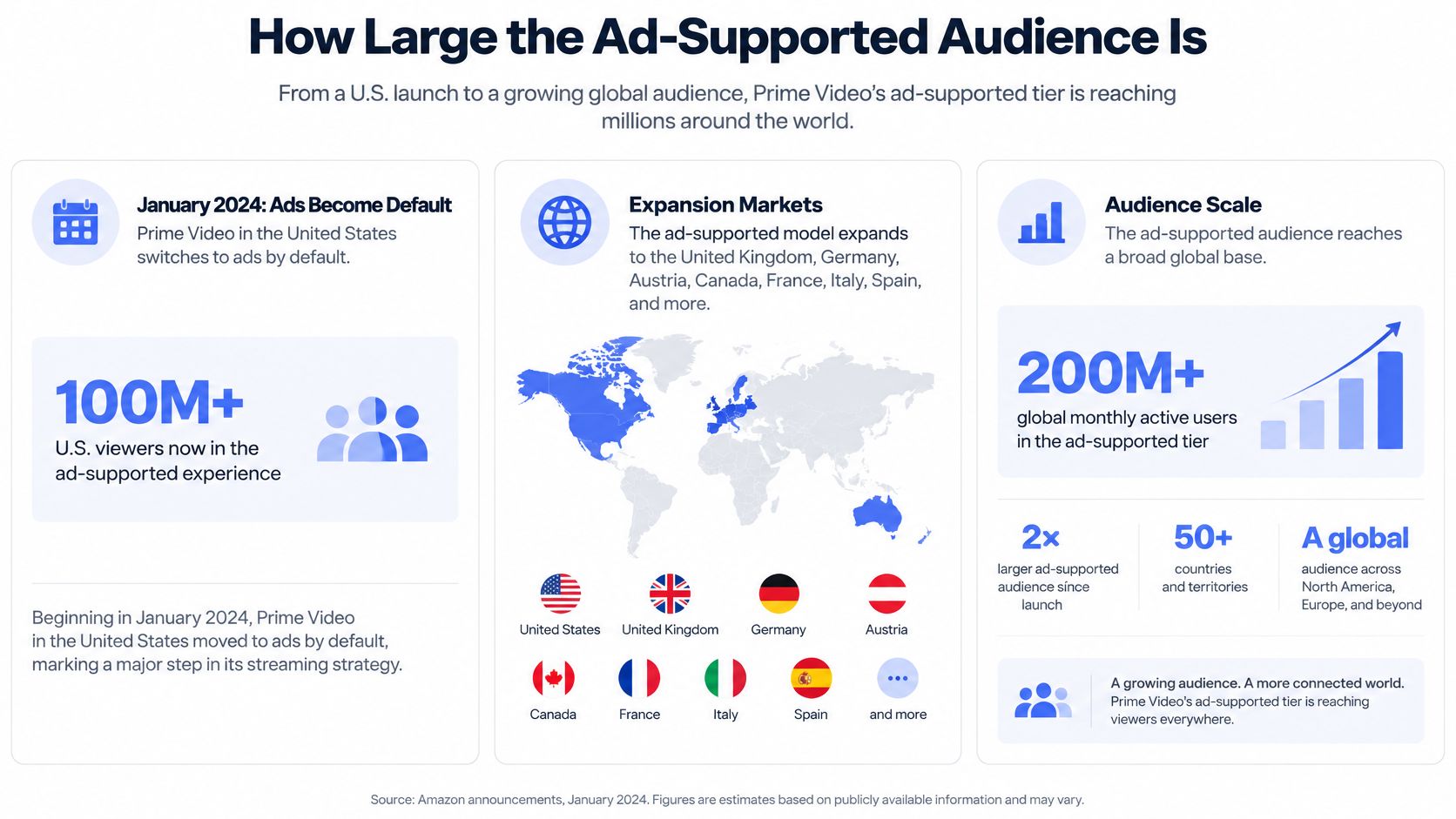
Here is the scale as published, with each denominator kept separate so you can see what is being counted.
Market and period | Figure | What it counts | Source |
|---|---|---|---|
Global, April 2024 | More than 200 million | Average monthly ad-supported viewers | Amazon |
Global, Sep 2024–Aug 2025 | 315 million | Unduplicated average monthly ad-supported audience | Amazon |
United States, 2024 to 2025 | More than 115 million, then more than 130 million | Monthly ad-supported customers | Amazon |
United States, 2024 | 130.4 million, 57.6% of subscription OTT viewers | Ad-supported viewers | EMARKETER |
United Kingdom, Q3 2024 | 11.5 million homes, 86% of Prime Video homes, 39.3% of UK homes | Homes on the ad tier | BARB |
Ad-free opt-out, launch | $2.99 per month; under 10% paid by May 2024 | Subscribers who removed ads | Amazon reporting |
The gap between the first two rows is the headline Amazon sells. The later global figure sits 115 million viewers, or approximately 57.5%, above the April 2024 count of more than 200 million, and Amazon describes it as an unduplicated average monthly audience spanning originals, licensed series and films, live sports, events, and free ad-supported channels, as the Economic Times report on the 315 million figure sets out.
Independent research fills in country detail. EMARKETER counted 130.4 million U.S. ad-supported viewers in 2024, equal to 57.6% of subscription OTT viewers, according to EMARKETER's Prime Video audience analysis. In the UK, BARB's establishment survey found 86% of homes with Prime Video access were on the ad tier in Q3 2024, which works out to 11.5 million homes or 39.3% of all UK homes, per BARB's Q3 2024 SVOD data.
What monthly reach does not measure
Every figure in that table counts whether someone watched during a month. Not one of them counts hours. A household that caught a single period drama in four weeks and a household that runs Prime Video most evenings both appear once in a monthly reach total, so the same number can hide wildly different amounts of attention.
Amazon's figures are also internal estimates over defined periods, and country totals shift with launch timing. Read them as platform-reported audience estimates, not as an audited census.
Use the table for scale, not for a plan. Ask for reach, frequency, and completion by country before you convert a global headline into budget.
The sequence is short. Use the published numbers to confirm the audience is big enough to matter in your category, then get market-level reach and frequency for the countries you sell in. One global figure is context. It isn't a media plan.
Formats From Standard Spots to Shoppable Breaks
Strip away the targeting layer and a Prime Video ad is a commercial inside a premium stream, running before or during a series, a film, or a live event. What changed with the shopping formats is what a viewer can do while the stream keeps running.
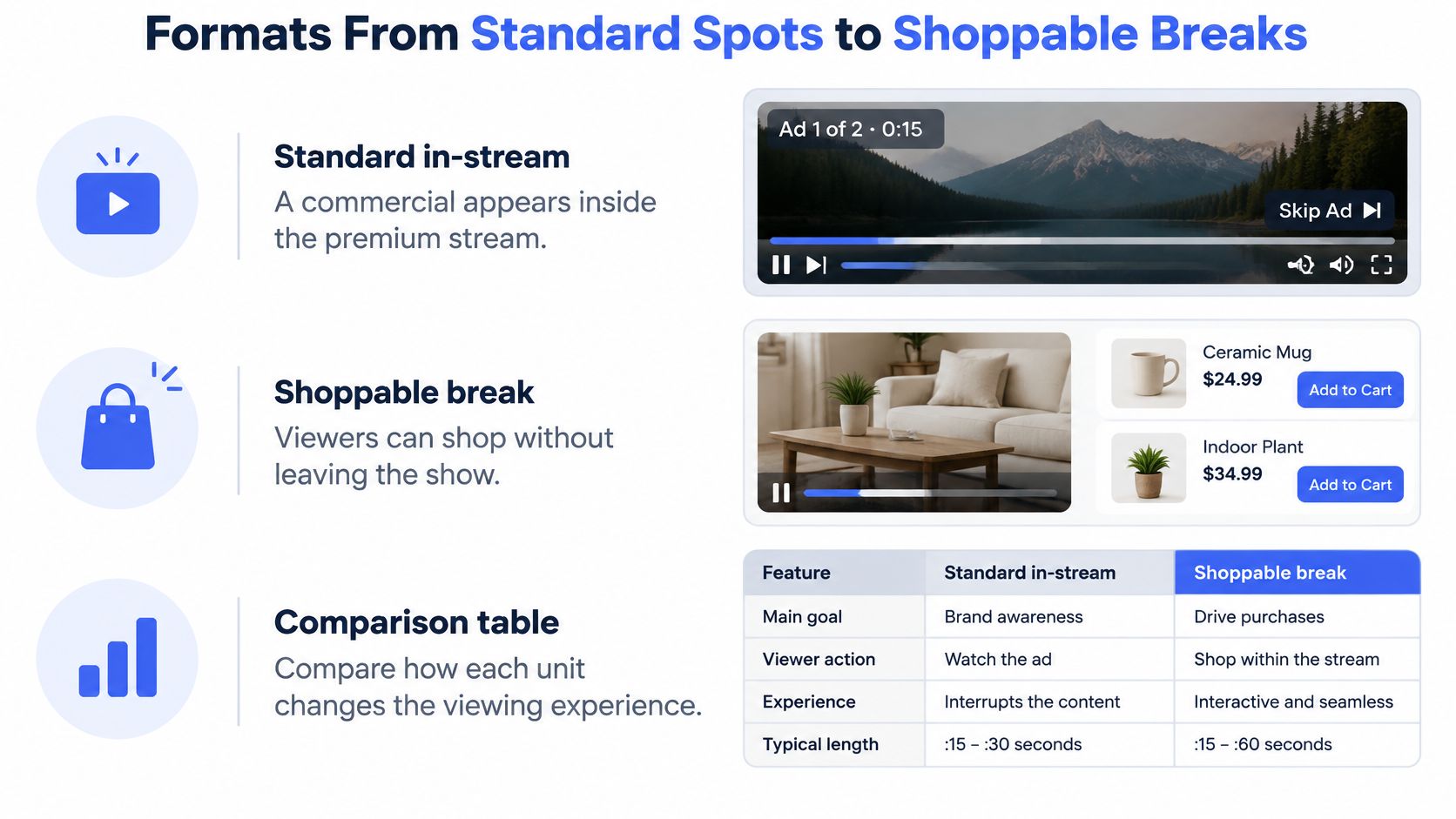
A compatible living-room remote, a phone, or a voice command is the entire interface. Viewers can click, scan, or speak to drop a featured product into an Amazon cart or request more information without leaving the show, as Amazon's interactive ads guide describes it.
Format | When it appears | Viewer action | Best campaign job | Reported result |
|---|---|---|---|---|
Standard in-stream spot | Commercial break in series, films, or live programming | Watch a 15, 30, 45, or 60 second spot | Reach and brand memory | No separate performance figure published; judged on completed views |
Shoppable carousel | Break, as a sliding product lineup | Browse with a remote; the ad pauses, then resumes | Product discovery and add to cart | Part of Amazon's 10x product-page views and conversions versus non-interactive ads |
Interactive pause ad | When the viewer pauses a program | Add to Cart, Learn More, or request email, then resume | Shopping or lead capture at a natural stop | Part of the same interactive comparison |
Interactive brand trivia | During the break as a branded interaction | Answer or engage, and can connect to shopping | Attention and branded memory | No separate figure published; counted inside the interactive comparison |
Thursday Night Football | Live NFL broadcast on Prime Video | Watch live; interactive units may sit around the game | Simultaneous mass reach and a seasonal tentpole | No performance figure published; sold on live simultaneous audience |
Amazon introduced three shopping-oriented formats together: shoppable carousel ads, interactive pause ads, and interactive brand-trivia ads, announced on the Amazon Ads blog. The carousel slides a lineup of related products through the break. A viewer moves along it with the remote, the ad holds while they browse, and the chosen item goes to a cart before playback picks up again.
Pause ads work differently because the viewer starts them. Instead of a static pause screen, they see a translucent branded overlay with buttons such as Add to Cart and Learn More; the overlay stays up while the program is paused, so a bathroom break becomes a cart add or an email request, as Android Authority's walkthrough of the formats explains. Trivia ads spend the break on a branded interaction rather than a silent spot.
The only performance claim in that table to treat carefully is the 10x. Amazon's cited comparison found advertisers using interactive formats alongside non-interactive video ads for Amazon product listings generated 10 times more product-page views and conversions than with non-interactive formats alone. That's a format-specific result for listings, not a promise for a brand with no ASINs.
Thursday Night Football is the other kind of buy entirely. It's live NFL inventory whose job is mass simultaneous reach, not a product carousel. If you want the deeper mechanics of units that keep viewers inside the player, this breakdown of shoppable video ads covers how the interaction layer is built. Then pick the row from the campaign job: memory and reach, on-Amazon product discovery, or a live tentpole.
Creative Specs That Clear Delivery
Treat the spec sheet as a delivery gate. A file either passes review and survives encoding or it does not, and the requirements below come from Amazon's Prime Video streaming TV ad specs.
Spec | Requirement |
|---|---|
Aspect ratio | 16:9 |
Minimum frame size | 1920×1080 |
Maximum file size | 500 MB |
Frame rate | Constant 23.976, 24, 25, or 29.97 fps |
Bitrate | Minimum 15 Mbps; 50 Mbps recommended |
Audio | AAC, minimum 192 kbps, 44.1 or 48 kHz, at least two channels |
U.S. spot lengths | 15, 30, 45, and 60 seconds |
The gap between the 15 Mbps floor and the 50 Mbps recommendation is headroom for encoding. Fast motion, small type, and gradients show damage first, so a file that barely clears the minimum can look softer on a TV than it did in the edit. A vertical social cut, a variable frame rate, or single-channel audio will bounce or arrive sounding thin.
The export routine
Master at 1920×1080 or higher in a 16:9 timeline, so the cutdowns inherit the resolution.
Export a constant-frame-rate file with headroom toward 50 Mbps, using the codec your Amazon delivery contact confirms.
Check the audio chain. AAC stereo, 44.1 or 48 kHz, at least 192 kbps, and loudness validated before trafficking.
Cut the 15, 30, 45, and 60 second versions from the same master so the look stays consistent across lengths.
Check product, price, and legal frames after encoding, especially where a carousel or pause overlay may sit beside them.
Three failures commonly cause files to be rejected: a vertical social cut submitted as a master, a variable frame rate inherited from a camera phone, and interactive overlays baked into the base film. The remote interaction lives in the ad product, not in every frame, so the film itself has to be clean.
If your team already cuts social-first video and needs a 16:9 base quickly, ShortGenius AI video ad maker can generate a starting master for this pipeline. The export still has to meet every row above once it reaches Amazon.
The master is ready when the longest spot and the shortest cut both survive a playback check on a TV-sized screen.
Three Buys That Use the Inventory Differently
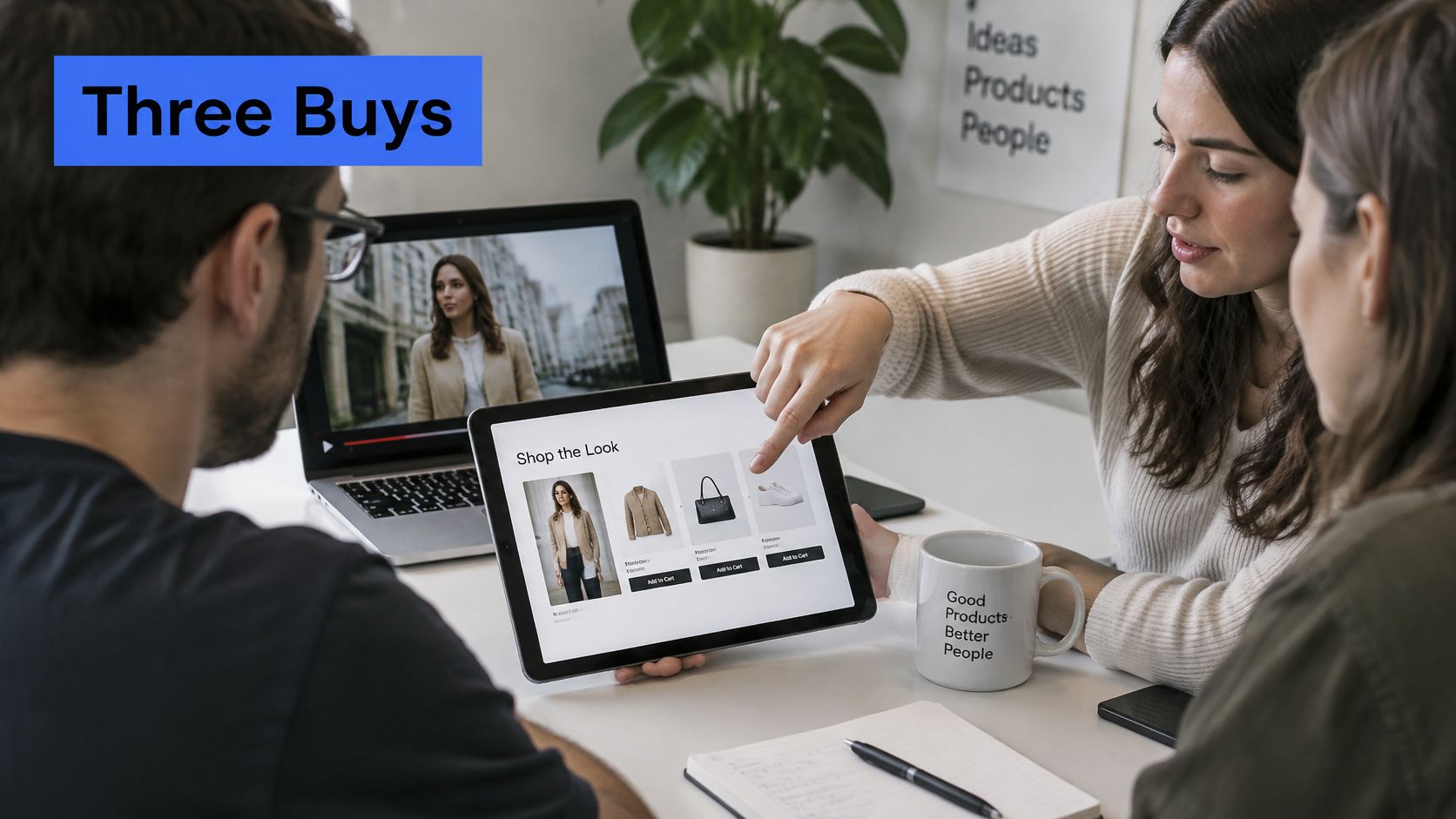
Three briefs, three different answers. Read them in the same order: the situation, the format choice, and the outcome that would prove it worked.
A marketplace brand with live ASINs
The brand sells on Amazon and has a hero SKU plus two natural complements. The buy pairs a 15 or 30 second spot for the hero with a shoppable carousel carrying all three products, and the pause unit repeats Add to Cart for the same hero. Success is product-page views and cart adds during the flight, read next to the impression, not a vague brand score. A shoppable flight planned through Amazon DSP for video advertisers can put those units in front of the audiences already shopping the category.
A non-endemic SaaS or healthcare brand
There's no cart to fill. The spot stays a clear problem-and-proof story, a pause or trivia unit asks for Learn More or an email address, and the landing page lives off Amazon where the compliance and sales teams can see it. The streaming exposure still does its job, but the shopping integration is a lead door, not a checkout. Judge it on qualified visits and cost per lead, never on cart adds it was never built to earn.
A tentpole flight around Thursday Night Football
The brand buys the live NFL audience for a short window around the game. A 15 or 30 second spot has to be understood over the noise of a living room, so the offer lands in one sentence and the logo appears early. Nobody expects a carousel to do the work of a broadcast. The metric is simultaneous reach and lift in the weeks around the game.
The edge case is a brand that both sells on Amazon and needs awareness. Run two flights rather than averaging the goals into one film: a shoppable flight against ASINs, and a separate football or series flight for reach. Interactive action through a remote, phone, or voice works best when the offer is one product or one next step. Ask for a homepage and you'll lose the room.
Measurement When the Sale Is Not on Amazon
Split the dashboard before you open it. Delivery metrics are reach, frequency, completion, and incremental reach after deduplication against other CTV and video. Outcome metrics are brand lift, site visits, qualified leads, offline sales, CRM conversions, or Amazon purchases. Mixing the two is how good campaigns get cancelled.
Amazon's commerce graph is strong for brands with ASINs. Product-page views, add-to-cart, and purchase-path reporting can sit directly next to the impression, which is why this analysis of advertising on Prime Video argues the platform's measurement story is more persuasive for Amazon-commerce advertisers than for everyone else.
Roughly 88% of Prime Video viewers have shopped on Amazon, according to that same analysis. Read it correctly: it shows commercial familiarity with Amazon, not that an impression caused a purchase, and not that the audience is equally valuable in every category.
Two questions to settle before launch. Which outcome can this brand actually observe, and which method will show that outcome moved because of the ad?
For SaaS, healthcare, technology, and other non-endemic advertisers, the sale or the qualified visit usually happens outside Amazon, so an on-Amazon conversion report will understate the job or measure the wrong one. Build a paired plan instead. Use Amazon reporting for delivery and, where it applies, ASIN outcomes. Use an independent brand-lift, geo, or audience test for consideration, site, and CRM outcomes.
Published lifts for the newer interactive formats, including awareness and purchase intent, are directional and format-specific until your own test repeats them. Two errors to avoid: reading a high completion rate as incremental reach, and judging a non-endemic campaign by cart adds it was never designed to produce.
Where Prime Video Sits in a Video Plan
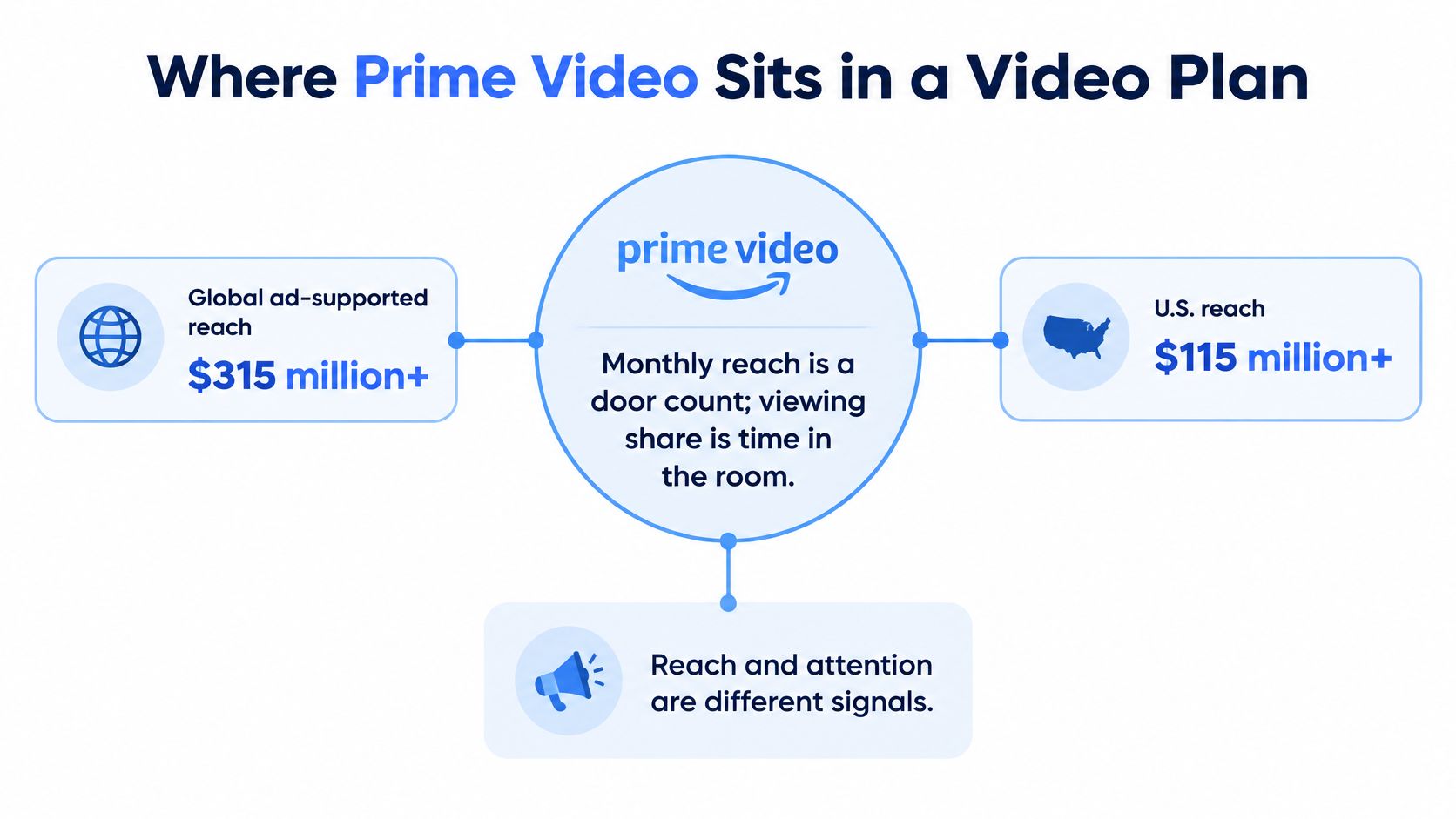
Monthly reach is a door count. Viewing share is time in the room. The two get quoted interchangeably, and that's where video plans go wrong.
Reporting has put global ad-supported reach above 315 million monthly viewers and U.S. reach above 115 million, while a separate viewing-share analysis places Prime Video at roughly 4.2% of U.S. TV viewing, as Amazon's own Prime Video advertising briefing sets out alongside those figures. Different denominators, different stories. You can add a large number of new people and still buy a modest slice of viewing hours.
That's why Prime Video usually works as an incremental premium video layer rather than a replacement for anything. YouTube still owns intent and search-adjacent viewing. Paid social still tests creative faster than any TV buy. Linear television still holds the mass hours in many markets. Prime Video sits alongside them with premium sight, sound, and motion plus a route to an Amazon cart or a learning moment.
The overlap question to ask before adding budget
How many Prime Video households were already reached on other CTV? What frequency remains after deduplication? Does completion hold on the live sports subset the way it does on demand series? Those three answers decide whether the buy adds reach or just re-buys the same people at a higher price.
Inventory quality varies too, because the reach pool mixes originals, licensed programming, live sports, events, and free ad-supported channels. A sponsor paying for prestige drama and a brand landing in a free channel are both counted in the same headline. If you also run Amazon search and sponsored placements, aligning the two buys is where efficiency improves; this guide to lower ACOS with smarter campaign optimization covers how sponsored campaigns are tuned alongside streaming exposure. For the wider category context, what CTV ads mean for budget allocation is worth reading before you set the split.
Use Prime Video when the job is premium video with a path to a cart or a learning moment, and use Thursday Night Football when the calendar needs a shared live event. Don't use the headline audience to justify pulling the whole video budget into one streamer.
Fund a flight large enough to read incremental reach and your chosen outcome. Then keep it, cut it, or pair it with YouTube or social based on overlap, not on the monthly reach number.
Decide the Buy and Brief the Work
Buy Prime Video when three checks pass. The country in the table is one you sell in. The format matches an on-Amazon product or a single off-Amazon next step. You can read incremental reach plus one outcome beyond completion. If any of the three fails, the buy isn't ready.
Wait when the only justification is the 315 million headline, when the product can't be shown clearly in 15 or 30 seconds, or when nobody owns the overlap report against YouTube and other CTV. Those are stop signs, not details to sort out later.
When the rule says go, the brief names five things: the format, the 16:9 master and its shorter cutdowns, the offer on the carousel or pause screen, the flight window including any Thursday Night Football dates, and the metric pair of delivery plus outcome. A brief that pins down all five goes into production once; a brief that leaves the offer or the flight window open comes back for a second round of approvals, and the launch date slips with it.
Two gaps close with Amazon or your agency before money moves. Pricing, buying access, and Thursday Night Football schedules are not set out in this guide, so confirm them directly with Amazon before committing budget rather than inheriting a number from a deck. Teams already producing retail media video can adapt that work to these specs and cut one film for both product pages and off-site placements; Busylike builds retail media ads to the specs of Amazon, Walmart Connect, and Instacart, so that adaptation is a familiar route. Book that conversation after the overlap question is written into the brief, not before.
Prime Video advertising rewards teams that treat it as a production and measurement problem first and a reach headline second. Busylike produces the 16:9 master and its 15, 30, 45, and 60 second cutdowns, adapts the master into platform-ready cutdowns for product pages and sponsored placements, and plans the flight so delivery and outcome are read together. If you want help deciding whether Prime Video belongs in your next plan, book a free consultation with Busylike and bring your overlap question with you.
