
Amazon DSP for Video Advertisers: How It Works in 2026

Amazon DSP accounted for 32% of total Amazon ad spend among the advertisers Digiday measured in the fourth quarter of 2024 (Digiday). That share is the clearest sign that the platform stopped being a side experiment. Video is the fastest-growing reason buyers open it, because the same seat that once bought display now buys streaming television, connected-TV apps and open-web video against Amazon's own audience data.

The decisions that follow are ordinary media decisions made in an unfamiliar interface. Which placements, which file for which placement, which audience signal, which metric, how much frequency, and who operates the buy. Get those six right and Amazon DSP behaves like a well-run television plan.
Table of Contents
Video Placements You Can Reach and Their Scale - Reading the Amazon-owned rows - Reading the partner and open-web rows
Video Specs for Amazon-Served and Third-Party Inventory - The muted-first checklist
Audience Targeting With Amazon and LinkedIn Signals - What the pairing looks like in practice
Viewability and Completion Metrics That Matter - What a weak result is telling you - Why last touch flatters the wrong ad
Cross-Screen Frequency and a Video Plan Example - A three-week sequence for a B2B brand
Choose Self-Service or Managed Access Before You Commit - The pre-commitment checklist
What Amazon DSP Is and Why Video Buyers Use It
An Amazon DSP seat is a buying counter. You arrive with three things: budget, audience rules and a video file. The counter puts that file into an auction across Prime Video, Fire TV, third-party streaming apps, display and audio, then reports back what ran. The alternative is what brands used to do: a separate account with every streaming service, separate minimums, separate reports and no way to stop the same household seeing the same spot four times.
That counter was assembled in stages. Amazon consolidated Amazon Marketing Services, Amazon Media Group and the Amazon Advertising Platform under a single Amazon Advertising brand in September 2018, which turned Amazon DSP into a programmatic buying system rather than only a search-advertising product (PPC Land's platform history). Two traits separate it from a plain video network: one campaign can buy Amazon-owned and third-party publisher inventory at once, and it can apply Amazon's audience signals, including shopping-related behavior, then extend those audiences across Amazon properties and third-party publishers.
Streaming and connected-TV inventory arrived after that consolidation, so capability varies by account, country and deal. Confirm what's live in your own seat before you brief a shoot.
Practical rule: Treat every placement list, including the tables here, as a starting point. Your account is the authority.
The order of work matters more than the tool. A reach goal, a consideration goal and a sales goal pull you toward different inventory, different creative lengths and different reporting. If the auction mechanics themselves are still fuzzy, our programmatic video ads explainer covers how bids, impressions and inventory meet before you commit a budget line.
Video Placements You Can Reach and Their Scale
Amazon reports an average monthly U.S. reach of approximately 200 million people for Streaming TV ads across Amazon-owned-and-operated properties and external inventory (Amazon Ads). That figure already includes Prime Video, which is the single most important thing to understand before reading the table below. The premium streaming and FAST row comes from Amazon's own reporting materials, which also describe deduplicated reach across Amazon Ads and partner inventory.
Placement | Environment | Reported scale or reach | Planning note |
|---|---|---|---|
Prime Video ads | Ad-supported streaming TV | About 315 million monthly ad-supported viewers across 16 countries by November 2025 (industry analysis) | Default viewing experience since January 2024 |
Streaming TV ads, Amazon and external inventory | Owned and external streaming TV | About 200 million average monthly U.S. reach | Suits broad U.S. video reach |
Fire TV | Amazon-owned connected TV | Counted inside Amazon's Streaming TV totals, not reported separately | Added through the November 2020 beta |
Roku partner CTV via Amazon DSP | Third-party connected TV | About 80 million connected-TV households, more than 80% of U.S. CTV homes (June 2025 partnership) | Partner inventory, figures come from the announcement |
Premium streaming and FAST ecosystem | Streaming and free ad-supported TV | More than 55 million monthly viewers (company-reported) | Treat as a planning input, not proof |
Desktop, mobile web and app video | Open web and apps | No published reach total, scale is set by the buy | Accepts Amazon-served and third-party-served creatives |
Reading the Amazon-owned rows
Prime Video moved to an ad-supported default viewing experience in January 2024, and industry analysis reported roughly 315 million monthly ad-supported viewers across 16 countries by November 2025. Those two Prime Video numbers and the Streaming TV figure describe overlapping audiences, so adding them together produces a headline nobody can buy. Fire TV inventory extends the same owned footprint into the connected-TV home screen; it doesn't create a separate audience pool.
Reading the partner and open-web rows
The June 2025 Roku partnership was reported to open approximately 80 million connected-TV households, more than 80% of U.S. CTV homes, through Amazon DSP. That's partner supply, and the figures come from the announcement itself, which makes them a planning input rather than audited measurement. Desktop, mobile web and app video rounds out the plan and accepts both Amazon-served and third-party-served creative, which matters later when you cut files. If your team still splits connected TV from online video in the media plan, our CTV ads primer covers where the line sits.
Netflix comes up in almost every planning conversation and doesn't belong in a confirmed Amazon DSP plan until you verify it in your market. Confirm availability in your own seat or with your Amazon contact before a client deck says otherwise.
Video Specs for Amazon-Served and Third-Party Inventory
Two creative tracks exist, and Amazon's video creative specifications set the baseline for each: a 1,920×1,080 master for Amazon-served placements and a lighter version for open-web supply. The same reference documents campaign-level frequency capping at 5 impressions per 24 hours when it's switched on, which is why variant rotation belongs in the production brief and not just the media plan.
Specification | Amazon-served video | Third-party-served video |
|---|---|---|
Resolution | 1,920×1,080 | 640×360 |
Video bitrate | 4–10 Mbps | Minimum 2 Mbps |
Frame rate | At least 24 fps | 24 fps |
Audio bitrate | 192 kbps | 128 kbps |
Audio sampling | 44 kHz | Not published in the third-party baseline |
Video formats | H.264, MPEG-2 or MPEG-4 | MP4, WebM, FLV or HTML5 |
Audio formats | MP3 or AAC | Not published, ship MP3 or AAC to match the master |
Ad tag type | Trafficked as a hosted Amazon creative | VAST or VPAID redirects |
The muted-first checklist
Amazon requires video to begin muted, with audio playing only after a user-initiated action, and a mute control must be present. That turns the first seconds into a visual problem, not a script problem.
Open on the product: put it on screen inside the first two seconds, in use, not in a logo sting.
Write the offer as text: price, category or benefit, legible at living-room distance.
Caption the narration: assume nobody hears the voiceover on the first pass.
Design the mute control: it's a requirement, so place it where it doesn't cover the offer.
Watch it with the sound off: if a stranger can't name the product and the offer after three seconds, re-cut the opening before you re-cut anything else.
The lighter third-party version keeps its own containers and its own VAST or VPAID redirect, so don't push the master file into open-web supply and hope the player compresses it for you. A team that also runs search video needs a third spec set entirely, and Nereo's Sponsored Brands video guide covers those requirements. For the 16:9 spec set most editors are working in at the same time, our YouTube advertising specs guide is a useful cross-check.
Before the edit locks, list each placement and mark which served type it uses. One file forced into both tracks is the most common reason a launch slips a week.
Audience Targeting With Amazon and LinkedIn Signals
Two signal families sit behind the same buying counter, and they answer different questions. Amazon audiences draw on shopping-related behavior and extend across Amazon properties and third-party publishers, which fits a consumer brand that needs purchase intent at scale. LinkedIn signals are first-party professional data, and Amazon and LinkedIn announced a deal-based option that brings them into Amazon DSP transactions in the United States (Amazon Ads announcement).
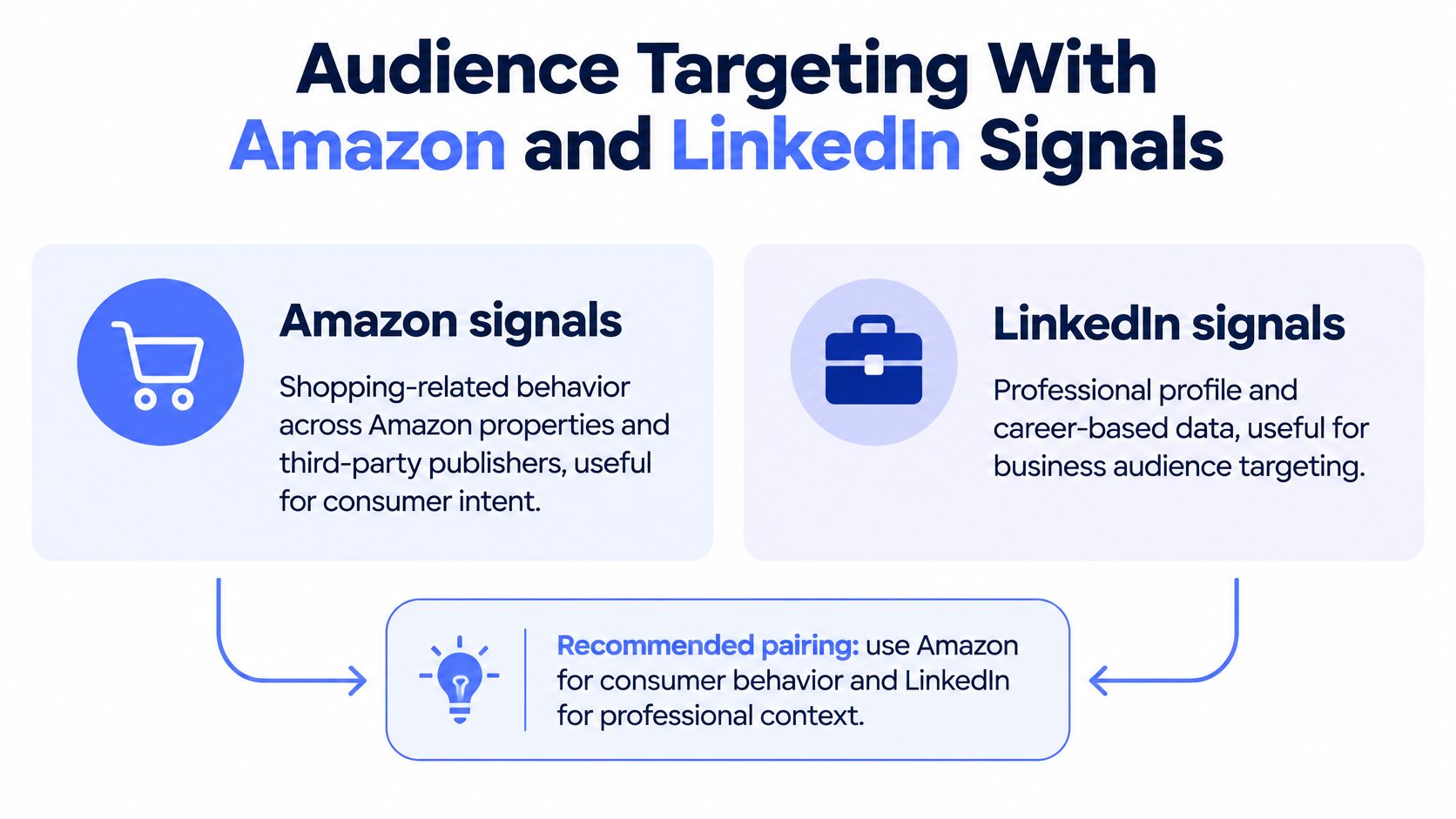
The professional signals come from more than one billion LinkedIn members and include job title, industry and seniority. Advertisers can activate LinkedIn audiences alongside Amazon audiences in the same campaign, across premium streaming-TV inventory delivered through Microsoft Monetize.
What the pairing looks like in practice
Say a B2B software vendor wants senior IT and finance leaders in healthcare and manufacturing on streaming TV. It builds the primary segment from title, industry and seniority, then layers Amazon audiences for follow-up exposure to people whose shopping behavior fits the same profile. The professional data finds the right room; the retail data tells you who in that room is also in market.
Signal family | What it's built from | Best fit | Watch out for |
|---|---|---|---|
Amazon audiences | Shopping-related behavior, extended across Amazon and third-party publishers | Consumer brands needing purchase intent | Intent signals skew to categories people shop on Amazon |
LinkedIn signals | First-party professional data from more than one billion members: title, industry, seniority | B2B and account-based campaigns | Each added criterion narrows reach fast |
The trade-off is arithmetic. Stack title, industry and seniority and the segment shrinks with every condition, so check audience size before you build the final segment rather than after the flight launches. The announced LinkedIn route covers the United States only, so advertisers planning in other markets need to confirm availability before it enters a deck.
Practical rule: set a minimum reach threshold for each segment before launch, then drop or widen any segment that fails it. A precise audience too small to deliver frequency is a rounding error with a media budget attached.
Match the signal to the buyer. Professional data for a named-account sale, shopper behavior for a category purchase, and both when the deal runs through a committee that also buys the product at home.
Viewability and Completion Metrics That Matter
The most common reporting mistake is reading completion rate as if it were business impact. A high completion rate tells you viewers didn't leave. It says nothing about whether they noticed, believed or bought.
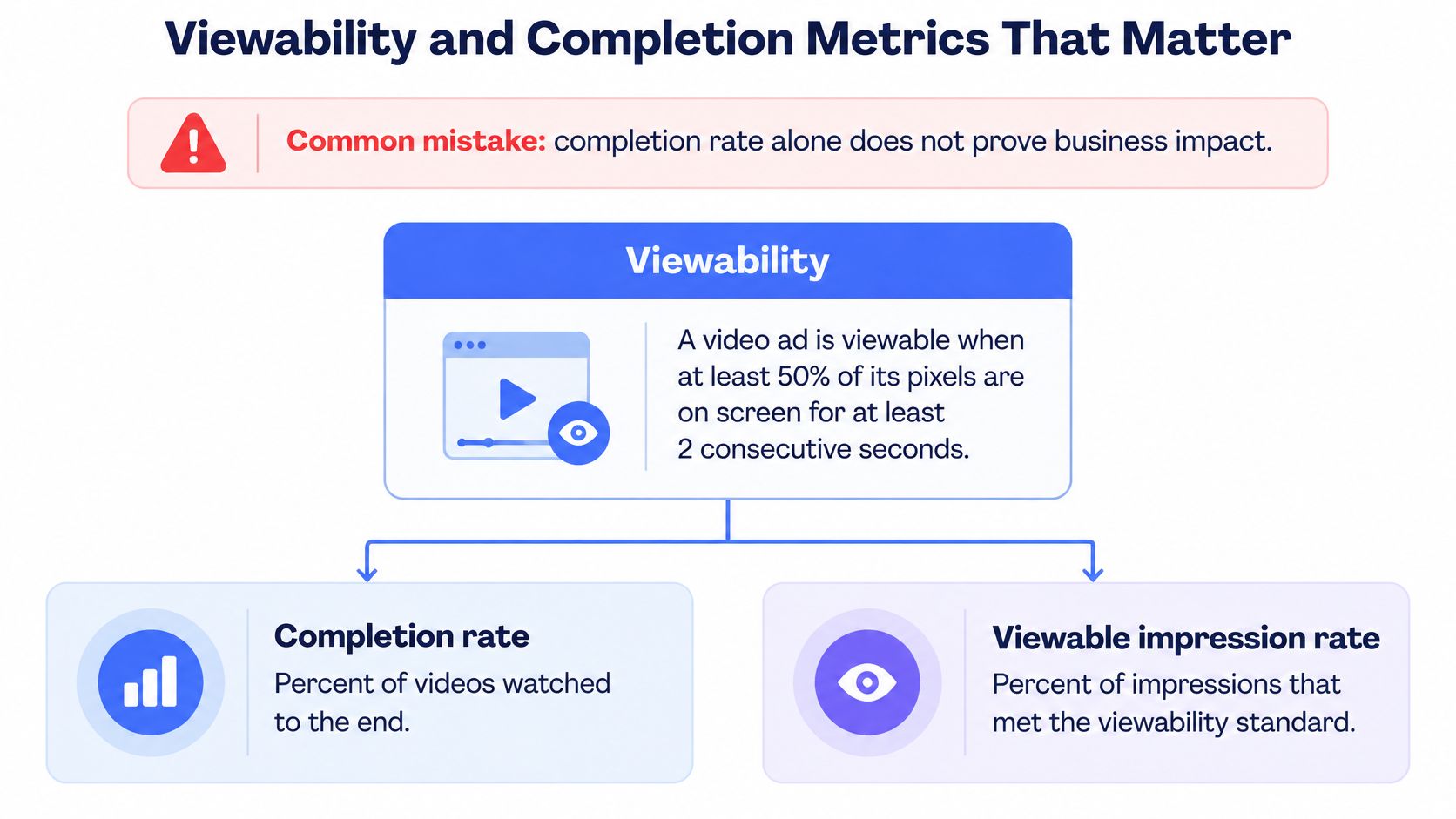
Amazon counts a video ad as viewable under MRC/IAB-style criteria when at least 50% of the ad is on screen for two seconds or longer, and its reporting separates measurable, viewable, non-viewable and non-measurable impressions along with playback initiation type and ad-break position (Amazon Ads video metrics documentation). Completion rate is simpler: completed views divided by video starts.
Amazon also publishes p25, p50 and p75 percentile benchmarks for peer comparison, and those benchmarks are weighted by brand ad spend. A large advertiser should compare against the matching percentile, not against a blended account average that mixes budgets and objectives.
Metric | Definition or benchmark | Weak result usually points to | Action |
|---|---|---|---|
Viewable impression | At least 50% of the ad on screen for 2 seconds or longer | Supply, placement or player quality | Review placements and supply sources |
Completion rate | Completed views divided by video starts | Slow opening or long edit | Shorten the edit or strengthen the first seconds |
Completion percentile | p25, p50 and p75 benchmarks weighted by brand spend | A result below your relevant percentile | Compare against the matching percentile, not an account average |
Cost per completed view | Media cost divided by completed views | Rising cost with flat completion | Shift budget toward stronger creative or supply |
Last-touch attribution | Credits the final exposure before an action | Overstates lower-funnel exposure | Pair with lift or matched-market tests |
What a weak result is telling you
Low completion usually indicts the edit. Viewers left before the offer arrived, or the spot ran longer than the inventory slot rewards. Weak viewability usually indicts the buy, because the player, the placement or the supply source failed to render the ad properly, and no amount of creative polish fixes it. Amazon's reports segment by supply, content rating and genre, which lets you separate a creative problem from an inventory problem instead of guessing.
Why last touch flatters the wrong ad
Amazon's standard attribution model is last-touch, assigning credit to the ad shown before an action (Amazon Ads attribution FAQ). That structure makes a retargeting impression look decisive and the video that created the demand look decorative. The fix is triangulation: reach and frequency to diagnose exposure, brand-search or consideration studies to test demand creation, and incrementality or matched-market testing to estimate causal lift.
Optimizing only to completion rate or ROAS quietly selects for the audiences that were going to convert anyway, then reports their behaviour as your advertising's achievement.
Cross-Screen Frequency and a Video Plan Example
Reach isn't productive reach. One household can meet your campaign three times in an evening, first on Prime Video, then on the Fire TV home screen, then inside a third-party streaming app, and each of those impressions is billed as a new touch.
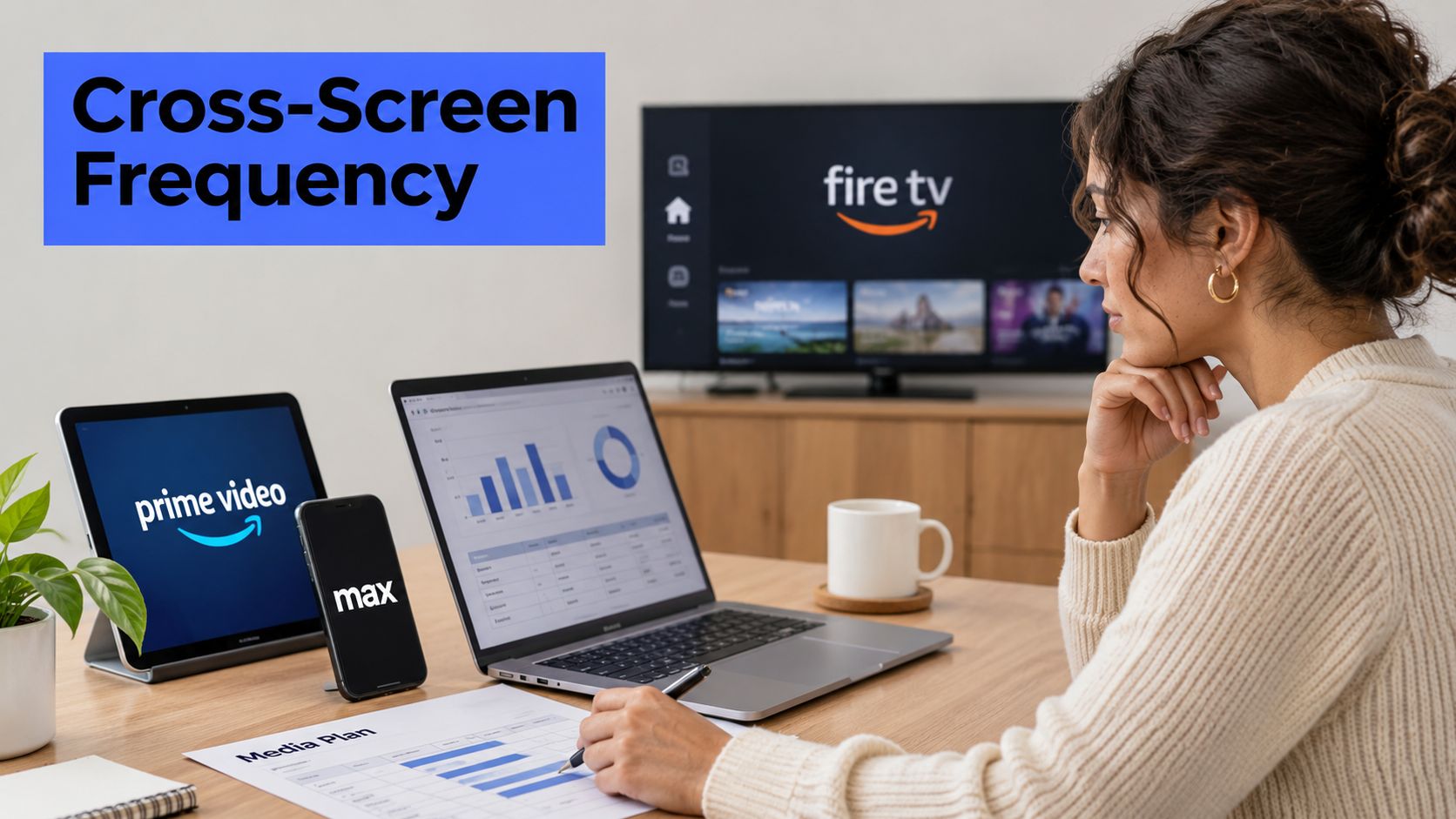
The reports that answer this are cumulative reach, daily reach, average impression frequency and frequency bins. Read the bins, not the average. An average frequency of four can mean everyone saw the spot four times, or half the audience saw it once and half saw it seven times. Those are different campaigns with different outcomes, and only the bins tell you which one you bought.
Identity resolution complicates the count further. A connected-TV household, a device, a browser and a logged-in retail user are matched differently, so deduplication across Prime Video, Fire TV and third-party supply is approximate rather than exact. Plan as if some duplication is invisible, because it is.
A three-week sequence for a B2B brand
Say a cybersecurity vendor buys streaming TV against IT and finance titles. Week one runs a short hook cut, fifteen seconds, one problem and one claim, to build reach. Week two swaps to a proof-led cut with a customer outcome and a demo frame. Week three runs a call-to-action cut aimed at viewers who saw either earlier version, which is where retargeting earns its keep.
Sequencing does two jobs at once. It moves a viewer along a story instead of repeating the same spot, and it keeps any one household from over-exposure, because the campaign cap limits how often a single cut can appear in a day.
Amazon Ads reported in 2025 that U.S. video campaigns using more than one Amazon video solution achieved 15% incremental reach versus campaigns using a single solution (Amazon Ads video solutions). That's a company claim, so test it against your own reach curves rather than budgeting from it.
Here's how the buying side of this looks in practice.
Before you add a fourth placement, ask for reach and frequency broken down by supply source, audience, geography, device and creative. If the incremental reach from the new placement is smaller than the duplication it brings, you've bought repetition at a premium.
Decision test: a smaller, deliberately sequenced plan with clean frequency rules beats a broad reach plan whose bins nobody has opened.
Choose Self-Service or Managed Access Before You Commit
Access is the last big decision in Amazon DSP for video advertisers, and the one most often made by accident. There are two routes: run the seat yourself, or hand execution to Amazon (Amazon DSP guide).
Access model | Management fee | Technology fee | Minimum spend |
|---|---|---|---|
Self-service | None | Percentage of media cost for system access and standard campaign management | No managed-service minimum |
Amazon-managed | Managed-services fee as a percentage of media cost | Percentage of media cost | Typically $50,000, varies by country |
Optional add-ons | Selected targeting, measurement or services | Disclosed at setup | Set by the add-on, quoted before you sign |
The pricing model is cost-plus rather than a single published rate. Amazon identifies a technology fee charged as a percentage of media cost for system access and standard campaign management, plus a separate managed-services fee when Amazon staff operate the campaign, with optional fees on selected targeting, measurement or other services, all disclosed during setup (Amazon Ads pricing transparency).
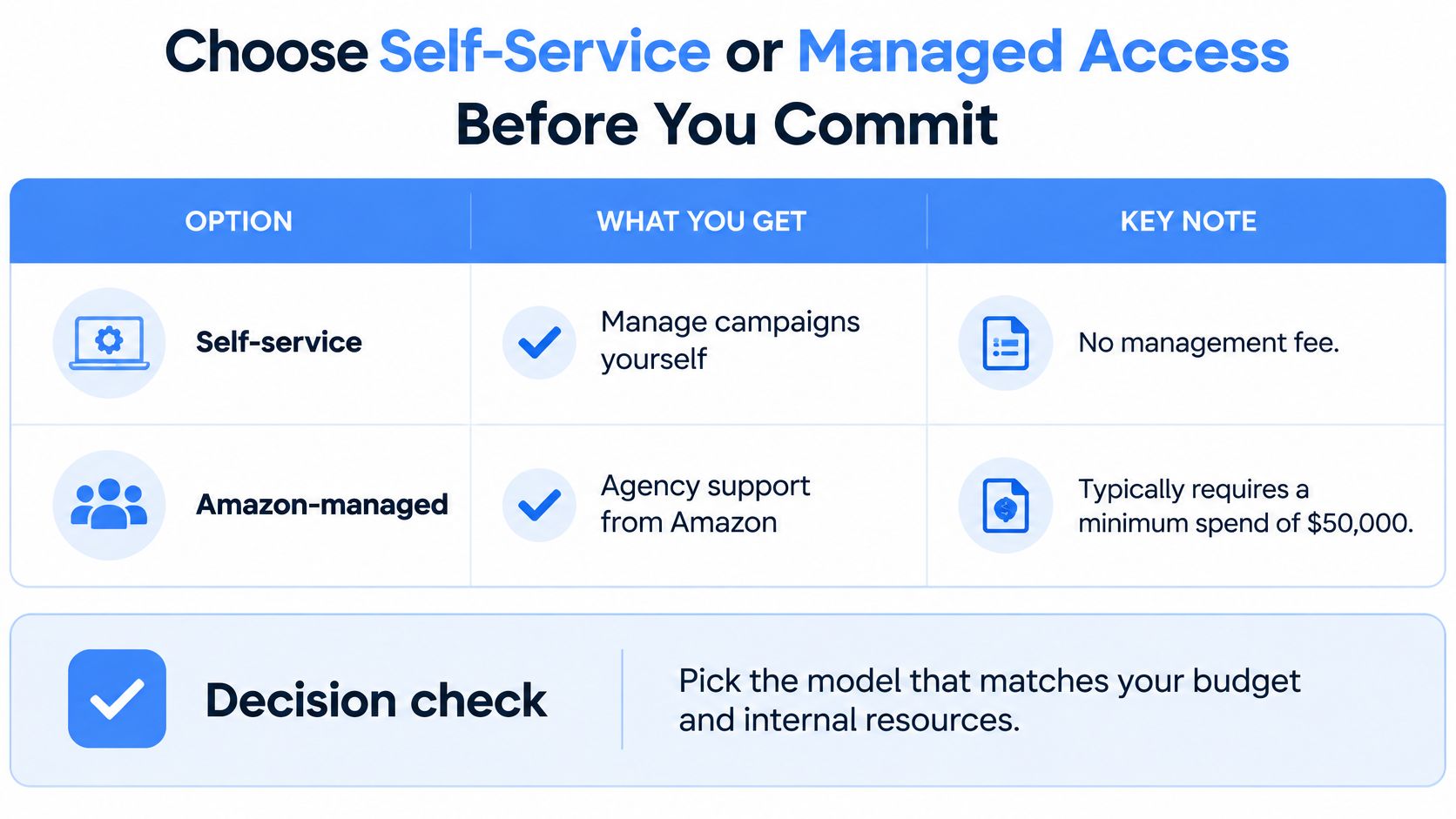
The $50,000 figure is a managed-service eligibility threshold, not a floor for every Amazon DSP campaign, and it moves by country. A team with in-house programmatic buyers and a measurement plan already agreed usually gets more from self-service, because it keeps full control of bidding, audience logic and reporting pulls. A team without buying capacity, or one whose budget clears the managed minimum comfortably, can justify paying the managed-services percentage for execution and troubleshooting.
The pre-commitment checklist
Define the goal: reach, consideration or sales, with the metric you'll judge it on written down.
Choose the audience type: shopper signals for consumer demand, professional signals for account-based work.
Confirm the spec for each served type: which placements take the master and which take the light version.
Set the measurement design: exposure and frequency for delivery, a demand measure for consideration, a lift test if the budget justifies it.
Check country availability: the announced LinkedIn audience option covers the United States only, so confirm your markets before planning around it.
Then price the whole thing, including any optional targeting or measurement add-ons quoted at setup, against the fee model you've chosen. Signing the access model before that math is how budgets surprise people in month two.

Busylike manages advertising across YouTube, connected TV and streaming apps, paid social and podcast, and produces the CTV-ready spots those placements need, so the media plan and the edit don't sit in separate rooms. If you're choosing between self-service and managed buying, or you want a second read on a DSP video plan before a quarter's budget goes behind it, book a free consultation with Busylike.

