
Subway Ads NYC: Costs, Digital Screens and Video Specs

NYC subway ads are proposal-priced, so budget against a specific Outfront inventory schedule rather than a universal rate card. The format table below separates print, station takeovers and digital screens, including impression-based Urban Panel campaigns and Liveboard video rotations.
The scale is substantial, but scale alone isn't a media plan. A useful subway buy matches repeated exposure, station context and creative behavior to a measurable business objective, then accounts for the audience you're also reaching through YouTube, CTV and paid social.
Table of Contents
NYC Subway Ad Formats and Costs - NYC subway ad formats and typical costs - The cost drivers that change the proposal
MTA Digital Screen Formats Sold Through Outfront - MTA digital screen formats compared - What the inventory schedule must identify
Video Specs and Creative Rules for Subway Screens - Subway screen video spec sheet - A production checklist that prevents expensive rework
Choosing Stations and Audiences for Subway Ads - Context changes both relevance and risk - Build the station clusters deliberately
Measuring Subway Ads Alongside Video and Social - Measurement methods for NYC subway campaigns - Connect the channels without overstating attribution
NYC Subway Ad Formats and Costs
NYC subway advertising is sold through Outfront, so your working price should come from an Outfront proposal naming the inventory, dates and delivery commitment. Don't treat a generic online rate range as an available offer, especially when it leaves out production, installation or measurement.
The audience opportunity is large: the New York City Subway overview records nearly 1.7 billion unlinked passenger trips in 2019. Trips aren't unique people, however, and a rider passing several placements doesn't represent several new prospects.
NYC subway ad formats and typical costs
The available sources don't establish dependable dollar ranges for these formats. The table therefore gives the pricing rule to confirm, rather than manufacturing a four-week rate.
Format | Where it appears | Typical 4-week range | Best for |
|---|---|---|---|
Interior car cards | Inside subway cars, including seated-rider sightlines | Outfront quote for the specified car-card network | High frequency with daily commuters |
Platform posters | Platforms and mezzanines near turnstiles | Outfront quote for selected poster inventory | Neighborhood and borough targeting |
Station domination | Most or all contracted advertising faces in a station | Station-specific takeover proposal | Launches and maximum share of voice |
Digital Urban Panels | Station touchpoints beside departure information | Impression-based proposal with confirmed minimum spend | Fast creative updates and contextual messaging |
Video Urban Panels | Sidewalk side of station entrances | Impression-based proposal for entrance-screen inventory | Full-motion brand films and demos |
Liveboards | Portrait screens on platforms and mezzanines | Direct or programmatic proposal for the booked rotations | Repeated motion exposure during waits |
A four-week comparison is useful for procurement, but it isn't proof that every package has the same minimum flight. Ask the seller to normalize competing proposals to the same dates and clearly identify anything sold on a different basis.
The cost drivers that change the proposal
Format tier. Start by comparing the job each format performs. Car cards and posters can support a straightforward print-led plan, digital panels introduce impression-based buying, and station dominations concentrate your investment in a takeover. A product launch doesn't automatically need the takeover if a distributed panel network can reach the intended audience more efficiently.
Station tier. Request separate pricing for neighborhood clusters and major hubs such as Times Square, Grand Central and Herald Square. A recognizable station name isn't a business outcome. For a retailer serving a local catchment, nearby station coverage may be more useful than visibility among people who won't visit.
Coverage. A concentrated cluster and a systemwide network are different purchases, even when both contain the same screen type. Ask what additional stations contribute to the objective. Buying breadth before establishing audience fit can leave you paying to repeat an irrelevant message across more locations.
Flight length and availability. Confirm minimum booking periods, creative deadlines and the treatment of extensions. Request availability specifically for holiday retail and tourist-heavy periods rather than assuming the same package remains open throughout the year. If your launch date is fixed, unavailable inventory can force a more expensive substitute.
Production. Print-ready poster artwork isn't equivalent to a collection of screen-ready video files. Price resizing, motion design, captions, versioning, exports and quality assurance separately. A campaign with a shared concept can still require substantially different compositions for each placement.
Buying channel. Compare the direct proposal with any programmatic option on an all-in basis. Programmatic can offer a more flexible test, but platform and data fees may change the apparent saving. Direct commitments can offer clearer inventory control, so ask what flexibility you surrender in exchange.
Ancillary costs. Put revisions, installation where applicable, late asset changes, extensions and measurement studies into the budget before approval. A low media quote becomes misleading when the team later adds the work needed to launch and evaluate it.
Buying rule: Compare the cost of delivering an agreed plan, not the cheapest-looking line on a format menu.
Keep a separate production-and-testing reserve rather than committing the entire budget to media. Size that reserve after reviewing the existing footage and required deliverables, not against an unsupported industry percentage.
Finally, request alternative terms. Ask whether peak-season hub demand changes the baseline and whether a multi-quarter commitment improves the effective rate. Neither a seasonal premium nor a commitment discount should be assumed until it appears in the proposal.
MTA Digital Screen Formats Sold Through Outfront
Outfront is the MTA's exclusive transit media partner, but its digital inventory isn't a single interchangeable screen network. The distinction matters because a placement that accepts a still image beside departure information isn't the same production opportunity as a full-motion entrance display.
The Outfront New York market materials describe footprints of more than 14,800 screens, more than 18,000 digital out-of-home screens, and a planned or deployed footprint of 50,000 screens, using different network descriptions. These aren't interchangeable denominators for a campaign forecast.
Treat those totals as directional descriptions of a large network. Your proposal needs an inventory-specific schedule showing the actual screens, locations, formats and delivery basis being purchased.
MTA digital screen formats compared
Outfront's MTA advertising guide distinguishes still-image Digital Urban Panels, full-motion Video Urban Panels and portrait Liveboards, which support static or full-motion creative in 15-second flips. It also identifies impression-based Urban Panel campaigns and programmatic Liveboard buying.
Screen type | Orientation | Motion | Location | Buying model |
|---|---|---|---|---|
Digital Urban Panels | Confirm in the booked inventory's spec sheet | Still images beside live departure information | Station corridors and high-foot-traffic touchpoints | Impression-based campaigns |
Video Urban Panels | Confirm in the booked inventory's spec sheet | Full-motion video | Sidewalk side of station entrances | Impression-based campaigns |
Liveboards | Portrait | Static or full-motion video in the specified flips | Platforms and station mezzanines | Programmatic or direct, with rotation terms confirmed in the order |
Digital Urban Panels suit a campaign that can communicate through a single strong composition. Don't commission animation for these placements merely because the word digital appears in the product name.
Video Urban Panels give you motion at the station entrance. Use movement to demonstrate the product or establish a recognizable visual, rather than requiring pedestrians to follow a detailed narrative while entering or leaving.
Liveboards offer a portrait canvas in platform and mezzanine settings. Build the composition for that canvas rather than shrinking a widescreen film and accepting unused space or tiny product details.
What the inventory schedule must identify
Placement identity. Station, screen type and the location within or outside the station.
Creative behavior. Still-image support, motion support and the booked rotation.
Delivery commitment. Impression goal, scheduling restrictions and reporting basis.
Operational terms. Asset deadlines, approval requirements and substitution rules.
The brief-writing rule is simple: name the screen type, orientation, placement and rotation length. A station name alone doesn't tell the creative team what to make, and a network total doesn't tell the buyer what will run.
Video Specs and Creative Rules for Subway Screens
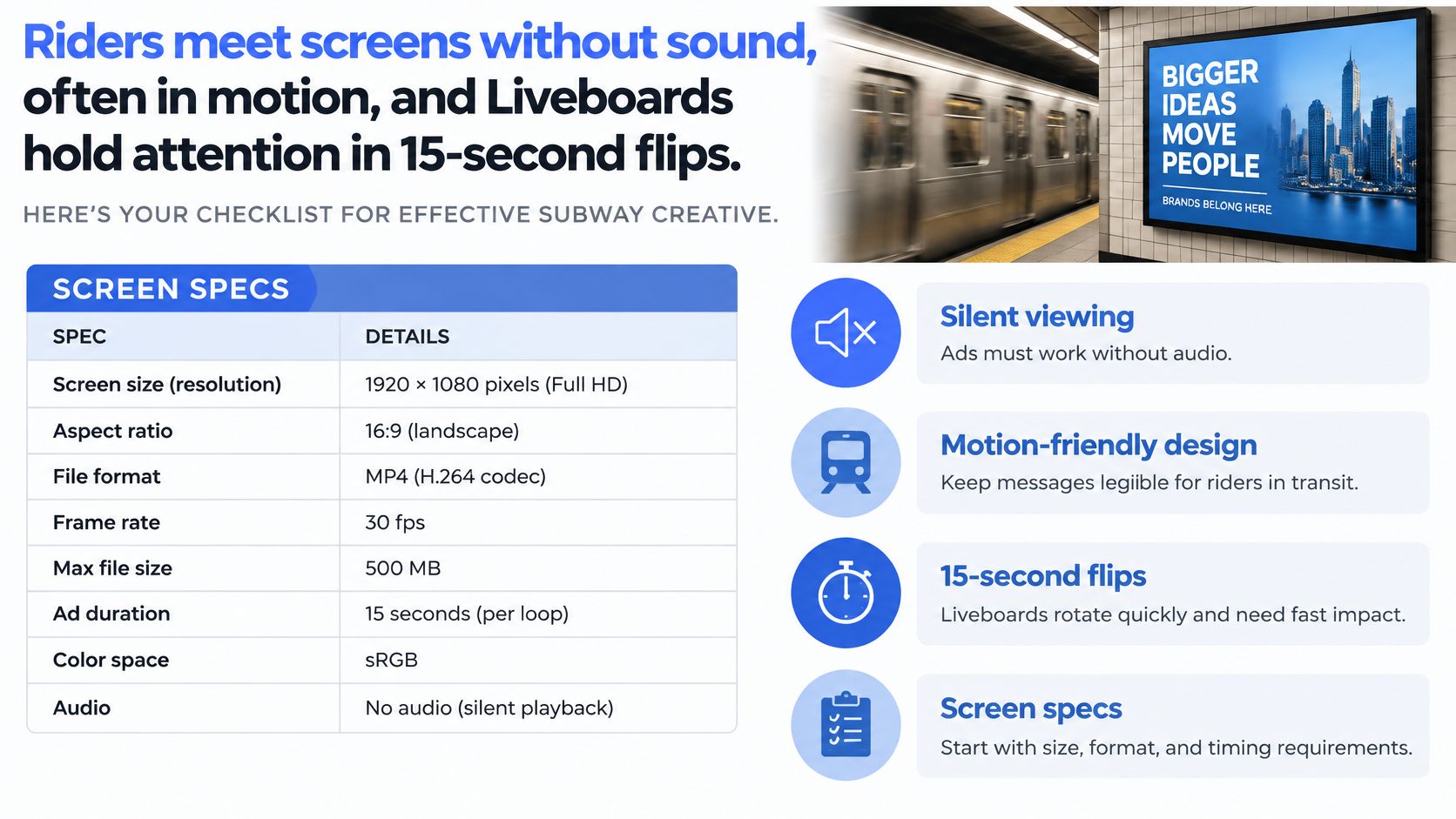
Design for riders encountering screens without sound and often while moving. A platform wait may allow a product demonstration, while a station corridor demands a message that makes sense almost immediately.
The MTA's advertising materials cite an average New York City transit commute of 54 minutes and describe digital placements at high-foot-traffic touchpoints. That isn't permission to make a long ad: the opportunity to notice any particular screen can be brief.
Subway screen video spec sheet
Use this as a production intake sheet, not a substitute for the technical specifications attached to the purchase.
Screen | Orientation | Spot length |
|---|---|---|
Liveboards | Portrait | Booked flip duration, confirmed in the order |
Video Urban Panels | Confirm from the exact screen spec sheet | Full motion, permitted duration requires confirmation |
Digital Urban Panels | Confirm from the exact screen spec sheet | Still image, display duration requires confirmation |
Resolution, file format, codec, frame rate and maximum file size remain unconfirmed here. Obtain the current requirements for the exact inventory before editing or exporting. Don't let a remembered specification from another campaign become the production standard.
A production checklist that prevents expensive rework
Lock the delivery requirements. Record format, orientation, rotation, technical specifications and approval deadlines in a shared asset matrix.
Compose for the canvas. Build portrait cuts for Liveboards and use the orientation specified for each Urban Panel placement.
Make the message readable. Use large type, strong contrast and an unmistakable product or brand identifier. Test the smallest text, not just the headline.
Remove audio dependence. Captions and text overlays should carry any essential spoken information. Music can support another channel's edit, but the subway version must stand alone.
Build a fast opening. Show the product or brand before a viewer needs to understand a story. Don't preserve a television-style introduction because the footage already exists.
Make response easy. Use a QR code or short URL leading to a mobile-first page with minimal form friction.
Proof at viewing distance. Review every frame at a reduced size and from several feet away. Reject compositions that only work on an editor's monitor.
Use a brand identifier, one benefit and a simple action prompt as the visual hierarchy. Platform creative can demonstrate the benefit; circulation creative should compress it; in-car creative can support a more considered read without turning into a brochure.
If the final frame is the only frame that explains the offer, the edit asks too much of a passing rider.
The digital signage content guide is a useful companion when building the asset matrix. Our production and delivery coverage extends to brands and screen networks anywhere, not only New York City.
Choosing Stations and Audiences for Subway Ads
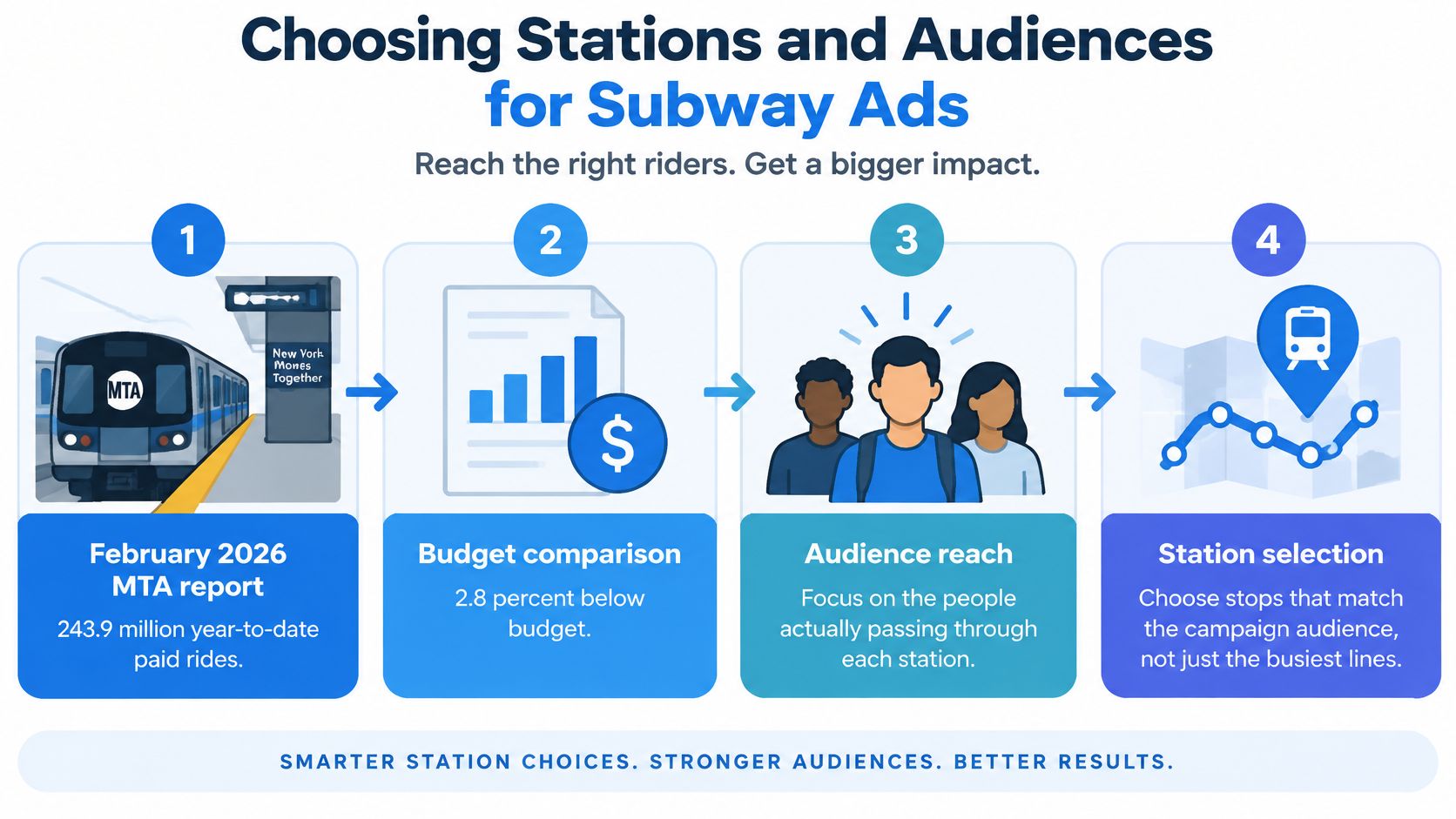
Choose stations around the people you need to influence, not around a headline ridership total. The MTA's February 2026 report recorded 243.9 million year-to-date paid rides, 2.8% below budget, a reminder that a systemwide audience forecast isn't a guarantee of delivery at a particular station or daypart.
Advertising revenue recovery and audience recovery describe different things. Neither proves that office commuters, weekend riders, students, tourists and essential workers have returned in equal proportions or follow the same routes.
A plan built entirely around traditional business hubs can therefore miss relevant audiences elsewhere. Conversely, a broad neighborhood network won't necessarily reach the professional decision-makers a narrowly defined B2B campaign needs.
Context changes both relevance and risk
A CUNY-led observational study discussed in the Columbia Center for Spatial Research analysis documented 1,586 food-and-beverage advertisements across 68 Bronx stations and found placement wasn't related to station entry volume. Less-healthful advertising correlated with neighborhood indicators including poverty, lower high-school graduation rates, larger Hispanic populations and higher proportions of children; the same analysis discusses R line category differences associated with ridership and gentrification characteristics.
That finding isn't a targeting recipe. It's a warning that local context can change the implications of a media placement, particularly for sensitive categories and communities already exposed to substantial advertising pressure.
Build the station clusters deliberately
Define the audience and decision. Specify who should respond and what should change. A software buying committee, a neighborhood shopper and a visitor considering an attraction need different coverage.
Map candidate stations. Combine station ridership with surrounding demographics, workplaces, retail destinations, institutions and transfer patterns. Keep neighborhood characteristics separate from assumptions about individual riders.
Shortlist plausible clusters. Midtown and Financial District corridors are starting hypotheses for B2B plans, while Union Square or tourist-heavy hubs may suit some consumer launches. Validate those hypotheses against the actual audience and available placements.
Audit the environment. Review language, accessibility, category sensitivity and nearby schools or healthcare destinations. Check whether the creative feels appropriate in that setting, not merely whether it meets the technical specification.
Set cluster-level reporting. Preserve the station grouping in delivery reports, landing-page tags and outcome analysis. Citywide averages can hide a productive cluster alongside an unproductive one.
For campaigns with a neighborhood creator component, Sup's tool to find influencers by city and niche can help organize relevant creator candidates. Evaluate those partnerships separately rather than treating a creator's followers as proof of station-level audience fit.
Use the broader advertising in NYC planning guide to coordinate subway coverage with the rest of the local campaign. The station shortlist should reflect the business's service area and audience, not just the city's best-known stops.
Measuring Subway Ads Alongside Video and Social
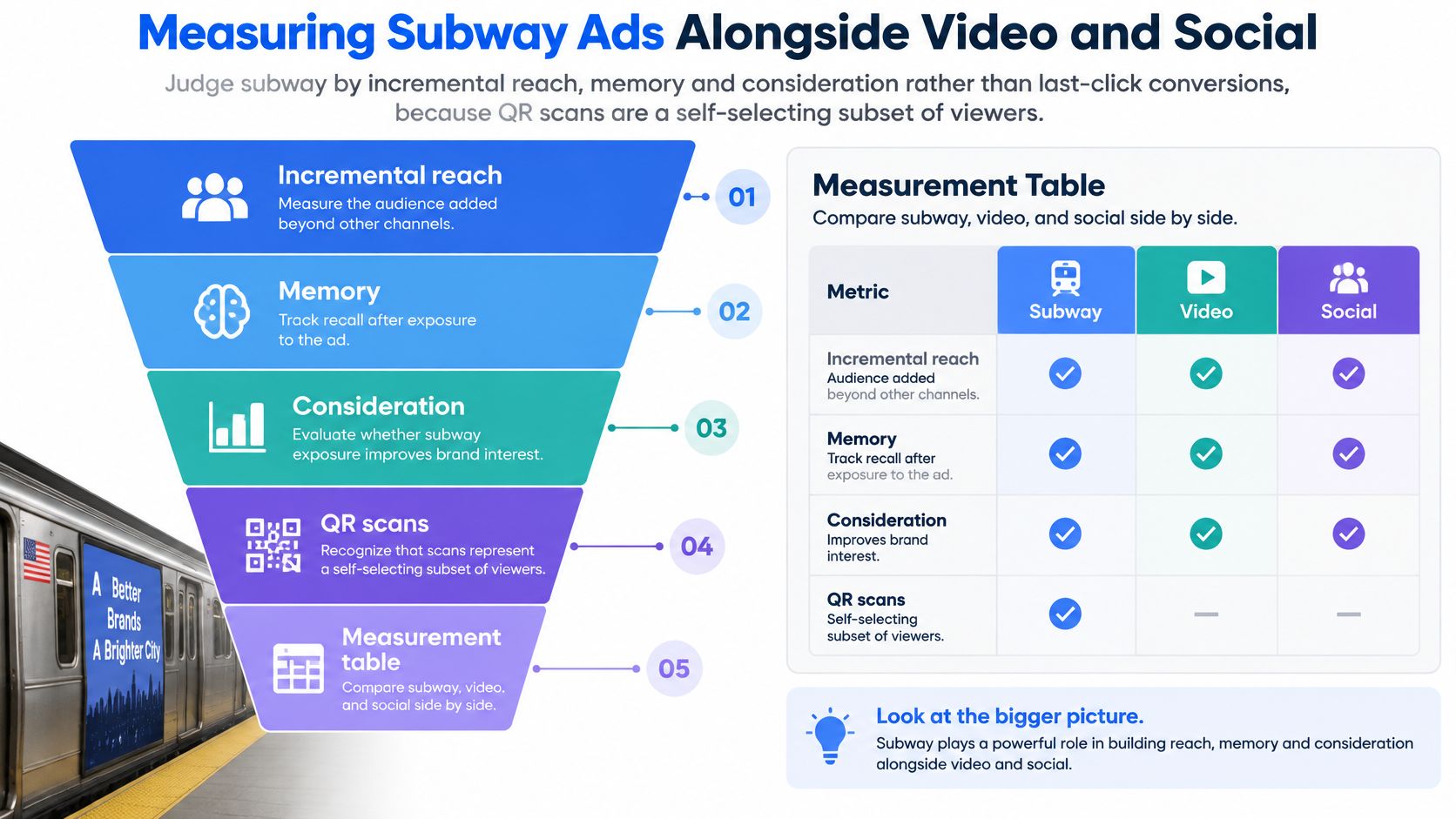
Judge subway advertising by incremental reach, memory and consideration, not only last-click conversions. QR scans capture a self-selecting group willing and able to respond at that moment, not everyone who noticed or remembered the campaign.
The New York State comptroller's MTA report records advertising revenue of $173 million in 2024, describes nearly 10,000 installed digital screens, and identifies roughly $183 million in projected advertising revenue in the MTA's 2026 budget. That financial scale makes campaign accountability important, but revenue and screen counts don't measure an advertiser's results.
Measurement methods for NYC subway campaigns
Method | What it tells you | Best for | Caveat |
|---|---|---|---|
Audited or modeled impressions | Estimated delivery against the bought schedule | Validating that the plan ran as agreed | Modeled exposure, not counted unique people |
QR codes and short URLs | Scans, sessions and attributable promo redemptions | Direct-response offers and launches | A self-selecting subset of viewers |
Geo pre/post or matched-market analysis | Traffic and sales movement in exposed areas | Retail footfall and regional rollouts | Seasonality, tourism and weather can confound |
Exposed-vs-control brand survey | Recall, consideration and message association | Brand campaigns and creative testing | Needs a sufficient, appropriately selected sample |
Media-mix or lift modeling | Estimated subway contribution within the full plan | Cross-channel budget allocation | Needs suitable historical variation and clean data |
Don't add subway impressions to YouTube, CTV and paid social reach and label the result unique people. Those measures use different definitions, and the same person can appear in several channel reports.
Where person-level deduplication isn't credible, say so. Report channel delivery separately and use a controlled design to estimate what the combined campaign added.
Connect the channels without overstating attribution
Align flight dates. Put subway, YouTube, CTV and paid social on a shared calendar. Record creative changes and promotions so the analyst knows what else could explain an outcome.
Create a meaningful holdout. Withhold subway exposure from comparable station clusters or geographic areas where feasible. Account for people traveling between test and control areas, because that movement can blur the comparison.
Assign distinct response paths. Use cluster-specific landing pages, tagged short URLs or promo codes. Preserve those identifiers through analytics and sales reporting rather than collapsing every visit into a generic campaign bucket.
Coordinate geographic social delivery. Use relevant ZIP codes and station trade areas for follow-up video. Describe this accurately as geographic targeting, not verified retargeting of everyone who saw a subway screen.
Field the brand-lift study during the campaign. Agree on exposed and control definitions, recruitment and questions before launch. Include message association and consideration, not just whether respondents recognize the brand.
Measurement discipline: Exposure establishes an opportunity to influence someone. It doesn't establish that the campaign caused their purchase.
For the online-video reporting layer, Taja AI's guide to compare video analytics tools for creators can help teams evaluate reporting options. Keep video engagement metrics separate from the experiment used to estimate subway's contribution.
A broader digital out-of-home advertising framework can help organize these responsibilities. Report subway delivery against the contracted inventory schedule: agency installation totals and seller network totals use different definitions, so neither is the campaign's denominator.
Build Your NYC Subway Campaign Plan
A launch-ready plan needs an owner, an approved inventory schedule and a decision rule for scaling. Creative approval alone isn't enough.
The launch checklist
Choose one primary goal. Decide whether the campaign is buying mass reach, neighborhood response or brand lift. Secondary metrics can help diagnose results, but they shouldn't replace the agreed objective after launch.
Select a starting format mix. Consider a digital panel network for a flexible test or a concentrated station-cluster takeover for a launch. Choose the smallest coherent plan that can answer the business question.
Request a specific Outfront proposal. Require station names, screen identities, flight dates, delivery commitments, production requirements and all-in costs. Replace every unconfirmed pricing or specification field with an approved answer before authorizing production.
Assign the creative deliverables. We produce fast 5-to-10-second hooks for digital billboards, transit screens and out-of-home networks, made to meet platform specs. Our ad production also adapts into platform-ready social, mobile, YouTube, CTV and DOOH formats, so each version can serve its actual placement.
Reconcile the media calendar. Check the subway booking against digital flights, holdout areas, promotions and landing-page availability. Silver Spoon Agency's perspective on how NYC brands build connected campaigns offers additional context for coordinating local touchpoints.
Approve measurement before launch. Name the owners of response tracking, geographic analysis and the brand survey. Document the comparison method and what result would justify further investment.
Start with a measurable station cluster, compare its outcome with a credible holdout, then expand into dominations or wider digital networks only when the evidence supports that decision. If the test is inconclusive, improve the design rather than presenting estimated impressions as proof of lift.
Bring your station shortlist, Outfront proposal and existing footage to Busylike to plan screen-ready creative and coordinated video assets for subway, YouTube, CTV and paid social. If you're in New York City, get in touch for a free coffee and a practical conversation about what to produce, test and measure before booking the wider campaign.


