
Times Square Billboard Cost in 2026: Pricing by Placement

A short Times Square booking can start around $250, a shared four-week digital placement runs about $20,000 to $50,000, and premium facades can exceed $300,000 a month, all before production and fees. The popular advice to compare monthly billboard prices misses the purchase: how visible your brand will be, how often it appears, and how much of the screen you control.
A photograph of your ad in Times Square and a sustained awareness campaign aren't equivalent media outcomes. Both can be legitimate purchases, but they need different budgets, creative, and measures of success. For planning, treat a Times Square billboard cost as the price of a defined level of visibility and exclusivity, not the rental of a screen.
Table of Contents
Times Square Billboard Cost by Placement Tier - Read the billing unit before comparing the price
What Sets the Price of a Times Square Board - The price levers that matter - Buy the viewing opportunity, not the address
How Spot Length and Frequency Change Your Bill - Separate storytelling time from purchased exposure - Confirm the accepted file duration before editing
Comparing Screens by Cost per Thousand Impressions - Check the denominator as carefully as the price - Use eCPM as a comparison tool, not a verdict
Production, Specs and Trafficking Costs for Times Square - Design for the booked surfaces - Protect the delivery schedule
Agency Fees, Taxes and Seasonal Premiums - Require an itemized commercial proposal - Compare date windows without inventing a multiplier
Build Your Budget and Confirm the Order Before You Book - Make the buying sheet usable across teams
Times Square Billboard Cost by Placement Tier
A Times Square billboard can mean a brief commercial booking or a prestigious monthly placement, and the placement tier determines what the price buys. In its 2026 pricing report, The Pricer puts a short commercial booking at as little as $250 and a one-day commercial rotation at $500.
Typical Times Square media costs by placement tier
Tier | What the Buyer Gets | Typical Media Cost | Billed Per |
|---|---|---|---|
Short commercial booking | Brief placement in a shared loop | From $250 | Per booking |
One-day commercial rotation | One day of rotation on a shared screen | $500 | Per day |
Shared rotation, secondary screen | Short slot in a shared loop | $150–$3,000 | Per day |
Low-share secondary screen | Limited share of voice | About $300 | Per day |
Short flight, digital | Brief campaign on a digital screen | $3,000–$15,000 | Per short flight |
Shared digital rotation | Shared loop over four weeks | $20,000–$50,000 | Per four weeks |
Standard digital, 15-second spot | 15-second spot over four weeks | $25,000–$50,000 | Per four weeks |
Standard digital, 30-second spot | 30-second spot over four weeks | $50,000–$80,000 | Per four weeks |
Premium digital, greater loop share | Higher loop share on a prominent screen | $50,000–$100,000 | Per four weeks |
Prominent digital display | Monthly placement on a prominent screen | $40,000–$100,000 | Per month |
Large spectacular, dedicated 30-second spot | Dedicated spot on a large screen | $5,000–$50,000 | Per day |
Full-board takeover | One advertiser dominates the display | $150,000–$400,000+ | Per four weeks |
Premium facade or flagship screen | Landmark facade with maximum prominence | More than $200,000 | Per month |
These are media-only planning ranges, before creative production, trafficking, fabrication, installation, taxes, and agency fees. The rows describe different products, not interchangeable offers.
Marketers' pricing guide places secondary-screen shared rotations at $150–$3,000 per day, prominent digital displays at $40,000–$100,000 per month, and the most prestigious locations above $200,000 monthly. Advertise in NY quotes $25,000–$50,000 for a standard 15-second spot over four weeks, $50,000–$80,000 for a 30-second placement, and premium full-motion facades reaching $300,000–$1.5 million per month.
Read the billing unit before comparing the price
A calendar-month contract and a four-week flight aren't identical terms. Confirm exact start and end dates, operating hours, and delivery commitments rather than treating every monthly-looking number as equivalent.
Published estimates also differ by year and inventory definition. AdQuick's 2026 estimate puts typical digital inventory at $20,000–$50,000 or more per month, while Blip Billboards' 2025 article quotes prime digital inventory at approximately $10,000–$50,000 per day.
For a broader city buy, compare landmark visibility with the repeated commuter exposure available through NYC subway advertising. Find the row that matches the visibility you need, not the budget you hope for, then test whether that exposure supports the campaign's goal.
What Sets the Price of a Times Square Board
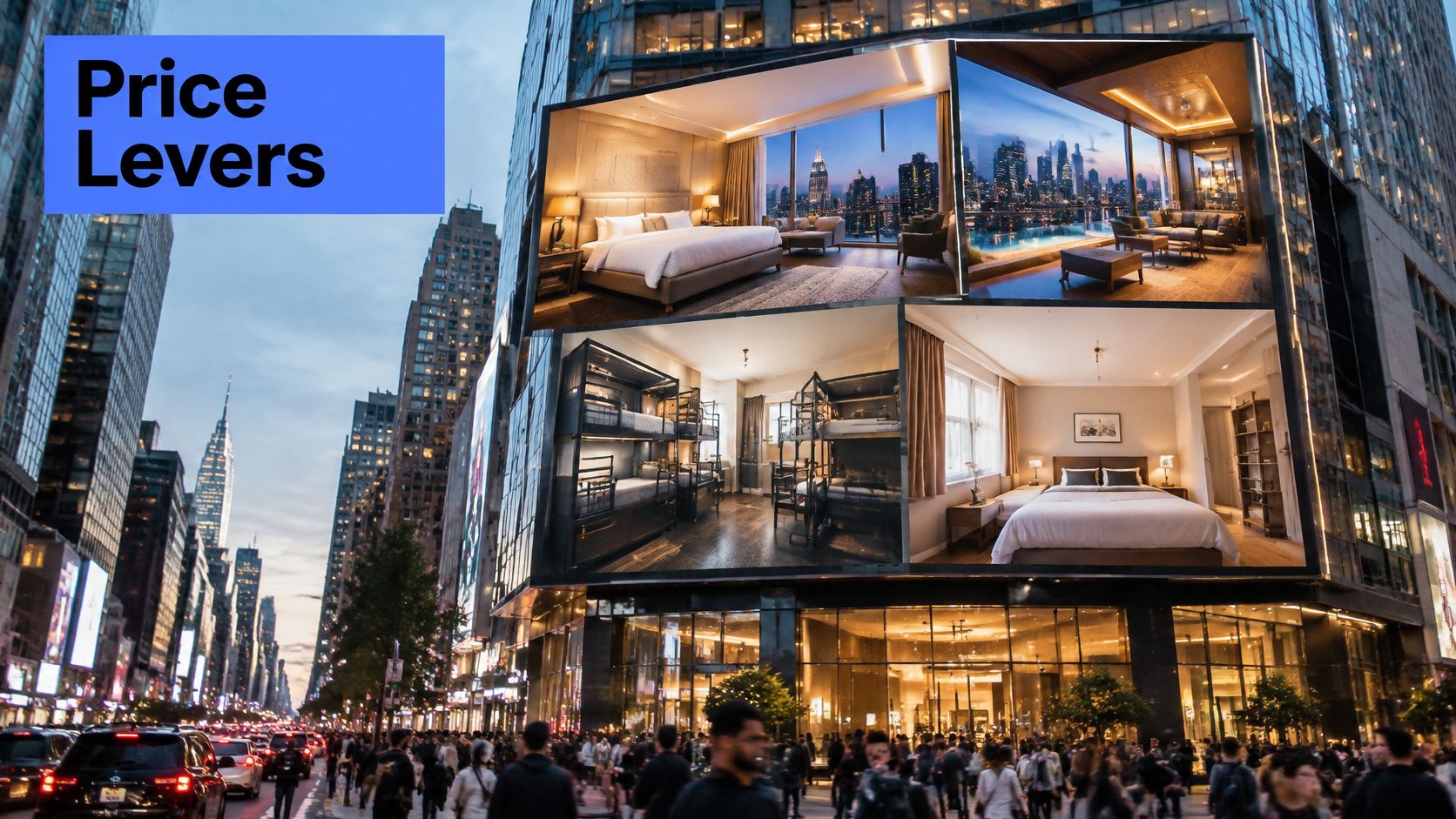
A Times Square board is like a hotel: the same address can offer something closer to a shared room or a penthouse suite. Buying the location doesn't tell you which experience you've purchased.
The mix of buildings, screen positions, and street-level activity makes that distinction visible.
The price levers that matter
Screen prominence: A flagship facade and a secondary side screen occupy the same district but offer different sightlines, scale, and visual dominance. Evaluate the actual unit, not just the neighborhood name.
Share of voice: A small slice of a shared loop isn't equivalent to a dominant presence on that same display. Ask how much of the contracted loop your brand receives.
Spot length: A short brand identification and a longer product demonstration require different amounts of screen time. The creative brief should justify the duration.
Loop frequency: An isolated appearance and repeated appearances across an hour are different delivery commitments. Confirm the schedule rather than inferring it from the file length.
Campaign duration: A launch-day appearance, a short flight, and an extended campaign serve different communication needs. Ask whether the quoted rate applies to the complete flight.
Exclusivity: A takeover can reserve a display for your brand, but it doesn't automatically exclude competitors from neighboring screens. Define the scope of exclusivity in writing.
Date demand: Treat New Year's Eve and peak holiday windows as separate availability and pricing inquiries, not ordinary dates with a presumed surcharge.
The district's pricing history illustrates the premium attached to landmark scale. American Guerrilla Marketing's historical overview describes the 2014 introduction of an approximately eight-story display reportedly renting for $2.5 million per month, with Google as its first advertiser.
Buy the viewing opportunity, not the address
Ask for a current view of the display from the pedestrian approaches your campaign depends on. Review nearby visual competition, obstructions, and whether your message remains understandable when someone sees only part of the animation.
This street-level video provides another way to assess the surrounding visual environment.
A Times Square address is a location credential. It isn't a delivery specification.
A budget becomes meaningful only when you attach it to a screen class, a contracted exposure schedule, and a visibility goal.
How Spot Length and Frequency Change Your Bill
Spot length and frequency pricing on one screen
Option | Plays per Hour | Hourly Exposure | Price per Day |
|---|---|---|---|
15-second spot, one play per hour | 1 | 15 seconds | $500 |
15-second spot, two plays per hour | 2 | 30 seconds | $950 |
15-second spot, four plays per hour | 4 | 60 seconds | $1,450 |
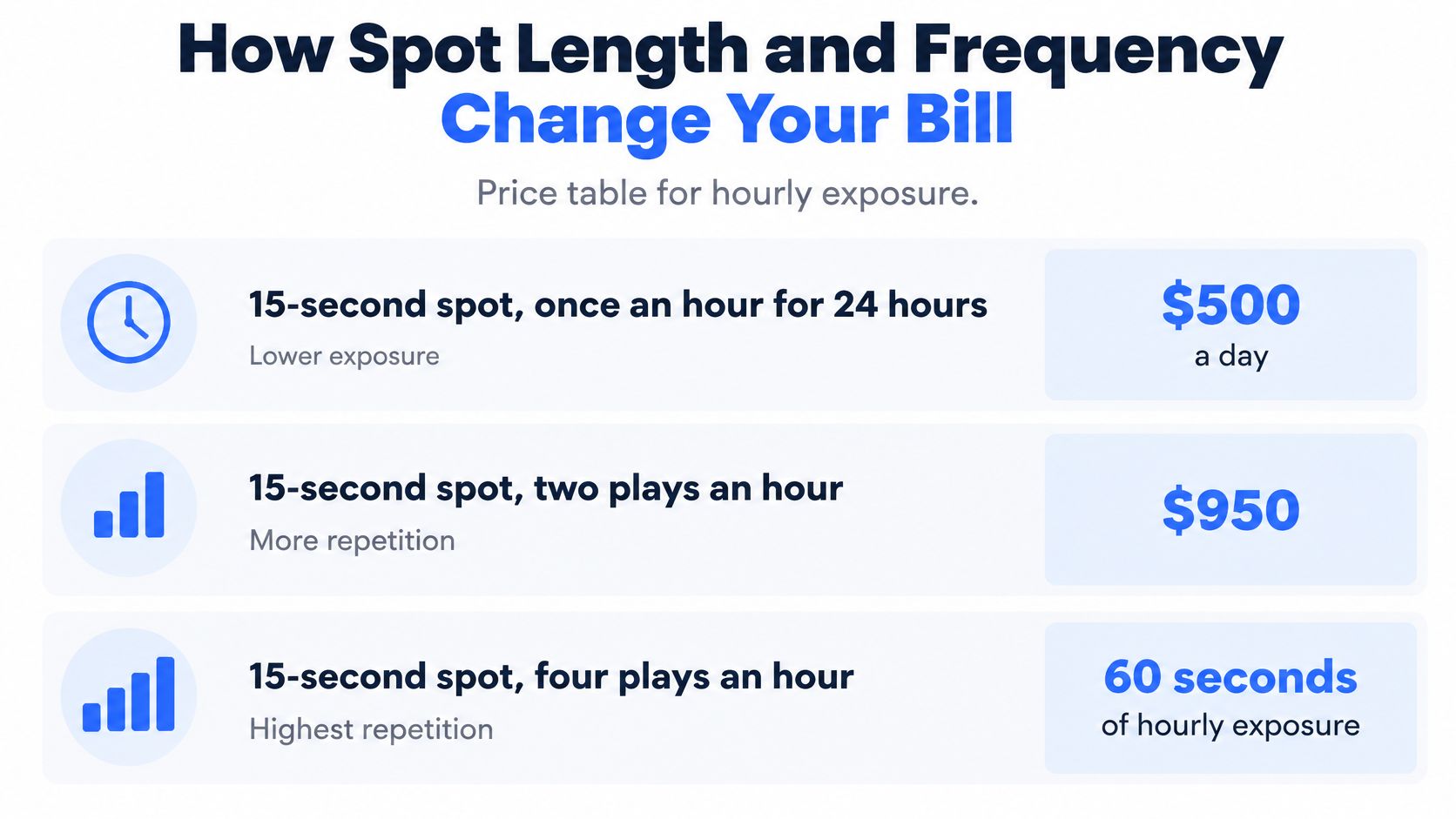
The Show and Tell Times Square display guide lists a 15-second spot once an hour for 24 hours at $500 per day, two plays per hour at $950, and four plays per hour at $1,450. In that offer, doubling the plays raises the daily price to 1.9 times the base price, while quadrupling them raises it to 2.9 times, calculated from the listed rates.
The important distinction is that the advertiser buys additional repetition of the same file. This isn't evidence that every longer spot on every Times Square display receives the same discount.
Separate storytelling time from purchased exposure
A longer file gives the creative team more room within an individual appearance. More plays give the brand additional opportunities to appear throughout the schedule. Those solve different problems.
Say a consumer electronics brand wants to show a product opening, operating, and returning to its compact form. It needs a coherent sequence within each play. A simple launch announcement may need less storytelling time but benefit from repeated appearances across the day.
Don't stretch an uncomplicated message just because a longer slot is available. Conversely, don't compress essential product information until viewers can't understand it.
Confirm the accepted file duration before editing
The same operator guide specifies permitted files of 15, 30, 45, or 60 seconds, requires exactly 450 frames at 30 fps for its shortest accepted file, and rejects 10- and 20-second files on that display. These are inventory-specific rules, not universal Times Square standards.
Build the edit against the accepted duration from the start. Frame-accurate delivery matters when the operator checks the asset against a fixed playback slot.
Before approving a storyboard, confirm:
Permitted increments: Obtain the accepted durations for the exact display.
Playback commitment: Get the promised plays and operating window in writing.
Loop structure: Establish how your appearances are distributed rather than assuming even spacing.
Creative priority: Decide whether the message needs a longer uninterrupted sequence or more repetition.
Practical rule: Choose lower frequency when a documented landmark appearance is the job. Choose greater repetition when sustained on-screen exposure is the job, subject to the audience evidence.
The brief's running time tells the editor what to make. The contracted schedule tells the media planner what the brand is buying.
Comparing Screens by Cost per Thousand Impressions
Effective cost per thousand impressions, or eCPM, puts different screen proposals on a common arithmetic basis:
eCPM = campaign media price ÷ rated impressions × 1,000
NVL & Partners illustrates the calculation with a hypothetical $30,000 four-week placement delivering 20 million rated impressions, producing an eCPM of $1.50. Its published planning ranges also distinguish shared digital rotations at $20,000–$50,000 over four weeks from premium placements with greater loop share at $50,000–$100,000.
Two screens compared on cost per thousand impressions
Screen | Four-Week Price | Rated Impressions | eCPM |
|---|---|---|---|
Screen A, shared loop | $30,000 | 20 million | $1.50 |
Screen B, hypothetical comparison | $30,000 | 8 million | $3.75 |
Screen B is a hypothetical comparison, not an inventory quote or a claim about a real display. Its impression assumption exists only to demonstrate how the formula changes the result when the media fee stays constant.
Check the denominator as carefully as the price
Pedestrian flow, screen visibility, loop position, campaign duration, and audience measurement all affect the exposure represented by a proposal. Don't accept district-wide footfall as a substitute for the vendor's campaign-rated impression estimate.
Ask how the estimate relates to your contracted schedule. A screen's total potential audience doesn't establish the impressions attributable to a limited-share placement.
Request the following from every shortlisted seller:
Rated impressions: The campaign total, methodology, and period covered.
Spot duration and plays: The accepted running time and contracted plays per hour.
Loop length and share of voice: Your allocation within the complete rotation.
Make-good policy: What happens when delivery falls short or the display is unavailable.
Included services: Whether production, installation, taxes, and measurement sit inside or outside the quote.
Use eCPM as a comparison tool, not a verdict
A lower eCPM doesn't prove that a placement is the better creative environment. A premium display might be valuable because its prominence is central to a launch, while a less expensive exposure opportunity might better suit broad awareness.
Use the same CPM framework when comparing Times Square with YouTube, CTV, and social video, but record differences in targeting, frequency control, and measurement. Our digital out-of-home advertising guide provides context for evaluating the channel within that broader media mix.
Unless conversion tracking is deliberately built into the campaign, evaluate the billboard as an awareness or experiential asset. Don't turn a rated impression estimate into an implied sales forecast.
Production, Specs and Trafficking Costs for Times Square
One master video can fail across multiple displays because each operator sets its own delivery requirements. Cropping, letterboxing, compression, and small text can undermine an otherwise strong concept, so creative adaptation belongs in the budget as a technical production workstream.
AdQuick's New York billboard buying guide describes common requirements including 16:9 at 1920×1080, MP4 or MOV, H.264, and 30 fps, while noting that larger spectaculars may require custom dimensions or 4K. It also identifies inventory that limits playback to 15 seconds or automatically trims longer videos to that opening duration.
Creative specs and their budget impact
Item | Common Requirement | Budget Impact |
|---|---|---|
Resolution and aspect ratio | 16:9 at 1920×1080; some spectaculars need custom sizes or 4K | Each custom size needs its own export |
File format and codec | MP4 or MOV with H.264 | A wrong format can delay approval |
Frame rate | 30 fps | A wrong rate can compromise motion and legibility |
Duration | 15 seconds on many displays; a 15-second file is 450 frames at 30 fps | Longer files may be trimmed automatically |
Production and fabrication | Creative adaptation, fabrication and installation | Thousands to tens of thousands of dollars |
Trafficking and proof of play | Vendor delivery and proof-of-play documentation | Budget staff time for uploads, revisions, validation, and reporting |
Lead time | Availability checks, specifications and approval | Four to eight weeks before the media start date |
The duration and frame-count requirements describe particular inventory, not a universal export preset. The production allowance is likewise a planning category rather than a mandatory surcharge on every digital campaign.
Design for the booked surfaces
Obtain each screen's technical sheet before editing. Record pixel dimensions, aspect ratio, file-size ceiling, codec, frame rate, duration, content restrictions, and approval contacts in the production handoff.
Build a safe-area master that keeps essential text, logos, product details, and the call to action away from edges and anticipated crop zones. Then create a deliberately composed derivative for each display instead of stretching or automatically cropping the master.
For synchronized screens, review the exports together. Check motion continuity, timing, color, and whether the message still works when a viewer sees only one surface.
At Busylike, our DOOH video is designed for paid out-of-home placements, including billboards and ad networks, and follows IAB DOOH creative specs. We plan portrait, wide, and ultra-wide deliverables from a single shoot or creative concept, while still matching each booked screen's requirements.
Protect the delivery schedule
American Guerrilla Marketing's production guide recommends allowing roughly four to eight weeks for availability checks, specifications, and approval, and identifies screen-specific exports, vendor trafficking, and proof-of-play documentation as operational requirements.
Separate physical fabrication and installation from digital file preparation. A digital export doesn't automatically require a physical build, while a custom execution can introduce a distinct production and installation scope.
Reserve approval time before committing the launch team to a public unveiling. A paid media reservation isn't written acceptance of the creative file.
Secure that acceptance before the flight starts. Also agree how playback will be documented, who receives the report, and who resolves any discrepancy between the order and the delivered schedule.
Agency Fees, Taxes and Seasonal Premiums
The quoted media rate isn't the same thing as your payable campaign total. A proposal can look inexpensive because the seller has priced only the screen time, leaving your team to fund the creative and operational work separately.
AdQuick's billboard cost guide describes public estimates including about $300 per day for low-share secondary inventory and $3,000–$15,000 for a short flight, while emphasizing that pricing may use per-play, daily, or campaign-based terms. Those entry points don't imply ownership of a prominent screen or sustained exposure across the district.
Require an itemized commercial proposal
Separate the following lines before comparing sellers:
Media: The exact display, dates, operating window, and contracted delivery.
Creative production: Concept development, shooting, animation, editing, and screen adaptations.
Fabrication and installation: Physical work required by the selected execution, if applicable.
Agency or broker fees: Planning, negotiation, coordination, and management charges.
Taxes: Applicable charges, identified rather than buried in a total.
Measurement: Audience reporting, campaign analysis, or other measurement services.
Date premium: Any additional charge associated with the requested event or holiday window.
Don't assume every category applies to every buy. Ask the seller to mark excluded or unnecessary items explicitly so a blank line can't later become an unplanned expense.
For retail and CPG video, we price production by scope and send a scoped estimate after the client shares project details. That keeps the production discussion tied to the actual deliverables rather than an unrelated media rate.
Compare date windows without inventing a multiplier
New Year's Eve and peak holiday availability require separate quotes. There isn't a reliable universal seasonal multiplier to apply across screens, sellers, and flight structures.
Request peak and off-peak proposals with the same flight length and delivery terms. If the seller changes the screen, share of voice, or operating window between proposals, identify that change before attributing the difference entirely to seasonality.
Buying test: Can the seller explain what changes in the product when the price changes?
A low-cost booking can have real symbolic value: the brand can legitimately appear in a landmark setting. But symbolic value isn't the same as controllable reach, and a premium takeover isn't automatically the most efficient demand-generation buy.
Compare all-in quotes for each date window, not an entry-level headline against a fully scoped premium proposal. Choose the commercial structure that supports the campaign's intended outcome, including how you'll document and evaluate it.
Build Your Budget and Confirm the Order Before You Book
Prepare a buying sheet before contacting inventory sellers. It should give the media planner, creative producer, and finance owner the same definition of a successful purchase.
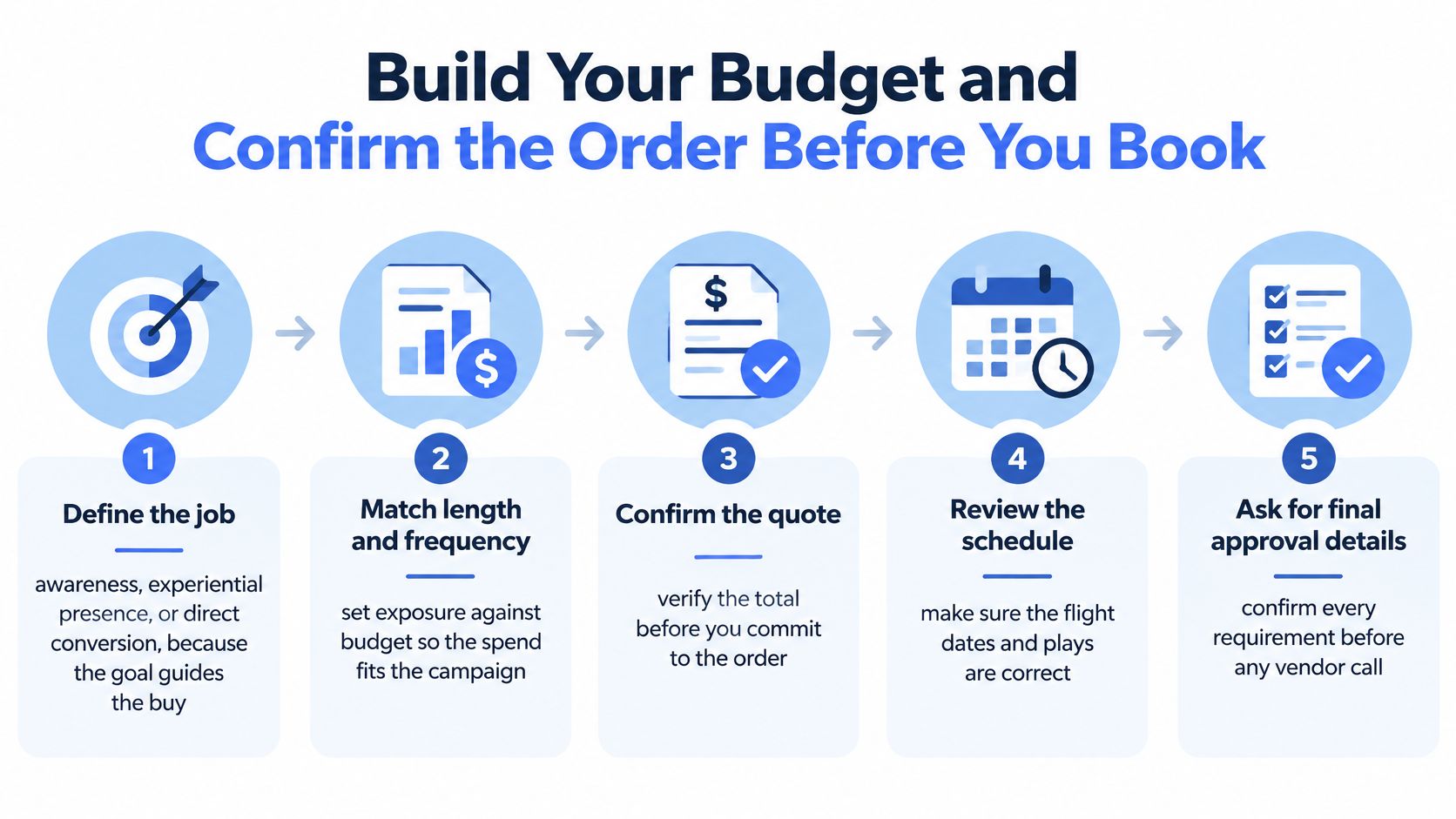
Define the job. Choose awareness, experiential presence, or direct conversion as the primary objective, because the goal determines which exposure commitments matter. Write down the evidence you'll use to judge success.
Set a media-only ceiling and select the appropriate tier. Choose the visibility level the campaign needs rather than the largest display the budget can stretch to. Keep the remaining production and operational allowance separate.
Match spot length with frequency. Specify both the creative running time and the playback commitment, because a file's duration doesn't establish the amount of scheduled exposure. Resolve permitted duration increments before the edit begins.
Calculate eCPM for the shortlist. Use each vendor's campaign-rated impressions and compare the result with YouTube, CTV, or social video on a consistent cost basis. Note differences in audience relevance and measurement alongside the calculation.
Build the all-in total. Add production, trafficking, any fabrication and installation, agency fees, measurement, and taxes. Require written inclusions and exclusions so finance can distinguish a complete proposal from a media reservation.
Work backward from the start date. Assign deadlines for specifications, creative review, exports, vendor approval, and final delivery. Don't schedule the public launch around an asset that hasn't been accepted.
Reserve a contingency line for adaptation. Allow for re-cuts and format fixes without assuming a universal percentage. We produce fast 5-to-10-second hooks for digital billboards, transit screens, and out-of-home networks, but the final file must still match the booked platform's accepted duration.
Confirm acceptance and playback evidence. Obtain written creative acceptance before launch and agree on proof-of-play requirements in advance. Actual playback documentation follows delivery, so specify its reporting deadline and the remedy for discrepancies.
Make the buying sheet usable across teams
For each ad concept, we produce multiple hooks, lengths, and formats, and refresh creative regularly to prevent ad fatigue. Identify which versions belong to the initial flight and which are optional refreshes, so the team doesn't confuse creative flexibility with unlimited deliverables.
Use our guide to advertising in NYC to place the landmark buy within the wider city campaign. Keep the final decision on a one-page budget sheet listing placement tier, spot length, frequency, all-in cost, eCPM, owners, and deadlines.
Busylike plans and produces DOOH video for billboards and ad networks, with screen-specific adaptations across portrait, horizontal, and ultra-wide formats. Bring your shortlisted screens, technical sheets, flight dates, and creative goals to Busylike to scope the production your Times Square placement needs.
