
10 Video Marketing Statistics to Guide 2026 Strategy

91% of businesses use video as a marketing tool in 2026, compared with 86% in 2024 and 61% in 2016, according to Wyzowl's video marketing statistics. That progression changes the strategic question. Video is no longer a single-channel tactic or a creative differentiator. It now spans audience behavior, platform reach, format selection, brand impact, demand capture, and performance measurement.
The figures below are organized around the decisions marketers must make. They explain why video deserves budget priority, how YouTube, connected TV, and social platforms serve different jobs, when short-form should give way to long-form, and why completion, engagement, and conversion need to be read together. The goal isn't to collect impressive benchmarks. It's to translate each statistic into a planning choice.

Methodologies and reporting periods differ across sources, so teams should verify the original study behind each figure before using it in a business case. A benchmark can guide a test, but it can't replace a baseline built from your audience, creative, media mix, and funnel objectives.
Table of Contents
1. Video Content Accounts for About 82% of Global Internet Traffic - What the traffic share means for planning
3. Digital Video Advertising Reached $191.4 Billion in 2024 - Use market scale to set priorities
5. YouTube CTV Ads Reach 90% to 96% Completion Rates - Plan CTV around attention and response
6. Video Can Lift Awareness by 80% and Purchase Intention by 34%
8. LinkedIn Is the Primary Video-Sharing Channel for 8 in 10 B2B Teams
9. Live Video Generates 10 Times More Comments Than Recorded Video - Build participation into the event
10. Video Testimonials Can Increase B2B Conversions by 50% to 80% - Build proof buyers can evaluate
1. Video Content Accounts for About 82% of Global Internet Traffic
About 82% of global internet traffic comes from video content, and 94.6% of online adults watched online video in the past 30 days, according to Statista's digital video advertising data. Together, these figures show that video has both broad supply and established audience demand. People encounter video across entertainment, search, advertising, and brand-owned experiences, so market priority should include distribution as well as production.
A video plan should first account for the environments where people already watch: YouTube, CTV, paid social, and owned web pages. Each destination gives the content a different job. YouTube can support discovery and search-led consideration, CTV can deliver high-impact household reach, and paid social can test messages through shorter, more targeted edits. Owned pages can provide context and support action after exposure.

What the traffic share means for planning
The statistic supports a market-priority decision, then informs channel and creative choices:
Set distribution before production: Placement determines aspect ratio, pacing, sound design, captions, and opening frames. A CTV spot and a social feed edit should not be planned as identical assets.
Create connected formats: A brand film can serve CTV, a product explanation can support YouTube, and shorter versions can supply paid social testing. This system improves reuse without forcing one execution into every channel.
Match metrics to the destination: A social view, a completed CTV impression, and a YouTube search visit indicate different stages of attention and intent. Reporting should preserve those differences instead of combining them into one score.
The practical decision is to allocate video according to audience behavior, platform role, and the action expected after exposure. This approach turns traffic share into a distribution framework, rather than a reason to increase production without a defined media plan.
2. 91% of Businesses Use Video as a Marketing Tool
91% of businesses use video as a marketing tool in 2026, compared with 86% in 2024 and 61% in 2016. 93% of video marketers also say video is important to their overall strategy, according to Wyzowl's 2026 research. Adoption has therefore moved video from an emerging capability to a standard part of marketing operations.
For market priority, the implication is clear: publishing video alone offers little differentiation. Advantage depends on connecting production with distribution, channel management, and optimization across YouTube, CTV, and social. A team should decide the audience, platform role, and expected action before commissioning the asset.
Wyzowl also reports that 67% of marketers who had not adopted video planned to do so. Adoption data shows competitive pressure; it does not guarantee performance for every new video investment. Marketing leaders should treat the figure as a planning signal, then require a defined job for each video, such as building awareness, explaining a product, or generating a response.
A practical operating model includes four decisions:
Set governance: Brand, product, growth, legal, and sales teams need shared rules for claims, visual identity, approvals, and calls to action.
Build a production pipeline: Repeatable processes can support brand films, explainers, short-form edits, and paid ads without treating every platform as the same environment.
Match evaluation to intent: Awareness videos require reach and attention measures, while product videos, testimonials, and explainers need criteria tied to consideration or action.
Fund promotion alongside creation: Wistia's State of Video research finds that 57% of teams spend more time creating videos than promoting them. Distribution should therefore receive planned resources for YouTube search and recommendations, CTV delivery, and social testing.
The strategic decision is to fund the system around video, not only the shoot. With adoption already widespread, consistent distribution and measurement determine whether production becomes an audience asset or remains a collection of unused files.
3. Digital Video Advertising Reached $191.4 Billion in 2024
Global digital video advertising spend reached $191.4 billion in 2024, was estimated at $214.76 billion in 2025, and is projected to reach about $338.64 billion by 2030, according to Statista's digital video advertising overview. The outlook also projects a 9.54% compound annual growth rate from 2025 to 2030.
The scale matters because video now competes for budget across YouTube, connected TV, streaming services, and paid social. Rising expenditure signals expanding inventory and stronger platform infrastructure, but it does not establish that every placement or creative approach will perform efficiently.
Use market scale to set priorities
Start with market priority, then make channel choices. YouTube can support searchable education and demand capture. CTV can provide broad-screen reach and repeated exposure. Social platforms can support rapid creative testing and audience-specific distribution. These channels should not share one forecast just because they all use video.
Budget decisions should follow a testable sequence:
Choose the audience and funnel task. Define whether the investment should build awareness, explain a product, support consideration, or generate response.
Compare platform roles. Set separate expectations for YouTube, CTV, and social rather than treating completed views or impressions as interchangeable.
Fund creative variation. Test openings, lengths, formats, audiences, placements, and calls to action before applying a benchmark across the plan.
Connect distribution to measurement. Track reach and completed views for exposure, then examine qualified visits, assisted conversions, and sales outcomes where the objective is performance.
The market's expansion supports giving video a deliberate place in the media mix. It does not replace audience selection, channel discipline, or evidence from campaign testing.
4. YouTube Is Used by 82% of Businesses
82% of businesses use YouTube for video marketing, while 78% of marketers rate it as effective, according to Vidico's summary of video marketing statistics. The comparison matters for market priority: adoption shows that YouTube is already a common distribution choice, while effectiveness indicates why it remains a practical benchmark for channel planning.
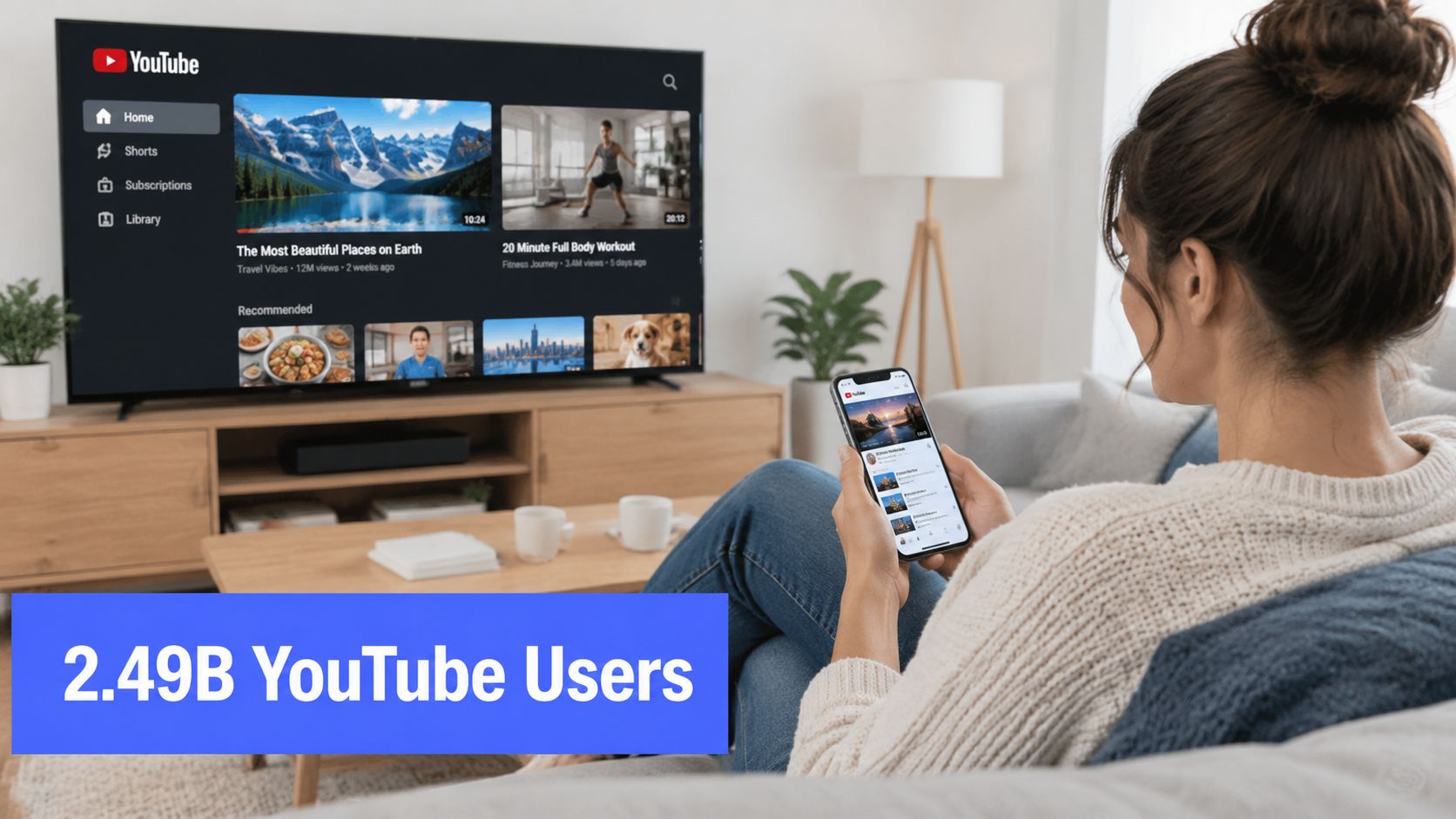
YouTube also serves more than paid reach. Its searchable library can support product education, answers to customer questions, thought leadership, demonstrations, event recordings, and short-form discovery. That range gives marketers a platform for several funnel tasks, rather than a single awareness placement.
The planning decision is format by intent:
Discovery content introduces a problem, category, or point of view with a concise opening.
Education content uses tutorials and explainers to address research questions.
Consideration content uses demonstrations, comparisons, and customer stories to reduce uncertainty.
Amplification content uses paid distribution to extend organic videos or test messages with defined audiences.
Titles, descriptions, thumbnails, playlists, subtitles, retention analysis, and calls to action help distinguish visibility from useful engagement. A video that attracts viewers but loses attention early needs a creative revision, not more media spend. YouTube performance should therefore be compared with CTV completion and social response according to each channel's role.
For brands with complex products, recurring customer questions, or a substantial education burden, YouTube can become a long-term audience asset. Set expectations around discovery, learning, consideration, and response, then use retention and downstream actions to decide which formats deserve further distribution.
5. YouTube CTV Ads Reach 90% to 96% Completion Rates
YouTube ads delivered on connected TV are reported to achieve 90% to 96% completion rates, compared with 30% to 40% on mobile, according to Autofaceless's 2026 YouTube advertising analysis. These figures describe a reported channel comparison, not a guaranteed result for every campaign. The difference still gives marketers a planning signal: viewing context can affect how much of a message audiences receive.
CTV places video in the living room, where viewers may accept longer narratives than they would in a mobile feed. That makes the format suitable for brand films, explainers, product launches, and sequential storytelling that depend on complete message delivery.
Plan CTV around attention and response
Treat CTV as a performance environment, with objectives that extend from completed viewing to recall, consideration, and later action. The format works best when creative, audience design, and measurement are set together.
Creative length and structure: Establish relevance quickly, then make the next action clear at the close.
Audience logic: Household targeting, first-party audiences, contextual signals, and retargeting can serve different campaign roles.
Measurement design: For longer sales cycles, assess reach, completed views, brand lift, site behavior, and assisted conversions alongside clicks.
Cross-channel sequencing: CTV can introduce the message, YouTube can provide deeper education, and paid social can reinforce it with a shorter reminder or offer.
For broader planning context, this guide to CTV advertising explains how connected TV fits within digital video buying.
The completion-rate comparison supports a practical allocation rule. Use CTV when full delivery and narrative comprehension matter, then adapt the same campaign for mobile rather than transferring one edit unchanged. Evaluate each placement against its role, with completion on CTV and response signals on YouTube or social interpreted together.
6. Video Can Lift Awareness by 80% and Purchase Intention by 34%
Video is reported to increase brand awareness by 80% and purchase intention by 34%, according to Autofaceless's cited 2026 video advertising data. Read together, the figures connect upper-funnel memory with a later buying response, rather than treating video as either a branding or conversion channel.
Awareness indicates whether people recognize or remember a brand. Purchase intention indicates whether the message has moved them closer to considering a transaction. Those outcomes require different evidence, so campaign reporting should separate them even when one video contributes to both.
Creative choice shapes the likely contribution. A brand film can build emotional association and memorability. A product demonstration can clarify functionality, while a customer testimonial can reduce perceived risk. An explainer can make a complicated offer easier to understand.
Adopt a portfolio approach: assign each video a primary funnel job before production starts. Set a secondary metric for the next stage, then select distribution accordingly. YouTube can carry education and demand capture, CTV can support broad attention and recall, and social can reinforce the message through repeated, action-oriented exposures.
Use awareness measures such as reach, completed views, attention, recall, and brand-lift signals for upper-funnel work. For consideration, examine site visits, product-page engagement, repeat viewing, search behavior, and qualified content consumption. Conversion reporting can include form completions, demo requests, purchases, assisted conversions, and revenue.
The figures should not be copied into a forecast without examining their methodology. Their practical value is strategic: give video a defined role before, during, and after active demand capture, then judge each asset against the job it was built to perform.
7. Short-Form Video Leads ROI Rankings at 49%
Short-form video ranks first for reported marketing return: 49% of marketers place it above other formats, compared with 29% for long-form video. 67% plan to increase investment, according to HubSpot's marketing statistics. The gap makes short-form a strong candidate for testing in TikTok, Instagram Reels, YouTube Shorts, and paid social, while YouTube and CTV can carry longer explanations and broader reach.

The format suits fast discovery, repeated exposure, cultural participation, and product introduction. Its short production cycle also creates more room to test hooks, framing, creators, captions, and calls to action. That testing value matters for distribution planning, but high exposure does not replace explanation or proof when the purchase decision is complex.
Format selection should follow the decision a viewer must make. Use short-form when the next step is to notice, recognize, or explore. Use long-form video or CTV when the audience needs sustained attention, while webinars can support education and trust.
HubSpot identifies webinars as the second most impactful video type and reports that they can continue attracting views for up to 12 months. The comparison gives marketers a useful portfolio logic:
Short-form: Test creative and earn initial attention on social feeds and Shorts.
YouTube education: Answer specific questions with demonstrations and explainers.
Webinars: Develop consideration through expert discussion and structured teaching.
CTV: Build completed viewing, recall, and broad awareness.
The 49% ROI ranking is therefore a planning signal, not a universal format rule. Measure whether each asset advances its intended outcome, rather than optimizing only for views, likes, or shares.
8. LinkedIn Is the Primary Video-Sharing Channel for 8 in 10 B2B Teams
Eight in ten B2B teams identify LinkedIn as their primary video-sharing channel, according to Wistia's 2026 State of Video report. The figure makes LinkedIn a clear priority for B2B distribution, while YouTube and CTV serve different roles. LinkedIn places expertise, product context, and customer evidence in a professional feed. YouTube supports searchable education, and CTV extends completed viewing and broad awareness.
Channel choice should follow the buyer's context and the decision the video must support. An executive perspective may work as a concise LinkedIn post. A product demonstration may need a fuller YouTube version. Customer proof can move across both channels, with the edit adjusted for each viewing environment.
A repurposing system reduces production waste, but copying the same file everywhere can weaken its relevance. A webinar excerpt needs a new opening when presented in a LinkedIn feed. A YouTube tutorial may require a shorter, self-contained explanation. A customer interview should include captions and on-screen context for viewers watching without sound.
Use four planning questions:
Who owns the problem? Executives, practitioners, procurement teams, technical evaluators, and partners may require different framing.
What action follows attention? Direct viewers to a deeper YouTube video, a report, a webinar registration, or a sales conversation.
Which metric indicates useful distribution? Engagement can signal relevance, while qualified traffic and conversion assists connect channel activity to pipeline.
Which version merits paid support? Organic response can identify candidates for amplification, provided audience fit and business intent also support the choice.
LinkedIn's B2B prominence supports a broader decision rule: prioritize the channel that matches audience behavior and buying context, then assign YouTube and CTV roles that extend explanation, reach, or recall.
9. Live Video Generates 10 Times More Comments Than Recorded Video
Live video generates 10 times more comments than pre-recorded video, according to Wistia's cited video marketing statistics. The figure measures real-time interaction specifically. It does not extend to conversions or reach, so marketers should use it to plan participation rather than forecast business results.
Comments are valuable when the audience's questions reveal buying friction, product confusion, or unmet information needs. A live product demonstration can expose objections that a recorded asset may never surface. An expert session can collect questions for future YouTube videos, CTV creative, social clips, or sales enablement content.
The format therefore changes the planning decision. Use live video when the marketing objective includes dialogue, learning, or objection handling. Choose a recorded asset when the message must remain concise, tightly edited, and consistent across placements.
Build participation into the event
A live broadcast needs more than a camera and a host. Define the audience promise, assign moderation, and decide how comments will influence the session.
Set the participation objective: Comments may identify objections, generate questions, support a launch, or strengthen community engagement.
Create response points: Q&A, polls, demonstrations, and direct prompts give viewers a clear reason to participate.
Prepare moderation: A team member can group recurring questions, remove distractions, and surface useful prompts for the host.
Plan the afterlife: Turn the recording into an on-demand video, short social edits, email content, sales material, and answers to unresolved questions.
Measure the event according to its role. Comment volume indicates interaction, while qualified follow-up, viewing behavior, and assisted conversions show whether that interaction supported the wider funnel. Live video is strongest when participation produces usable insight, not when comments are treated as a standalone performance goal.
10. Video Testimonials Can Increase B2B Conversions by 50% to 80%
Video testimonials are reported to increase B2B conversions by 50% to 80%, according to Busylike's customer testimonial video resource. Treat the 50% to 80% range as context-dependent evidence and validate it against your own baseline. Audience quality, offer strength, page experience, proof quality, and measurement method can all change the result. Pair testimonial lifts with data on advertorial conversions to calibrate expectations for proof-driven pages.
The format combines social proof with human delivery. A customer can explain implementation, resistance, workflow changes, and business impact in a way that makes the evidence easier to assess than a written claim alone. That distinction matters most in B2B buying cycles, where credibility and practical detail influence conversion decisions.
Build proof buyers can evaluate
A credible testimonial needs a clear narrative:
Before: What problem or constraint existed?
Decision: Why did the customer choose the product or service?
Experience: What changed during implementation?
Outcome: What result can the customer describe and substantiate?
Recommendation: Which type of buyer would benefit?
Match length and placement to intent. Short excerpts can support paid social and retargeting. Longer interviews fit sales pages, solution pages, and nurture sequences. A written case study adds searchable detail, while video contributes voice, presence, and emotional context.
Customer participation requires clear permission and careful claim review. Let customers speak naturally rather than forcing marketing language. Test testimonial video against a defined baseline, measuring qualified conversions and assisted outcomes alongside play counts. Use YouTube for searchable proof, CTV for controlled reach, and social for shorter excerpts that return interested viewers to deeper evidence.
10-Key Video Marketing Stats Compared
Item | 🔄 Implementation Complexity | ⚡ Resource Requirements | 📊 Expected Outcomes | 💡 Ideal Use Cases | ⭐ Key Advantages |
|---|---|---|---|---|---|
Video Content Drives 80% of Internet Traffic | 🔄 High, cross‑platform strategy and scale required | ⚡ High, sustained production, distribution & platform expertise | 📊 Broad reach; validates long‑term video-first investment | 💡 Multi-platform brand & performance campaigns (YouTube, CTV, social) | ⭐ Strong proof for large video budgets and audience preference |
92% of Marketers Believe Video is Important | 🔄 Low–Medium, strategic alignment easier than execution | ⚡ Medium, needs agency partnerships or internal upskilling | 📊 Organizational buy‑in; easier budget justification | 💡 Business cases for hiring agencies or securing budgets | ⭐ Industry consensus that supports investment in video |
Video Lifts Click‑Through Rates and Time Spent | 🔄 Medium, integration and ongoing A/B testing required | ⚡ Medium, production + optimization/tracking tools | 📊 Higher CTRs (contextual lifts reported up to ~96%) and longer engagement | 💡 Email, landing pages, paid campaigns, SaaS conversion funnels | ⭐ Direct, measurable conversion and revenue impact |
YouTube Reaches 2.49B Logged‑In Users Monthly | 🔄 Medium, channel strategy, SEO, and consistent uploads | ⚡ Medium–High, quality production and channel management | 📊 Massive scale and discovery; strong audience growth potential | 💡 Long‑form education, tutorials, creator partnerships, audience building | ⭐ Unmatched reach, discovery mechanics, and analytics |
Connected TV Reaches 90% of US Households | 🔄 High, fragmented platforms and creative specs | ⚡ High, premium inventory costs and household targeting setup | 📊 Premium reach and high ad visibility; strong brand impact | 💡 Brand campaigns, high‑consideration purchases, premium launches | ⭐ Premium viewing environment with precise household targeting |
Video Increases Awareness by 80% & Purchase Intention by 34% | 🔄 Medium, requires integrated brand + performance planning | ⚡ Medium, production plus brand‑lift measurement | 📊 Significant lifts in awareness and purchase intent (contextual) | 💡 Full‑funnel campaigns combining brand films and performance ads | ⭐ Demonstrable impact across awareness and consideration stages |
Short‑Form Video Dominates Younger‑Audience Consumption | 🔄 Low–Medium, fast iteration; trend responsiveness needed | ⚡ Low, lower per‑asset cost but high volume cadence | 📊 Very high engagement with Gen Z/younger millennials; rapid virality | 💡 Trend participation, product discovery, creator collaborations | ⭐ Exceptional engagement and algorithmic amplification |
Live Video Generates 10x More Comments Than Pre‑Recorded | 🔄 Medium–High, technical setup and live moderation required | ⚡ Medium, basic broadcast tools, host resources, promotion | 📊 Much higher real‑time interaction and community engagement | 💡 Launches, webinars, Q&A, interactive shopping/events | ⭐ Strong authenticity, immediacy, and community building |
Instagram Reels Deliver 5x Higher Engagement Than Feed Posts | 🔄 Medium, frequent content production and trend monitoring | ⚡ Low–Medium, mobile‑first production and creator partnerships | 📊 Substantially higher engagement and discoverability on Instagram | 💡 Social commerce, influencer campaigns, short‑form discovery | ⭐ Superior reach and engagement within Instagram ecosystem |
Video Testimonials Increase B2B Conversions by 50–80% | 🔄 Medium, customer coordination and loose scripting needed | ⚡ Low–Medium, shoot logistics and editing with customers | 📊 Large conversion lift in B2B contexts (50–80%) when well executed | 💡 Sales pages, case studies, enterprise nurture campaigns | ⭐ High credibility and measurable conversion improvement |
Turn Video Marketing Statistics Into Better Decisions
The figures point to a planning sequence rather than a single universal formula. Start with audience and platform data. Global digital video consumption and advertising growth support making video a serious budget category, while channel-specific evidence helps determine where that budget should work. YouTube can support discovery, search, education, and paid reach. CTV can support completed viewing and household-level storytelling. LinkedIn and other social platforms can support professional distribution, short-form discovery, engagement, and retargeting.
Next, match format to intent. Short-form video has a strong reported ROI position, so it deserves a place in discovery and creative testing. That doesn't make it the best format for every problem. Webinars, explainers, customer testimonials, and longer connected TV narratives can serve education, trust, consideration, and recall more effectively when buyers need context.
Then connect brand metrics with conversion metrics. Awareness, recall, completed views, and reach help explain whether a campaign was seen and remembered. Watch time, retention, engagement, qualified traffic, form completions, assisted conversions, and revenue help explain whether the attention created business value. Teams should avoid forcing every asset into a last-click framework, but they also shouldn't treat engagement as a substitute for commercial measurement.
Creative testing should sit inside this system. Test hooks, openings, pacing, thumbnails, captions, aspect ratios, offers, presenters, customer proof, and calls to action. Compare results against a baseline from your own audience and channel mix, because external benchmarks describe context rather than promise performance.
Document every source used in a business case. Record the publication date, reporting period, sample, methodology, definition of each metric, and whether the figure is a forecast or observed result. That discipline matters especially when planning across YouTube, CTV, paid social, email, landing pages, and owned channels.
For teams that need one operating model across strategy, production, paid video advertising, and channel optimization, Busylike is one option to evaluate. The New York City-based agency works with brands on branded video, YouTube, CTV, social campaigns, creator partnerships, media buying, and performance reporting. Its role is relevant to the central lesson in these statistics. Video works better when creative, distribution, and measurement are planned together.

Busylike helps brands plan and produce video, manage paid placements, and optimize channels across YouTube, CTV, and social. Visit Busylike to connect your video marketing statistics with a practical strategy, production pipeline, and measurement plan.

