
How to Choose the Right Video SEO Agency in 2026

The CMO inherits a YouTube channel with a stalled publishing schedule, an empty pipeline report, and six vendor decks promising “page-one rankings.” The budget committee wants a decision within 30 days, but the problem isn't choosing a production style. It's choosing an operating model that can connect video discovery to qualified demand.
That distinction matters because video has moved from an optional brand tactic to a mainstream marketing channel. 91% of businesses use video as a marketing tool, compared with 61% in 2016, while global digital video advertising spend reached $191.4 billion in 2024, up from $173.5 billion in 2023, with further growth projected for 2025 and beyond, according to SocialPilot's video marketing statistics. A serious video SEO agency should therefore integrate strategy, production, distribution, optimization, and measurement rather than sell metadata edits as a complete solution.
This guide focuses on how these agencies operate, which KPIs map to revenue, how to evaluate vendors, and which contract terms deserve scrutiny. It doesn't cover production-only studios, influencer sourcing, or paid social as a standalone strategy. The central buying question is simple: can this engagement produce qualified pipeline, not merely more watch time?
Table of Contents
A Practical Starting Point for Video SEO Buying Decisions - Treat the buying window as procurement
What a Video SEO Agency Actually Does - The four operating functions
The Ranking Levers That Drive Video Performance - CTR earns the first opportunity - Retention decides whether distribution expands
Why Most Video SEO Advice Stops at Metadata - Match the format to the surface
KPIs and Outcomes That Justify the Investment - Build one measurement model
A Step-by-Step Vendor Evaluation Checklist - Days 1 to 7, define the engagement - Days 8 to 15, test the evidence - Days 16 to 23, commission a technical audit - Days 24 to 30, pressure-test measurement and terms
Choosing a Partner and Getting the First 90 Days Right - The first 90 days
A Practical Starting Point for Video SEO Buying Decisions
A stalled channel usually creates the wrong internal conversation. The team debates whether the next video should be a customer interview, a product demo, or a short-form clip, while finance asks why the existing library hasn't influenced a single visible opportunity. Vendors respond with familiar promises about rankings, reach, and channel growth.
Those promises sound reasonable until you ask what happens after someone watches. Does the viewer visit a product page? Does a prospect complete a form? Does sales recognize the account? Can the vendor connect those actions to a CRM record, or will the quarterly report stop at impressions and views?
Treat the buying window as procurement
Use the first week to define the business problem before reviewing creative concepts. Write down the audiences, products, buying stages, existing video assets, distribution surfaces, conversion paths, and handoff points between your team and the agency. Require every shortlisted vendor to respond to the same brief.
The scope should distinguish among:
Demand capture: Videos designed for YouTube Search and Google video results, where the viewer already expresses a problem or category need.
Demand creation: Content intended for Suggested Videos, Browse, Shorts, or paid distribution, where packaging and retention determine whether an unfamiliar audience continues watching.
Product education: Demonstrations, comparisons, implementation explainers, and proof-led content connected to consideration and sales enablement.
Measurement: A defined route from exposure to site behavior, lead quality, opportunity creation, and revenue influence.
Buying rule: If a vendor can't describe the next business action after a view, the proposal is a media plan, not a revenue plan.
The strongest agency proposal will explain which surfaces deserve priority and why. YouTube is both a content platform and a search environment, with more than 3 billion searches per month and 2.53 billion monthly active users, according to industry data on video marketing in 2026. That scale creates opportunity, but it also makes vague targeting expensive. Your 30-day decision should end with a measurable operating hypothesis, not a prettier content calendar.
What a Video SEO Agency Actually Does
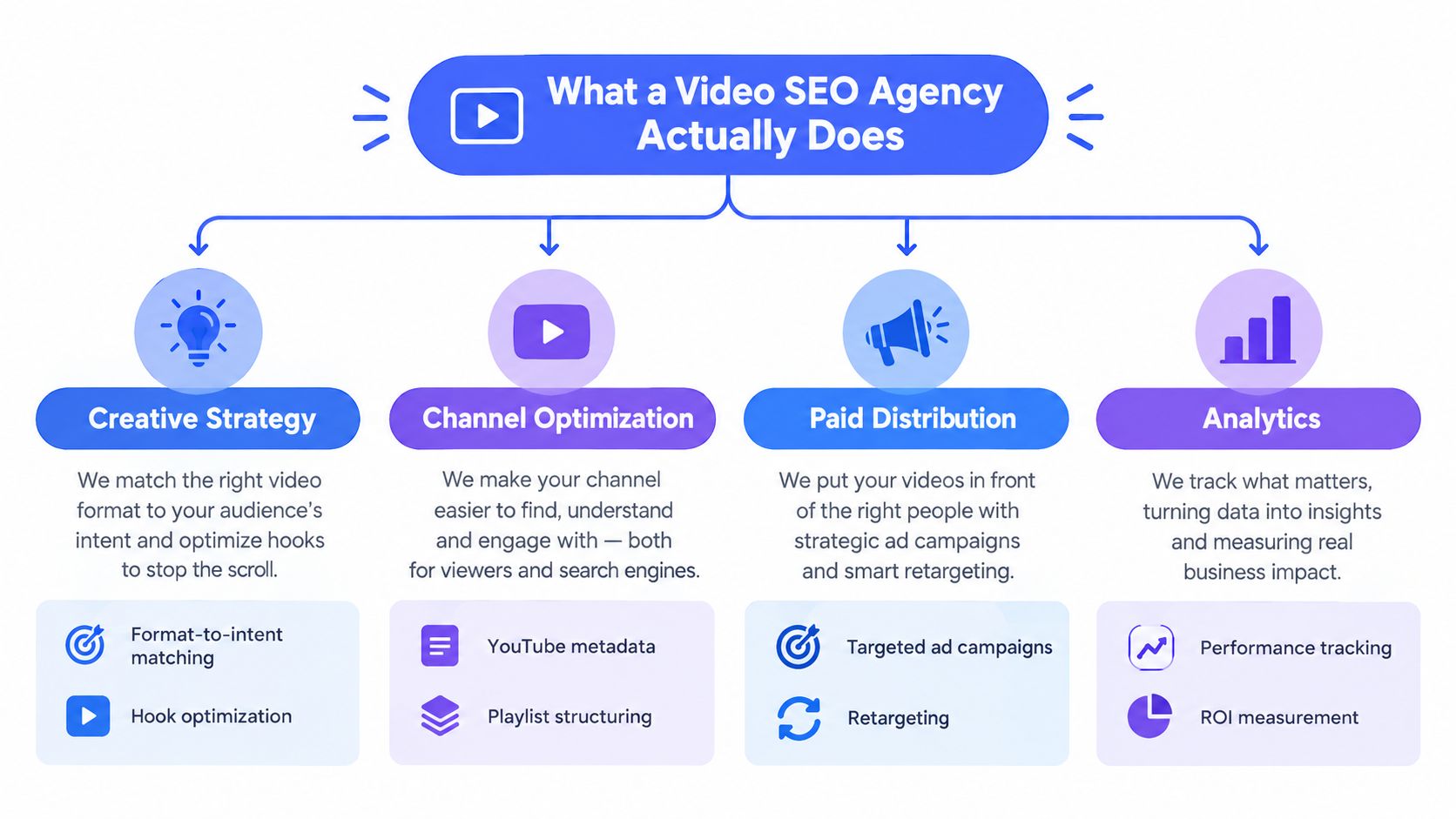
A video SEO agency should function as a control room, not a production house. Creative is the camera, channel optimization is the lens, paid distribution is the lighting crew, and analytics is the monitor that tells the team whether the scene is working. Remove any one of those parts and the agency loses the ability to learn and improve.
The four operating functions
Creative strategy starts with intent, not a camera brief. The agency should decide whether a query needs a tutorial, a comparison, a product walkthrough, a customer story, or a short-form explanation. It should also shape the opening hook, information density, visual rhythm, title, and thumbnail around the audience's reason for watching.
Channel optimization covers more than YouTube keywords. It includes YouTube Search, Suggested Videos, Browse, Shorts, Google's blended video results, and emerging AI search surfaces such as AI Overviews. It also includes channel architecture, playlists, descriptions, transcripts, internal links, and structured data. Google's supported VideoObject markup uses JSON-LD and includes fields such as name, description, thumbnailUrl, and uploadDate, as outlined in Google-focused technical video SEO guidance.
Paid distribution should amplify a validated idea, not disguise a weak one. The agency may use in-stream promotion, targeted audiences, retargeting, or account-based distribution, but it must separate paid exposure from organic discovery in reporting.
Analytics connects platform behavior to business records. YouTube Studio can explain discovery and retention, analytics platforms can track site actions, and the CRM can identify qualified leads and opportunities. The agency's job is to make those systems answer one commercial question.
For teams comparing operating models, a practical overview of how agencies manage social channels is available in this Scheduler.social agency guide. The useful principle is ownership clarity. Someone must own the channel, someone must approve creative, and someone must reconcile performance data.
The best agencies run these functions as a weekly feedback loop. A weak thumbnail changes without a retention diagnosis. A weak opening gets blamed on keywords. A paid campaign produces views without a quality assessment. A strong partner instead asks whether the format matched the surface, whether the promise matched the delivery, and whether the resulting audience took a valuable next step.
The operating model is demonstrated in the following video:
The Ranking Levers That Drive Video Performance
A vendor can present dozens of ranking factors. Buyers should first demand evidence on two controllable levers, click-through rate and audience retention. Industry benchmarks commonly place healthy CTR around 4% to 10% and target average retention above 50%, according to this practical YouTube SEO benchmark guide. Use those figures as directional benchmarks, not promises. Your channel's history, audience, and format set the more useful baseline.
CTR earns the first opportunity
CTR measures whether an impression becomes a view. Thumbnail, title, topic, and surface context all shape that decision. Search viewers assess relevance. Suggested viewers assess curiosity and continuity. A thumbnail that performs in Search can fail in Browse because the surrounding recommendations change the choice.
Require the agency to compare proposed changes with recent channel performance. It should test title and thumbnail combinations, segment audiences, and separate sustained packaging gains from a short-lived traffic spike. The same test should account for each discovery surface, including YouTube Search, Suggested, Shorts, Google video results, and emerging AI Overviews.
Retention decides whether distribution expands
Retention shows whether the video delivers on its packaging. Start with the opening portion of the curve. A sharp early decline usually signals a weak hook, a mismatch between title and delivery, or an introduction that takes too long. A later drop can identify repetitive explanation or a point that demands too much patience.
Replay spikes also deserve review. They may mark a useful demonstration, a confusing instruction viewers revisit, or a high-value passage that should become a Short or supporting asset. The curve provides a map of viewer intent, not merely a score.
Practical interpretation: CTR earns the initial viewing opportunity. Retention indicates whether the platform should extend distribution.
Strong packaging with weak opening retention can attract clicks without building reach. Excellent retention with weak packaging may leave the system with too few initial viewers to learn from. Busylike's video distribution guidance belongs in the same evaluation as keyword research because distribution, packaging, and viewing behavior operate together.
The broader case for video spans more than rankings or view counts. Pages with video are reported to be 53 times more likely to appear on Google's first page, while 62% of Google universal search results include video and pages with embedded video can see 157% more organic traffic than text-only pages, according to reported video search performance data. Treat those figures as support for investment, not a forecast. A credible agency must identify the lever it will change, the surface it targets, and the measurable business outcome that should follow.
Why Most Video SEO Advice Stops at Metadata
Metadata is necessary, but it isn't a strategy. Titles, descriptions, and tags help platforms understand relevance. They don't force the right audience to click, stay, continue watching, or convert. Those behaviors determine whether distribution develops after the initial exposure.
The standard vendor playbook usually looks familiar. Research keywords, place them in the title, repeat them in the description, add tags, publish, and report ranking movement. That workflow can improve clarity, especially when a channel has poor topical organization. It won't fix a video whose format conflicts with the viewer's intent.
Match the format to the surface
A 12-minute product walkthrough can serve a buyer comparing implementation options. A 45-second demonstration Short can create product discovery among viewers who aren't ready for a detailed explanation. A 3-minute customer story can give a cautious prospect proof that a feature works in a real operating context. Each asset has a different job, pace, packaging logic, and conversion path.
The agency should map those jobs across the discovery system:
YouTube Search: Capture explicit questions, problems, comparisons, and how-to intent.
Suggested Videos and Browse: Create continuity with adjacent viewing behavior through strong packaging and a clear narrative promise.
Shorts: Introduce a product, insight, or problem quickly, then direct qualified viewers toward a deeper asset.
Google video results: Support pages where video clarifies a topic and structured data accurately describes the content.
AI Overviews and conversational search: Make the subject, entities, transcript, and supporting page clear enough for systems to interpret and potentially cite.
A vendor that optimizes only for Search may miss the larger discovery opportunity. A vendor that promises AI visibility without improving the underlying content, transcript, page structure, and proof is selling a label rather than a capability.
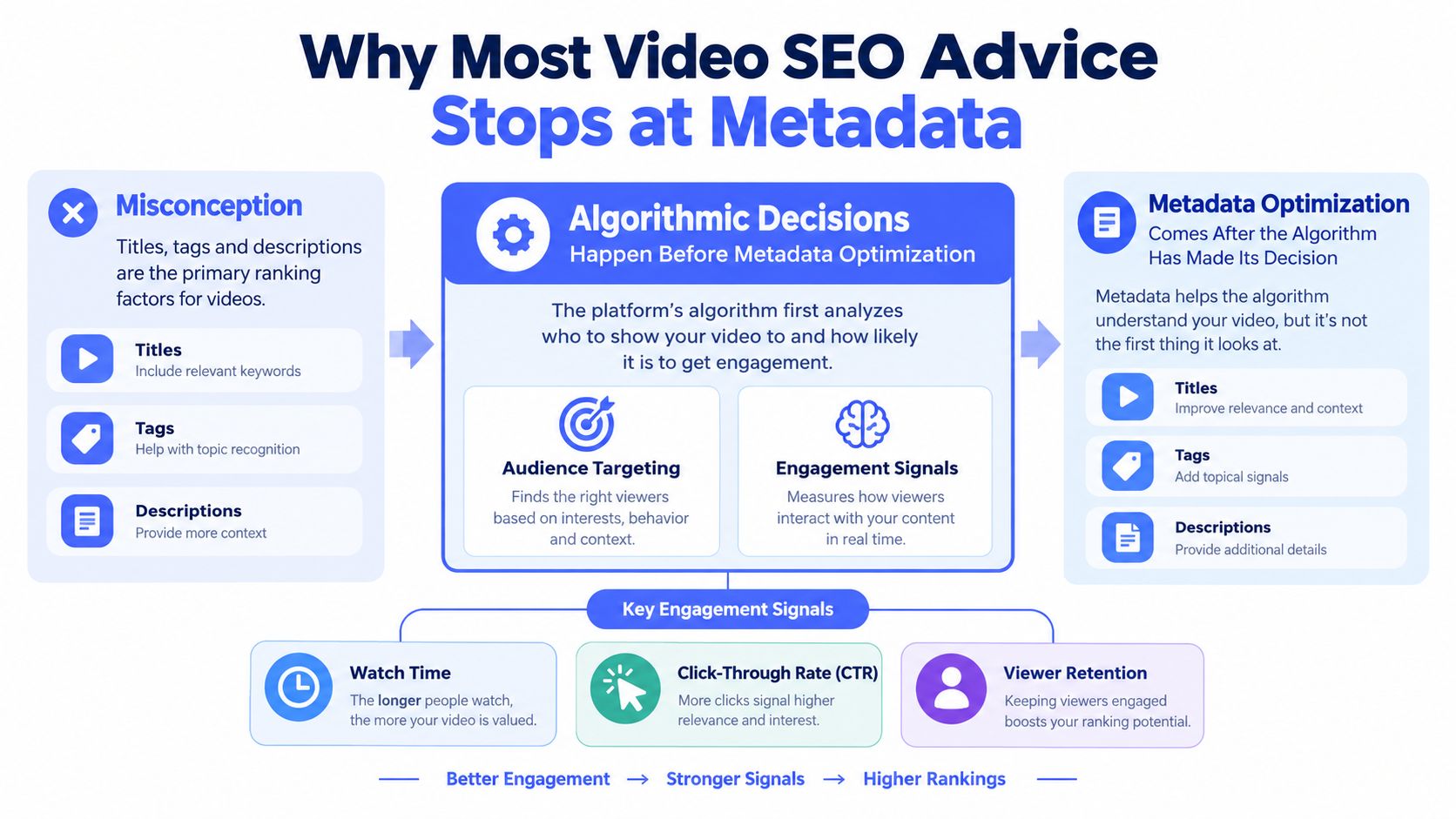
For mid-market and enterprise teams, surface prioritization usually matters more than another round of tag edits. One well-matched video in Suggested can outperform a library of keyword-optimized assets that never satisfies the audience it reaches. The next question isn't whether a vendor can improve rankings. It's whether the vendor can explain how discovery becomes qualified action.
KPIs and Outcomes That Justify the Investment
Leadership won't renew a video SEO agency because a dashboard looks busy. Finance and revenue leaders want to know whether the program created demand, influenced an opportunity, or improved the efficiency of an existing acquisition channel. Views and subscribers can provide context, but they shouldn't carry the business case.
Separate visibility metrics from decision-grade metrics. A ranking may show that a video is discoverable. A qualified lead shows that the content reached someone with commercial relevance. An assisted conversion can show that video contributed to a journey even when it wasn't the final click.
Build one measurement model
The agency should connect YouTube Studio, GA4, and CRM data where the organization's privacy, governance, and technical setup permit it. Every report should state the attribution window, define what counts as a qualified lead, and distinguish sourced pipeline from influenced pipeline.
Useful measures include:
Qualified leads from video-attributed forms
Pipeline sourced or influenced by video content
Assisted conversion paths that include YouTube or an on-site embed
Subscriber quality, assessed through subsequent viewing and commercial actions
Cost per qualified video lead compared with relevant paid social benchmarks
Sales acceptance and opportunity progression for video-engaged accounts
A useful framework for proving SEO business impact is to connect activity metrics to commercial decisions rather than treating visibility as the final result. For implementation details around channel reporting, use YouTube video analytics guidance as a reference point, then adapt the model to your CRM definitions.
Common Pitch Metrics | Decision-Grade Metrics for Buyers | Why It Matters |
|---|---|---|
Views | Qualified leads attributed to video | Shows whether attention reached a commercially relevant audience |
Subscribers | Subsequent engagement and conversion quality | Separates passive growth from an audience that can support demand |
Search rankings | Sourced and influenced pipeline | Connects visibility to revenue discussions |
Watch time | Assisted conversion paths | Shows whether video contributed before the final conversion |
Impressions | Cost per qualified video lead | Makes video comparable with other acquisition programs |
CTR | CTR by surface and audience segment | Reveals whether packaging works for the intended discovery environment |
CFO question: “Which opportunities would we have missed if this video program had not existed?”
A serious agency won't avoid that question by presenting a larger view count. It will explain the limits of attribution, show the evidence available, and identify the next measurement improvement. That honesty is more valuable than false precision.
A Step-by-Step Vendor Evaluation Checklist
Run the evaluation as a 30-day sprint. Don't allow six vendors to submit six different definitions of success. Give each one the same channel data, commercial objectives, audience information, and access constraints, then compare the reasoning behind the recommendations.
Days 1 to 7, define the engagement
Put the scope in writing before discussing creative volume. Specify the channels, discovery surfaces, formats, publishing responsibilities, paid media boundaries, approval process, reporting systems, and in-house handoff points.
Ask each vendor to identify what it will not own. That answer often reveals more than the service list. A proposal that says “channel growth” without naming who writes scripts, publishes videos, manages comments, updates thumbnails, or coordinates CRM tracking leaves the buyer carrying the operational risk.
Review practical guidance on choosing a video marketing agency, but use your own procurement document as the source of truth. The engagement should include deliverables, decision rights, response times, and acceptance criteria.
Days 8 to 15, test the evidence
Request references from comparable clients and interview them directly. Ask how the agency handled weak retention, poor lead quality, missed approvals, and disagreements over attribution. Ask what changed in the client's operating process, not just what appeared in the final deck.
Require evidence that separates organic performance from paid promotion. A vendor that reports aggregate watch hours without showing the acquisition source may be hiding the difference between audience fit and media spend.
Days 16 to 23, commission a technical audit
Pay for a focused audit rather than accepting a free generic teardown. The deliverable should inspect channel structure, topic coverage, video packaging, retention patterns, transcripts, landing pages, embeds, structured data, conversion paths, and reporting quality.
Then compare the audit with the agency's proposed 90-day plan. Look for prioritization. A strong plan names the problems it won't fix immediately and explains why. A weak plan lists every possible improvement and assigns equal importance to all of them.
Days 24 to 30, pressure-test measurement and terms
Ask the agency to diagram its attribution model. Confirm how it will handle direct conversions, assisted conversions, multiple video touches, offline sales activity, and CRM status changes. Require attribution windows to appear in the contract or measurement appendix.
Review these commercial terms before approval:
IP ownership: Confirm who owns raw footage, edited files, thumbnails, scripts, transcripts, and channel assets.
Data portability: Require access to dashboards, source files, tagging conventions, and historical performance data.
Exit clauses: Define how quickly the relationship can end and what handoff the agency must provide.
Scope boundaries: Itemize production, media management, optimization, reporting, and third-party costs.
Approval rights: Clarify who can publish, alter metadata, launch campaigns, or make claims about customer results.
Red flags should stop the process, not become negotiation points. Reject guaranteed rankings, refusal to share live or exportable dashboards, unclear paid-versus-organic reporting, and one-size-fits-all pricing that ignores the number of surfaces and measurement requirements.
What Good and Bad Video SEO Engagements Look Like
The difference between agencies becomes obvious when you compare operating behavior rather than slogans. The examples below are representative buying scenarios, not attributed case studies. Use them to test whether a proposal understands the commercial context.
A mid-market B2B SaaS company should not accept a channel plan built around generic thought-leadership clips. A stronger engagement would pair search-led educational content with gated demos and sales follow-up, then inspect whether viewers resemble in-market buyers. The weak version chases views from broad topics, while the worst version buys watch hours through promotion and reports no pipeline connection.
For a DTC brand, the format mix should reflect the path to purchase. Shorts can support product discovery, while longer videos can answer comparisons or usage questions. Recycling television cuts without adapting the opening, pacing, and call to action signals that the vendor understands production, not platform behavior.
Enterprise B2B requires another layer. A capable partner can align video content with named-account plays, product priorities, and account-based content hubs. A poor partner optimizes subscriber count while the sales organization can't identify which accounts engaged or what action followed.
Engagement Type | Strategy Approach | Reporting Focus | Business Outcome |
|---|---|---|---|
Good B2B SaaS engagement | Search-led education paired with gated demos and sales enablement | Qualified trials, account quality, assisted conversions | Video supports demand capture and buyer progression |
Mediocre B2B SaaS engagement | Broad thought-leadership clips optimized for reach | Views, subscribers, general engagement | Attention grows without clear in-market relevance |
Bad B2B SaaS engagement | Paid watch-hour acquisition with no CRM connection | Aggregate watch time | The buyer can't evaluate commercial impact |
Good DTC engagement | Shorts for discovery and longer content for comparison intent | Product actions, qualified traffic, content-assisted conversions | Formats support different purchase questions |
Weak DTC engagement | Television edits reused across platforms | Completion and reach totals | Content lacks surface-specific packaging |
Good enterprise B2B engagement | Account-aligned content hubs and named-account distribution | Account engagement, opportunity influence | Video supports coordinated sales and marketing activity |
Bad enterprise B2B engagement | Subscriber growth as the primary objective | Subscriber count | Channel size masks weak revenue relevance |
In quarterly reviews, ask the account lead to explain what the agency stopped doing and why. Strategic discipline often appears in the cuts. A vendor that keeps every format, audience, and surface active without clear evidence is spending your budget to avoid making decisions.
Choosing a Partner and Getting the First 90 Days Right
Choose a specialist video SEO agency when YouTube or Google video is a primary demand channel and your team lacks deep optimization expertise. Choose a full-service video marketing agency when production is the bottleneck and search optimization needs to operate alongside creative, paid media, and channel management. Build in-house only when the organization can sustain dedicated ownership for strategy, publishing, creative coordination, and measurement.
AI search adds another evaluation criterion. A partner should understand how transcripts, structured content, supporting pages, and proof affect discoverability across traditional and conversational interfaces. The LLMrefs guide to AI search agencies provides useful context for evaluating that broader capability, but don't let AI terminology substitute for a clear operating plan.
The first 90 days
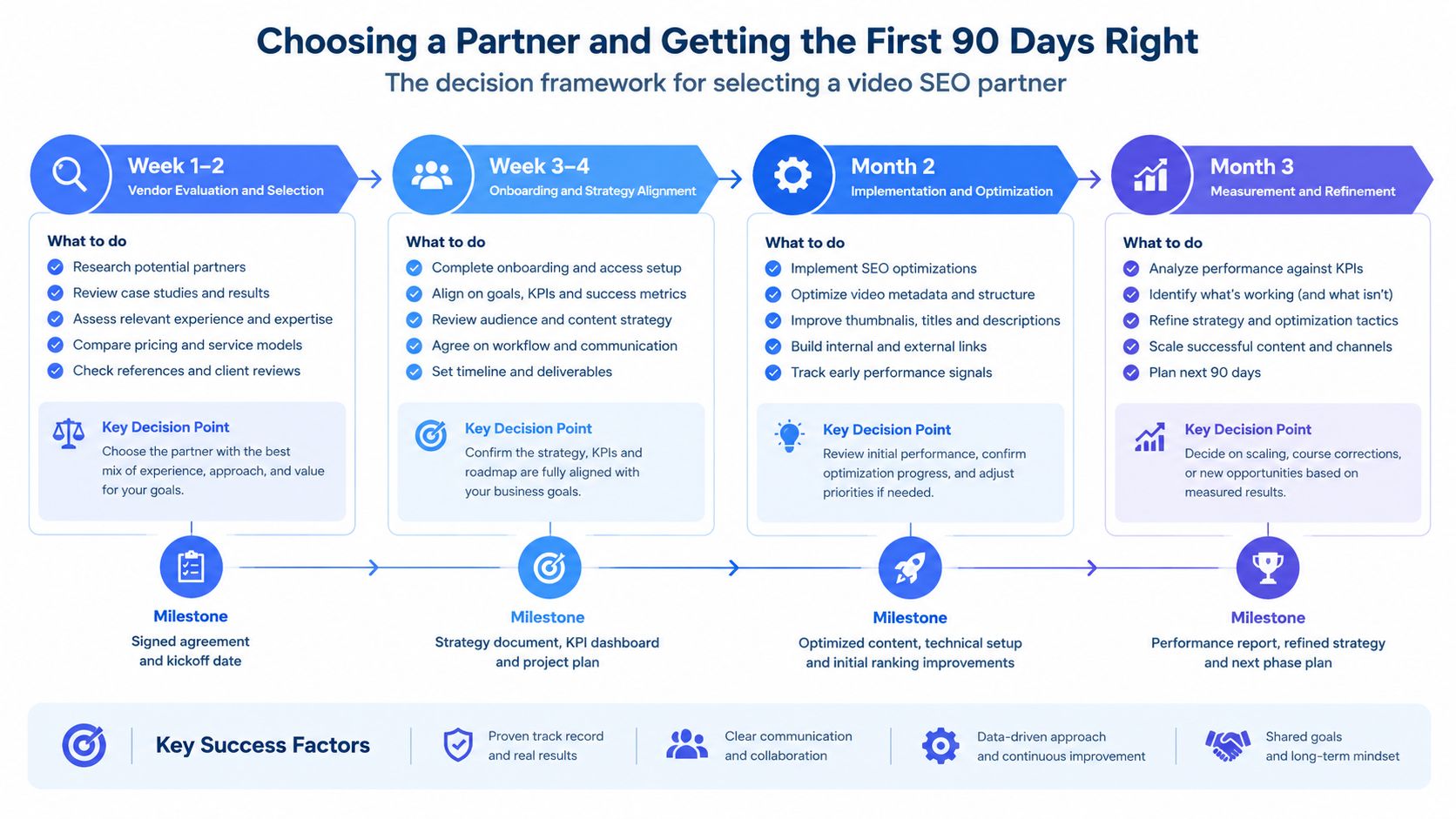
Days 1 to 30: Baseline current performance, audit the channel, confirm access, map surfaces to business goals, and finalize attribution definitions. Don't approve a new content calendar until the team agrees on what success means.
Days 31 to 60: Implement quick-win packaging changes, test formats, improve conversion paths, and document early retention and audience-quality signals. Treat the first experiments as learning assets, not proof of a permanent trend.
Days 61 to 90: Consolidate findings into a channel playbook, lock in KPI ownership, and decide whether to expand, restructure, or end the engagement. Require the agency to explain which assumptions survived contact with the data.
Before renewal, ask one question: “What would you stop doing next quarter if you were spending your own money?” The answer reveals whether your partner is managing a growth system or protecting a list of billable activities.
Busylike combines creative production, paid video advertising, and channel management and optimization for brands using YouTube, CTV, and social, with video SEO and metadata support included in its channel services. If your team needs a partner that connects production, distribution, and channel performance to a practical video demand plan, visit Busylike to discuss the first 90 days.


