
Video Retargeting Guide: Strategy, Setup, and KPIs

A prospect watches your product video, visits the pricing page, and leaves without converting. Your retargeting platform reports an impression, your analytics tool records a return visit, and your CRM eventually shows a sale. Then the numbers fail to line up. CTV reaches the household, mobile sees a different identifier, Safari blocks part of the journey, and the team debates whether the video created demand or just appeared before a decision that was already happening.
That's the current video retargeting problem. Audience selection still matters, but measurement, sequencing, suppression, and cross-device identity determine whether the campaign produces useful pipeline evidence. A strong program connects first-party behavior, platform signals, server-side events, creative intent, and incrementality testing instead of treating a video impression as proof of impact.
Table of Contents
What Video Retargeting Actually Does for Your Pipeline - The pipeline role is different from the awareness role
Audience Segmentation and Tracking Signals That Matter - Build audiences around intent, not volume - Use browser and server signals together
Platform Tactics for YouTube, Meta, CTV, and Programmatic - Match the platform to the signal
Creative Frameworks for Sequential Video Flows - Assign one job to each stage - Design continuity across the sequence
Measuring Video Retargeting Impact and Attribution Models - Separate delivery metrics from business outcomes - Use attribution as a decision system
Setting Up Video Retargeting Campaigns That Perform - Use a controlled launch sequence - Read the early data correctly
AI-Powered Personalization and Predictive Optimization - Give the system better decisions to make - Keep humans accountable
Case Examples and Testing Strategies for Real Results - A testing matrix that produces learning
What Video Retargeting Actually Does for Your Pipeline
A visitor lands on a product page after searching for a solution. She watches part of the explainer, checks the pricing page, then closes the tab because a meeting starts. A conventional display ad might show the same product image later. Video retargeting gives the next interaction a job, such as answering a concern, demonstrating the product, or proving that similar buyers achieved the outcome they wanted.
The mechanics are straightforward. A platform receives an eligible audience signal, matches that person or household where its identity rules allow, and serves a video placement on a connected platform. The campaign then records downstream events such as a return visit, form completion, trial start, purchase, or qualified opportunity. Retargeting is paid re-engagement, while broader remarketing can also include first-party email and other customer communications, as Adobe's explanation of remarketing and retargeting describes.

The pipeline role is different from the awareness role
Video earns attention, but attention alone isn't a pipeline stage. The useful question is whether the ad changes the prospect's next action. A person who viewed a pricing page needs different information from someone who only watched a brand film. A cart abandoner may need reassurance about delivery or returns, while a sales-qualified visitor may need a proof point that helps a buying committee agree.
Use the signal to decide the message:
Page visitor: reconnect with the problem and make the next step clear.
Video engager: deepen understanding with a demonstration or testimonial.
High-intent visitor: address objections, reinforce proof, and reduce friction.
Converted customer: suppress from acquisition retargeting and move into an expansion or advocacy path.
The campaign earns its place in the pipeline when those distinctions shape delivery, not when the reporting dashboard counts completed views.
Practical rule: Retarget the unanswered question, not the URL someone visited.
Audience Segmentation and Tracking Signals That Matter
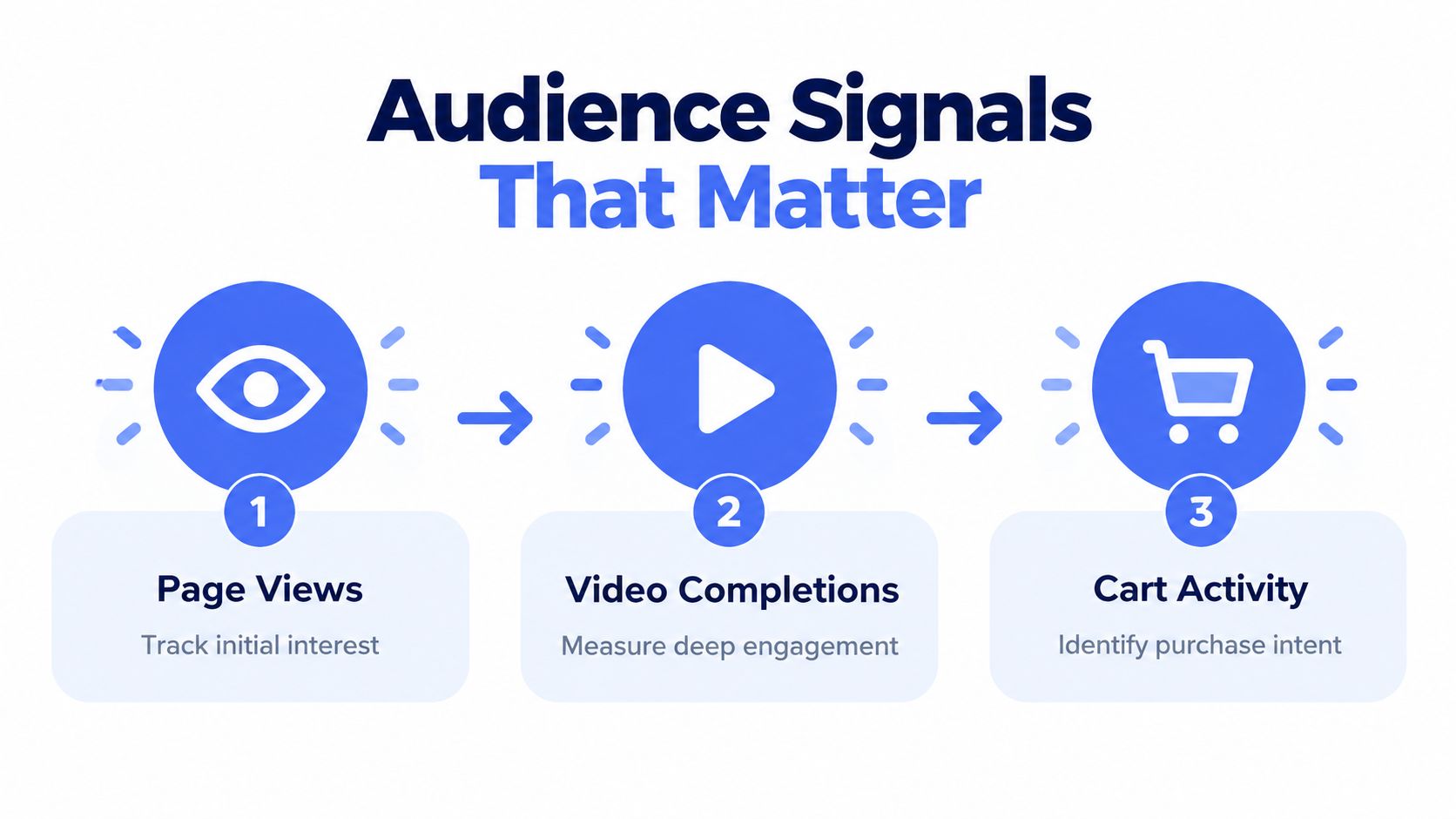
A video retargeting audience becomes useful when each event reflects a different level of intent. A page view shows initial interest, but it does not establish readiness to buy. Meaningful video engagement indicates that the message held attention. Cart activity, checkout visits, or a form start usually signal a more immediate commercial opportunity. Combining these events into one pool creates weak sequencing and mismatched offers.
Build audiences around intent, not volume
Use distinct audience states and assign each one a clear follow-up:
Signal | What it tells you | Suitable follow-up |
|---|---|---|
Product or category page view | Initial consideration | Clarify the product's role |
Meaningful video engagement | The message earned attention | Add proof or a deeper demonstration |
Pricing, checkout, or form activity | Commercial intent | Remove friction and present the next action |
Conversion event | The desired action happened | Suppress from acquisition messaging |
Freshness matters as much as audience membership. Set lookback windows that match the buying cycle, exclude converters promptly, and stop people who visited several pages from entering conflicting ad groups. Keep separate pools for product interest, content engagement, and high-intent actions. This makes frequency controls, creative decisions, and reporting easier to interpret.
The measurement problem is growing as CTV adoption expands across connected devices while browser, app, and household identity signals continue to fragment. Browser-only reporting can miss a substantial share of conversion events because of Safari tracking protections, iOS ATT, and ad blockers. Platform-reported conversions therefore provide only a partial view when a campaign spans mobile web, desktop, apps, and CTV.
Use browser and server signals together
Dual-tagging connects client-side behavior with server-confirmed outcomes. The browser can record page context and engagement, while the server can validate lead creation, order status, or CRM progression. Consent requirements still apply. Server-side tracking preserves measurement for permitted events; it does not justify collecting every possible signal.
Document the operating rules before launch:
Event definitions: Specify what counts as a view, completion, qualified lead, purchase, and suppression event.
Identity boundaries: Record where deterministic matching ends and household or modeled delivery begins.
Data freshness: Set expiration and suppression logic so old intent does not remain active indefinitely.
Reporting ownership: Reconcile platform conversions with analytics and CRM outcomes instead of choosing the most flattering number.
Predictive signals can help teams prioritize audiences. This guide to AI audience targeting is relevant when evaluating that approach, but prediction should build on clean event definitions and verified conversion instrumentation. It cannot repair missing consent records, broken tags, or unclear business outcomes.
Platform Tactics for YouTube, Meta, CTV, and Programmatic
Each platform solves a different part of the retargeting problem. YouTube offers strong video engagement signals and a direct relationship with Google's advertising ecosystem. Meta is effective for social engagement and flexible creative testing. CTV extends reach to household screens, but identity, attribution, and frequency control require more discipline. Programmatic connects inventory across publishers and devices, with greater operational complexity.
Match the platform to the signal
Channel | Useful retargeting strength | Main trade-off |
|---|---|---|
YouTube | Video engagement, search context, and Google audience workflows | Skip behavior makes the opening seconds decisive |
Meta | Site events, social engagement, dynamic creative, and rapid testing | Placement variation can complicate creative consistency |
CTV | Large-screen impact and household-level reach | Person-level attribution and suppression are less direct |
Programmatic | Cross-publisher reach and inventory flexibility | Identity, brand safety, supply quality, and frequency need active management |
On YouTube, create audiences from meaningful video behavior rather than every impression. A viewer who watches a substantial portion of a demonstration can receive a deeper proof asset, while someone who skips quickly shouldn't automatically get the same sequence. Link the campaign to conversion events and monitor assisted actions, not only platform-reported last interactions.
Meta works well when the creative system produces multiple versions for different placements and intent states. Use short cut-downs for fast feeds, captions for sound-off environments, and product-specific variants when the event data supports them. Keep exclusion logic tight. A purchaser shouldn't continue seeing the acquisition offer if a delayed event fails to reach the platform.
CTV requires a different expectation. It can establish a memorable household touchpoint and support mid-funnel progression, but it shouldn't carry the entire burden of direct-response attribution. Use it with mobile and desktop video, define household frequency rules where available, and reserve stronger conversion claims for experiments that compare exposed and unexposed groups.
Programmatic adds breadth, not automatic quality. This overview of programmatic video advertising is useful for planning the channel, but the operating discipline comes from supply controls, placement reporting, viewability review, and clear audience exclusions. A broad deal ID or inventory package won't fix weak creative or an audience definition built from low-intent visits.
CTV can belong in retargeting, but only when the measurement plan acknowledges household exposure and cross-device uncertainty.
Creative Frameworks for Sequential Video Flows
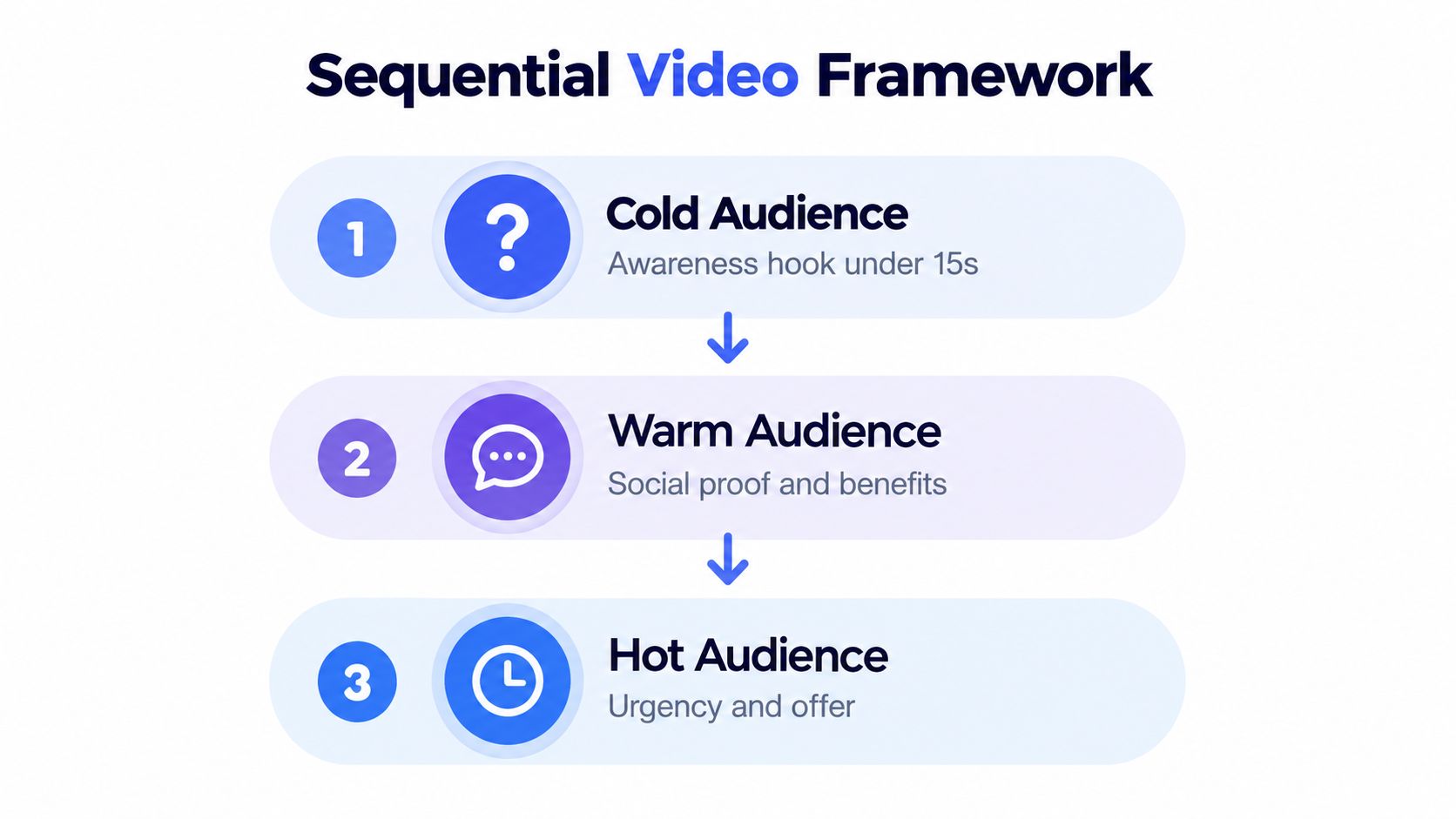
The familiar short retargeting ad often fails because it answers the wrong question. A cold prospect may need a sharp problem statement. A warm prospect needs evidence. A hot prospect may need reassurance about implementation, price, timing, or risk. Length should follow the job of the ad, not a platform habit.
Assign one job to each stage
Start with a sequence rather than a single asset:
Consideration stage, testimonial: After a meaningful product interaction, show a customer explaining the original problem, the decision criteria, and the practical result. The viewer is no longer asking whether the category exists. They're asking whether your solution is credible.
Evaluation stage, objection handling: Address the barrier implied by behavior. A pricing-page visitor may need implementation detail. A repeat product viewer may need comparison guidance. A stalled form starter may need a simpler explanation of what happens next.
Decision stage, proof-led offer: Use a case-specific demonstration, review, guarantee, or clear commercial invitation. Keep the call to action aligned with the event you can measure.
The same 15- to 30-second asset shouldn't carry every stage. For a considered audience, a 30- to 60-second video can create room for proof, context, or an objection that a short cut cannot resolve, a point also reflected in industry guidance on video distribution formats. The trade-off is attention. Longer creative needs a stronger opening and tighter editing, not padding.
Design continuity across the sequence
Use a consistent visual system so viewers recognize the brand, but change the substance of each exposure. Repeat the same opening and offer, and the sequence feels like frequency waste. Change everything, and the audience may not connect the ads.
A useful production matrix includes:
Hook: Name the pain, outcome, or question in the first beat.
Evidence: Show the interface, product, customer, expert, or process that supports the claim.
Next action: Ask for the appropriate step, such as returning to the comparison page, booking a conversation, or completing checkout.
Exit rule: Stop the sequence after conversion or move the person into a customer-specific path.
Creative testing should compare jobs, not only edits. Test testimonial versus demonstration for warm audiences, objection handling versus offer-led proof for high intent, and different sequence orders where the platform supports it. A stronger thumbnail can't rescue a message that arrives before the prospect is ready for it.
Measuring Video Retargeting Impact and Attribution Models
A retargeting video can receive no immediate click and still influence a later branded search, direct visit, sales conversation, or purchase. The reverse is also possible. A platform may report a conversion after an ad impression even when the person would have converted without exposure. Measurement must therefore answer two separate questions: who saw or interacted with the ad, and what changed because of it?

Separate delivery metrics from business outcomes
Build reporting in layers:
Delivery: Reach, completed views, attention signals, placements, and frequency.
Response: Clicks, return visits, product interactions, form starts, and checkout activity.
Pipeline: Qualified leads, opportunities, revenue events, and sales-cycle progression.
Causality: Results from holdouts, geo tests, audience splits, or other incrementality designs.
A completed view describes delivery, not revenue. A click shows response, not proof that the ad caused the sale. Keep these levels separate so leadership can see both campaign activity and measurable business change.
CTV adoption increases the value of video while privacy fragmentation makes attribution less complete. As noted in the audience section, browser-only tracking misses a substantial share of conversions. Consent-aware tagging and server-side confirmation therefore matter, especially when viewers move between browsers, apps, connected TVs, and CRM records. Reconcile platform reports with analytics and CRM outcomes rather than treating any single dashboard as the source of truth.
Use attribution as a decision system
Choose the model according to the decision it must support:
Platform attribution: Useful for optimizing delivery within one channel, but governed by that platform's rules.
Position or data-driven attribution: Useful for distributing credit across known interactions, though it still depends on observable identity.
Holdout testing: Useful for estimating incremental impact by comparing exposed and eligible unexposed groups.
CRM analysis: Useful for checking whether retargeted contacts become qualified opportunities or revenue.
For YouTube, examine retention, watch behavior, traffic quality, and conversion paths together. YouTube video analytics guidance can support the engagement layer. Your CRM should determine whether those engagements produce commercial progress. Combine modeled attribution with controlled tests where possible, then use the results to adjust budgets, audience rules, and creative sequencing.
Setting Up Video Retargeting Campaigns That Perform
A clean launch starts with the event map, not the media plan. Define the audience states, conversion events, exclusions, creative jobs, and reporting owner before choosing bids. Otherwise, the platform will optimize toward whatever signal is easiest to collect, often a view or click rather than a qualified action.
Use a controlled launch sequence
Begin with a narrow audience that has a clear intent definition. Separate product viewers, meaningful video engagers, high-intent visitors, and converters. Check that the platform receives the expected events, that consent handling works, and that suppression removes people after conversion.
Then validate the creative system:
File and placement fit: Prepare aspect ratios, captions, thumbnails, safe areas, and cut-downs for each destination.
Message alignment: Match the video to the page or event that created the audience.
Frequency controls: Set caps where possible and monitor repeated exposure across campaigns.
Exclusion rules: Remove purchasers, active opportunities, employees, irrelevant geographies, and audiences with conflicting offers.
Bid logic: Optimize toward a meaningful conversion only after the event has enough quality and consistency to guide delivery.
Don't launch every platform at full breadth. Start with a channel where the audience signal is strong, establish a baseline, and add CTV or programmatic inventory when the measurement plan can handle their identity differences. Keep a holdout or comparable control design in mind from the start, even if the first phase focuses on instrumentation.
Read the early data correctly
Early delivery tells you whether the campaign can find and reach the intended audience. It doesn't settle incrementality. Review placement quality, completion behavior, return visits, event match rates, and CRM progression together, then change one major variable at a time.
A campaign that produces cheap views but weak commercial movement needs a message or audience correction. A campaign with fewer clicks but stronger qualified progression may deserve more investment. The useful setup is the one that lets you distinguish those outcomes.
AI-Powered Personalization and Predictive Optimization
Behavioral retargeting begins with a rule: visited page, watched video, started form, or abandoned cart. Predictive retargeting adds a probability layer. The platform estimates which eligible people are more likely to take a valuable action, then allocates delivery accordingly. That shift can improve efficiency, but it also makes the underlying event quality and creative relevance more important.
A recent 2026 source reports that 61% of enterprise advertisers already use some form of predictive retargeting, indicating that adoption has moved beyond basic rule-based audience selection. The finding appears in this discussion of retargeting advertising trends. It should be treated as a market signal, not as evidence that predictive delivery will improve every account.
Give the system better decisions to make
AI works best when the team supplies clean inputs and enough creative variation to match different situations. Build assets around:
Audience intent: Product interest, comparison, evaluation, and decision.
Creative angle: Demonstration, testimonial, objection handling, proof, and offer.
Format: Short cut-downs, vertical social edits, connected-TV versions, and longer explanatory pieces.
Outcome: Qualified lead, purchase, booked meeting, activation, or another business event.
Dynamic creative can change product, copy, opening frames, or calls to action based on available signals. Predictive expansion can find viewers who resemble high-value converters, but expansion should remain separated from the strongest first-party retargeting pool. Otherwise, you won't know whether performance came from re-engagement or acquisition.
Keep humans accountable
Prediction doesn't understand positioning, legal sensitivity, brand context, or sales objections by itself. Review which audiences receive which claims, especially in regulated or high-consideration categories. Keep a human approval layer for scripts, disclosures, landing-page alignment, and exclusion logic.
AI also raises a measurement issue. If the platform changes audience composition while changing bids and creative, a better blended result may hide a weaker retargeting result. Preserve clear test cells, label predictive expansion separately, and judge quality through downstream pipeline rather than cheap delivery.
Case Examples and Testing Strategies for Real Results
A responsible practitioner shouldn't invent a case study to make video retargeting sound more predictable than it is. Outcomes depend on audience quality, offer strength, sales cycle, inventory, consent coverage, creative fit, and the definition of conversion. The useful substitute is a test design that makes each of those variables visible.
Consider a SaaS launch. Create one audience from product-page visitors and another from meaningful engagement with the explainer. Serve the first group an implementation-focused demonstration and the second a customer proof asset. Keep a comparable eligible group unexposed, then compare qualified conversations and opportunity progression rather than relying on view-through conversions.
For retail, separate category browsers from cart users. The browser sequence can explain product differences, while the cart sequence handles delivery, returns, or reassurance. Suppress purchasers immediately and test whether a proof-led video increases completed orders without increasing unwanted frequency.
For consumer electronics, connect product comparison behavior with creative that demonstrates the feature under consideration. Use YouTube or Meta for observable engagement, then test CTV as an additional household touchpoint rather than assuming that a large-screen impression caused the sale. Report the channels separately before evaluating the combined journey.
A testing matrix that produces learning
Change one dimension at a time:
Audience: Page visitors versus deeper video engagers.
Message: Demonstration versus testimonial versus objection handling.
Sequence: Proof first versus education first.
Channel: Social and YouTube exposure versus a mix that includes CTV.
Outcome: Immediate conversion versus qualified pipeline progression.
Record exposure, frequency, event match quality, creative version, landing-page response, and CRM status. If the result improves only inside a platform dashboard but not in server-confirmed or CRM outcomes, treat the finding as an optimization clue, not a business conclusion.
Busylike combines video production, paid video advertising, and channel management across YouTube, CTV, and social, helping teams connect audience signals with performance-focused creative. Visit Busylike to discuss a video retargeting program built around cleaner measurement, intentional sequencing, and measurable pipeline outcomes.

