
YouTube Ad Formats: Complete Reference for Marketers

YouTube's ad ecosystem generated $40.4 billion in 2025, so the practical question isn't which format wins in isolation. It's how to allocate budget across formats that serve different jobs, from discovery and reach to storytelling, response, and connected TV exposure.
Table of Contents
Why YouTube Ad Formats Demand a Systematic Approach - Format choice is an operating decision
YouTube Ad Performance Benchmarks by Format - Read the benchmark as a trade-off
Current Self-Serve Format Landscape and Campaign Consolidation - The current buying question - Consolidation changes creative planning
Technical Requirements and Creative Specifications - Build the asset matrix before buying media
Matching Formats to Awareness, Consideration, and Conversion Objectives - Awareness needs scale and memory - Consideration needs room to explain - Conversion requires a deliberate handoff
In-Stream Ads for Storytelling and Direct Response - When forced exposure is the right tool - Use the two formats together
How to Build a YouTube Format Strategy That Scales - Use a working decision sequence - Make reporting reflect the system
Why YouTube Ad Formats Demand a Systematic Approach
A list of YouTube ad formats is easy to produce and difficult to use. Marketers can name skippable in-stream, non-skippable, Shorts, in-feed, bumper, and masthead ads, yet still make poor allocation decisions because the format name doesn't explain the role it should play in a campaign.

YouTube has moved beyond its original in-stream model. Google Ads now supports a broader portfolio that includes in-feed video ads, bumper ads, and masthead ads, alongside in-stream placements. Google describes in-feed ads as discovery-oriented units, bumpers as a six-second reach format, and mastheads as premium homepage placements designed for high-visibility exposure. The platform can therefore support short-form viewing, longer-form storytelling, brand building, and direct response within one media ecosystem, as documented in Google's overview of YouTube video ad formats.
The strategic mistake is treating those placements as competing answers to one question. They aren't interchangeable. A bumper can't carry the same narrative burden as a skippable in-stream ad, while a masthead serves a different commercial purpose from an in-feed unit that relies on discovery behavior.
Format choice is an operating decision
A useful plan starts with three questions:
What must the campaign achieve? Awareness, consideration, action, or a combination?
Where is the audience making the decision? In a Shorts feed, on a watch page, in search and browse surfaces, or on a connected TV?
What can the creative team produce well? A vertical demonstration, a concise reminder, a product story, or a premium brand moment?
Practical rule: Assign every format a job before assigning it a budget.
The strongest YouTube programs behave like systems. Reach formats introduce the message, storytelling formats develop interest, and action-oriented executions give motivated viewers a next step. That structure also makes measurement more useful, because teams can judge each placement against its intended role instead of declaring a format ineffective just because it wasn't designed for the same outcome.
YouTube Ad Performance Benchmarks by Format
The available benchmark data show why a single “best” format doesn't exist. Shorts ads averaged a 1.24% CTR, compared with 0.65% for skippable in-stream, 0.95% for discovery, and 0.21% for non-skippable ads. Those figures point to a meaningful engagement difference, but CTR alone doesn't tell a brand whether it needs efficient interaction, guaranteed exposure, or message retention.
The same benchmark set reports Shorts at a $4.85 CPM, the lowest listed CPM. Skippable in-stream reached $11.42, discovery $10.85, bumper $9.20, and non-skippable $14.85, according to the YouTube advertising benchmark comparison from Digital Applied.
Format | CTR | CPM |
|---|---|---|
Shorts | 1.24% | $4.85 |
Skippable in-stream | 0.65% | $11.42 |
Discovery | 0.95% | $10.85 |
Non-skippable | 0.21% | $14.85 |
Bumper | Not provided | $9.20 |
The table makes one point clear. Low CPM and high CTR don't automatically make Shorts the right choice for every campaign. Shorts can provide an efficient performance and reach surface, but a brand may still need in-stream storytelling to explain a complex product or non-skippable inventory to protect complete-message delivery.
Read the benchmark as a trade-off
Use the data to form a hypothesis, not to declare a permanent winner.
Shorts: The benchmark combines the strongest CTR with the lowest CPM in the cited set. That supports testing vertical, fast-moving creative when interaction efficiency matters.
Skippable in-stream: Its middle position on CTR and CPM reflects a format that can support deeper storytelling while allowing viewers to self-select.
Discovery: Its CTR sits above skippable in-stream in the benchmark, which suits campaigns that want users to choose to engage from search or browse contexts.
Non-skippable: The low CTR and highest CPM are consistent with a format purchased for exposure and message delivery rather than voluntary clicking.
Bumper: The cited CPM sits below in-stream and non-skippable, making it useful as a compact reach or reinforcement layer.
Teams should pair these metrics with conversion quality, assisted behavior, audience fit, and creative diagnostics. A campaign optimized only toward CTR may overfund a format that generates interactions but doesn't move qualified demand. For a broader measurement view, connect placement data with YouTube video analytics practices, then compare each format against the business outcome it was assigned to influence.
Current Self-Serve Format Landscape and Campaign Consolidation
The buying interface has changed faster than many format guides. Marketers still ask questions based on an older map of YouTube advertising, while current planning increasingly involves six live self-serve formats and a more consolidated campaign structure.
Demand Gen has become the main conversion-focused pathway after Video Action Campaigns stopped accepting new creation and were upgraded. That matters because the campaign type influences how advertisers access inventory, optimization, and format combinations. A team that thinks only in terms of legacy campaign labels may misdiagnose a setup problem as a creative or placement problem.
The current buying question
The practical question isn't just whether a format exists. It's whether a surface deserves budget within the campaign's objective and operating constraints.
Planning question | What to evaluate |
|---|---|
Conversion focus | Whether Demand Gen provides the appropriate route for action-oriented delivery |
Vertical video | Whether Shorts creative is native enough to earn attention in a fast-scrolling environment |
Discovery behavior | Whether in-feed placements can turn search and browse intent into engaged viewing |
Storytelling | Whether in-stream assets have enough narrative flexibility for the product |
Creator-led execution | Whether creator-style assets fit the audience and brand governance requirements |
Automation | Whether the campaign can optimize without hiding important format-level differences |
Recent industry commentary identifies Shorts as a performance surface and creator-led paid ads as a growth trend, but those developments don't remove the need for planning discipline. Automation can help distribute delivery, yet it can't repair a weak opening, an unsuitable aspect ratio, or a message designed for the wrong decision stage.
Consolidation changes creative planning
Campaign consolidation also affects production. Instead of making one generic video and assuming the platform will solve the adaptation problem, teams should prepare a creative family: vertical assets for Shorts, horizontal assets for in-stream and television environments, and discovery-oriented executions that make sense when users choose whether to watch.
The current YouTube advertising format and objective guide from Relevant Audience is useful as a reference point for the changing campaign map, but marketers should verify availability and settings in their own Google Ads account before finalizing a media plan. Platform labels and buying paths can change, and the operational details matter more than a static format list.
Technical Requirements and Creative Specifications
Creative production should begin with the placement environment, not the edit timeline. Google recommends 1080p assets and supports three primary aspect-ratio approaches: 16:9 horizontal, 9:16 vertical, and 1:1 square. The minimum standard HD threshold is 720p, while SD isn't recommended for optimal quality, according to Google's video ad specifications.
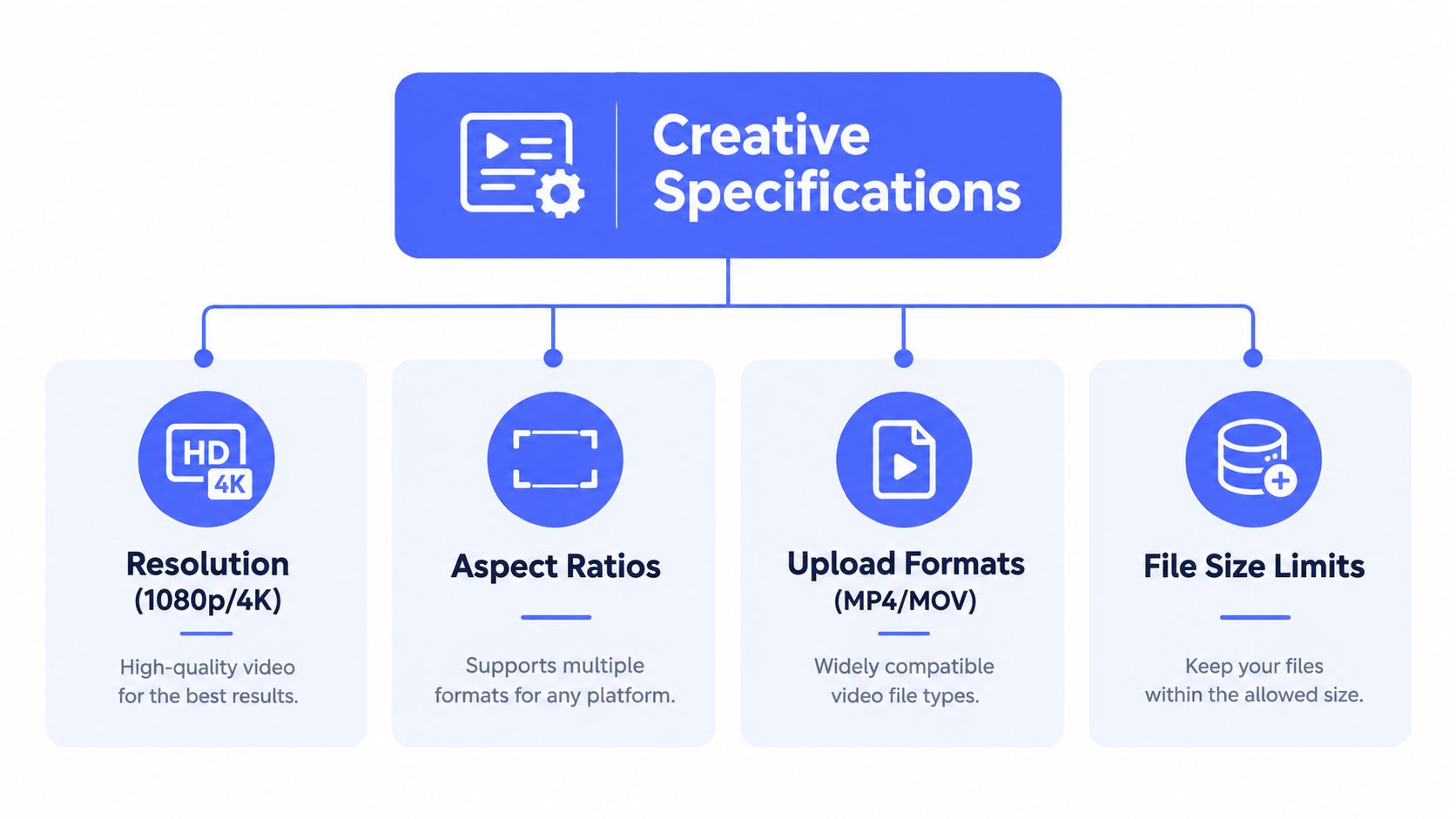
That doesn't mean every campaign needs three separate productions. It does mean the team should decide early which content can be adapted safely and which executions need a dedicated composition. A horizontal product demonstration may crop badly in a vertical feed, while a vertical creator-style cut may feel misplaced in a premium television environment.
Build the asset matrix before buying media
Start with the message, then map it to the format:
Horizontal 16:9: Use for traditional in-stream storytelling, long-form viewing, and connected TV environments.
Vertical 9:16: Use when the concept depends on a native Shorts experience, with the subject, captions, and CTA composed for a narrow screen.
Square 1:1: Consider when a campaign needs a flexible social-style asset that can work across selected placements without severe cropping.
The technical file itself also deserves attention. Preferred upload formats include MPG/MPEG-2 or MPEG-4, while Google supports formats such as WMV, AVI, MOV, FLV, MP4, WebM, ProRes, and HEVC. Files can be as large as 256 GB, but a large file limit doesn't make a large export strategically useful.
The specification is the floor. Placement-specific composition is what protects performance.
Before launch, check that text remains legible on a phone and a television, the product isn't hidden by interface elements, captions are accurate, and the opening frame works without relying on a slow setup. Produce alternate hooks and CTA treatments where the objective justifies testing them. This approach reduces re-editing after media has already started and gives the buying team assets that can be compared fairly.
Matching Formats to Awareness, Consideration, and Conversion Objectives
The most useful way to evaluate YouTube ad formats is to assign them to decision stages, then design the sequence between them. Google's YouTube measurement material says brands combining awareness and action formats see higher ROI than brands using either alone, as outlined in Google's full-funnel YouTube measurement guidance.
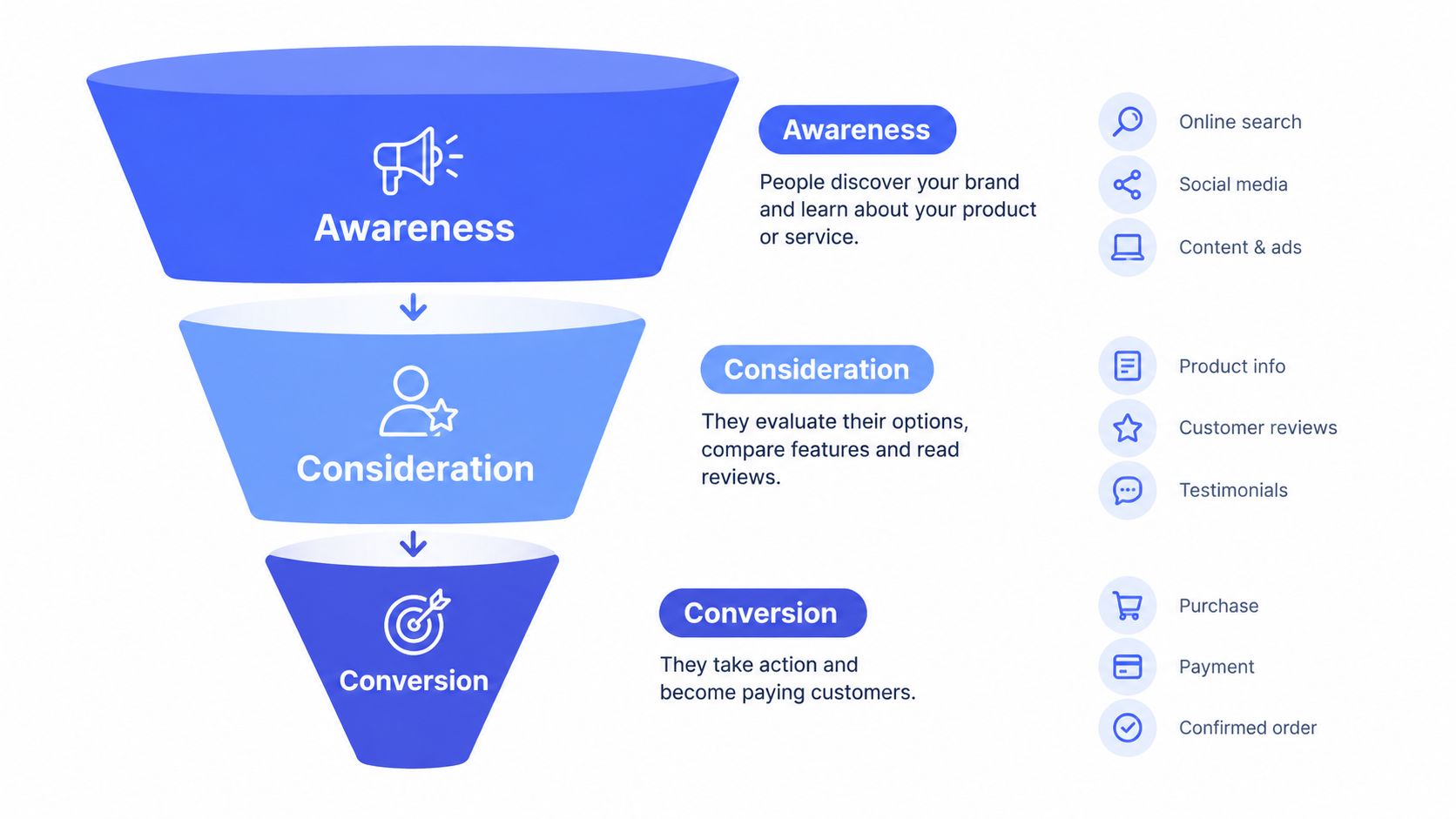
That finding changes the planning conversation. A format shouldn't be judged only by whether it can generate a conversion immediately. It may be doing valuable work by creating familiarity, qualifying attention, or supplying a warmer audience for a later action message.
Awareness needs scale and memory
At the awareness stage, bumper and non-skippable ads can provide concise exposure and reinforce a central brand idea. Masthead placements can support a premium homepage visibility moment when a brand has a major launch or broad reach requirement. In-feed ads can also create discovery when the campaign benefits from users choosing to investigate rather than being interrupted inside another video.
The creative should be simple enough to recognize quickly. The job isn't to explain every feature. It's to establish the brand, category, or problem strongly enough that later communication has context.
Consideration needs room to explain
Skippable in-stream is often the most flexible consideration format because it can carry a product story, demonstration, comparison, or proof point while allowing uninterested viewers to leave. In-feed can complement it by meeting users on discovery surfaces where they're already browsing or searching for video content.
This stage benefits from a message that rewards continued viewing. Product marketers should give the viewer a clear reason to stay, while brand teams should resist compressing a complex proposition into a bumper because the shorter unit is easier to produce.
Conversion requires a deliberate handoff
Action-oriented campaigns need a clear next step, a landing experience that matches the ad, and an audience strategy that recognizes existing interest. Shorts can support response when the creative is built for vertical consumption and makes the value proposition immediately understandable. Skippable in-stream can carry a stronger explanation before asking for a click, signup, demo request, or purchase.
Sequence the message, not just the placements. Let one format create recognition, another develop confidence, and an action-oriented execution make the next step obvious.
Connected TV adds another layer. A television placement may be valuable for attention and recall, but it shouldn't be forced to perform like a mobile click unit. Treat screen type as part of the objective definition, then evaluate the contribution of television, Shorts, in-stream, and discovery as a portfolio.
In-Stream Ads for Storytelling and Direct Response
In-stream formats differ less by their names than by the permission they give the viewer. Skippable in-stream ads let people leave after the opening moment, so the creative must earn continued attention. That makes the format suitable for storytelling, product education, and response, especially when the message needs more room than a short reach unit allows.
Skippability is an advantage, not merely a constraint. Viewers who continue may be signaling interest, while those who leave don't consume the same amount of paid viewing time. The advertiser still needs a strong opening and a visible value proposition, but the format can support a fuller argument than a forced-exposure unit.
When forced exposure is the right tool
Non-skippable in-stream ads serve a different purpose. They protect complete-message delivery and can support a concise brand moment, launch message, or recall layer where the advertiser doesn't want the viewer to choose whether the message plays.
That protection comes at a cost. The benchmark data cited earlier show non-skippable ads with a 0.21% CTR and a $14.85 CPM, so marketers shouldn't interpret guaranteed viewing as guaranteed response. The format is better evaluated through reach, message retention, audience quality, and the downstream role it plays in the larger plan.
Use the two formats together
A practical sequence might introduce a product story through skippable in-stream, then use shorter non-skippable or bumper creative to reinforce the central idea among relevant audiences. The exact setup depends on campaign controls and audience availability, but the operating principle is stable: permission-based storytelling and forced exposure solve different problems.
What doesn't work is asking a non-skippable unit to perform like a direct-response landing-page ad, or using a skippable video with no meaningful hook and blaming the skip behavior. Match the edit, CTA, bid objective, and success metric to the format's actual delivery mechanics.
Shorts, Discovery, Bumper, and Masthead Placements
These placements cover four distinct user experiences, so they shouldn't share one generic creative brief.
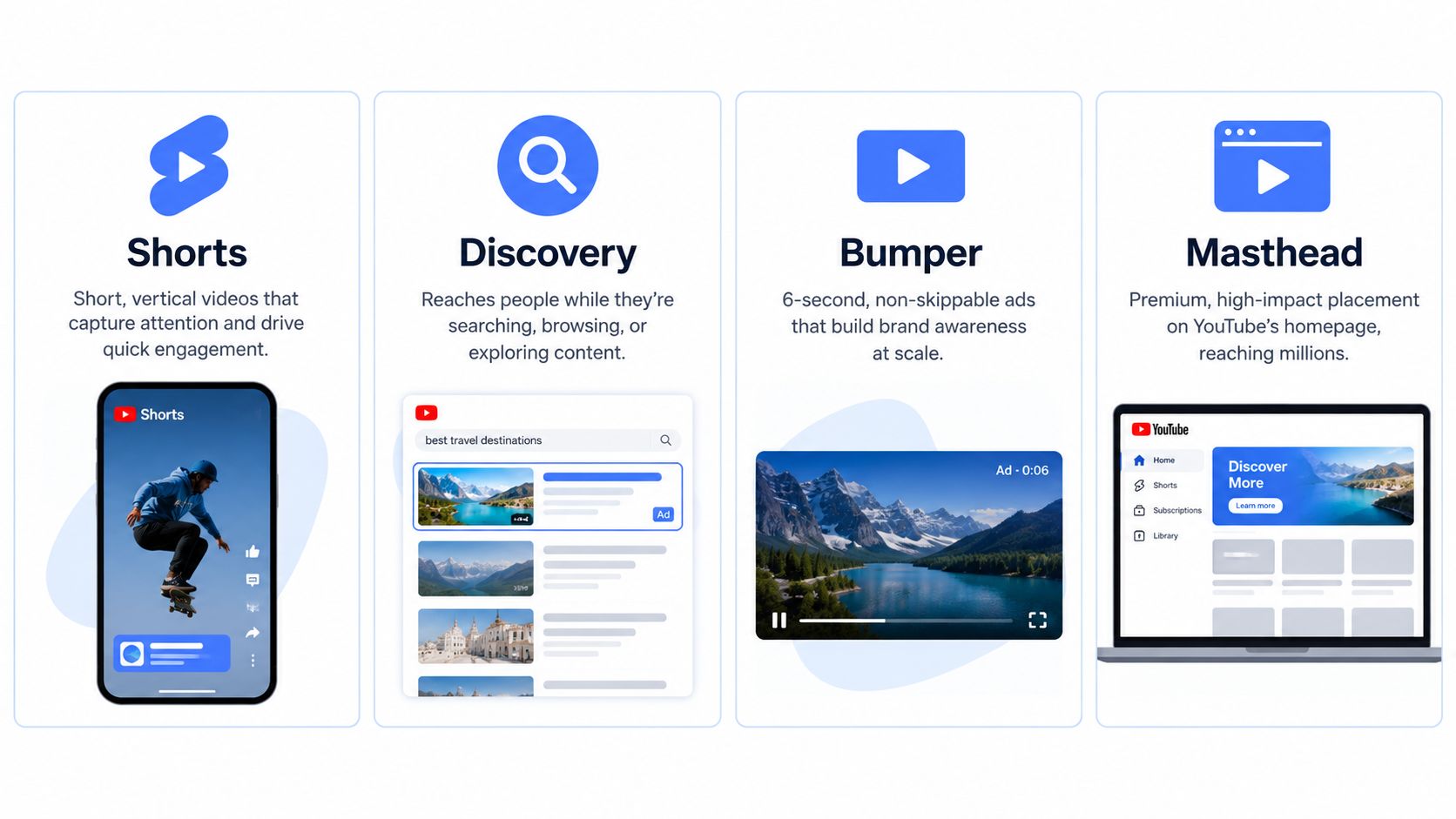
Shorts ads appear in a vertical, fast-consumption environment. The benchmark data report a 1.24% CTR and $4.85 CPM, which makes Shorts a credible test for efficient engagement and reach. That efficiency only matters if the creative feels native to the feed. A landscape asset squeezed into a vertical frame usually communicates that the advertiser adapted the placement as an afterthought.
Teams planning YouTube Shorts marketing should develop a vertical-first concept, keep the subject visible, and make the value proposition understandable quickly. Creator-style production can work when it serves the message rather than becoming a decorative imitation of organic content.
Discovery, or in-feed video ads, are chosen from search, browse, or related-video contexts. The user has more agency than in an interruption-based placement, so the thumbnail, headline, and opening frame need to make the proposed viewing experience clear. This format suits education, product exploration, and content-led consideration.
Bumper ads are six-second reach units. They can't carry a full product argument, but they can repeat a distinctive phrase, visual, or brand cue after a longer exposure. Their value lies in compact reinforcement and frequency, not in explaining a complicated offer from scratch.
Masthead ads occupy premium homepage visibility and should be reserved for moments where scaled exposure and prominence justify the investment. A masthead needs a strong visual system and an unmistakable brand presence because the placement creates attention, not automatic relevance.
A simple allocation test is to ask what the audience should do next. If the next step is “notice,” consider bumper or masthead. If it is “choose to learn,” consider discovery. If it is “engage quickly,” test Shorts. If it is “understand and act,” connect these placements to a stronger in-stream or action layer.
How to Build a YouTube Format Strategy That Scales
Scaling starts with a campaign architecture, not a larger media budget. Define the business objective, identify the decision stage, choose the screen environments, and then commission the asset variants that those environments require.
Use a working decision sequence
Define the primary outcome. Separate awareness, consideration, and conversion goals, even when one campaign supports more than one.
Assign each format a role. Use reach-oriented placements to establish memory, storytelling placements to develop understanding, and action-oriented placements to capture demand.
Prepare the creative system. Build horizontal, vertical, or square executions according to the intended surfaces rather than relying on one master video.
Launch with a measurement hypothesis. Decide which signal will indicate success for each placement, such as qualified action for a response unit or audience development for an awareness layer.
Optimize the portfolio. Shift budget only after considering how one format supports another, not just which placement has the cheapest immediate result.
Creative fatigue can undermine an otherwise sound plan. Teams that want a practical perspective on why stale assets damage paid media should work with Crank 11 as a resource for thinking about creative refresh cycles and production discipline.
Make reporting reflect the system
A useful report separates placement performance while preserving the full-funnel view. Compare cost, engagement, qualified actions, audience quality, and assisted contribution by format. Don't use one CTR benchmark to judge every unit, and don't move all spend to the cheapest CPM if that decision removes the storytelling or recall layers that make later action possible.
Ongoing management also means checking whether the campaign still has suitable creative for each surface. YouTube ads management can include placement monitoring, creative adaptation, audience refinement, and performance reporting, but the strategic requirement remains the same. Every optimization should answer which role the format is serving and whether that role is helping the wider business objective.
The most resilient YouTube plans treat formats as connected components. Consolidated campaign paths, purpose-built creative, and combined-format measurement give decision-makers a clearer basis for budget allocation than a static ranking of ad types.
Busylike plans, produces, and manages video advertising across YouTube, CTV, and social, including platform-adapted creative for different ad formats and campaign objectives. If you need a connected approach to production, paid distribution, and channel optimization, visit Busylike to discuss your video strategy.


