
YouTube Ads for Lead Generation: A 2026 Playbook

You've launched YouTube ads, watched the platform report conversions, and still can't explain the pipeline movement. The dashboard shows modest lead volume, while sales says more target accounts are mentioning your brand, comparing your product, or arriving at calls with a shortlist already in mind. A viewer watches a connected TV ad in the evening, searches for your company later, and submits a form from a phone the next morning. Your reporting system may credit the final interaction and discard the exposure that helped create the demand.
That's the uncomfortable reality of YouTube ads for lead generation. The media buy matters, but measurement architecture determines whether the campaign looks useful. YouTube's advertising-planning data estimated that its ads could reach 2.53 billion users worldwide in January 2025, equivalent to approximately 30.9% of the global population and 45.5% of internet users, although the figure represents addressable advertising reach rather than a count of monthly active users. DataReportal's YouTube audience analysis also reported that potential ad reach increased by 39.7 million people, or 1.6%, between January 2024 and January 2025.
The practical question isn't “How many forms did YouTube generate?” It's “Which exposures created qualified demand, and how can we prove that without claiming every post-view conversion was caused by an ad?”
Table of Contents
Why Most YouTube Lead Programs Undercount Their Own Impact - The dashboard is often measuring the wrong handoff
Choosing the Right YouTube Ad Format for Each Funnel Stage - A practical format comparison
Building the Audience Layering That Actually Qualifies Leads - Build four layers with distinct jobs
Picking a Lead Capture Path Without Sacrificing Data - Three paths, three compromises - Design the handoff before launching
Bidding and Budget Tactics That Match Funnel Stage - Use a stage-based decision rule
Measuring Influence Beyond the Click - Connect platform events to CRM value - Test the influence claim
Optimization Playbook and Maintenance Habits That Compound - Review the system, not just the dashboard
Why Most YouTube Lead Programs Undercount Their Own Impact
A B2B SaaS team can do everything that a standard performance playbook recommends. It can install the Google tag, add UTM parameters, import conversions, optimize toward forms, and report cost per lead every week. Yet the sales team may still tell a different story. Prospects recognize the product, ask about features covered in videos, and appear further through the buying process than the form data suggests.
The reporting gap usually begins with a false definition of conversion. A click is easy to record, but video can influence a buyer without producing an immediate click. Google distinguishes ordinary conversions from view-through conversions and engaged-view conversions. A view-through conversion can happen after someone sees an ad impression without clicking, while an engaged-view conversion can follow at least 10 seconds of a skippable ad view without a click. Google's YouTube conversion documentation explains these categories and gives marketers a more useful vocabulary for post-exposure behavior.
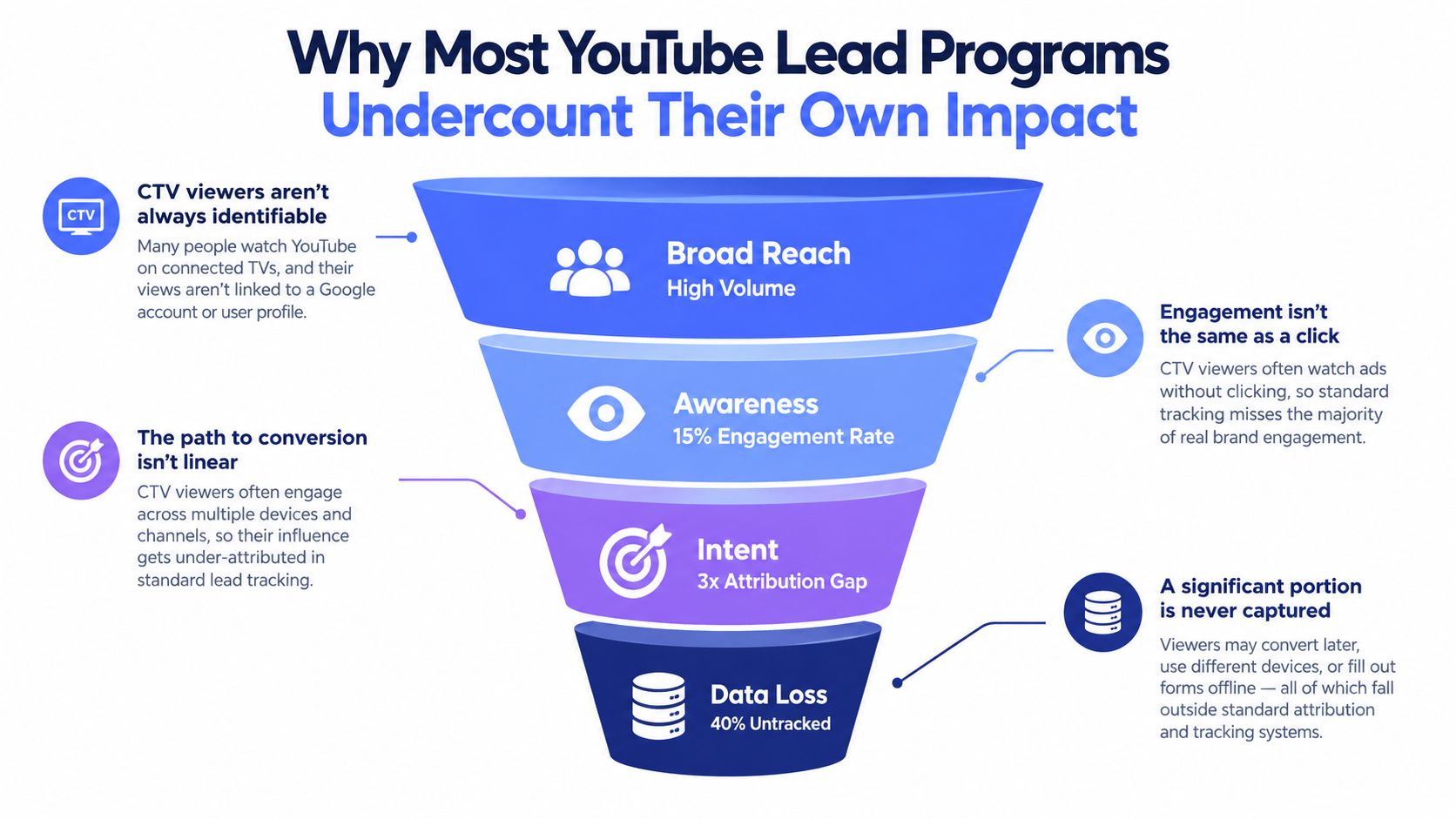
The dashboard is often measuring the wrong handoff
Suppose a buyer sees your ad on CTV, later watches a product tutorial, searches for your brand, and fills out a form on mobile. A last-click report will usually credit the branded search or direct visit. That report isn't necessarily wrong. It's just incomplete.
The same problem appears in account-based B2B campaigns. Available research cited in the brief indicates that 60% of B2B buyers used YouTube during vendor research, while 82% had shortlisted vendors before active research began. Those figures make immediate lead volume a particularly weak standalone proxy for influence. If buyers use YouTube to validate a shortlist rather than discover a vendor from scratch, an ad may contribute to pipeline before anyone submits a form.
Practical rule: Treat a YouTube lead as a progression of signals, not a single form event.
A stronger measurement model separates four outcomes:
Direct response: The viewer clicks and converts in the same measurable path.
Engaged influence: The viewer watches long enough to qualify as an engaged view, then converts later.
View-through influence: The viewer sees the impression and converts without a recorded click.
Pipeline influence: The exposed account produces a qualified opportunity or revenue event in the CRM.
That model doesn't grant YouTube automatic credit. It gives the campaign a way to earn credit through CRM quality, time-window analysis, and controlled testing. The rest of the program should be built around that standard.
Choosing the Right YouTube Ad Format for Each Funnel Stage
Format selection becomes easier when each surface has one job. Skippable in-stream ads can explain a complex offer and create a retargeting pool. Bumpers can reinforce recognition. Shorts can create inexpensive attention in a vertical environment. Discovery placements can meet users while they're actively choosing what to watch.
No format should carry the entire funnel. A connected TV impression is valuable for attention but awkward for form completion. A short direct-response ad may work on mobile but feel too aggressive during a long-form viewing session. The right mix respects the viewer's context instead of forcing every person into an immediate conversion.
A practical format comparison
Format | Attention Window | Best Funnel Stage | Typical Role |
|---|---|---|---|
Skippable in-stream | Variable, with the first seconds carrying the opening promise | Consideration and conversion | Explain the problem, demonstrate the product, or drive a qualified action |
Bumper | Very short, non-skippable exposure | Awareness and reinforcement | Build recall around a simple message or proof point |
Shorts | Fast, vertical viewing context | Prospecting and early consideration | Test hooks, creator-led concepts, and mobile-native explanations |
Discovery | User-selected viewing context | Consideration and intent | Capture active interest with tutorials, comparisons, or demonstrations |
The 10-second engaged-view threshold matters most for skippable ads because it distinguishes a fleeting impression from a meaningful exposure. It still isn't a lead, and it shouldn't replace CRM qualification, but it's a more useful audience signal than treating every served impression equally.
For B2B offers, tutorials often outperform a rushed “book a demo” message because the viewer may still be deciding whether your category or approach deserves consideration. Industry coverage cited in the brief indicates that 60% of B2B buyers who used YouTube during research watched product tutorials. That supports using educational video earlier in the journey, then reserving harder conversion asks for viewers who demonstrate deeper engagement.
A useful planning companion is this guide to how to create a revenue funnel, particularly when your video stages need to align with sales definitions rather than platform events. Keep the campaign architecture lean. Start with two or three formats, then expand only when a specific audience, device, or creative job justifies another surface. The practical differences between placements are outlined in this YouTube ad formats overview, but the operating principle is simple: brief first, format second.
Building the Audience Layering That Actually Qualifies Leads
Audience layering works when each layer answers a different question. Broad prospecting asks who might have the problem. Topic and interest targeting asks who is already close to the category. Customer Match identifies known relationships. Engaged-view retargeting asks who has demonstrated enough attention to deserve a more specific next message.
Build four layers with distinct jobs
Prospecting should reach beyond existing demand while protecting relevance through geography, language, demographic fit, and brand-safety controls. Don't expect this layer to produce the same lead quality as a retargeting pool. Its job is to create qualified exposure and learn which messages earn attention.
Topic and interest audiences narrow the context. Use relevant topics, interests, search themes, and custom segments built around the problems your buyers research. If the audience becomes too narrow, delivery may become erratic and the algorithm may struggle to find enough people. If it's too broad, watch quality and downstream qualification will deteriorate before the platform reports an obvious problem.
Customer Match and modeled expansion can help you reach prospects resembling known customers or qualified accounts. Keep current customers, employees, existing opportunities, and recent converters excluded from acquisition campaigns unless the campaign has a deliberate expansion or cross-sell purpose. Otherwise, your prospecting report can look efficient because it's repeatedly finding people you already know.
Engaged-view retargeting is where the audience becomes operationally useful. Build separate pools for people who watched a meaningful portion of a tutorial, visited a key page, interacted with a channel asset, or completed a lower-friction action. Serve them proof, comparison content, implementation details, or a form offer that matches their demonstrated interest.
A simple sequence might look like this:
Prospect with a problem-led video.
Retarget engaged viewers with a product tutorial.
Exclude converters and sales-qualified records from acquisition.
Present high-intent viewers with proof and a clear next action.
Send every conversion event into the CRM with source, campaign, creative, and exposure context.
Frequency control matters because repeated exposure can either reinforce memory or exhaust it. Review frequency by audience and creative, not just at the campaign level. If the same people see the same hook repeatedly while completion quality declines, refresh the message or move that audience to a later-stage asset. The video retargeting workflow provides useful context for sequencing viewers instead of treating them as one undifferentiated list.
The audience layer should also reflect the mobile handoff. A viewer who watches on CTV may later return through a phone, tablet, or desktop. Preserve identity and campaign context as far as privacy rules and platform capabilities allow, then judge the layer by qualified progression rather than by immediate click rate.
Picking a Lead Capture Path Without Sacrificing Data
The capture path determines both conversion friction and what your team can learn afterward. YouTube lead forms reduce the distance between exposure and submission. On-site landing pages give your team more control over messaging, analytics, consent, and qualification. Server-side conversion infrastructure can improve the durability of measurement, but it requires technical ownership.
Three paths, three compromises
YouTube lead forms work well when the offer is simple and the buyer can act without extensive education. The native experience reduces the mobile handoff problem and can capture demand while the viewer is still inside Google's environment. The trade-off is limited control over the surrounding experience and less ownership of the behavioral data than you'd have on your own site.
On-site landing pages are usually the stronger choice for high-consideration B2B offers. You can explain the use case, add proof, qualify the prospect with carefully chosen fields, and connect the form directly to marketing automation and CRM workflows. The cost is friction. A viewer who would complete a short native form may abandon a slow or overbuilt page.
Conversions API, or CAPI, provides a server-side bridge for sending qualified events back to the advertising system. It can support more resilient measurement and reduce dependence on browser-side signals, but it isn't a magic attribution layer. Your team still needs clear event definitions, consent handling, deduplication, and a CRM process that distinguishes a real opportunity from an unqualified inquiry.
For most enterprise and high-consideration B2B campaigns, the practical default is a focused landing page paired with reliable first-party event handling. For a top-of-funnel guide, newsletter, consultation request, or other low-friction offer, a native lead form may win because completion is easier. The decision should follow the buyer's required effort, not a preference for one platform feature.
Design the handoff before launching
CTV creates a particular challenge. The viewer can't be expected to type a long URL with a remote, and a QR code shouldn't be the only bridge. Use memorable brand cues, short spoken calls to action, companion mobile placements, and retargeting sequences that make the later form experience feel connected to the original ad.
On the landing page, match the promise in the video. Keep the first screen specific, make the form proportionate to the offer, and pass campaign and creative metadata into the CRM. Teams improving this path can use a practical guide to B2B landing page optimization to review friction, message match, and page behavior without reducing the analysis to form count alone.
Bidding and Budget Tactics That Match Funnel Stage
When Maximize Conversions delivers cheap leads that sales rejects, the bid strategy is solving the wrong problem. Switch to Target CPA only after defining an accepted-lead benchmark, then import that downstream event so the campaign optimizes toward pipeline value rather than form volume.
Maximize Conversions fits a new lead campaign when the conversion action is reliable and the audience is broad enough for the system to test different users and placements. For example, a B2B campaign can optimize for completed consultation forms during its initial learning period, but the team must audit those records quickly. If many are duplicates, poor-fit inquiries, or incomplete contact details, the campaign is learning from the wrong signal. Replace the soft form event with an accepted-lead event as soon as tracking supports it.
Target CPA fits a campaign with a repeatable conversion pattern and a documented quality threshold. Set the target against what the business can pay for an accepted lead, not against a cheap submission benchmark from another channel. If sales rejects most submissions, reducing reported CPA by buying more of them hides the actual acquisition cost. A higher platform CPA can be the better result when acceptance and opportunity rates improve.
Target CPV belongs in upper-funnel campaigns built to create attention and qualified remarketing audiences. Use it for a product introduction or proof-led video, then retarget engaged viewers with a stronger offer and a lead capture path. CPV does not optimize directly for leads, so judge it by the quality of the audiences and later pipeline they assist, not by direct form volume.
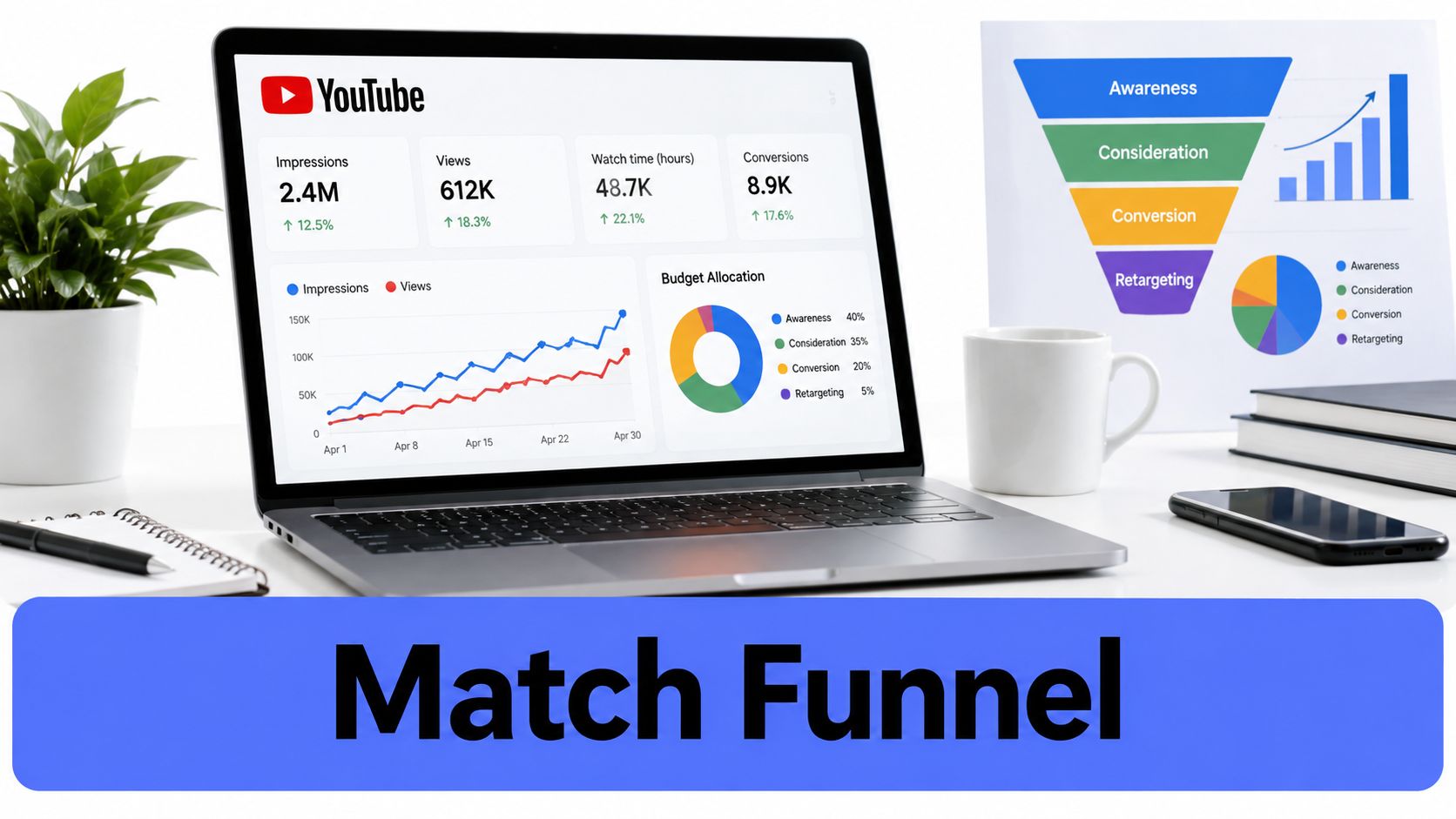
Use a stage-based decision rule
Warm audience and qualified action: Start with Maximize Conversions, then move to Target CPA once accepted-lead data is stable.
Established efficiency target: Use Target CPA and send the platform downstream qualification events.
Attention and audience creation: Use Target CPV, then assess view-through and engaged-view influence separately.
Budget pacing should give the campaign enough room to learn without funding a broken conversion setup. Review lead acceptance, duplicate handling, consent signals, and CRM matching before increasing spend. Raise budgets in measured steps only after accepted-lead quality holds across the campaign's recent traffic.
Audit two settings before launch. The primary conversion action must represent the business outcome the bid system should pursue. Audience exclusions must remove existing customers, recent converters, and active opportunities, so acquisition spend is not credited for demand the sales team already owns. A bid strategy cannot repair either configuration error.
Measuring Influence Beyond the Click
A connected-TV viewer may see an ad on the largest screen in the home, then complete a form later on mobile. If reporting counts only the final click, that sequence disappears. Measure YouTube influence by separating observation from causation and by following exposed users into qualified pipeline.
A view-through conversion records a conversion after an impression within the platform's reporting rules. An engaged-view conversion records a viewer watching at least 10 seconds of a skippable ad without clicking before converting, as defined in Google's conversion documentation. These events show exposure and timing. Causal impact requires a comparison.
Connect platform events to CRM value
Map advertising events to the stages sales already uses:
Lead submitted: A form or landing-page completion.
Accepted lead: Sales or marketing confirms basic fit.
Sales-qualified lead: The record meets agreed qualification criteria.
Opportunity: A real commercial process begins.
Revenue: The CRM records a closed business outcome.
Import click, view-through, and engaged-view fields into the reporting layer. Match them to CRM records through campaign identifiers, permitted user-provided data, and consistent timestamps. Preserve the device path where possible, so CTV exposure followed by mobile completion remains visible rather than being treated as an unexplained direct response.
Judge campaigns by progression, not form count. A campaign producing fewer direct leads may deserve more budget if its exposed audience creates stronger opportunities.
Keep these reporting buckets separate:
Reporting bucket | What it answers |
|---|---|
Click conversions | Which ads produced a measurable direct response? |
Engaged-view conversions | Which ads influenced viewers who watched meaningfully without clicking? |
View-through conversions | Which exposures preceded a later conversion without a recorded click? |
Assisted pipeline | Which exposed records reached qualified commercial stages? |
Incremental outcome | Did exposure create more action than a comparable unexposed group? |
Test the influence claim
Use a holdout or geo-lift design once the campaign can support a controlled comparison. Hold back a comparable audience or market where practical, keep the sales process consistent, and compare qualified progression instead of raw traffic. Control for audience mix, device exposure, and the period between viewing and form completion.
The YouTube video analytics framework can help structure exposure and engagement reporting. Marketing and sales should then review direct leads, influenced leads, qualified pipeline, and test results as separate measures. The test reveals whether exposure changes behavior beyond the click path.
Optimization Playbook and Maintenance Habits That Compound
Daily campaign editing feels productive because the interface always offers something to change. In practice, constant bid edits, audience swaps, and creative interruptions can make it harder to identify what caused a result. A stronger operating rhythm uses weekly diagnostics, deliberate tests, and CRM feedback.
Review the system, not just the dashboard
Each week, inspect:
Lead quality: Compare accepted leads and sales-qualified leads by audience, format, device, and creative.
Exposure quality: Look for completion behavior, engaged-view activity, frequency, placement fit, and audience overlap.
Capture integrity: Confirm that tags, UTM values, consent signals, deduplication, and CRM imports still work.
Creative role: Check whether each asset has a clear job, from problem recognition to proof or action.
Budget distribution: Identify whether spend is concentrating in a low-quality pocket because it converts cheaply.
Refresh creative when frequency and audience feedback indicate fatigue, not because a calendar reminder says it's time. A new opening, proof point, spokesperson, edit, or call to action may be enough to restore relevance. Don't replace a productive asset before you understand which element is working.
The first troubleshooting question should be diagnostic, not tactical.
If CPA rises, check lead acceptance, audience mix, landing-page friction, and conversion integrity before changing the bid. If match rate falls, inspect consent, identifier quality, CRM formatting, and server-side event delivery. If creative fatigue appears, compare performance by audience and frequency, then refresh the weakest message rather than shutting down the entire campaign.
A mature program should run a holdout or geo-lift test as a recurring incrementality check. That test keeps the account honest and helps quantify whether view-through and engaged-view influence corresponds with additional qualified demand. The maintenance habit that compounds is disciplined learning: change fewer variables, document the reason, and judge success at the pipeline stage the business values.
Busylike plans, produces, and manages YouTube and CTV campaigns, connecting performance-focused creative with audience targeting, conversion tracking, optimization, and reporting. If your team needs to turn video exposure into a clearer qualified-lead and pipeline measurement system, visit Busylike to discuss the campaign architecture and creative required.

