
YouTube for Retail: A Strategic Playbook for Modern Brands

YouTube reduced the average online video shopper's journey by six days, and 89% of U.S. shoppers say YouTube creators provide the best product information. Those figures make YouTube for retail a strategic channel, not an optional awareness experiment.
The important shift isn't just that more brands are publishing video. Shoppers now use video to understand products, compare alternatives, assess credibility, and decide whether a purchase deserves further attention. A retailer that treats YouTube as either a passive billboard or a final-click sales machine misses the platform's real value.

YouTube works best as an integrated system. Owned content explains the product, creators make the recommendation credible, paid media puts useful content in front of the right audience, and commerce infrastructure gives interested viewers a practical next step. The difficult part is connecting those pieces to delayed purchases, marketplace transactions, and store visits.
Table of Contents
Why YouTube Matters for Retail Right Now - The platform influences more than awareness
Building a YouTube Channel Architecture for Retail - Build around customer questions - Make every upload earn its place
Using Creators to Build Trust at Scale - A creator program needs governance
Combining Paid Media, Owned Content, and Commerce - Design the handoff between stages - Align the data layer
Measuring YouTube Impact Beyond Last-Click ROAS - Separate attribution from incrementality
Turning Strategy Into a Repeatable Retail System - The operating model
Why YouTube Matters for Retail Right Now
YouTube has become a decision layer between discovery and purchase. In Google and Material's 2023 U.S. survey of 2,420 adults who had used an online video platform for shopping, relevant video content reduced the average online video shopper's journey by six days. Google also reported that 89% of surveyed U.S. shoppers agreed YouTube creators provide the best information about products and brands, while 87% said YouTube provides the highest-quality product information when they shop or browse. Google's retail consumer insights puts those findings in the context that matters to marketers: people aren't using video only for entertainment.
They're watching demonstrations, reviews, comparisons, tutorials, and recommendations. A product page can confirm specifications, but a well-made video can show how a product fits into someone's routine, answer an objection, and make an unfamiliar feature easier to understand. That distinction matters for categories where shoppers need confidence before they act.
The platform influences more than awareness
YouTube can contribute at several points in the same journey:
Discovery: Brand films, Shorts, and creator recommendations introduce a product before the shopper has settled on a specific solution.
Education: Demonstrations and tutorials clarify setup, use cases, sizing, compatibility, ingredients, or performance.
Consideration: Reviews and comparisons help shoppers evaluate alternatives and justify a higher-consideration purchase.
Conversion: Product links, retailer availability, landing pages, and retargeting give motivated viewers a route to action.
Google found that 63% of U.K. YouTube viewers had bought from a brand after seeing it on the platform, and 75% of U.S. shoppers said YouTube adds unexpected inspiration to the traditional shopping journey. Those figures don't prove that every YouTube view causes a sale. They do show why a retailer should evaluate the platform as part of the buying process rather than isolate it as a reach channel.
The practical implication is straightforward. If your product appears only after a shopper reaches a search result or product page, competitors may already have shaped the customer's expectations. YouTube lets retailers participate earlier, while the shopper is still defining the problem and deciding which claims to trust.
Building a YouTube Channel Architecture for Retail
A retail channel shouldn't become a warehouse for press releases, product sheets, and disconnected campaign edits. It needs an architecture that helps viewers move from understanding the brand to understanding the product and then to taking a useful next step.
Build around customer questions
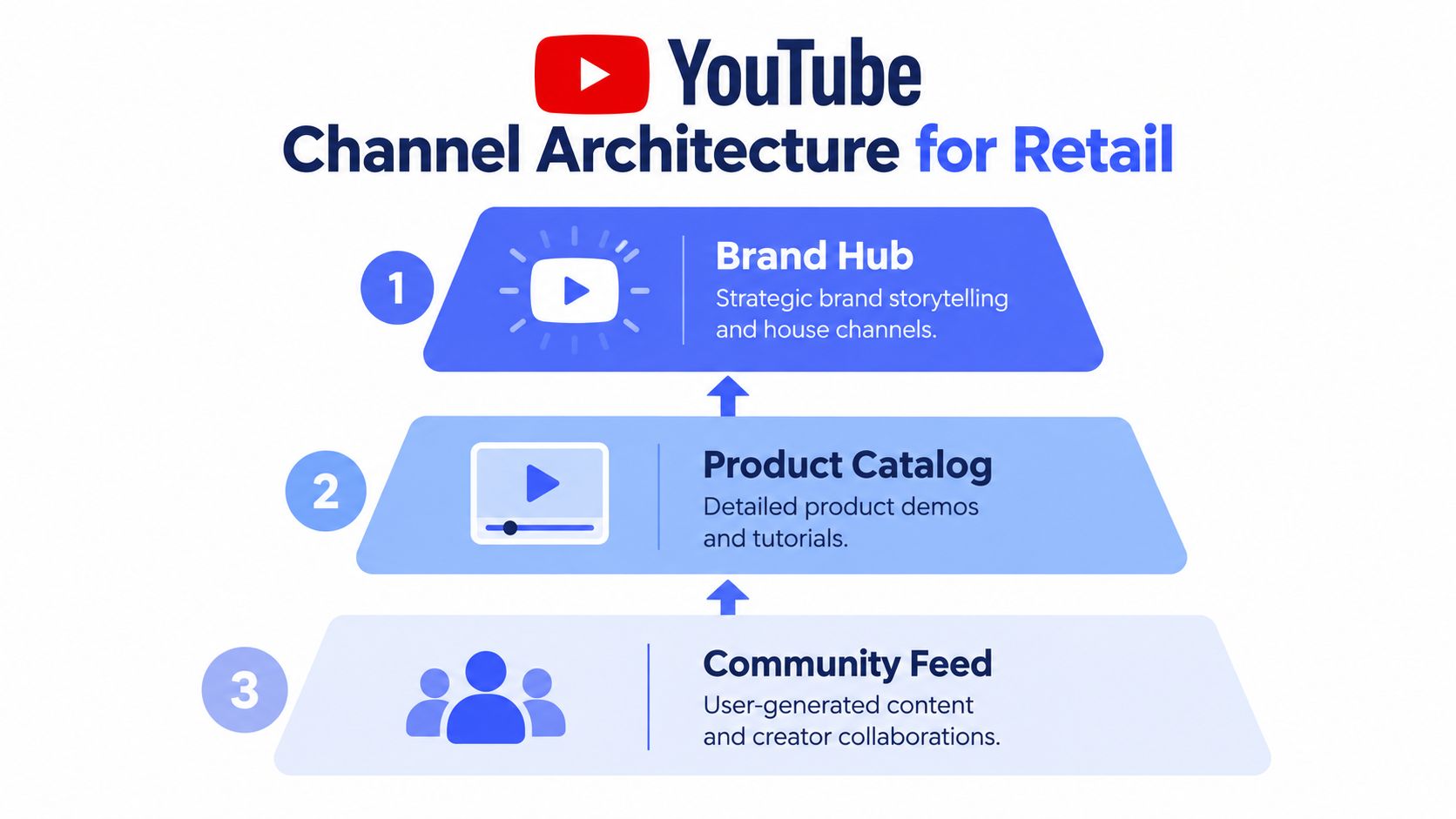
Start with three connected layers:
Brand hub: Use brand storytelling, founder or design perspectives, seasonal narratives, and broader category education to establish meaning and distinction.
Product catalog: Organize detailed demos, comparisons, setup guides, maintenance instructions, and buying guidance around real customer questions.
Community feed: Publish creator collaborations, customer experiences, responses to comments, live conversations, and user-generated content.
This structure prevents a common mistake, which is organizing everything only by product category. Shoppers don't think in catalog taxonomy when they search. They ask how to choose, install, style, repair, compare, or use something. Playlists should reflect those jobs.
Make every upload earn its place
Use a consistent visual system across thumbnails, opening frames, presenter treatment, and on-screen product details. Creator content can retain its native credibility, but viewers should still recognize the retailer and understand which claims are approved.
Titles should identify the customer problem and product context without sounding like keyword lists. Descriptions should include relevant specifications, retailer availability, product links, and supporting resources. Thumbnails need a clear visual hierarchy, not a crowded collage of logos and text. Test the promise of the thumbnail against the actual opening of the video. If the packaging makes an expectation the content doesn't fulfill, retention will suffer and trust will weaken.
Practical rule: Every video should have one primary job, one primary audience, and one next action.
That action might be watching a related tutorial, comparing two models, checking local availability, visiting a product page, or finding a nearby store. A channel becomes a retail asset when its content paths are deliberate, measurable, and useful even before a viewer is ready to buy.
Choosing the Right Video Formats for Shopping Journeys
No single YouTube format can serve every retail objective. A Short can create initial curiosity, but it rarely replaces the depth required for a technical comparison. A livestream can answer objections in real time, but it requires hosts, moderation, inventory coordination, and a plan for questions that may expose gaps in the product experience.
Format | Funnel Role | Production Effort | Best For |
|---|---|---|---|
Shorts | Discovery and attention | Low to moderate | Fast product benefits, visual hooks, trend-responsive ideas |
Long-form reviews | Consideration and validation | Moderate to high | Comparisons, technical products, high-consideration purchases |
Livestream commerce | Education and conversion | High operational effort | Demonstrations, launches, questions, limited-time events |
How-to tutorials | Education and retention | Moderate | Setup, maintenance, styling, recipes, troubleshooting |
Creator-led unboxings | Discovery and trust | Moderate | First impressions, product experience, audience-specific recommendations |
Shorts work when the product benefit is visual and immediate. Use them to demonstrate a transformation, answer a narrow question, or extract a strong moment from a longer production. Don't force a complex product into a short format just because the edit is cheaper.
Long-form reviews and comparisons earn their production effort when shoppers need evidence. A creator or specialist can test competing features, explain trade-offs, and show the product in use. The presentation should disclose what was provided, separate observation from official claim, and avoid a scripted endorsement that sounds indistinguishable from an ad.
Tutorials often have the longest useful life because they solve a recurring ownership problem. They also create a natural path from product education to support, especially when the video links to the correct manual, replacement part, retailer page, or service option. Livestreams are more demanding, but they can combine demonstration, community questions, and direct shopping when inventory and moderation are ready.
For teams refining creative concepts, ad creative examples for e-commerce can help prompt useful comparisons between hooks, demonstrations, testimonials, and product-led formats. Retailers should adapt the principle rather than copy the execution.
A practical portfolio starts with the formats your team can sustain and expands only when the measurement and production workflow are stable. Retail and CPG video production guidance is relevant when a brand needs to connect product demonstrations, paid edits, and channel publishing instead of commissioning each asset in isolation.
Using Creators to Build Trust at Scale
Creators add something a brand channel often can't manufacture internally: earned context. Their audience has a reason to believe the creator understands a specific routine, category, or problem. That credibility is especially useful when the purchase requires comparison, explanation, or personal confidence.

The wrong approach is to select creators by audience size, request a product mention, and treat the resulting views as the program's purpose. Retail commerce creates operational risks that a simple sponsorship model doesn't address. Pricing can change, inventory can disappear, product claims can exceed approved language, and a creator's link can send shoppers to an unavailable or poorly localized offer.
A creator program needs governance
Choose partners against a practical scorecard:
Category credibility: Does the creator regularly explain or use products in the relevant category?
Audience fit: Do their viewers resemble the shoppers the retailer needs to reach?
Demonstration ability: Can they show the product clearly rather than only display it?
Brand safety: Do their recent content, tone, and sponsorship history meet the retailer's standards?
Commercial discipline: Can they use approved claims, disclose the relationship, and follow linking requirements?
Contracts should define disclosure, claims review, usage rights, paid amplification, exclusivity, content revisions, and what happens when the featured item is out of stock. Give creators room to speak in their own voice, but don't leave product facts, pricing, or safety language ambiguous.
Google reported that in India, affiliate payouts to creators rose more than 160% year over year, active YouTube Shopping participants increased 200%, more than 19 million videos had affiliate products tagged, and shopping-related watch time grew 55% year over year. These figures come from Google's report on YouTube Shopping and Indian creators. They indicate meaningful scale, but they don't establish that creator volume alone produces incremental retail growth.
The strongest model combines tiers. A small group of trusted experts can handle deep demonstrations, a broader group can produce localized or audience-specific content, and paid media can amplify the assets that earn strong engagement and useful downstream behavior.
The influencer marketing agency model is useful when a retailer needs support with creator selection, campaign coordination, content approvals, and usage management.
Creators should be treated as a governed distribution layer, not an uncontrolled source of reach.
The creative test is simple. Would the video still help a shopper if the affiliate link were removed? If the answer is no, the content may be optimized for a transaction without building enough confidence to create demand.
Combining Paid Media, Owned Content, and Commerce
Retailers often separate YouTube into two budgets. The brand team owns the channel and publishes content, while the media team buys ads and optimizes toward immediate response. That division creates weak handoffs. The brand film doesn't reach enough of the audience, the product tutorial isn't promoted to interested viewers, and the conversion campaign lacks the credibility built by useful content.
Design the handoff between stages
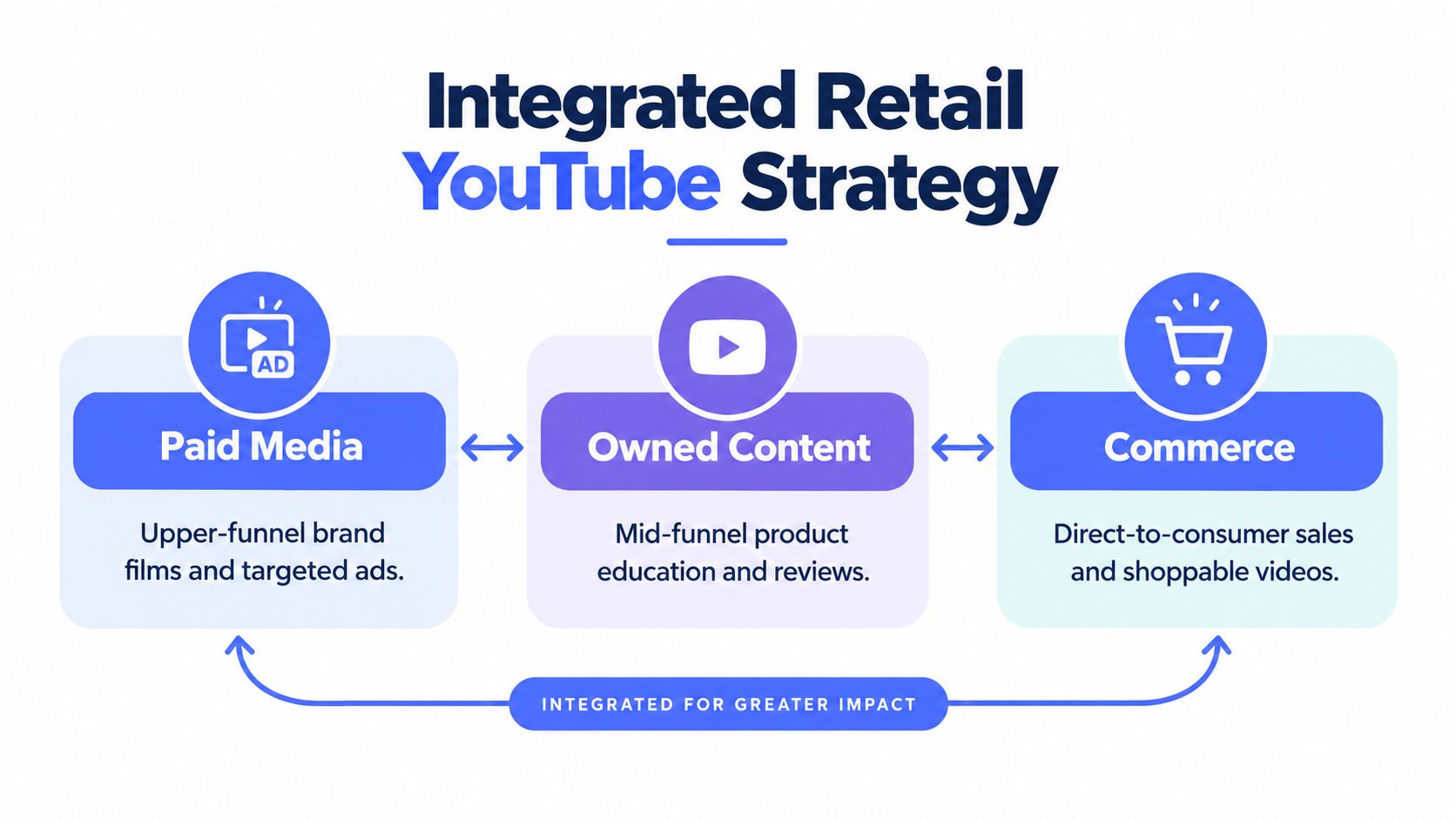
A connected system can work like this:
Paid media creates qualified attention. Use brand films, category narratives, and audience-specific ads to introduce the problem and the retailer's point of view.
Owned content answers the next question. Send engaged viewers to product education, comparisons, tutorials, and creator demonstrations that resolve uncertainty.
Commerce captures intent. Use product links, retailer availability, relevant landing pages, store-location information, or a marketplace route that matches the shopper's context.
Google reported that people watched more than 35 billion hours of shopping-related video content on YouTube during the year preceding its 2025 analysis, while YouTube ads viewed on connected-TV screens generated more than 1 billion conversions. The same YouTube shopping journey analysis reports that video commerce represented 20% of total e-commerce gross merchandise value in Southeast Asia in 2024, compared with 5% in 2022, and that more than 40% of online shoppers in the region relied on multimedia formats to make informed buying decisions.
Those figures support a broader operational point. Shopping isn't confined to a product page or a desktop browser. YouTube supports long-form videos, Shorts, livestreams, connected-TV viewing, and purchase links that can appear alongside content. The experience can move from large-screen discovery to mobile research to a retailer or marketplace transaction.
Align the data layer
Use the same product IDs, campaign taxonomy, audience definitions, naming conventions, and conversion events across YouTube, Search, ecommerce, and CRM systems. Retargeting should distinguish between a viewer who watched a brand story and a viewer who watched a detailed product demonstration. Their next messages shouldn't be identical.
Retailers should also maintain stock-aware feeds and localized pricing. A beautifully targeted ad that points to an unavailable product wastes media and damages confidence.
For teams reviewing allocation across formats, ad budget optimization methods can provide a useful planning reference. The principle is more important than any single bidding tactic: protect the relationship between creative intent, audience stage, and commercial action. Reach campaigns create future demand. Direct-response campaigns capture demand that already exists. Retail YouTube works when both functions share a plan.
Measuring YouTube Impact Beyond Last-Click ROAS
Last-click ROAS is easy to read and often wrong for video. It rewards the channel that receives the final measurable interaction, even when an earlier YouTube exposure introduced the product, explained the benefit, or prompted a branded search. That doesn't make ROAS useless. It means retailers shouldn't use it as the only verdict on upper-funnel video.
Google reports that 94% of surveyed U.S. holiday shoppers who used YouTube took a further purchase-related step after watching a relevant video. The Google research on demand generation doesn't establish causality or identify whether the eventual purchase happened on a retailer website, marketplace, or in a physical store. Treat the finding as evidence of post-view activity, not proof of a universal sales lift.
Separate attribution from incrementality
A stronger measurement design combines platform reporting with controlled tests:
Geo-split tests: Compare carefully matched markets with and without the incremental YouTube exposure, while controlling for distribution, seasonality, and local promotions.
Holdout audiences: Keep a comparable audience unexposed where possible, then compare qualified actions and sales outcomes.
Post-view windows: Report view-through activity separately from click-through activity and use a window that reflects the product's buying cycle.
New-versus-returning analysis: Determine whether video is acquiring new customers, reactivating existing customers, or assisting people who were already close to purchase.
Marketplace and store measurement: Reconcile retailer-partner sales, marketplace performance, branded search, store traffic, and product availability instead of stopping at the owned website.
The broader shopping pattern reinforces this need. Google reports that 8 in 10 online purchase journeys involve multiple touchpoints. Research across surveyed global markets found that 61% of holiday shoppers used five or more channels, including search, video, and social media, within a two-day shopping period, while online search preceded 96% of in-store holiday shopping occasions across those markets. These findings appear in Google's retail marketing insights.
A retailer should therefore report YouTube in layers: reach and attention, consideration actions, direct response, assisted behavior, and incremental sales. A practical ecommerce integration guide can help teams think through the system connections required to reconcile those signals.
Video SEO and AI visibility also belongs in the operating model because findability affects how long owned content can contribute after paid distribution ends.
Reach campaigns deserve budget protection when they generate qualified attention, improve downstream branded behavior, and pass an incrementality test, even if their immediate click metrics look modest.
Turning Strategy Into a Repeatable Retail System
A durable YouTube retail program starts with a customer question, not a production calendar. “Which model should I choose?” calls for a comparison. “How do I install it?” calls for a tutorial. “Will this work for my routine?” may call for a credible creator demonstration. “Why should I consider this brand?” may require a wider story before a product appears.
That logic keeps the channel useful and prevents the common pattern of publishing whatever the production team happened to finish. It also gives paid media a stronger set of assets to distribute because each video has a defined job and audience.
The operating model
A repeatable system connects four disciplines:
Content strategy: Map videos to discovery, education, consideration, ownership, and conversion questions.
Creator governance: Approve claims, disclosures, rights, localization, pricing references, and stock-aware links before distribution.
Media orchestration: Amplify strong owned and creator content, then retarget viewers with a message that reflects what they watched.
Measurement: Compare attributed behavior with controlled tests, offline outcomes, marketplace signals, and new-customer quality.
The retailer's catalog, CRM, media platform, analytics environment, and store data don't need identical reporting views. They do need shared definitions. A product ID should mean the same thing in a creator link, a video description, a paid campaign, and a sales report.
YouTube isn't a substitute for search, retail media, email, stores, or product pages. It can connect them. The teams that get value from the platform don't chase views as an end in themselves. They build a content and distribution system that earns attention, answers questions, and makes the next action easier to measure.
Start by auditing your existing catalog and customer questions. Select one product family, create a small set of connected formats, define the creator and claims workflow, and establish the measurement plan before scaling distribution.

Busylike combines video strategy, production, paid video advertising, channel management, and creator partnerships for brands building that kind of connected retail program. Visit Busylike to discuss a YouTube plan that links useful content with measurable commerce outcomes.

