Austin Video Production Guide for Brands and Marketing Teams

You've approved an Austin shoot, but the production brief still says “one hero video,” the location list is a mood board, and nobody can explain how the footage will work on YouTube, CTV, or paid social. That's a familiar problem. The team isn't short on creative ambition. It's short on a production system that connects Austin's local advantages to measurable distribution.
Austin, Texas, deserves to be treated as more than a photogenic backdrop. It's a scaled production market inside a broad creative, technology, startup, music, film, and digital media economy. The right crew can give your brand strong local texture, but the right production strategy turns one shoot into a usable library of platform-specific assets.

Table of Contents
Why Austin Is a Real Production Market for Marketing Leaders - What Austin gives a marketing team
The Austin Creative Economy Behind Your Video Budget - Production infrastructure changes the buying decision
How Austin Video Production Actually Works From Brief to Final Cut - Pre-production sets the commercial ceiling - The shoot is a controlled capture day - Post-production turns footage into a campaign
What Austin Video Production Really Costs and What Drives the Number - Build the quote from line items - Cost ranges by deliverable
Filming in Austin Locations That Double as Brand Story - Match venues to the production problem
Designing Video for YouTube, CTV, and Social Instead of One Hero Cut - Plan the frame for future placements - Tie every version to a measurement loop
How to Choose an Austin Video Production Partner - Five criteria for a defensible shortlist
Why Austin Is a Real Production Market for Marketing Leaders
A marketing team planning a shoot in Austin has more to evaluate than whether South Congress looks good on camera. The decision is whether the city can support the entire operating model, from crew and equipment to locations, post-production, versioning, and distribution across YouTube, CTV, and social.
Austin can support that model. City-owned Austin Studios has generated more than $2.6 billion in economic impact over 25 years, supported more than 1,100 projects, and supported more than 37,000 jobs, according to the 2024 Austin Film Society creative metrics report. For marketing leaders, that record signals accumulated production capacity rather than a short-lived creative trend.
The market extends beyond a few recognizable studios. The official production directory lists more than 1,900 film crew, film-related business, and support-service listings, giving buyers access to specialists for commercial, corporate, entertainment, and branded work through the City of Austin production resources directory.
Strategic rule: Treat Austin as a recurring production base, not a one-time destination shoot.
What Austin gives a marketing team
Austin's creative economy connects film and music with software, advertising, social media, digital content, and education technology. That mix supports product explainers, launch campaigns, event coverage, customer stories, creator content, paid ads, and employer branding. It also gives production partners experience with both brand storytelling and performance-focused creative.
The city's startup identity creates steady demand for launch videos and demand-generation content. A state economic development presentation lists 3,300 tech companies and 100,000 tech workers in the region, according to the Texas Governor's Office film and creative industry material. That concentration helps explain why Austin's video buyers extend well beyond film and entertainment.
The trade-off is clear. Los Angeles and New York offer larger crew pools and more specialized departments, while Austin can be more efficient for high-volume commercial work. Live-action work typically runs 15% to 25% below San Francisco on crew and operating costs, according to Austin production cost guidance from LV Productions. Austin is not inexpensive. It is a credible mid-cost major market for brands that need quality, repeatability, and enough output to support multiple distribution channels.
Producing Video for Advertising in Austin
For brands investing in video production in Austin, the shoot is often only the beginning. The same production can be planned to create assets for YouTube advertising, paid social, connected TV (CTV), streaming platforms, and digital campaigns. Building these formats into the production plan from the start can help brands get more value from each shoot, with different edits, aspect ratios, hooks, and calls to action designed for specific channels and audiences.
Austin is also an attractive production market for brands running campaigns locally, across Texas, or nationally. Marketing teams can combine commercial video production with media planning and distribution to take a campaign from concept and filming through post-production and paid promotion. When choosing an Austin video production partner, advertisers should consider not only production quality, but also whether the team understands how creative needs to perform across YouTube, social media, CTV, and other digital advertising environments.
The Austin Creative Economy Behind Your Video Budget
Austin's production market draws spending from several industries at once. Film and television build crew capability. Technology and SaaS companies commission demos, explainers, customer stories, recruitment assets, and launch campaigns. Consumer brands need product films, lifestyle content, paid creative, and social cutdowns. Music, sports, conferences, festivals, and brand activations add another layer of demand around SXSW, Austin City Limits, Formula One activity, and other major events.
That mix gives marketing leaders more than a backdrop. It creates a production base that can support recurring campaigns, not just one destination shoot. A local partner may handle a startup launch, corporate event, customer interview, and lifestyle campaign within the same quarter. The variety helps sustain crews, studios, rental houses, and specialist vendors across different formats.
Austin's creative and digital media sector supports more than 70,000 employees across the metro, spanning game development, software, mobile apps, music and film technology, education technology, advertising, social media, and digital content, according to Austin's creative and digital media overview. For a CMO, the business implication is direct: video production sits inside an economy where products are built, brands are launched, events are staged, and audiences gather. That makes Austin a practical base for producing one campaign system, then adapting it for YouTube, CTV, and social.
Best Times of Year for Brand Activations and Video Production in Austin
Austin’s biggest events create some of the best opportunities of the year for brands to produce content, launch experiential campaigns, and connect with large audiences. SXSW in March is the standout activation period, bringing together technology, film, music, media, and business audiences from around the world. Brands take over venues across the city with pop-ups, brand houses, lounges, product launches, panels, creator events, and sponsored experiences—creating significant demand for event videography, social content, interviews, and fast-turnaround video production. SXSW itself reported nearly 499,000 total participants across its 2026 conferences and festivals.
October is another major brand marketing window in Austin. Austin City Limits Music Festival brings large audiences to Zilker Park across two weekends, while the Formula 1 United States Grand Prix attracts an international motorsports and entertainment audience to Circuit of the Americas. Other opportunities throughout the year include University of Texas football weekends, Austin FC matches, major food and cultural festivals, and the holiday season around Austin’s Trail of Lights. For brands planning activations around these moments, video production can extend the value of an event well beyond the attendees—turning live experiences into social content, creator collaborations, interviews, recap films, paid ads, and campaign assets that can be distributed long after the event ends.
Production infrastructure changes the buying decision
Austin Studios is a 20-acre production complex with two sound stages, a cyclorama, production offices, wardrobe and mill space, a base-camp tarmac, and onsite vendors, according to local Austin production infrastructure guidance. The wider market also includes more than a dozen studio spaces and equipment suppliers, giving buyers options beyond a single facility.
Permit requirements depend on the location and use. Right-of-way shoots, parks, airports, and similar public spaces can require different approvals. Controlled work on private property may involve fewer steps, but producers still need to confirm access, parking, insurance, and operating limits before the schedule is locked.
Indicator | Austin Figure | Buyer Implication |
|---|---|---|
Creative and digital media employment | More than 70,000 employees (source) | A broad talent and client ecosystem can support recurring content work |
Official production directory | More than 1,900 listings (source) | Buyers can identify local crew, vendors, and support services |
Video production businesses | 145 businesses, about 13% of Texas businesses in the category as of August 2026 (source) | The directory provides a useful view of local supplier depth |
Austin Studios impact | More than $2.6 billion over 25 years (source) | Long-term infrastructure investment supports production capacity |
Austin Public access | More than 550 active producers annually (source) | Training, equipment, and studio access widen the creative pipeline |
Use these figures as market context, not as a quality guarantee. A large supplier pool does not remove the need to check portfolio fit, crew leadership, rights handling, and the partner's ability to deliver platform-specific versions from the same shoot.
How Austin Video Production Actually Works From Brief to Final Cut
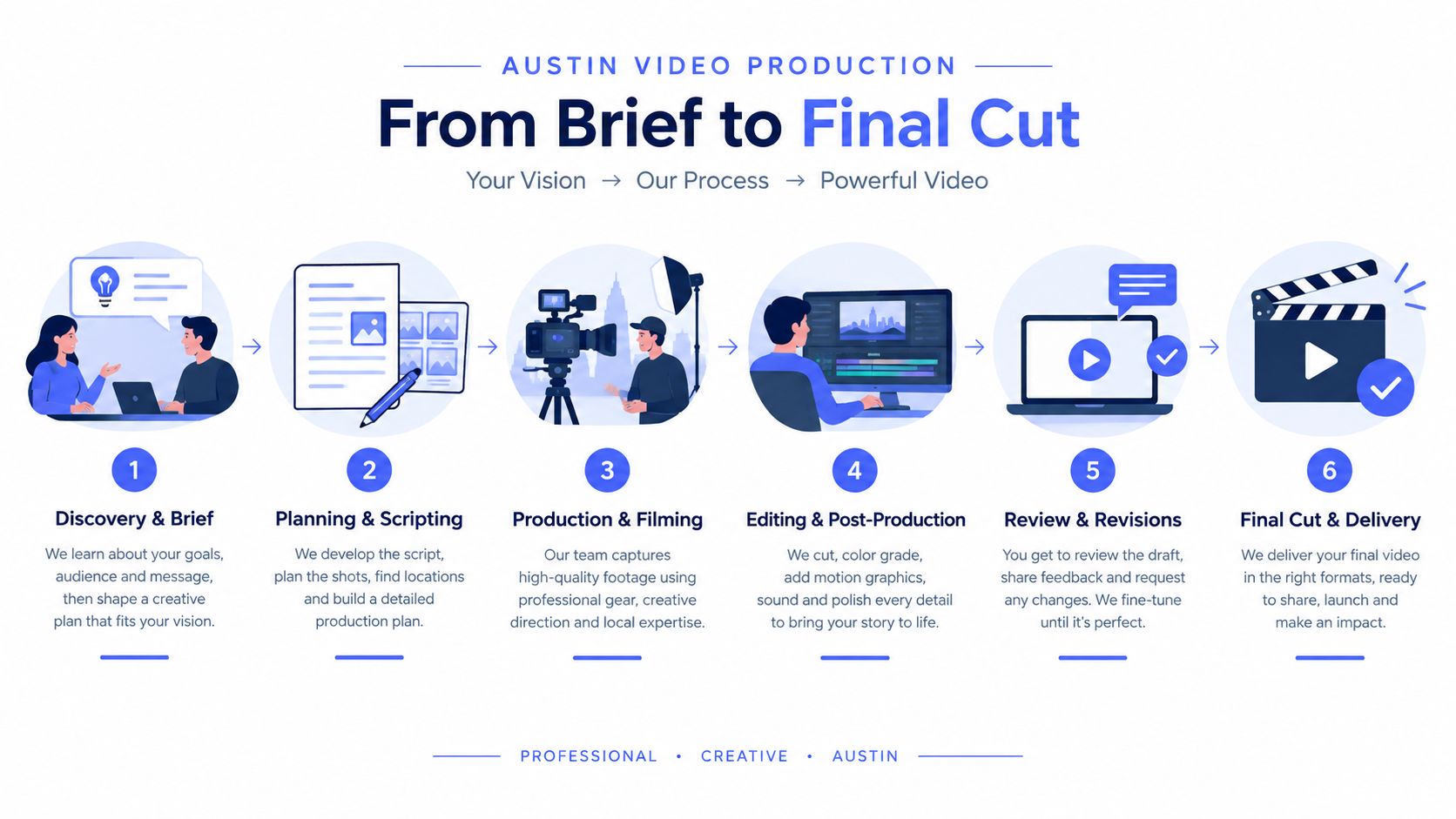
A successful shoot begins before anyone books a camera. The production team must turn a marketing objective into a creative brief, then turn that brief into scenes, interviews, locations, talent, and deliverables.
Pre-production sets the commercial ceiling
Start with the audience, offer, platform, and action you want the viewer to take. Then lock the script, storyboard, interview questions, visual references, casting requirements, location list, schedule, insurance, and release terms.
Location planning deserves early attention. Austin's permit requirements vary by use, so the producer should confirm whether a shoot affects a right-of-way, park, airport, private venue, or another regulated area. A late location change can trigger new permissions, parking issues, crew movement, and schedule pressure.
The brief should also define every output. If the campaign needs a hero edit, vertical social versions, captions, paid cutdowns, still frames, and clean footage for future use, those requirements belong in pre-production. A useful reference for turning video material into usable written assets is transcripts and summaries from videos, particularly when teams need searchable interview material or repurposing inputs.
The shoot is a controlled capture day
The producer builds the crew around the work, not around a generic package. A talking-head interview may need a director, director of photography, camera assistant, sound recordist, gaffer, and producer. A live event or multi-camera production needs a different structure.
During the shoot, protect time for principal scenes, interviews, cutaways, product details, room tone, and alternate performances. Capture clean audio separately when the environment demands it. Ask the crew to frame key action with future crops in mind, especially if the final campaign will include vertical placements.
A practical production workflow should make the handoff clear. Guidance on digital video production workflows can help marketing teams understand how planning, capture, editing, and delivery connect.
Post-production turns footage into a campaign
Post includes the assembly edit, story refinement, color correction, sound mix, music, motion graphics, captions, legal review, and exports. Versioning should happen from an approved master rather than through improvised re-edits that alter the message.
Set review rules before the first cut. Decide who consolidates feedback, how many structured review rounds the quote includes, and which changes count as a new scope item. Most post-production friction comes from unclear approval authority, not from the edit software.
What Austin Video Production Really Costs and What Drives the Number
A marketing team can spend heavily on an Austin shoot and still receive one polished video with limited campaign value. Set the budget around the production system, not a single hero film. The right quote covers the crew, equipment, creative scope, post-production, and the versions needed for YouTube, CTV, and social.
Austin offers a meaningful cost advantage, but it is not a low-cost shortcut. A standard crew day covering director or director of photography, camera, audio, and gaffer labor typically falls around $2,500 to $6,000, before gear, studio, scripting, or post-production, according to Austin production pricing guidance.
Equipment adds a separate cost layer. Gear can run about $800 to $3,500 per day, while a broader full production day can reach roughly $3,500 to $9,000 before pre-production and post-production. Use these figures to set a budget boundary, then compare quotes by scope rather than by headline total.
Build the quote from line items
Require the producer to separate labor, gear, locations, studio, talent, travel, insurance, production design, music, editing, motion graphics, color, sound, captions, and delivery versions. A bundled quote may look simpler, but it conceals the choices that determine the final cost.
The main cost drivers are clear:
Shoot days: Additional locations and interviews create company moves, setup time, and more crew hours.
Crew complexity: A commercial with lighting, art direction, camera movement, and multiple cameras needs more specialists than a controlled interview.
Gear requirements: Camera bodies represent only part of the package. Lenses, lighting, grip, wireless audio, monitors, and support equipment also affect the rate.
Post-production scope: Motion graphics, visual effects, sound design, color finishing, captions, and multiple aspect ratios add editing labor.
Review discipline: Unconsolidated feedback creates change orders and can reopen creative decisions that were already approved.
Budget rule: If the quote does not state what happens after the included review rounds, the budget is not finished.
Cost ranges by deliverable
Use the verified production-day figures as the numeric foundation. The table stays limited to costs with concrete ranges, while creative formats should be scoped from those components.
Cost item | Verified range | What it covers |
|---|---|---|
Crew labor day | $2,500 to $6,000 | Director or DP, camera, audio, and gaffer labor |
Equipment day | $800 to $3,500 | Camera, lenses, lighting, grip, audio, monitors, and support equipment |
Full production day | $3,500 to $9,000 before pre-production and post-production | Combined production-day labor and equipment scope |
For a social or talking-head shoot, budget from the crew-day floor plus one to two edit days. The dominant variables are the interview setup, lighting, editing, captions, and number of platform versions. A full commercial needs a separate treatment because art direction, talent, visual effects, and finishing can expand the scope quickly.
A recurring content program should be priced by shoot cadence, asset count, platforms, and revision load. Ask whether rates are daily or weekly, when overtime begins, whether unused gear is refundable, and whether raw footage is included. Confirm music, talent, location, and usage rights in writing. Also require the quote to list every YouTube, CTV, and social deliverable, so production savings do not disappear during post-production.
Filming in Austin Locations That Double as Brand Story
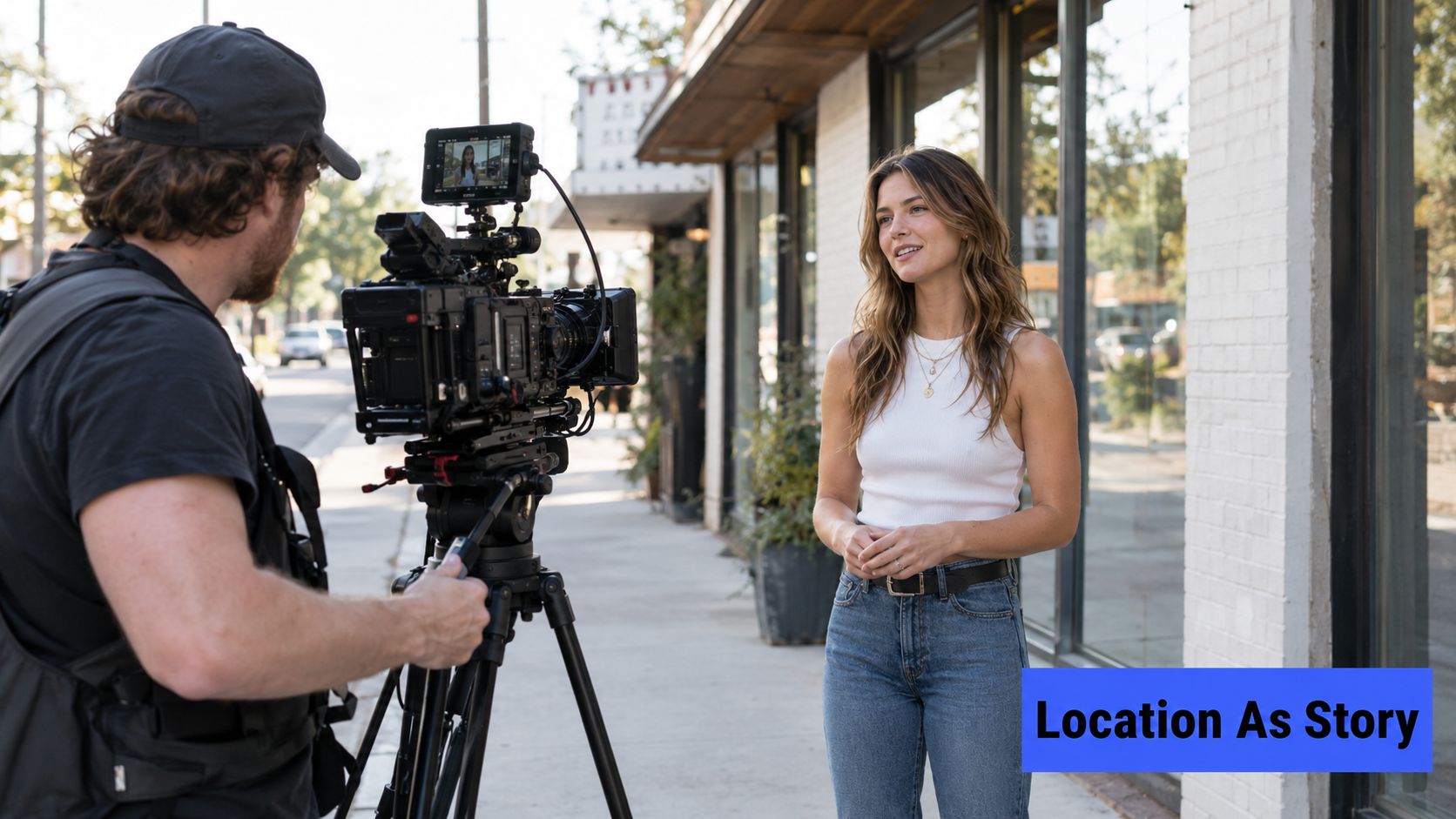
Location choice should communicate something before the spokesperson says a word. Austin gives marketing teams distinct visual languages, but each neighborhood carries different logistics, access, noise, traffic, and brand associations.
South Congress works for lifestyle, travel, hospitality, retail, and culture-led campaigns. The area can provide recognizable Austin texture, but a busy pedestrian environment can make sound and controlled movement harder. The Domain offers a more polished setting for enterprise, technology, retail, and modern workplace stories. It can support a cleaner commercial look, especially when the brand needs contemporary architecture rather than historic character.
East Austin gives founder stories, food, music, and community-focused campaigns more texture. Sixth Street and the Red River area support nightlife and music narratives, but production teams should expect sound, pedestrian movement, and access considerations. These locations are strong when the environment is part of the message, not when the team needs a quiet, repeatable interview setup.
Match venues to the production problem
The Neal Kocurek Memorial Austin Convention Center at 500 E Cesar Chavez St., the Palmer Events Center, and nearby event facilities make practical bases for conference, panel, trade show, and hybrid-event coverage. A convention shoot needs a plan for room turns, speaker releases, sound feeds, audience movement, and fast b-roll capture.
Hotels can work as both hospitality settings and production venues. The Driskill sits near Sixth Street, Hyatt Centric is positioned near Sixth Street and the Austin Convention Center, and South Congress Hotel is located at 1603 South Congress, according to Austin venue and hotel location references. These properties can support interviews, executive portraits, hospitality storytelling, and event content, subject to venue approval.
Austin's permit structure is situation-specific. Don't assume a public-looking sidewalk is automatically available for a controlled commercial setup. Confirm right-of-way, park, airport, venue, insurance, parking, and access requirements early, then schedule around traffic and usable light.
Location test: Choose the place that strengthens the audience's interpretation of the brand, then solve the logistics. Don't choose a landmark first and force the story around it.
Designing Video for YouTube, CTV, and Social Instead of One Hero Cut
One polished 90-second film rarely does enough work for a modern campaign. It may explain the brand on a landing page, but it won't automatically create an effective pre-roll, vertical social ad, CTV spot, or short-form hook.
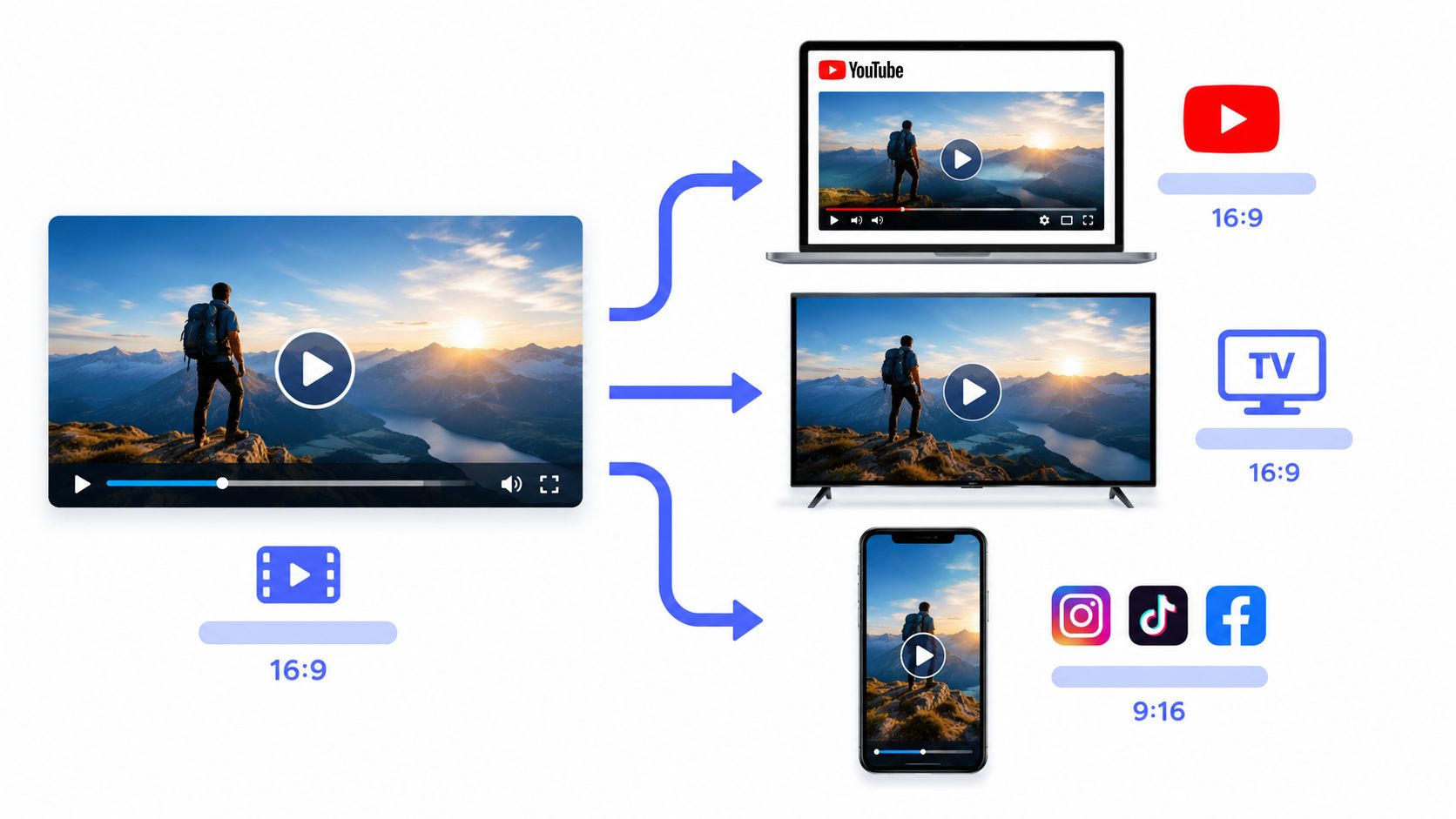
Build the asset architecture before the shoot. A practical starting point includes a 60 to 90-second hero edit for a landing page, 30-second and 6-second versions for CTV and YouTube pre-roll, 9:16 vertical cuts for Reels, Shorts, and TikTok, and 1:1 versions for paid social feeds. These are creative formats, not mechanical crops. Each version needs its own opening, framing, pacing, text treatment, and call to action.
Plan the frame for future placements
Shoot wider than the hero composition when the footage may need a vertical crop. Keep faces, products, and essential action inside safe areas. Capture b-roll with enough visual space for captions and platform overlays. Record alternate hooks and concise answers rather than relying on an editor to manufacture short-form energy from a slow interview.
The trade-off is production discipline. More variants require more planning, footage selection, editing, captioning, sound mixing, approvals, and quality control. That cost is usually lower than reshooting because the original footage ignored the distribution plan.
Tie every version to a measurement loop
Use view-through rate to evaluate how CTV creative holds attention. Use watch time and audience retention to understand YouTube performance. Use hook rate and share rate to judge whether social creative earns attention and participation.
Distribution planning should also account for paid, owned, and partner channels. FindClout's distribution models offers useful context for thinking beyond the initial upload and matching content to how audiences encounter branded video.
A production brief should name the platform, placement, audience, message, length, aspect ratio, caption treatment, and success signal for every deliverable. For teams planning CTV buying and creative delivery, CTV advertising agency guidance provides a useful reference point. Production quality gets the asset into consideration. Distribution design determines whether the asset gets a fair chance to perform.
How to Choose an Austin Video Production Partner
Start with the reel, but don't stop at aesthetics. A vendor can produce beautiful work and still be a poor fit for a campaign that needs interviews, product demonstrations, paid cutdowns, vertical edits, captions, and fast review cycles.
Use a 25-point evaluation rubric, with five points for each category. Keep the scoring documented so procurement and finance can see why the shortlist reflects business requirements rather than personal taste.
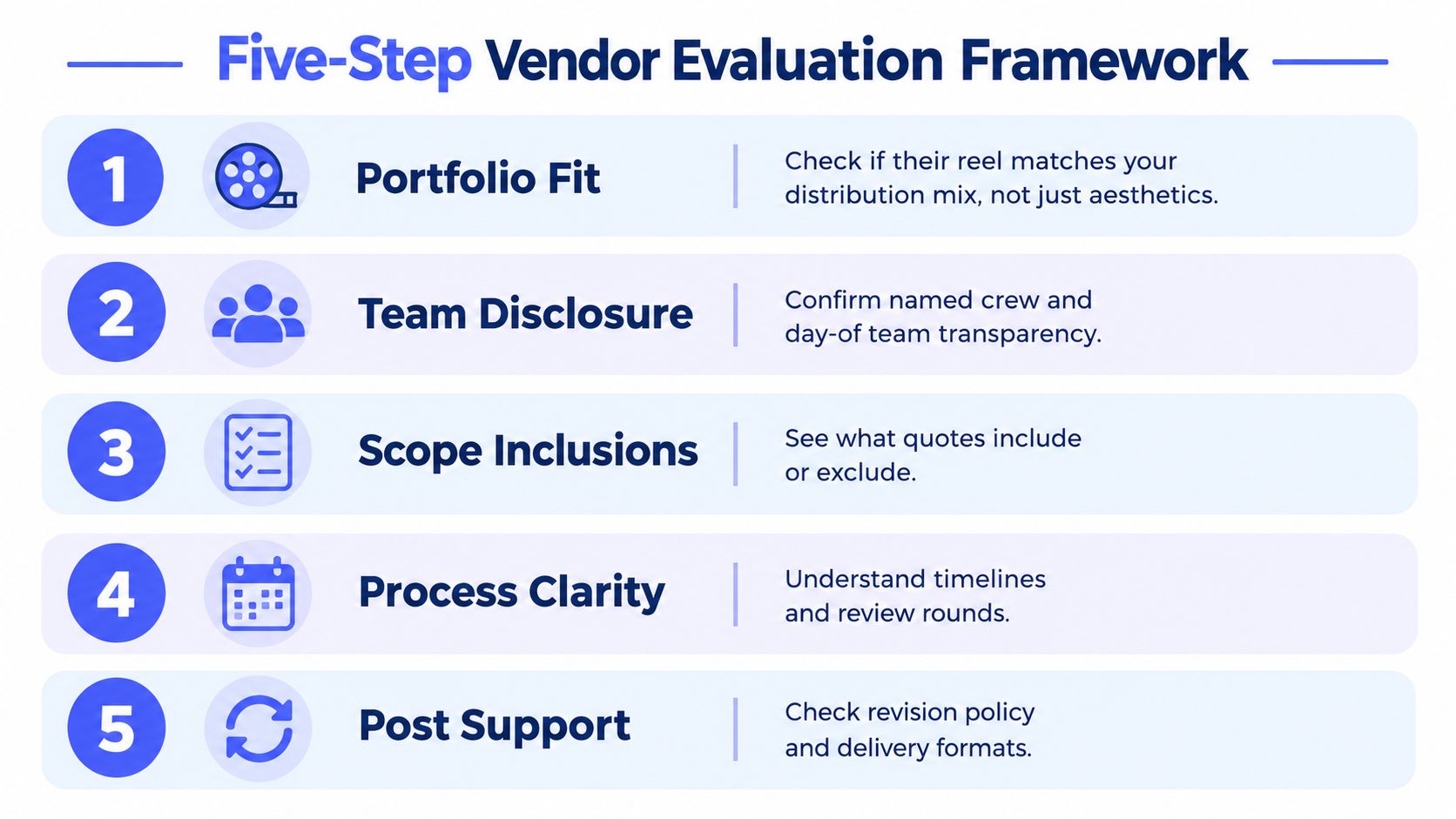
Five criteria for a defensible shortlist
Portfolio fit: Score the reel against your actual distribution mix. Look for work with comparable audiences, products, environments, pacing, and platform requirements. A cinematic travel film doesn't prove the vendor can sell enterprise software.
Team disclosure: Request the names and roles of the proposed producer, director, DP, sound recordist, editor, and post team. Confirm whether the people in the reel will work on your project or whether the vendor plans to substitute a different crew.
Scope clarity: Require a written list of included shoot days, gear, locations, pre-production, edit rounds, aspect ratios, captions, music, graphics, raw footage, and final exports. Ask what triggers an overage.
Process clarity: Ask for the approval path, schedule, review windows, file handoff, backup approach, and escalation process. A clear calendar protects the campaign when stakeholders disagree.
Post support: Confirm whether the partner can refresh hooks, create paid media cutdowns, reformat for new placements, and deliver updated versions after launch. This matters if the campaign will run beyond the initial release.
A first-call checklist should include direct questions:
Which Austin productions have you shot, and what did your team handle?
Can you show examples designed for YouTube, CTV, and vertical social?
Who will be on set, and who will edit the project?
Does the quote include paid media cutdowns and captions?
Who owns the footage, project files, music licenses, and final masters?
How many review rounds are included?
What happens when the client changes the script after filming?
Can you provide references from brands with a similar budget and approval process?
For transportation and on-location logistics, teams can also review coach rental Austin Texas when a production involves moving crew, talent, or equipment between venues. The service requirement is different from a creative partner, so keep transportation, production, and post-production responsibilities clearly separated.
The right partner should make the budget legible, the crew accountable, and the deliverables useful after launch. For a broader comparison of agency capabilities, video production agency evaluation guidance can help structure the procurement conversation.

Busylike combines creative production, paid video advertising, and channel management for brands that need Austin video assets to work across YouTube, CTV, and social. If your team wants one partner to plan the shoot, produce the footage, build platform-ready versions, and connect creative to distribution, visit Busylike to discuss the campaign.