Hotel Video Production: The 2026 Playbook

A cinematic hotel film can be beautiful, on-brand, and almost useless to someone deciding where to stay. The popular advice says to invest in one polished hero video, publish it on the homepage, and expect awareness to turn into bookings. That approach confuses visual appeal with decision support.
Travelers often want to know what the room looks like, how far the property is from transport, whether the public areas suit their trip, and what the experience feels like before they commit. Effective hotel video production answers those questions in the format and channel where they arise. The strongest hospitality programs don't treat video as a single campaign asset. They build a modular system that supports discovery, comparison, reassurance, and booking.

Table of Contents
Rethinking the Cinematic Brand Film - Start with the questions - Make the film library behave like a sales team
Building a Modular Production Engine - Design the library before the shoot - Connect production to a publishing calendar
Mapping Content to Traveler Intent - Inspiration should create a reason to continue - Consideration needs proof - Booking-stage content should remove uncertainty
Technical Packaging for Multi-Platform Delivery - Capture for the final frame - Build accessibility into the master plan
Editing for Platform-Specific Attention Windows - Short-form needs a clear promise - Long-form should reward intent
Distribution and Paid Media Integration - Match assets to audience signals - Keep organic and paid teams connected
Measuring Video ROI and Booking Attribution - Use a measurement hierarchy - Build attribution around realistic behavior
Rethinking the Cinematic Brand Film
The cinematic brand film still has a place. It can establish atmosphere, express a property's point of view, and give a luxury brand a distinctive visual language. The mistake is asking one film to perform every job, from introducing a destination to resolving accessibility concerns on a booking page.
Consumer research indicates that viewers mainly want practical information, including room types, public areas, and straightforward walkthroughs. Many also prefer an actual guest or no narrator at all over a conventional cinematic brand film, as discussed in this research on what consumers want from hotel videos. A slow aerial shot may create desire, but it won't tell a family whether the lift reaches every guest floor or show a business traveler the route from the lobby to the meeting space.
Practical rule: Every hotel video should answer a question that a prospective guest might otherwise ask the reservations team.
Start with the questions
Audit the existing video library by intent, not by production value. Put each asset into one of four categories:
Inspiration: destination films, seasonal experiences, and brand atmosphere.
Orientation: property walkthroughs, arrival sequences, and location explainers.
Evaluation: room tours, amenity demonstrations, dining previews, and meeting-space overviews.
Reassurance: accessibility information, family suitability, parking, transit access, and operational details.
Most hotels discover that the first category is well supplied while the last two are thin. That imbalance creates an attractive upper funnel and a weak booking experience. A prospective guest can feel interested without ever feeling confident.
Short-form, mobile-first discovery has intensified the problem. A traveler may first encounter a property through a vertical clip showing a pool, rooftop, or neighborhood. The next useful asset shouldn't just repeat the same mood. It should answer the next question, such as what the room looks like, how the property connects to the destination, or what a particular stay includes.
Make the film library behave like a sales team
Ask front-desk staff, reservations agents, and sales managers which questions appear repeatedly in calls and email. Their answers should influence the shot list. If guests regularly ask whether a room accommodates a cot, film the relevant space clearly. If event planners need to understand loading access or room configurations, create a dedicated walkthrough rather than burying those details in a brand montage.
Brand consistency still matters. Create a shared visual system covering color treatment, typography, music, logo use, transitions, and presenter style. A practical hotel video brand guidelines resource can help teams define those rules before production begins, but guidelines should support clarity rather than force every asset into the same cinematic template.
The strategic shift is simple. Commission a hero film when the brand needs one, but build the rest of the program around the questions that move a traveler closer to booking.
Building a Modular Production Engine
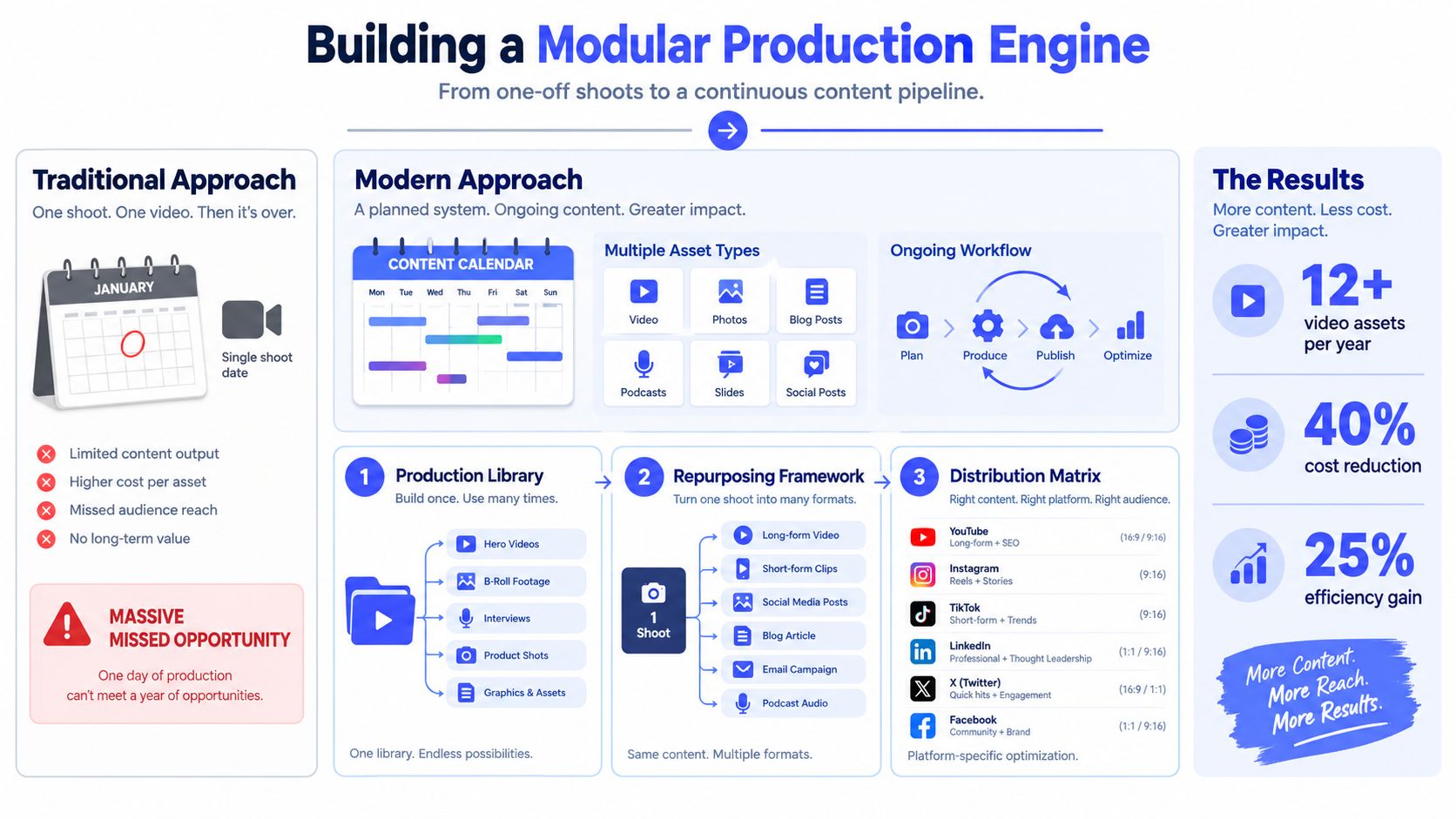
A hotel shoot shouldn't end with one approved export. It should create a structured production library that editors, media buyers, social managers, and website teams can use repeatedly.
That requires a different brief. Instead of asking a crew to “capture the property,” specify the audiences, questions, scenes, formats, destinations, languages, and future cutdowns required from the visit. A room sequence might support a website tour, a paid social hook, a vertical accessibility explainer, a YouTube chapter, and a sales presentation. The footage becomes useful because the team plans its possible applications before the cameras roll.
Industry data reports that 96% of hospitality marketers use AI for content creation, while 43% describe their use as highly mature, according to current hospitality AI video coverage. The same source describes pipelines capable of producing 15–30 assets per site visit. Those figures don't mean AI replaces creative judgment. They show why post-production now needs to be designed as an operating system rather than a single edit.
Design the library before the shoot
A useful library contains more than finished videos. It includes:
Organized source footage: room categories, amenities, staff interactions, destination scenes, entrances, signage, and detail shots labeled with searchable metadata.
Reusable text elements: approved property descriptions, amenity names, location references, accessibility wording, and calls to action.
Audio options: clean room tone, natural ambience, music stems, voice-over versions, and caption files.
Rights documentation: releases, music licenses, usage permissions, and expiration dates.
Platform variations: horizontal, vertical, square, captioned, sound-off, and localized exports.
AI can assist with transcription, scene detection, rough selects, subtitle generation, translation, resizing, and version management. It shouldn't decide whether a room feels truthful, whether a guest interaction looks staged, or whether a claim matches the actual experience. Human review remains essential, especially for hospitality brands where an inaccurate visual promise can damage trust.
Connect production to a publishing calendar
The output should flow into a calendar tied to business priorities. A destination campaign might need an awareness film, several vertical discovery clips, and a landing-page tour. A renovation might require room walkthroughs, amenity updates, email assets, and retargeting variations. A conference-sales push needs meeting-space demonstrations and practical logistics content.
Teams also need clear ownership. Someone should approve factual accuracy, someone should manage brand compliance, and someone should connect each asset to a distribution destination and measurement plan. A structured video asset management workflow helps prevent approved footage from disappearing into disconnected drives and chat threads.
The engine works when every shoot creates options. That flexibility reduces dependence on reshoots, gives paid media more creative to test, and lets the hotel respond to changing guest questions without rebuilding the entire production plan.
Mapping Content to Traveler Intent
A useful video starts with the viewer's question, not the hotel's list of features. The same swimming pool can serve different content roles depending on who is watching. For a leisure traveler, it may represent relaxation. For a parent, it may raise questions about safety and suitability. For an event planner, it may be irrelevant.
Map each concept to a stage of intent, then define the action the viewer should take next.
Inspiration should create a reason to continue
At the awareness stage, the viewer may not know the property or may be comparing destinations. Use atmosphere, neighborhood context, distinctive architecture, food, service rituals, and a clear sense of place. Keep the message focused. A destination film doesn't need to show every room category or explain every policy.
The next action could be exploring the property, saving the video, visiting a destination page, or watching a more specific clip. A strong awareness asset creates curiosity without pretending to answer every operational question.
Consideration needs proof
Mid-funnel viewers are evaluating alternatives. They want to understand how the property fits their trip, not just whether it looks attractive. Build amenity and experience videos around concrete use cases:
For families: room layouts, pool access, dining flexibility, nearby activities, and practical movement through the property.
For business travelers: workspace, arrival convenience, meeting facilities, connectivity, and proximity to transport.
For couples: dining flow, spa experience, room atmosphere, privacy, and nearby experiences.
For event planners: room scale, layouts, entrances, breakout areas, service access, and the path guests take through the venue.
Sales and front-desk teams are valuable research sources here. Review recurring questions, objections, and requests for clarification. Turn each pattern into a short brief with a clear opening, a sequence of proof points, and a next step.
Booking-stage content should remove uncertainty
Bottom-funnel videos should be direct. A room walkthrough can show the entry, bed, storage, bathroom, view, and movement between spaces without interrupting the sequence with decorative shots. A location video can show the actual arrival experience and explain nearby access in plain language. An accessibility video should be precise about what the property offers and avoid broad language that leaves interpretation to the guest.
This is also where owned content can support efforts to cut reliance on OTAs. A useful room or amenity video gives the direct booking page information that an OTA listing often compresses into standard fields. It helps the hotel compete on understanding and confidence, not only on price and availability.
A video earns its production cost when it resolves hesitation, not when it merely earns a compliment from the creative team.
Use a simple content brief for every asset: audience, question, proof required, destination URL, format, caption, and success signal. If the team can't identify the question or the next action, the concept probably belongs in a brand mood board rather than the production schedule.
Technical Packaging for Multi-Platform Delivery
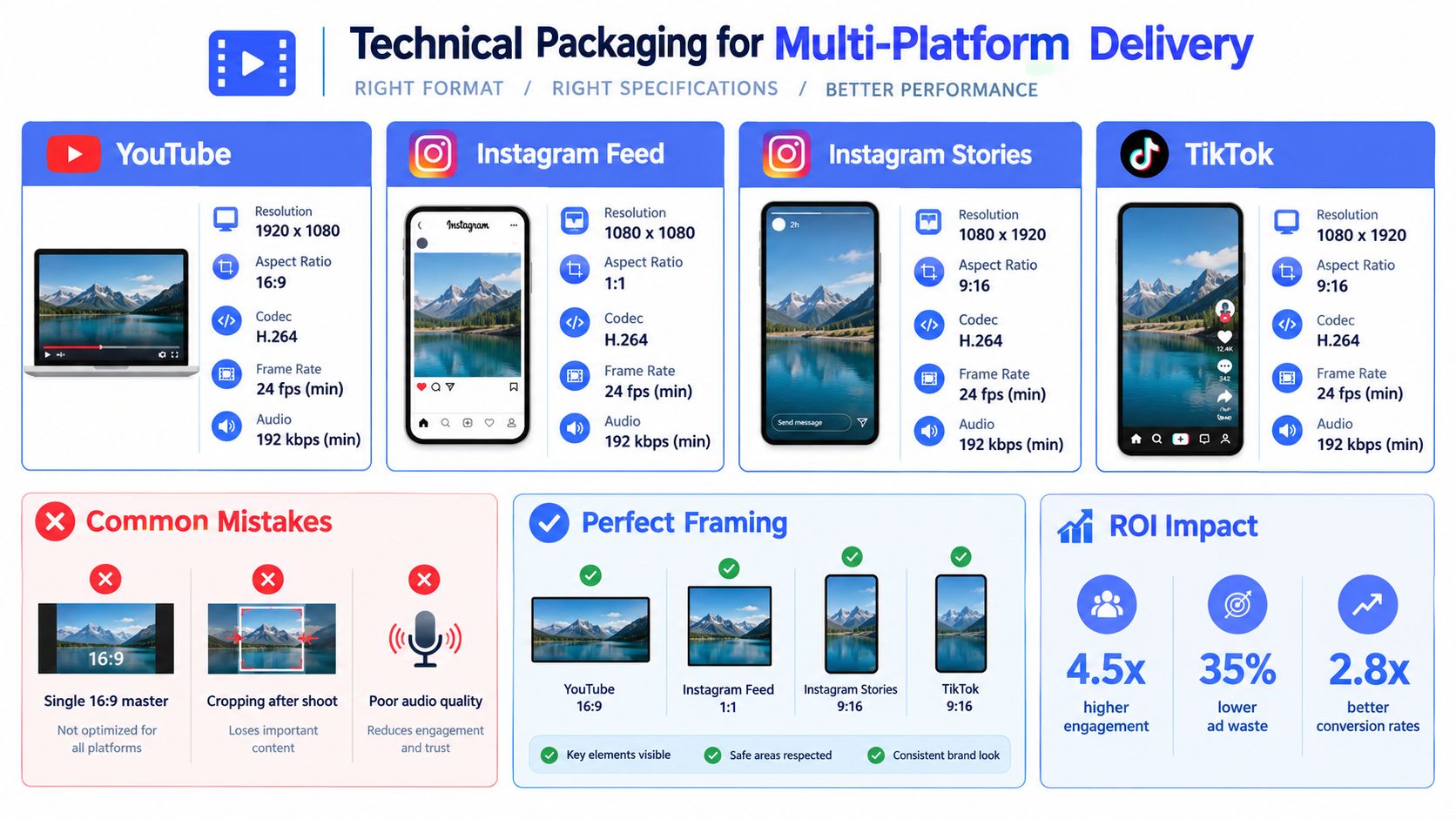
Shooting one horizontal master and cropping it later is an avoidable production error. A room composed beautifully in 16:9 can become cramped in 9:16, with the bed cut off, the presenter outside the safe area, or the most important text hidden behind interface controls.
The production brief should specify the deliverable family before the crew arrives. That changes framing, blocking, camera movement, and even how talent addresses the viewer.
Capture for the final frame
Plan the shoot around at least three composition needs:
16:9: website hero placements, YouTube property tours, sales presentations, and connected-TV environments.
9:16: Reels, TikTok, Shorts, Stories, and vertical paid social.
1:1 or feed formats: square placements and environments where a vertical crop would waste valuable space.
The hotel promotional video briefing guidance recommends treating these as a multi-format deliverable set, with separate 15-, 30-, and 60-second cutdowns, captions, sound-off versions, thumbnails, and safe-area compliance. These specifications should appear in the estimate and approval process, not as an afterthought in post-production.
Frame with negative space where text will appear, but don't cover important architectural details with overlays. Capture clean plates without talent or graphics when possible. Record room tone and natural ambience separately so editors can create versions that feel alive even when dialogue is removed.
Build accessibility into the master plan
Muted autoplay is common across social and paid placements, so captions aren't a cosmetic addition. They carry the message when audio isn't available. Use concise, readable text, check contrast against bright interiors, and keep essential information away from platform controls.
A good packaging checklist also includes:
Caption files: editable versions for localization and burned-in versions for environments that need them.
Thumbnails: distinct images and text treatments that communicate the video's subject immediately.
Safe-area checks: review every placement on a real mobile interface before approval.
Audio versions: dialogue-led, music-led, and sound-off variants where the message remains understandable.
Naming and metadata: identify property, room or amenity, audience, language, format, duration, and approval status.
Teams responsible for frequent publishing can use this guide for social publishing teams to keep platform specifications aligned. The larger principle is operational: don't deliver a folder full of exports that nobody can confidently place. Deliver clearly labeled assets that already match the intended destination.
Editing for Platform-Specific Attention Windows
A vertical social clip and a website property tour may use the same source footage, but they shouldn't use the same edit. The viewer's context determines how quickly the video must establish value, how much explanation it can carry, and when the call to action should appear.
Feed-based placements compete with unrelated content. The opening frame has to identify the property, experience, or question immediately. Start with the strongest proof, not a logo animation or a slow exterior reveal. A room clip might open on the view or the movement from the entrance into the living space, then add concise text that tells the viewer why the sequence matters.
Short-form needs a clear promise
Short-form social and vertical-video placements typically work best at 15–60 seconds, while a website or YouTube tour can extend to about 2–3 minutes when it remains tightly edited and information-dense, according to hotel video marketing guidance on platform-specific lengths.
That doesn't mean every social video should be rushed. It means the edit should earn each additional second. Remove repeated hallway shots, decorative transitions, and generic establishing footage that doesn't advance the viewer's understanding. Use movement to connect scenes, not to disguise a lack of information.
A practical short-form structure might look like this:
Opening proof: show the room, view, amenity, or experience immediately.
Context: identify the property and explain who the asset serves.
Evidence: show two or three specific details that support the promise.
Action: direct the viewer to the relevant room page, amenity page, or booking path.
Long-form should reward intent
A visitor who has reached the hotel website has different expectations. They may be comparing room categories, checking the layout, or looking for reassurance before booking. A longer tour can therefore include an arrival sequence, public spaces, room details, amenities, and a clear transition to the booking page.
Longer doesn't mean slower. Keep the information architecture visible through chapters, on-screen labels, or a deliberate sequence. If the video covers several room types, separate them clearly rather than making the viewer search through one continuous montage.
Test creative by context, not only by aggregate performance. Compare the first three seconds, completion behavior, clicks to the relevant page, and booking-path engagement. A fast social edit may generate attention, while a calmer room tour may assist a later conversion. They serve different jobs, so the team shouldn't judge them by one shared creative score.
Distribution and Paid Media Integration
Production creates potential. Distribution turns that potential into qualified attention.
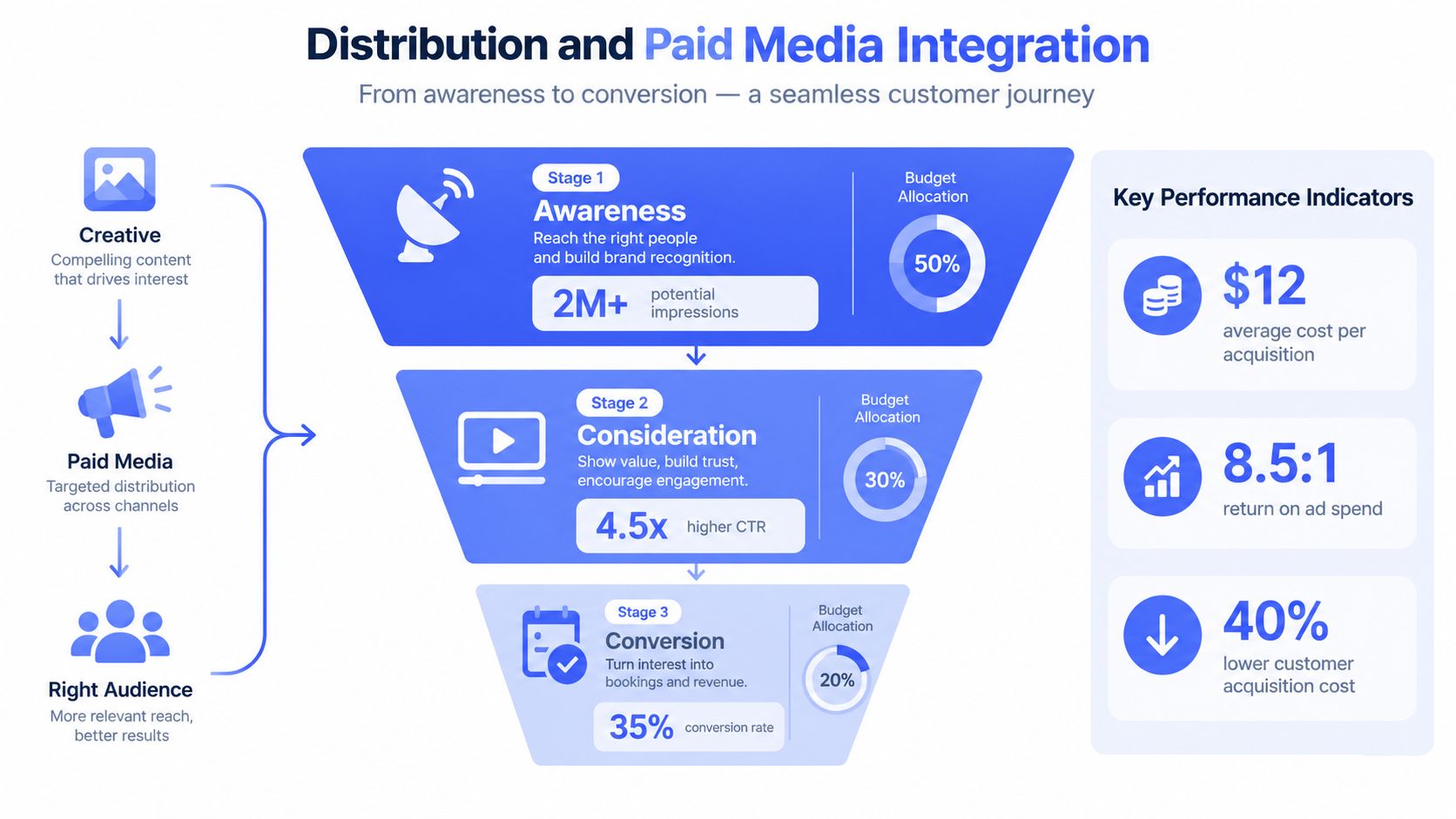
Start with the audience and the next action, then select the channel. YouTube can host searchable property tours, destination content, and intent-led explainers. Connected TV can support broad awareness where sight, sound, and premium presentation matter. Paid social can introduce a property through short-form creative and retarget viewers with more specific room or amenity content.
YouTube's scale makes it useful for a reusable hotel video library. Industry coverage reports that the platform has more than one billion monthly users watching more than six billion hours of video, and that video is shared ten times more than other forms of content, as documented by 4Hoteliers' hotel marketing coverage. The implication for a hotel isn't that every asset belongs on YouTube. It's that a well-organized library can extend beyond the booking page into search, social sharing, creator distribution, and media campaigns.
Match assets to audience signals
Use broad creative for people who haven't interacted with the property. Destination atmosphere, a distinctive experience, or a clear reason to visit can introduce the brand without overloading the viewer.
For people who watched, visited the website, engaged with a social post, or explored a room page, change the message. Retarget them with a relevant walkthrough, an amenity demonstration, or an explanation of the booking experience. Someone who has already shown interest doesn't need another generic montage. They need evidence that the property fits their needs.
The distribution plan should define:
Audience signal: search behavior, video engagement, website visit, room-page visit, or booking-engine interaction.
Creative response: destination film, amenity clip, room tour, testimonial, or practical explainer.
Landing destination: homepage, room category, offer page, meeting-space page, or booking path.
Measurement event: qualified visit, click, engaged session, assisted booking, or completed booking.
Keep organic and paid teams connected
Organic channel managers often know which questions attract comments and saves. Paid media teams know which audiences respond to specific hooks and offers. Production should capture that feedback and turn it into new briefs.
A practical hotel content guide from WaveGen.ai can help social teams think through recurring formats and publishing needs. The content calendar, media plan, and asset library should then share the same naming conventions and campaign language.
Documenting the process in a video distribution workflow prevents the common failure where a finished video is uploaded once, receives little support, and is forgotten. A strong distribution system gives each asset multiple appropriate opportunities to work, while preserving a clear relationship between creative, audience, destination, and business outcome.
Measuring Video ROI and Booking Attribution
Views are useful for diagnosing distribution, but they don't prove that hotel video production influenced revenue. A video can attract broad attention and still send the wrong audience to an irrelevant page. Another asset may receive fewer visible interactions while helping a highly interested traveler choose a room.
Measurement should follow the booking journey. Start by assigning each video a specific purpose, audience, destination, and conversion event. Then separate immediate response from assisted influence.
Use a measurement hierarchy
Exposure metrics such as reach, impressions, view starts, and completed views help determine whether the asset found an audience. They don't explain whether the audience was qualified.
Engagement metrics reveal whether the creative held attention and prompted action. Review watch-time patterns, completion behavior, click-throughs, saves, shares, landing-page sessions, and interactions with the booking interface. A sharp drop at the point where the video introduces the offer may indicate a messaging problem. A strong completion rate with weak page engagement may indicate a poor call to action or an unsuitable landing page.
Commercial metrics should carry the most weight. Track direct bookings, assisted bookings, booking-engine visits, room-category engagement, offer interactions, and revenue associated with exposed audiences where the analytics setup supports that analysis. Use campaign naming, tagged destination links, platform conversion tools, and a consistent event taxonomy so the team can connect creative variations to downstream behavior.
Measurement rule: Don't ask whether a video “performed.” Ask which traveler question it answered, which action followed, and whether that action moved the guest closer to booking.
Build attribution around realistic behavior
Travelers rarely watch one video, click once, and book immediately. They may discover a property through a short clip, return through search, compare room pages, and book after a later visit. That path makes view-through and assisted-conversion analysis valuable, but the team should avoid claiming more influence than its tracking can support.
Compare assets by role. An awareness film may be judged by qualified reach and later branded searches. A room walkthrough should be judged by room-page engagement and booking-path behavior. An accessibility explainer may have a narrower audience but remove a significant barrier for the people it reaches.
Video is already a mainstream hospitality marketing format. The cited industry source reports that 91% of businesses use video as a marketing tool in 2026, while 65% of people watch videos when planning a trip and 54% use video when searching for accommodation. Those figures from hotel video statistics for 2026 support investment, but they don't replace disciplined attribution.
Review results by property, audience, format, question, and distribution channel. Scale the concepts that produce meaningful booking-path activity, refresh assets when rooms or amenities change, and retire videos that attract attention without commercial relevance. That turns production from an annual creative expense into a measurable content system.

Busylike plans, produces, and manages branded video across YouTube, CTV, and social, combining creative production with paid video advertising and channel optimization. If your hotel needs a modular video system built around traveler questions and booking outcomes, visit Busylike to discuss the production and distribution approach.