
Omnichannel Video: How to Drive Measurable ROI in 2026

You've probably seen this campaign before. A polished brand film runs on connected TV, the same cut appears on YouTube, and a shortened version follows the audience through social feeds. The dashboard reports plenty of views, but nobody can answer a more important question: how many people did the campaign reach that another channel hadn't already reached, and what business action did that exposure cause?
That's the core challenge with omnichannel video in 2026. Producing more assets won't automatically improve performance. The advantage comes from assigning each channel a job, adapting the creative to the viewing context, deduplicating audiences, and measuring incremental business impact instead of celebrating repeated delivery.
Table of Contents
Why Omnichannel Video Is the Only Viable Video Strategy - Fragmentation changes the planning problem - The single-screen plan is losing its logic
Choosing the Right Channels for Each Campaign Goal - Assign the job before assigning the budget
Strategic Frameworks for Planning and Production - Build a production system around reusable decisions
Creative Adaptation Across Different Viewing Contexts - Adapt the experience, not just the dimensions - Make accessibility part of the creative brief
Proving True Incremental Impact and Business Lift - Use holdouts to estimate the missing counterfactual - Count delayed effects without claiming causality
Optimizing Reach and Frequency with AI - Use AI to make allocation decisions faster
Why Omnichannel Video Is the Only Viable Video Strategy
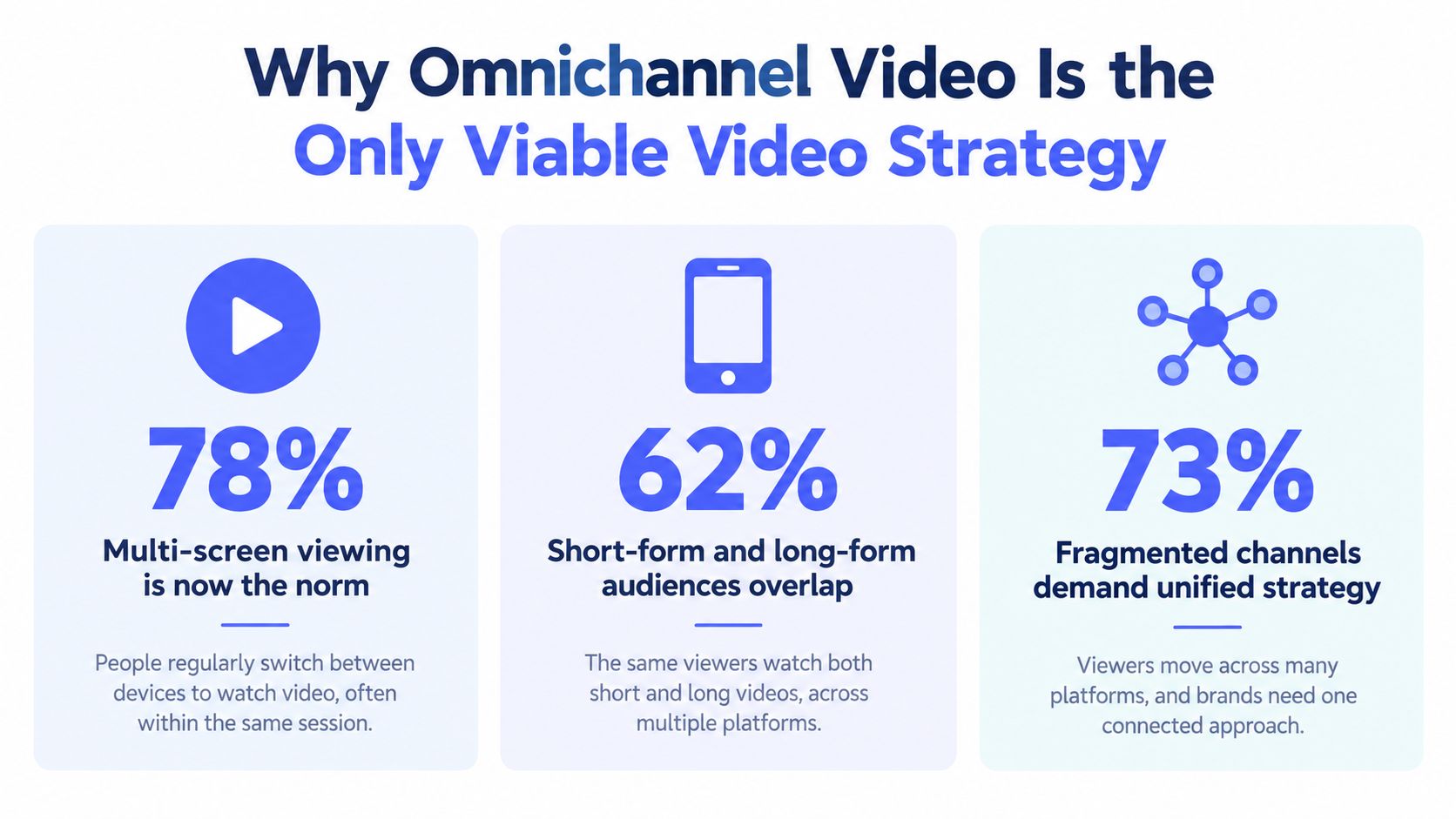
Video consumption no longer follows a clean path from television to website. The same person might watch a short social clip during a commute, search YouTube for a product explanation later, and encounter a longer brand narrative on a connected TV at home. Those are different moments, with different levels of attention and different expectations of the message.
In April 2025, more than 9 in 10 online adults worldwide watched online video each week, excluding major streaming services such as Netflix. Audiences spent an average of 6 hours and 37 minutes per week watching short-form and longer online video formats, according to We Are Social's Digital 2025 April Global Statshot. That behavior makes a single-channel plan structurally incomplete.
Fragmentation changes the planning problem
Short-form and long-form viewing now coexist. The April 2025 data found that online adults spent an average of 6 hours and 37 minutes per week on short-form content, while also spending nearly five hours per week watching longer online videos. YouTube remained a major cross-platform destination, with Similarweb data cited by We Are Social showing average usage of 1 hour and 24 minutes per user per day on Android devices.
The screen matters as much as the platform. Google data cited in the same report found that almost 45% of YouTube accounts globally accessed YouTube through a connected TV at least once per month. The audience isn't divided neatly into “social users,” “YouTube users,” and “television viewers.” It overlaps across devices, environments, and stages of consideration.
That overlap creates two operational risks. A brand can underinvest in a channel that reaches a valuable audience, or it can pay repeatedly to reach the same household through several platforms. Both problems remain hidden when teams optimize each platform in isolation.
Planning rule: Treat channels as connected parts of an audience system, not as separate media properties competing for isolated view counts.
The single-screen plan is losing its logic
Television still offers scale and emotional immersion. YouTube supports search, education, and viewing on both personal and household screens. Social video creates rapid discovery, conversation, creator influence, and direct action. None of these environments can reproduce the full role of the others.
An omnichannel strategy doesn't mean placing every edit everywhere. It means coordinating reach, frequency, sequencing, creative context, and measurement across the environments where the audience spends time. A campaign that lacks that coordination may look busy in reporting while leaving meaningful reach uncovered.
Choosing the Right Channels for Each Campaign Goal
Channel selection should begin with the job the audience needs the video to perform. CTV, YouTube, and social video aren't interchangeable containers for the same asset. They create different attention conditions, and those conditions should shape the narrative, offer, pacing, and measurement.
Environment | Strongest role | Creative emphasis | Useful evidence |
|---|---|---|---|
CTV | Emotional connection and broad household reach | Narrative depth, visual impact, memorable brand cues | Brand and reach studies |
YouTube | Education, intent capture, and consideration | Demonstration, explanation, search relevance, clear next step | View quality, engaged actions, lift testing |
Social video | Discovery, credibility, and action | Fast hook, creator voice, comments, captions, mobile-first framing | Engagement, assisted actions, conversion testing |
CTV is a lean-back environment. Viewers may be watching a program with others, and the brand has more room to establish atmosphere, tension, or emotional meaning. That doesn't make CTV a guaranteed awareness solution. If the same household has already received heavy exposure elsewhere, another CTV impression can add frequency without adding meaningful reach.
YouTube sits between television and active digital research. It can carry a brand narrative on a TV screen, a product demonstration on a laptop, or a practical answer on a phone. The right role depends on the campaign objective. A software company might use a longer explanation to resolve product uncertainty, while a retailer could use product-led edits that help viewers move from discovery to evaluation.
Social video operates closer to the feed and the hand. Users can scroll past immediately, comment, share, click, or follow a creator into a recommendation. Its strength is speed and participation, not cinematic continuity. A social edit often needs to communicate the problem, proof, and next action before the viewer has committed sustained attention.
Market conditions reflect this shift. Connected TV advertising was forecast to reach $39.9 billion in 2025, while YouTube generated $36 billion in advertising revenue across devices in 2024, according to Advanced Television's report on the streaming shift. The same report stated that 56% of marketers planned to increase OTT and CTV budgets in 2025, while linear television spending continued to decline.
Assign the job before assigning the budget
A practical allocation might look like this:
CTV builds memory: Use it for the central promise, emotional stakes, and broad household exposure.
YouTube removes uncertainty: Use demonstrations, comparisons, explainers, testimonials, and intent-oriented sequences.
Social accelerates action: Use creator-led proof, rapid hooks, audience comments, and context-specific offers.
The sequence won't always run in that order. A product with strong social discovery may start with a creator demonstration, then use YouTube to answer objections and CTV to reinforce brand meaning. The point is to design the journey rather than let platform defaults design it for you.
Teams building a broader media system can also use an end-to-end ad approach to connect planning, activation, and measurement across platforms. The useful test is simple: can the plan explain what each channel contributes that the others can't?
Strategic Frameworks for Planning and Production
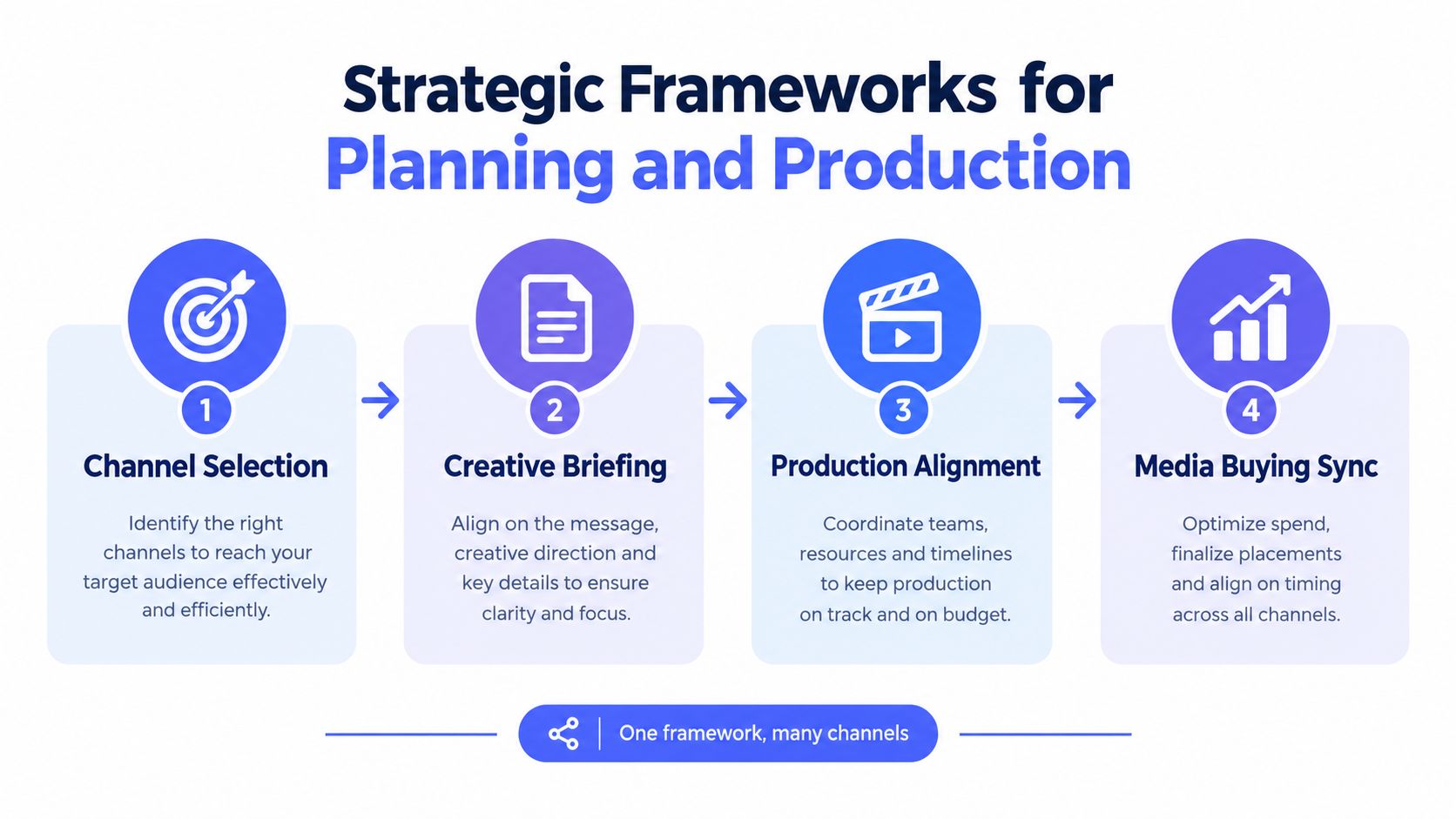
The most efficient omnichannel teams don't produce one generic video and hope automated placements solve the rest. They build a modular creative system. One core idea supplies the strategic spine, while separate scenes, openings, proof points, aspect ratios, captions, and calls to action serve different viewing contexts.
Start with the audience and business objective, not the production format. Define the action that matters, the audience segment most likely to take it, and the evidence that would show progress. Then decide which channel should introduce the idea, which should deepen it, and which should make the next action easiest.
Build a production system around reusable decisions
Channel selection comes first. Document the role of CTV, YouTube, social, and any additional environments before a script is approved. This prevents a common failure mode, where a long television edit is forced into a vertical feed with nothing more than a crop.
Creative briefing should specify the invariant elements and the flexible elements. The invariant layer includes the promise, brand codes, product truth, tone, and compliance requirements. The flexible layer includes the hook, sequence, runtime, framing, captions, proof, and CTA.
Production alignment turns that brief into capture choices. Film clean plates for reframing, record alternate openings, capture product details separately, and plan scenes that can work with or without sound. A production crew should know whether a moment must survive a muted phone feed, a large television screen, or a quick out-of-home encounter.
Media buying sync completes the loop. Media planners need the asset map before launch, not after editing ends. They should know which variants are intended for prospecting, retargeting, sequential exposure, household reach, or frequency control.
Production principle: Capture modularly, edit contextually, and preserve one recognizable brand promise across every version.
A create once publish everywhere approach can improve production efficiency, but only when “publish everywhere” doesn't mean “publish unchanged everywhere.” Repurposing works when the team starts with adaptable source material and makes deliberate editorial choices for each environment.
Your workflow should also connect production to distribution ownership. A practical video production and marketing workflow helps clarify who approves the brief, who owns platform specifications, who manages paid placements, and who turns performance signals into the next creative iteration.
Creative Adaptation Across Different Viewing Contexts
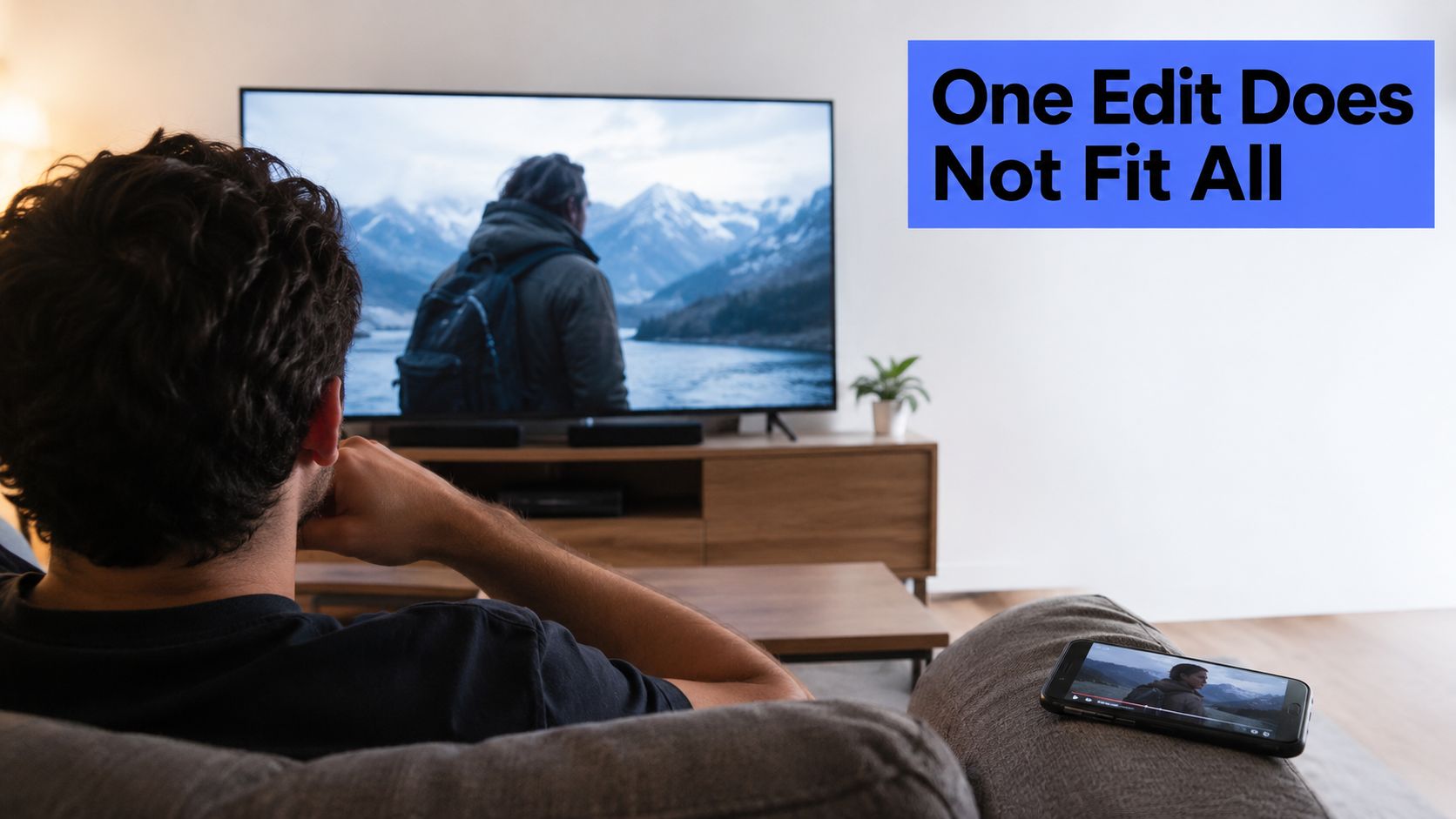
The same audience doesn't bring the same attention to every screen. A person scrolling social video may see the first frame with sound off and a thumb ready to move. That person may later watch a CTV ad from several feet away, with time for a story to develop and other household members present.
Adapt the experience, not just the dimensions
Social video needs a strong opening frame, visual clarity, captions, and a reason to continue. It should often make the product or problem legible before the viewer has settled into the story. Creator delivery, comments, and social proof can carry credibility that a polished brand voice may not provide on its own.
YouTube supports more varied pacing. A viewer may arrive with a question, accept a recommendation, or watch from a connected TV without immediate purchase intent. Use that range deliberately. A product demonstration can be detailed, while a paid pre-roll version may need a faster route to proof and a clear option to learn more.
CTV gives the narrative more room, but that room should serve memory rather than indulgence. Establish a distinctive situation, emotional tension, or visual world, then make the brand's role unmistakable. A beautiful film that viewers can't connect to the product may produce attention without useful association.
Research cited in Mediaocean's H1 2025 Advertising Outlook found that social video can create a shorter path to purchase than a lean-back television experience, while CTV is valued for immersive emotional connection. The implication is practical: creative consistency means a consistent promise and distinctive brand cues, not identical footage everywhere.
The following video illustrates why the same concept can feel different when audiences move between screens. Pay attention to framing, pacing, and the role of the viewer's environment.
Make accessibility part of the creative brief
Captions shouldn't be an afterthought. Visual-first storytelling, readable type, safe-area discipline, and strong contrast protect comprehension when sound is unavailable or attention is divided. Vertical, square, and horizontal versions should be composed intentionally, not generated by allowing a platform to crop the master.
Build a variant matrix before production:
Opening: Lead with a question, visual disruption, product result, or creator statement based on the environment.
Middle: Use narrative depth on CTV, evidence on YouTube, and rapid proof or participation on social.
Ending: Reinforce brand memory on CTV, provide a next step on YouTube, and make the social action native to the platform.
Measurement: Judge each version against its intended job, not against a universal view-through benchmark.
That system gives the audience a coherent brand while respecting the context in which the message appears.
Proving True Incremental Impact and Business Lift
A platform can report a conversion without proving that its exposure caused the conversion. The user may have searched for the brand already, seen another channel's ad, or converted because of existing demand. Platform attribution is useful for operations, but it isn't sufficient evidence of incrementality.
The measurement model should separate three questions. Did the campaign reach the intended audience? Did it change behavior or perception? Did that change produce incremental business value beyond what would have happened without the channel?
Use holdouts to estimate the missing counterfactual
A geo-holdout design provides a practical route to causal evidence. Select comparable test markets, suppress TV or CTV exposure in those markets, and use historical transaction data to estimate the conversions that would have occurred without the channel. The difference between predicted and observed conversions represents the channel's incremental impact, as explained in Measured's guide to TV and CTV incrementality.
The quality of the result depends on operational discipline:
Match the markets: Compare areas with similar demand patterns, customer composition, media conditions, and distribution.
Protect the test: Keep creative, offer, pricing, and other major conditions consistent so the holdout isolates the channel as cleanly as possible.
Model the baseline: Use a sufficiently long pre-period to understand normal demand, seasonality, and local variation.
Predefine the outcome: Agree in advance whether the primary result is incremental conversions, incremental CPA, incremental ROAS, branded search, store visits, or another business measure.
Report by segment: Break out results by audience and channel where the design supports it, rather than hiding differences inside an aggregate total.
A brand-lift study can help evaluate awareness, recall, or consideration. Conversion-lift and matched-market testing can address performance questions. Neither approach should be selected because it produces a favorable headline. Select the design that matches the decision the marketing team must make.
Count delayed effects without claiming causality
CTV may influence branded search, direct traffic, retail behavior, or assisted conversions after the exposure. Those signals belong in the analysis, but correlation alone doesn't establish causal impact. Use them as supporting indicators unless a test design connects the exposure to the outcome.
Last-touch reporting has a role in optimization. It can reveal which ads receive credit under a platform's rules and help identify broken paths. It can't answer whether the credited conversion would have happened anyway. A measurement program that reports both platform attribution and causal lift gives executives a more honest view of efficiency.
Teams can also use video retargeting to reconnect with engaged viewers, but retargeting should follow a defined audience and frequency strategy. Otherwise, it can turn prior engagement into a reason to repeat exposure rather than a reason to improve the next message.
Optimizing Reach and Frequency with AI
The most expensive impression is often the one that reaches someone who has already seen the same message repeatedly while another qualified household remains untouched. Cross-platform duplication makes that waste difficult to see because each platform may report its own delivery accurately while the combined campaign tells a different story.
CTV benchmark data from Innovid, published through the IAB's CTV Takes Center Stage report, found that campaigns reached only 9.23% of more than 95 million U.S. CTV households measured, with an average frequency of 4.08 exposures. The report also found that two-thirds of campaigns generated only one to two exposures, while a smaller group exceeded ten exposures. These figures point to a planning problem: many campaigns still have available reach capacity while some audiences receive unnecessary repetition.
Use AI to make allocation decisions faster
AI is useful here when it supports clear objectives and reliable inputs. It can help reconcile audience signals, identify likely overlap, prioritize households with lower exposure, and recommend budget shifts as marginal frequency rises. It shouldn't be treated as a substitute for measurement design or human judgment about brand safety, context, or creative fatigue.
A practical optimization loop looks like this:
Unify the exposure view: Bring CTV, YouTube, social, and linear-TV delivery into a shared reporting layer where privacy and platform permissions allow.
Estimate duplication: Compare household or audience exposure across channels instead of reviewing unique reach separately inside each platform.
Set guardrails: Apply household-level frequency caps, define acceptable exposure ranges, and reserve spend for incremental reach.
Score marginal value: Watch whether another impression creates lift in brand, engagement, or conversion outcomes. If it doesn't, redirect spend.
Match creative to exposure: Change the message after the audience has seen the introduction. Repeatedly serving the same edit wastes an opportunity to advance the story.
Review exceptions: Have marketers inspect anomalies, small segments, and new audiences before automated recommendations become permanent rules.
The goal isn't maximum delivery. It's maximum useful coverage. A campaign can produce fewer total impressions and still create more business value if those impressions reach new qualified people and move them through a deliberate sequence.
For teams evaluating AI audience targeting, the important questions are practical. What identity signals feed the model? How does it handle overlap? Can the team inspect the reason for a recommendation? Does the system optimize toward incremental reach or just toward cheaper delivery?
Case Study - Executing a Unified Video Campaign
A mid-market consumer electronics brand had a familiar problem. Its CTV campaign delivered strong household exposure, YouTube generated product interest, and paid social produced active engagement, but each team optimized within its own reporting environment. The brand couldn't tell whether social was finding new prospects or repeatedly reaching people already exposed on television.

The marketing team changed the operating model before changing the media mix. It defined CTV as the narrative and memory layer, built YouTube edits around demonstrations and objections, and used social versions with creator-led openings and concise proof. The production team captured modular footage, while media owners agreed on shared audience definitions, exposure rules, and a common reporting cadence.
The team then compared reach and frequency across platforms rather than accepting three separate dashboards. When overlap increased, it shifted delivery toward less-exposed audiences and used follow-up creative instead of repeating the launch film. A geographic holdout provided a stronger read on incremental business impact than platform-reported conversions alone.
The important result wasn't a dramatic headline metric. It was a more reliable decision system. The brand could see which channel introduced the promise, which one resolved uncertainty, and where additional frequency stopped adding value. That made the next production cycle more focused and gave finance a clearer connection between video investment and business outcomes.
Next Steps for Building Your Video Program
Audit existing footage, formats, rights, captions, and brand assets before commissioning new production. Assign one owner for the audience map, one for creative adaptation, one for media delivery, and one for measurement. Define baseline demand, matched markets, holdout rules, frequency caps, and primary business outcomes before launch.
Create a channel-by-job matrix, then brief modular assets around those jobs. Connect platform reporting to a shared exposure view, review duplication regularly, and schedule creative and budget decisions around incremental reach rather than total views.
Busylike plans, produces, and manages video campaigns across YouTube, CTV, and social, including platform-ready adaptations that connect creative decisions with paid distribution. Visit Busylike to discuss a video program built around audience deduplication, context-specific creative, and measurable business lift.

