
Video Marketing for Ecommerce: The Complete Guide

Your product videos are probably doing too many unrelated jobs. A polished brand film sits on YouTube, a rushed vertical clip appears on Instagram, and a product-page demo gets uploaded without anyone deciding which buying objection it should answer. The team stays busy, but performance remains difficult to explain.
Video marketing for ecommerce works best when every asset has a defined role in the buying journey. Awareness creative should earn attention, consideration content should clarify value, and product-page video should remove the hesitation that blocks checkout. Distribution, production, and measurement then operate as one system rather than as separate tasks.

Table of Contents
Why Ecommerce Brands Need a Unified Video Strategy - Connect creative to the decision moment
The Four Pillars of Ecommerce Video Strategy - Strategy defines the job - Production turns the brief into proof - Paid distribution buys qualified attention - Channel management creates the feedback loop
Platform-Specific Tactics Across Distribution Channels - Product pages need evidence - Social needs speed and native behavior - YouTube and CTV serve different jobs
Creative Production Workflows for High-Impact Video - Write for the first useful moment - Shoot a modular asset library - Edit for clarity, not ornament
Measuring Performance and Optimizing ROI - Build a metric chain - Test the friction, not just the color
Common Misconceptions About Video Marketing for Ecommerce - More content isn't automatically better
Your Roadmap to Video Marketing Excellence - Define the first commercial problem - Build the minimum viable system - Establish a learning cadence - Scale what proves useful
Why Ecommerce Brands Need a Unified Video Strategy
Scattered video activity creates familiar problems. Creative teams make attractive footage without a distribution brief, paid media teams test ads that don't reflect the product-page experience, and ecommerce managers add videos to product pages without measuring whether shoppers engage or convert differently. Each decision can look reasonable in isolation while the complete customer journey feels inconsistent.
A unified strategy starts with the buying friction, not the channel. A fashion shopper may need to see fit and movement. A consumer electronics buyer may need proof of setup, scale, and use. A skincare customer may want texture, application, and credible routine context. The right video makes that uncertainty visible and resolves it quickly.
The commercial case is now difficult to ignore. 91% of businesses use video as a marketing tool in 2026, while 93% say it's an important part of their strategy, according to HubSpot's video marketing statistics. On ecommerce product pages, embedded video has been reported to convert at 4.8% versus 2.9% without video, a 65% lift, from the same source.
Connect creative to the decision moment
Paid social may introduce the product, YouTube may explain it, and the product detail page may prove that it works. Those assets shouldn't repeat the same script. They should answer progressively more specific questions.
A short ad earns the click by showing the outcome. A longer demonstration addresses comparison and functionality. The PDP video handles the final doubt, such as fit, installation, ingredients, durability, or compatibility.
Practical rule: Build the product-page video around the question most likely to stop the sale, then cut shorter versions from that core footage.
This approach also makes scaling demand with video content more manageable. One strategically planned shoot can generate paid creative, organic clips, product-page demonstrations, retailer assets, and customer education content, provided the team captures enough angles and context during production.
The payoff isn't more published content. A connected system gives media buyers stronger creative inputs, gives ecommerce teams assets built for conversion, and gives analysts a clearer path from exposure to action. Brands stop asking whether a video received attention and start asking which format helped a shopper move forward.
The Four Pillars of Ecommerce Video Strategy
A durable program rests on four connected pillars. Remove one, and the others become less effective. Strong creative without distribution stays invisible, paid reach without a useful landing experience wastes demand, and measurement without a clear brief produces data nobody can act on.
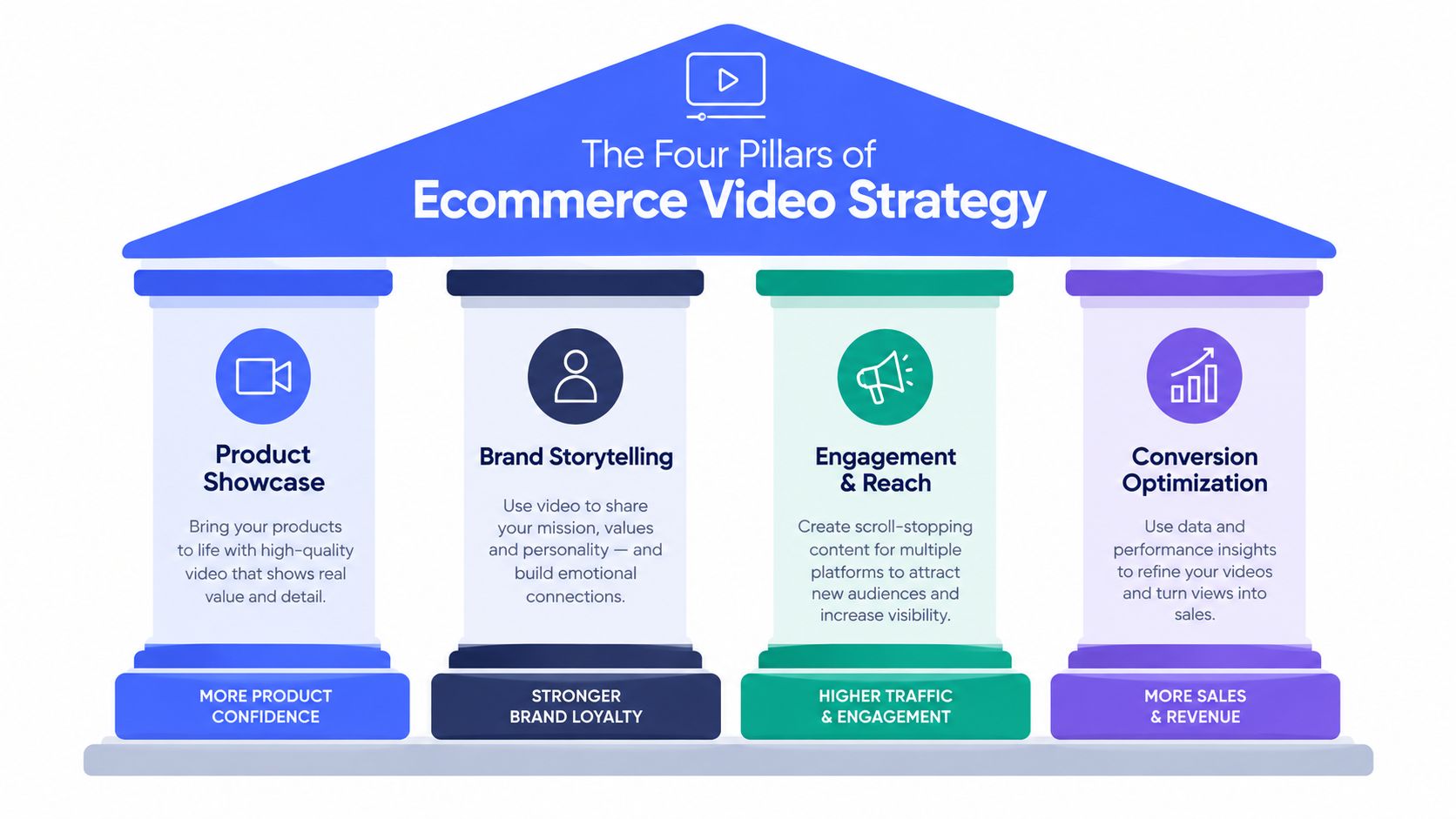
Strategy defines the job
Start by naming the audience, buying stage, objection, and business outcome. “Make a product video” isn't a brief. “Help first-time buyers understand how the garment fits on different body types” is a usable brief.
The strategy should also define the voice and evidence the brand can credibly provide. A medical product may need careful claims review. A technical product may need screen recordings and demonstrations. A lifestyle product may benefit from creator-led use cases rather than a formal presentation.
Production turns the brief into proof
Production includes scripting, casting, locations, product preparation, lighting, sound, and shot planning. The most expensive-looking footage isn't automatically the most persuasive. The useful question is whether the viewer can see the product performing the task that matters.
Capture wide, close, detail, and action shots in the same session. Record clean product audio where it adds value, but plan captions and text overlays for silent viewing. A production checklist should protect both brand consistency and later editing flexibility.
Paid distribution buys qualified attention
Paid advertising gives the strongest creative a chance to reach relevant audiences at scale. YouTube suits searchable demonstrations and intent-led viewing. Paid social supports rapid creative testing. CTV can deliver broad, high-impact storytelling, but it usually needs a separate path for direct response.
The media plan should specify audience, placement, bid objective, creative ratio, landing destination, and exclusion rules. Shoppable formats can connect demonstrations to retail actions, and teams exploring that route can review shoppable video ads for examples of how commerce interactions fit into video planning.
Channel management creates the feedback loop
Optimization covers publishing, metadata, thumbnails, captions, comments, audience signals, tests, and reporting. It also includes version control, because the wrong cut or outdated offer can remain live after the campaign has changed.
The four pillars reinforce one another. Performance data reveals which objections deserve new creative. Production turns those insights into variants. Distribution puts the variants in front of defined audiences, and channel management shows whether the new assets changed behavior.
Video marketers report tangible commercial value: 83% say video directly helped increase sales and 82% report a positive ROI, according to Webtonic's ecommerce video statistics. Those outcomes depend on treating the pillars as a system, not as departments working in sequence.
Platform-Specific Tactics Across Distribution Channels
A shopper comparing two products needs evidence, while someone discovering a product on TikTok needs a reason to stop. The footage can overlap, but the edit must match the purchase-stage friction, viewing context, and next action on each channel.
Channel | Best role | Creative priorities | Main mistake |
|---|---|---|---|
Product page | Resolve purchase hesitation | Demonstration, proof, captions, visible product use | Treating video as decorative media |
Short-form social | Earn attention and qualify interest | Vertical framing, immediate hook, native pacing | Reusing a horizontal commercial unchanged |
YouTube | Capture intent and build understanding | Searchable titles, useful thumbnails, demos, explainers | Optimizing only for views |
Paid social | Test messages and drive action | Multiple hooks, clear offers, platform-native edits | Testing audiences without testing creative |
CTV | Build reach and memory | Strong visual storytelling, brand clarity, audio design | Expecting a direct-response edit to do a brand-film job |
Product pages need evidence
Place the video beside the information gap that may block purchase. For apparel, show movement, drape, and fit. For furniture, show scale and assembly. For electronics, demonstrate ports, setup, controls, and real use. Open with the buyer's question or concern, not a long logo animation.
The player experience affects conversion too. Use a clear thumbnail, captions, mobile-friendly framing, and hosting that does not direct shoppers toward unrelated content. Keep the viewer inside the purchase path, with the product page providing the detail needed to compare and decide.
Social needs speed and native behavior
Short-form creative should make sense before a viewer reads the caption. Put the product or outcome in the first visual beat, add on-screen text, and create versions for different objections. One cut can show the problem, another the demonstration, and another a creator's personal use case.
Fast pacing does not require frantic editing. If the product needs explanation, let the demonstration breathe. 46% of shoppers prefer short-form video for product discovery and evaluation, and 91% of viewers prefer videos under two minutes, according to Shopify's video marketing statistics. Keep the format concise, while retaining the proof required for the category and purchase stage.
Paid social is a testing environment as well as a distribution channel. Test hooks, demonstrations, offers, creators, and calls to action alongside audiences. A strong audience cannot rescue a creative that leaves the product benefit unclear.
YouTube and CTV serve different jobs
YouTube supports searchable education, product comparisons, tutorials, reviews, and remarketing. Write titles around questions buyers search, choose thumbnails that show a concrete outcome, and place the next step where it fits naturally in the viewing experience. A comparison video can reduce uncertainty, while a tutorial can address setup friction after initial interest.
CTV usually suits broad storytelling and brand memory better than detailed product instruction. Keep visual identity consistent across channels, but adapt the call to action to the viewing environment. A QR code, memorable URL, or coordinated retargeting path can connect the screen to commerce without forcing the spot to behave like a social ad. The right measure may be qualified site activity or assisted demand, rather than an immediate last-click order.
Creative Production Workflows for High-Impact Video
Efficient production begins with a usable brief. It should identify the audience, buying stage, product promise, proof points, mandatory claims, destination, format requirements, and success metric. Without those decisions, filming becomes an expensive attempt to collect “good footage” and editing becomes a negotiation over taste.
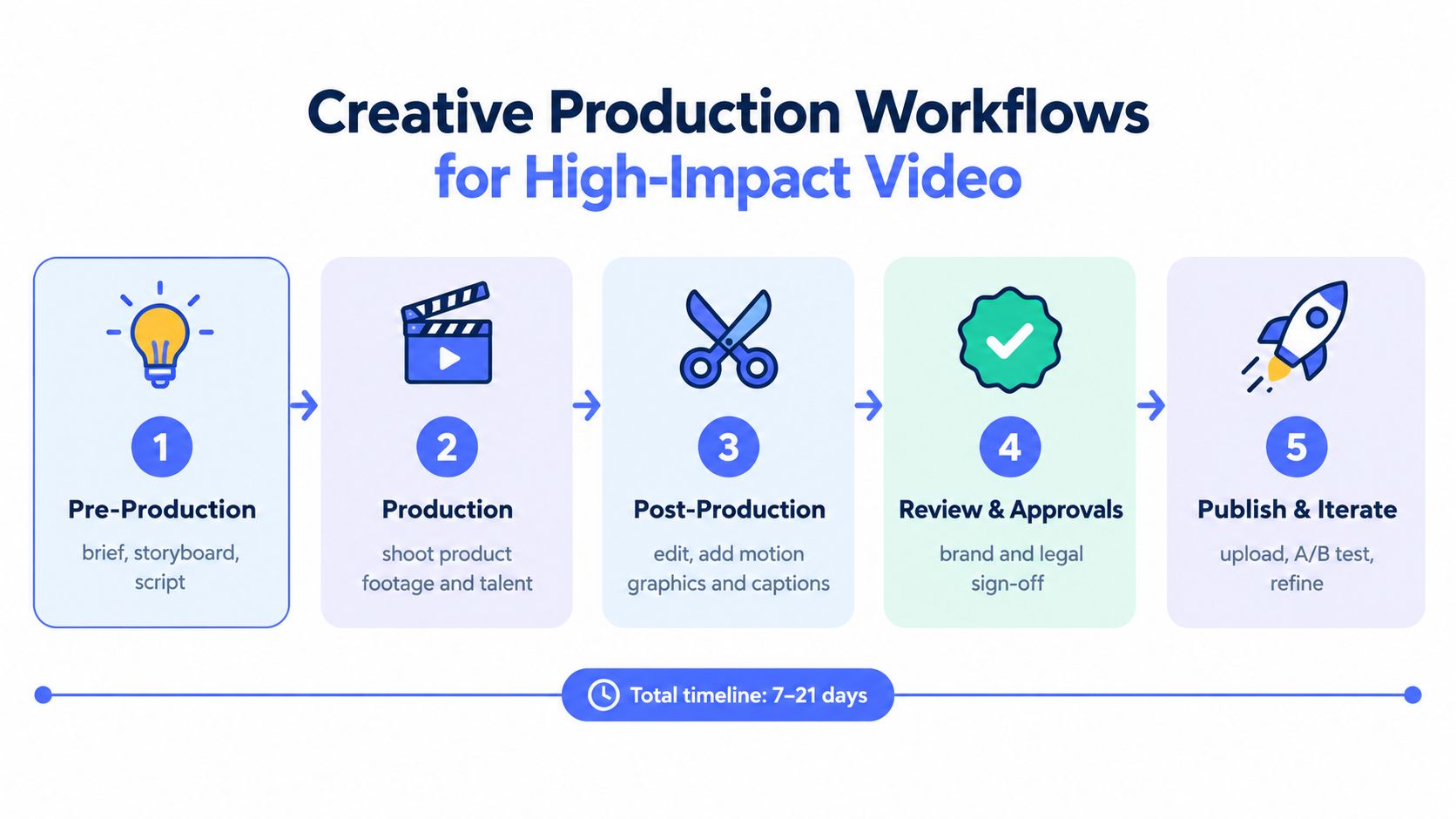
Write for the first useful moment
Open with the problem, outcome, or product action. A skincare video can begin with the application texture. A coffee machine can begin with the finished pour. A software product can begin with the workflow that saves the user effort.
For a short-form cut, write one clear idea rather than compressing an entire brochure into a minute. Use a simple structure:
Problem or desire: Name what the shopper wants to solve.
Demonstration: Show the product doing the work.
Proof: Add a visual detail, customer perspective, comparison, or use context.
Action: Tell the viewer where to learn, shop, compare, or claim the offer.
Shoot a modular asset library
Plan shots by later use, not only by the hero edit. Capture vertical and horizontal compositions where possible, clean product-only footage, hands-in-use sequences, reaction shots, packaging, details, and alternate openings. Record several versions of the first line and call to action so media buyers can test the message without commissioning a new shoot.
Sound also deserves a deliberate plan. Record clean dialogue, room tone, and product sounds, then create a captioned version that remains understandable with audio muted. Authentic creator footage can be effective, but obtain consent, usage rights, and clear disclosure. Teams managing creator content should review legal best practices for UGC before publishing.
Edit for clarity, not ornament
Remove pauses that don't add meaning, but don't cut away from the action before the viewer understands it. Use text overlays to reinforce the point, not to duplicate every spoken word. Check the first frame, thumbnail, captions, brand marks, product visibility, claims, music rights, and destination before approval.
A disciplined video asset management process keeps masters, cutdowns, captions, usage permissions, and approved claims connected. That prevents teams from publishing an attractive but expired version of a promotion or losing the source file needed for a new platform adaptation.
Measuring Performance and Optimizing ROI
A view is a delivery event, not a business result. Ecommerce teams need a measurement model that connects creative behavior to the next meaningful action, then separates the role of the video from the role of the offer, audience, landing page, and media placement.
Build a metric chain
Use metrics in layers:
Attention: Impressions, starts, and view rate show whether the opening earns a chance.
Engagement: Watch time and completion patterns reveal where the narrative loses relevance.
Intent: Clicks, product-page visits, add-to-cart actions, and retailer interactions show movement toward purchase.
Commercial outcome: Conversion rate, revenue contribution, and acquisition cost connect the asset to business performance.
Efficiency: Compare production and media investment with the value of the actions the campaign influenced.
The primary KPI should match the video's job. A prospecting brand film may be judged on qualified reach and subsequent site behavior. A PDP demonstration should be judged much more directly on product interaction and conversion. If every video is evaluated by the same metric, the team will favor easily counted activity over useful commercial work.
Test the friction, not just the color
A/B testing works when the variants represent meaningful hypotheses. Test a problem-led opening against an outcome-led opening. Test a creator demonstration against a polished studio version. Test a benefit-led call to action against a product-detail call to action.
Track the destination experience as well. A strong ad can appear weak if it lands on a slow, confusing, or mismatched page. Compare cohorts carefully, document the audience and placement, and give the test enough consistency to support a decision rather than reacting to isolated fluctuations.
For teams building a financial model, calculating video marketing ROI requires more than dividing attributed sales by media spend. Include production, editing, usage rights, distribution, assisted conversions, and the time period used for attribution.
YouTube deserves its own diagnostic layer because retention can reveal a creative problem before sales data becomes clear. A review of YouTube video analytics can help teams identify weak openings, audience drop-off, traffic sources, and the relationship between viewing behavior and downstream action.
Measurement principle: If the video doesn't answer a specific buying question, performance data won't tell you what to improve.
Real-World Examples of Ecommerce Video Success
A useful scenario is a fashion brand with strong traffic but persistent uncertainty around fit. Its first instinct might be to produce a cinematic campaign showing models in a striking location. That content can strengthen brand memory, but it won't necessarily answer the product-page question, “How will this garment move on me?”

A more useful program would assign each format a job. Short social edits could show movement and styling combinations. YouTube could host a fuller fit guide with sizing context. The product page could feature a concise demonstration with multiple body types, close details, and captions. Paid retargeting could return to the specific hesitation rather than replaying the original awareness film.
The strategic progression matters more than the production style. The brand begins with a friction audit, creates a core demonstration, captures modular footage, distributes platform-specific versions, and compares behavior on pages with and without the relevant video experience. The team then uses shopper questions and performance patterns to decide which categories deserve the next production investment.
Consider a consumer electronics brand selling a device that requires setup. A glossy product reveal may generate interest, but buyers closer to checkout need to see the unboxing, connection process, controls, and result. A creator-led setup can provide credibility, while a clean support tutorial can reduce uncertainty after purchase. Those assets can share footage, but their scripts and calls to action should remain distinct.
The same logic applies to beauty, home goods, supplements, and specialist equipment. Video succeeds when it makes the invisible visible. Texture, scale, fit, sequence, sound, and real-world use are difficult to communicate through static imagery alone.
The following video can be used as a reference point for how brands present a product or campaign story in a broader visual context.
Avoid turning these scenarios into promises of a universal lift. The benchmark cited earlier establishes that product-page video can be associated with materially stronger conversion, but each brand still needs to validate placement, message, audience, page speed, and category-specific friction.
Common Misconceptions About Video Marketing for Ecommerce
Video does not belong only at the top of the funnel. Brand films can build recognition, while demonstrations, reviews, tutorials, and testimonials address concerns closer to purchase and after delivery. Choose the format according to the shopper's question and the friction blocking action.
A large production budget is not a requirement for every ecommerce video. Controlled studio work makes sense when lighting, product detail, or a defined brand world carries the message. A creator-style demonstration may perform better when authenticity, routine, or real-world context provides stronger proof. The trade-off is control versus credibility, so match production choices to the claim the video must support.
More content isn't automatically better
More clips will not correct weak positioning. If every asset opens with the logo, repeats the same benefit, and directs viewers to a mismatched page, the brand creates volume without useful learning. A smaller group of differentiated variants can reveal more than a large library of near-duplicates.
Short-form video can still be persuasive. One clip can demonstrate a feature, answer an objection, or show a use case precisely. It becomes weak when editing removes the evidence shoppers need to believe the product will work for them.
Consumer preference favors concise formats, but not careless editing. Respect limited attention while keeping the proof required by the category. A skincare product may need application detail, a technical device may need setup steps, and a fit-sensitive product may need scale or movement. Format length should follow the friction, not an arbitrary template.
Views are not sales. A video can attract broad attention without reaching qualified shoppers or directing them to a relevant next step. A modestly viewed product demonstration may create greater commercial value when it answers hesitation on a product page, in a retargeting sequence, or near checkout. Measure the asset against the purchase-stage problem it was designed to solve.
Your Roadmap to Video Marketing Excellence
Start with an audit, not a shoot. Gather existing ads, organic posts, product-page videos, creator assets, retailer content, tutorials, and customer questions. For each asset, record its audience, funnel role, destination, format, rights status, and the action it was intended to influence.
Define the first commercial problem
Choose one product category or customer journey with a visible friction point. Examples include uncertainty about fit, setup complexity, ingredient comprehension, compatibility, durability, or the difference between product tiers. Write the problem as a question a shopper would ask, then select the video format that can answer it most directly.
A practical starting brief includes:
Audience: Who is watching, and what do they already understand?
Friction: What prevents confidence or action?
Proof: What must appear on screen to resolve that doubt?
Destination: Where should the viewer go next?
Measure: Which downstream action will determine usefulness?
Build the minimum viable system
Create one strong core demonstration before expanding into a large content library. From that production, capture enough material for a product-page edit, short-form versions, paid variations, still frames, captions, and support content. Store masters, permissions, transcripts, claims, thumbnails, and exports in a controlled library.
Then adapt by channel. Social needs immediate visual clarity and native framing. YouTube needs searchable usefulness and a compelling thumbnail. Product pages need clean playback and decision-stage proof. CTV needs a memorable brand message and a coordinated path to action.
Establish a learning cadence
Review performance on a regular schedule with creative, media, ecommerce, and analytics stakeholders in the same conversation. Ask four questions:
Did the opening earn attention?
Did viewers understand the product?
Did the destination continue the same promise?
Did the asset influence the intended commercial action?
When the answer is no, diagnose the failure before producing more content. A weak opening requires a new hook. Strong engagement with weak conversion may indicate a page or offer mismatch. Strong product-page engagement with weak checkout behavior may point to pricing, shipping, trust, or merchandising issues outside the video itself.
Scale what proves useful
Once the first program produces a reliable learning loop, expand by friction and category rather than by publishing volume. Prioritize products with high uncertainty, strong demand, and a clear visual demonstration. Reuse proven structures, but refresh the evidence and audience context.
Busylike offers integrated creative production, paid video advertising, and channel management and optimization across YouTube, CTV, and social, alongside product and demo video work for consumer brands. That type of partner can support teams that need one operating model connecting audience insight, production, media distribution, and reporting.
The mature goal isn't to make video everywhere. It's to make the right video appear where a shopper needs reassurance, then use measured results to improve the next decision.

If your ecommerce team needs product demos, paid creative, or a channel plan tied to conversion goals, Busylike can help connect strategy, production, distribution, and optimization. Visit the site to discuss which buyer friction your next video should resolve and how to turn one production into a practical multi-channel asset system.

