
Top Brooklyn Video Production Agency Picks for 2026

Updated: 4 days ago
The most recognized studio in Brooklyn isn't automatically the right answer. A strong video production agency Brooklyn search should start with the brief, not the logo, because the key question is whether a partner matches your creative style, production scale, post-production needs, and distribution model. New York's film and TV ecosystem is large and specialized, with 185,000 total jobs and $81.6 billion in total economic output in 2019, while the motion picture and video production sector alone accounted for 46,700 direct jobs and 47% of direct industry employment (NYC film and TV industry study). That scale explains why the city has everything from boutique directors to full-funnel video marketing teams, and why buyers should compare working models, not just reels.

Use this roundup by matching the closest creative and operational fit, then reviewing the most relevant reel or case study. Budgets aren't published in the supplied material, so request custom scopes and compare the same deliverables, audience, channels, timeline, and approval requirements across vendors. If you also need remote execution guidance for distributed teams, SaaS founders video production tips is a useful companion read.
Table of Contents
1. Busylike - Where Busylike is strongest - Watch-outs before you sign
2. Indigo Productions - Best use case for Indigo - What to ask in the pitch
3. m ss ng p eces - Where the fit is strongest - How to evaluate the reel
4. Hornet - What Hornet does well - Trade-offs to keep in mind
5. Dress Code - Why teams bring Dress Code into the pitch - What can limit the fit
6. Sibling Rivalry - The advantage of one creative chain - What to press them on
- Where they are the strongest
1. Busylike
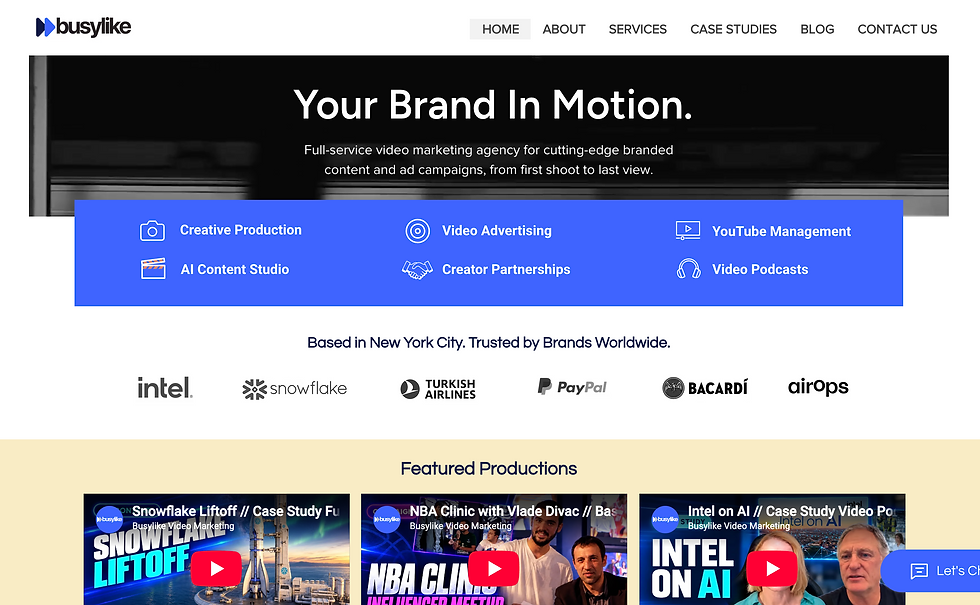
Busylike is the clearest fit for teams that need production and distribution under one roof. The agency is built for brands that don't just want footage, they want video that can live on YouTube, CTV, TikTok, Instagram, LinkedIn, and podcasts while still serving a performance goal. That matters in a market where YouTube has become a major CTV surface, with Nielsen-reported viewing reaching 13.5% of all U.S. TV usage in March 2026, and agency research finding 75% of brand and agency respondents already placing ads on YouTube in Q1 2026 (CTV and programmatic video advertising research).
Where Busylike is strongest
Busylike is the better choice when the challenge is video-first growth, not a one-off shoot. Its mix of creative production, paid video advertising, and channel management is useful for mid-market and enterprise teams that need one concept broken into platform-native versions, cutdowns, and testing variants. That approach lines up with current marketing benchmarks, where short-form video ranked as the top ROI-driving format for 49% of marketers, and 82% of video marketers reported good ROI in Wyzowl's 2026 survey (video marketing ROI benchmarks).
Practical rule: if you need a hero film, a YouTube cutdown, CTV-safe framing, and paid-social variants from the same shoot, ask how the team plans modular production before you ask about aesthetics.
The agency also offers flexibility that many production shops don't. It can be hired for production-only, media-buying-only, or end-to-end programs, which is a useful test if your internal team already owns part of the funnel. Pricing isn't public, so buyers should expect a custom proposal, and should ask to see the agency deck or a case study that matches their actual channel mix.
A good Busylike brief should spell out audience, objective, and distribution in one pass. Ask for deliverables by format, not just by concept, and push for examples showing how the team translated one shoot into multiple assets without losing message clarity.
Watch-outs before you sign
Busylike is strongest for brands that want measurable video systems, not a purely auteur-led production experience. If your only goal is a standalone brand film, a more film-centric shop may be a closer fit. Still, for marketers who care about recall, consideration, and conversion across multiple placements, its integrated model is a real advantage.
2. Indigo Productions
Indigo Productions fits briefs that need scale, reliability, and a broad crew network more than a narrow creative signature. Its public positioning spans concept, scripting, production, and post, so it can handle corporate shoots, commercials, social content, and virtual events. That breadth matters in Brooklyn, where the market can support many specialized vendors, but buyers still pay for capabilities they may not need. For a useful benchmark on the local market, review the New York State movie and video production industry overview, then compare it with the agency's own digital video production approach and see which model matches the brief.
Best use case for Indigo
Choose Indigo when you need a dependable vendor that can handle end-to-end production and post-production without forcing you to stitch together separate teams. That usually suits internal comms groups, B2B marketers, and companies with recurring needs such as executive interviews, product explainers, training content, or event coverage. The value is operational coverage, not a strong visual stamp.
For teams comparing it with a more strategy-led agency, the question is simple. Do you need someone to execute a defined brief, or do you also need help shaping distribution? Indigo is the safer answer when the brief is already clear and the job is to deliver cleanly.
A practical production lead matters more than a flashy reel when the scope is straightforward.
What to ask in the pitch
Ask for relevant work samples: Request case studies for the exact format you need, not a general montage.
Clarify post scope: Editing, motion graphics, 3D, VFX, color, and sound should be spelled out.
Check crew access: If your timeline is tight, ask how they staff shoots and how quickly they can scale.
Separate production from distribution: If you need media buying or optimization, confirm those services are not assumed.
Indigo is useful for organizations that want one accountable vendor. It is less compelling if you need a partner to interpret performance data, build platform variants, or manage channel growth after the cut is finished.
3. m ss ng p eces
m ss ng p eces is the kind of partner brands call when the brief is aimed at high-concept creative and the stakes are visibility, not just output. The Brooklyn-based studio has a director-driven reputation, and that matters if your team wants a campaign film with distinct point of view rather than a serviceable brand asset. Their public recognition, including Ad Age A-List and Webby Production Company of the Year, signals a craft-forward profile that's aligned with premium campaign work (m ss ng p eces).

Where the fit is strongest
This is a strong choice for brand films, launch campaigns, and experiential work where the director matters as much as the concept. If the assignment is to create attention, earn internal pride, or support a flagship launch, a production-first shop with strong creative pedigree can be the right call. If the assignment is to create a repeatable system of assets for paid distribution, the fit gets narrower.
The trade-off is obvious. Premium creative usually comes with premium expectations on budget discipline, approvals, and lead times. That's not a criticism, it's the cost of high craft and focused direction.
How to evaluate the reel
A reel is useful only if it shows more than polish. Look for evidence that the studio can adapt its style to different brand worlds without losing control of tone. Ask which directors are available for your project, because the roster is part of the value, and not every director is the right match for every brief.
If your team needs multiple cutdowns, platform-specific edits, and paid-media testing, ask how the project will be versioned after the hero spot is approved. The answer will tell you whether the studio is built for campaign production or just marquee storytelling.
4. Hornet
Hornet is the better conversation for briefs that need animation, motion design, and mixed-media craft. Its strength is visual identity as much as camera work, so it fits brands that want a design-led story or a piece that can sit naturally in commercials and branded content. For teams comparing live-action shops with studios that can build a more stylized language, Hornet is a useful reference point.
What Hornet does well
Hornet's bench in 2D, 3D, stop-motion, and hybrid animation/live action helps when the message needs abstraction, structure, or a graphic world that is easy to recognize. For SaaS, consumer, and brand teams, that can solve a familiar problem, making a product or idea memorable without falling into a generic explainer. It also helps on campaigns that need a consistent motion system across multiple touchpoints.
The fit is strongest when the story benefits from crafted visuals. A polished reel matters less than whether the studio can turn the brief into a visual system that supports the message. If the work will also need distribution planning, teams should pair production thinking with video SEO guidance and separate that from the studio's creative role.
Practical rule: if the product is simple but the brand needs a stronger visual identity, motion design can do more work than a larger live-action shoot.
Trade-offs to keep in mind
Hornet's profile is animation-heavy, so it may be less suited to documentary-style corporate pieces or straightforward testimonial work. Media buying and channel growth are not emphasized publicly, so buyers should treat Hornet as a production specialist, not a distribution partner. That works if the internal team already has media support. It becomes a gap if the video has to perform across YouTube, CTV, and social without extra vendors.
For briefing, bring references that show pacing, graphic density, and tone. If the team wants a clean, live-action-first corporate film, this is probably not the first call. If the goal is a distinctive visual system, Hornet deserves serious attention.
5. Dress Code
Dress Code is a strong option for brands that want design, animation, and live action to feel like one integrated system. The Lower East Side studio is useful for product stories, branded content, and projects where visual expression is part of the message, not decoration. Its appeal is in the blend, not the single discipline.
Why teams bring Dress Code into the pitch
A lot of video production agencies can shoot footage. Fewer can make the design language and the production language feel like they were built together. Dress Code's hybrid model is especially useful for product launches, explainers, and culture-forward brand pieces where motion graphics need to support the narrative instead of sitting on top of it.
That makes the briefing process important. If you want the studio to nail the result, you need to show them the actual content problem, not just the aesthetic references. Give them the product, the audience, and the exact decision you want the viewer to make.
What can limit the fit
Dress Code's boutique scale is part of the appeal, but it can become a constraint if you need very large simultaneous series production. It's a better fit for carefully made projects than for volume-heavy monthly output. The studio also isn't positioned publicly as a performance-media or channel-operations partner, so buyers should not assume post-launch support is included.
For teams comparing vendors, Dress Code sits in a useful middle ground. It's more creatively integrated than a pure production house, but less channel-centric than a video marketing agency. That makes it especially useful when the deliverable is a visually strong asset and the distribution plan already exists.
6. Sibling Rivalry
Sibling Rivalry is worth a close look when a brand wants concept development and production execution handled together. The New York office and the combination of creative studio plus director roster make it a good fit for campaigns that need continuity from strategy and design into the finished film. That continuity can save time and reduce the handoff friction that often shows up when separate shops own concept and production.
The advantage of one creative chain
When one team shapes the idea and then produces it, the final piece usually feels more coherent. That's the core advantage here. Sibling Rivalry is strongest for filmic brand storytelling, identity-led campaigns, and experiential work where the production is part of a larger brand system.
That structure is especially helpful for marketing teams that want fewer vendors in the room. You get a cleaner path from concept to execution, which can be valuable when approvals are already slow internally.
What to press them on
The main trade-off is that a brand and creative-heavy shop may prioritize craft over rapid iteration. If your campaign depends on frequent versioning, testing, or performance optimization, ask how they handle post-production rounds and asset adaptation. Also ask which director will lead the work, because availability can change quickly during busy periods.
For teams bringing a broad campaign brief, the comparison becomes practical here. If the job is to create a unified brand story, Sibling Rivalry is compelling. If the job is to support a channel engine with constant output, a more performance-oriented partner may be the better fit.
7. Fame Crew
Fame Crew fits briefs where the creative is already decided, and the need is fast, vetted execution. Rather than bundling concept, strategy, and production into one retainer, Fame Crew connects B2B brands directly with a vetted network of NYC directors, cinematographers, sound engineers, and editors on a day-rate basis, cutting out the overhead of a full-scale agency engagement.

Where Fame Crew is strongest
This is the practical choice for marketing teams that already have a clear brief and just need a dependable crew, fast. It's built for corporate interviews, event coverage, client testimonials, and social content, formats where speed and reliability matter more than a singular creative point of view. The on-demand booking model means a professional crew can typically be secured in days, not weeks, with transparent, predictable day-rate pricing instead of a bundled agency fee.
Practical rule: if you already know what you want to make and just need hands on the ground in NYC, brief Fame Crew directly with shoot dates, location, and required roles. You'll get a fixed quote back fast.
Watch-outs before you sign
Fame Crew is an execution partner, not a creative or strategy shop. If you need concept development, campaign direction, or channel/distribution planning, pair it with a strategist or expect to own that part in-house. It's the right call when the brief is set, and the job is to get it shot well and delivered fast.
Top 7 NYC Video Production Agencies Comparison
Agency | 🔄 Implementation complexity | ⚡ Resource requirements | 📊 Expected outcomes | Ideal use cases | ⭐ Key advantages / 💡 Tips |
|---|---|---|---|---|---|
Busylike | Medium–High, integrated creative + media ops | High, production, paid media budgets, channel management | Measurable lift in recall, consideration, and conversions | Performance-led brand growth, YouTube/CTV/social campaigns | ⭐⭐⭐⭐, End‑to‑end video strategy + media execution. 💡 Request case studies and references. |
Indigo Productions | Medium, clear end‑to‑end production process | High, full crew, post, VFX capabilities | Broadcast‑quality commercial and corporate pieces | Corporate video, commercials, virtual events, scalable productions | ⭐⭐⭐⭐, Deep production expertise (30+ years). 💡 Specify director for a distinct auteur look. |
m ss ng p eces | Medium, director‑driven creative process | High, premium directors, longer lead times | Award‑level creative work and high‑visibility campaigns | Brand films, national/global campaigns, experiential | ⭐⭐⭐⭐, Strong creative pedigree and industry awards. 💡 Budget for premium creative and timing. |
Hornet | Medium, animation/mixed‑media workflows | Medium–High, specialized animation and motion teams | Distinctive visual identities and design‑forward spots | Animated commercials, motion design pieces, hybrid work | ⭐⭐⭐⭐, Best for design‑led storytelling. 💡 Plan for longer production cycles for animation. |
Dress Code | Low–Medium, boutique, studio‑like engagement | Moderate, agile NYC team with hybrid skills | Visually expressive branded content and product stories | Product films, design‑focused branded content, social pieces | ⭐⭐⭐, Integrated design + production under one roof. 💡 Good for mid‑scale creative briefs. |
Sibling Rivalry | Medium, combined studio + production handoff | Moderate, creative studio resources + director roster | Cohesive campaigns from concept through execution | Concept‑driven brand campaigns, identity and experiential work | ⭐⭐⭐, Seamless strategy → production workflow. 💡 Expect creative‑first prioritization over media optimization. |
Fame Crew | Low, on-demand crew booking with a set brief | Low to Moderate, day-rate crew, no agency retainer | Fast, reliable delivery of predefined video assets | Corporate interviews, event coverage, testimonials, social content | ⭐⭐⭐⭐, Fast turnaround and transparent day-rate pricing. 💡 Come with a clear brief; this is an execution partner, not a creative studio. |
Turn the Shortlist Into a Comparable Production Brief
The fastest way to compare a video production agency Brooklyn shortlist is to give every vendor the same brief and force the differences into the open. Ask each agency to respond to the same set of requirements, objective, audience, core message, deliverables, aspect ratios, platforms, locations, talent, animation or live-action needs, usage, post-production rounds, timeline, and budget range. That removes the fluff and shows who is solving your problem.
Request a relevant reel or case study, not a general portfolio. A polished montage can hide a poor fit, while a project that matches your channel mix or category will tell you far more about process, speed, and judgment. Also clarify whether media buying and channel optimization are included, because production and distribution are not the same service, and the contract should say so clearly.
Busylike is useful here because it can be evaluated in three different ways. You can compare production-only support, media-buying-only support, or a full end-to-end program, then ask for the agency deck or a free consultation to see how the team would structure your specific mix of creative and paid distribution. That gives you a better read on scope than a generic intro call.
The best choice isn't the most famous name. It's the partner whose reel matches your goal, whose working model matches your team, and whose deliverables can be measured after launch. In this market, fit and scope clarity beat prestige every time.
If you need a Brooklyn team that can plan, produce, and manage video across YouTube, CTV, and social, Busylike is built for that exact brief. Visit Busylike to review the agency deck, compare production-only and full-funnel support, and see whether its video-first model fits your next campaign.

