
Voice Overs for Videos: A Practical Guide

You're probably in one of two situations right now. Either the edit is nearly done and someone just said, “We still need a voice-over,” or you're planning a new video and trying to decide whether the narration should come from a professional actor, a founder, an internal expert, or an AI voice.
That decision changes more than the soundtrack. It changes how the brand feels, how clearly the message lands, how much revision pain the team takes on later, and whether the final asset can safely scale across paid, organic, and localized use. In practice, voice overs for videos work best when they're treated like a brand system, not a post-production patch.

Table of Contents
Why the Voice-Over Matters More Than You Think - What the voice is actually carrying - Why this deserves attention early
Types of Voice-Overs Used in Branded Video - Human voices and where they win - AI and hybrid workflows - A simple way to choose
Casting and Directing the Right Voice - Build the brief before you open demo reels - Where to source and how to audition - How to direct without flattening the read
Recording, Editing, and Timing the Audio - Set the room before you touch the script - Record in passes, not in panic - Sync is not a small technical detail
Licensing, Rights, and AI Consent - The four rights variables that drive real risk - What teams miss with AI voice agreements
Putting It Together for Your Next Video - A Monday-morning decision framework - The checklist teams actually need
Why the Voice-Over Matters More Than You Think
Two cuts of the same video can perform very differently even when the visuals never change. Swap the voice from flat and generic to confident and well-paced, and viewers often read the whole piece differently. They don't just hear a new narrator. They infer a different level of competence, warmth, and trust.
That isn't just producer folklore. A controlled study on video voice-over treatments found statistically significant differences in how audiences rated trustworthiness across voice conditions, with F(3, 194) = 6.71 and p = 0.00025 according to this voiceover trust study summary. For marketing teams, that matters because the voice track can change how the same message is judged.
What the voice is actually carrying
In branded video, the voice-over isn't only reading lines. It carries three jobs at once:
Brand voice: Is this company calm, premium, approachable, technical, playful, or direct?
Message hierarchy: Which line gets emphasis, where the pause lands, and what the audience remembers first.
Emotional pacing: Whether the video feels rushed, steady, reassuring, urgent, or credible.
A lot of teams confuse voice-over with on-camera delivery. They're related, but they do different work. On-camera narration asks the audience to evaluate both a face and a performance. Voice-over removes visual distraction and puts more pressure on cadence, phrasing, and tone. That's why weak VO can make polished visuals feel cheaper than they are.
Practical rule: If the audience needs to understand, trust, or act, the voice is doing sales work whether the script sounds “salesy” or not.
Why this deserves attention early
The market itself reflects how established this discipline has become. The global dubbing and voice-over market was valued at $4.2 billion in 2024 and is projected to reach $8.6 billion by 2034, while human-based voice-over and dubbing accounted for over 58.2% of industry share in 2024 according to voice-over industry market data. That tells you two useful things. Demand is growing, and human narration still holds the larger share.
For marketers planning social, YouTube, or CTV, that means the choice isn't “old way versus new way.” It's a practical production decision with trade-offs. Short-form teams testing a voice over for TikTok may prioritize speed and volume, while a product launch film may need a human performance that can hold nuance for longer than a quick social cut.
The expensive mistake is leaving this choice until picture lock. By then, every script problem sounds like a recording problem.
Types of Voice-Overs Used in Branded Video
Most branded video projects don't need “a voice-over.” They need a specific kind of voice-over matched to the stakes of the asset. The shortlist usually comes down to four human options and two synthetic ones.
Human voices and where they win
Professional broadcast talent is what you use when the script has to sound finished on the first pass. These voices usually come with strong mic discipline, pace control, clean pickups, and the ability to adjust tone without sounding coached.
Working voice actors are often the most flexible middle ground. They may not have the polished broadcast sheen of top commercial talent, but they can usually take direction well and handle explainer, product, training, and campaign work reliably.
Subject-matter experts inside the company can work when authority matters more than polish. A physician for healthcare content, a product lead for SaaS, or an engineer for technical demos can outperform a generic actor if the audience values domain fluency.
Founder or executive voices can be powerful, but only in the right context. They work best when the message benefits from ownership, conviction, or personal accountability. They struggle when the leader is monotone, over-scripted, or too busy for retakes.
AI and hybrid workflows
AI voice tools have improved enough that many teams now use them for drafts, localization, training videos, product updates, and versioning. Long gone are the days when every synthetic read sounded robotic. Still, even good AI often reveals itself in stress points: long-form pacing, emotional turns, sarcasm, subtle reassurance, and pronunciation of brand-specific language.
A useful middle ground is the hybrid workflow. Teams draft with AI, test timing against picture, and then decide whether to keep it, refine it, or replace it with a human read. Some teams also use AI for multilingual variants, then put a human director or native reviewer on top of the output before release. That matters because recent coverage points to rising demand for localized voice work and more production-ready multilingual AI options, while leaving a real gap in guidance around when native talent, AI, or a hybrid approach is safest for the brand, as discussed in this analysis of voice-over trends for 2026.
Voice-Over Type | Typical Cost per Finished Minute | Best Fit For | Key Trade-Off |
|---|---|---|---|
Professional broadcast talent | Higher than most other options | Brand films, paid campaigns, hero explainers | Strong performance, but less economical for constant small revisions |
Working voice actor | Moderate and flexible | Explainers, product videos, promos | Good balance of quality and cost, but quality varies by talent |
Internal subject-matter expert | Lower direct spend, higher internal time | Technical demos, trust-led education | Credibility is high, delivery may be uneven |
Founder or executive | Lower external spend, high scheduling cost | Mission videos, founder-led brands | Authentic, but often hard to direct and revise |
AI-generated voice | Low marginal cost after setup | Volume content, drafts, localization, internal videos | Fast and scalable, but can sound thin on emotion |
Hybrid AI plus human review | Middle ground | High-volume branded content with oversight | Efficient, but workflow discipline matters |
A simple way to choose
If the video is a hero asset, human usually wins.
If the video is high-volume, low-risk, and frequently updated, AI often wins.
If the video needs scale with brand control, hybrid tends to win.
That's the practical frame. Don't ask which format is best in the abstract. Ask which one survives real-world revisions without damaging trust.
Casting and Directing the Right Voice
Casting goes wrong when teams shop for a “nice voice” instead of a usable performance. A pleasant demo reel means very little if the talent can't hit your message under direction.
Start with the brief before you listen to a single audition.
Build the brief before you open demo reels
A useful casting brief answers five questions:
Who's listening? A procurement team, first-time consumers, clinicians, developers, or channel partners.
What's the one sentence that must land? Not the whole script. The one line the audience has to remember.
What tone does the brand need here? Warm, clinical, assured, conversational, playful, neutral.
What language or accent constraints exist? Regional English, neutral U.S., U.K., bilingual delivery, native local adaptation.
Where will the asset run? Paid social, website, trade show, internal enablement, YouTube pre-roll, CTV.
That brief prevents a common mistake: teams falling in love with a voice that sounds good in isolation but wrong for the buying context.
Where to source and how to audition
Voices.com and Backstage are common starting points for non-union sourcing. Union rosters, including SAG-AFTRA talent pathways, make more sense when campaign scale, rights complexity, or broadcast usage raises the stakes. For founder-led brands, internal voices are worth testing too, but test them the same way you'd test external talent.
Use the same short script for every audition. Two paragraphs is enough. One should be informational. The other should require a tonal shift. That exposes whether the voice can move from clarity to persuasion without sounding like two different people.
A few audition rules save time:
Ask for untreated or lightly treated reads: Over-processed auditions can hide bad recording habits.
Give one directional note on callback: “Less announcer, more peer-to-peer” tells you whether they can adjust.
Listen for pickup consistency: Can they match energy and pacing line to line?
The best audition isn't the one that sounds perfect. It's the one that improves when you direct it.
How to direct without flattening the read
Bad direction tends to be abstract. “Make it pop” or “sound more premium” forces the actor to guess. Good direction is specific.
Try notes like these instead:
Pacing note: “Slow the first sentence and let the second sentence carry momentum.”
Emphasis note: “Hit the product benefit, not the feature name.”
Emotion note: “This section should reassure, not excite.”
Audience note: “Read it like you're explaining it to a smart customer who's skeptical, not confused.”
Live sessions usually produce better work than endless async revisions. Talent can test alternate reads in the room, and the brand team hears the difference immediately. If schedules force self-records, ask for one clean primary read plus two alternates for the lines most likely to change.
Before recording day, lock three things in writing: approved script version, usage scope, and pickup window. If any of those are vague, the “cheap” session won't stay cheap.
Recording, Editing, and Timing the Audio
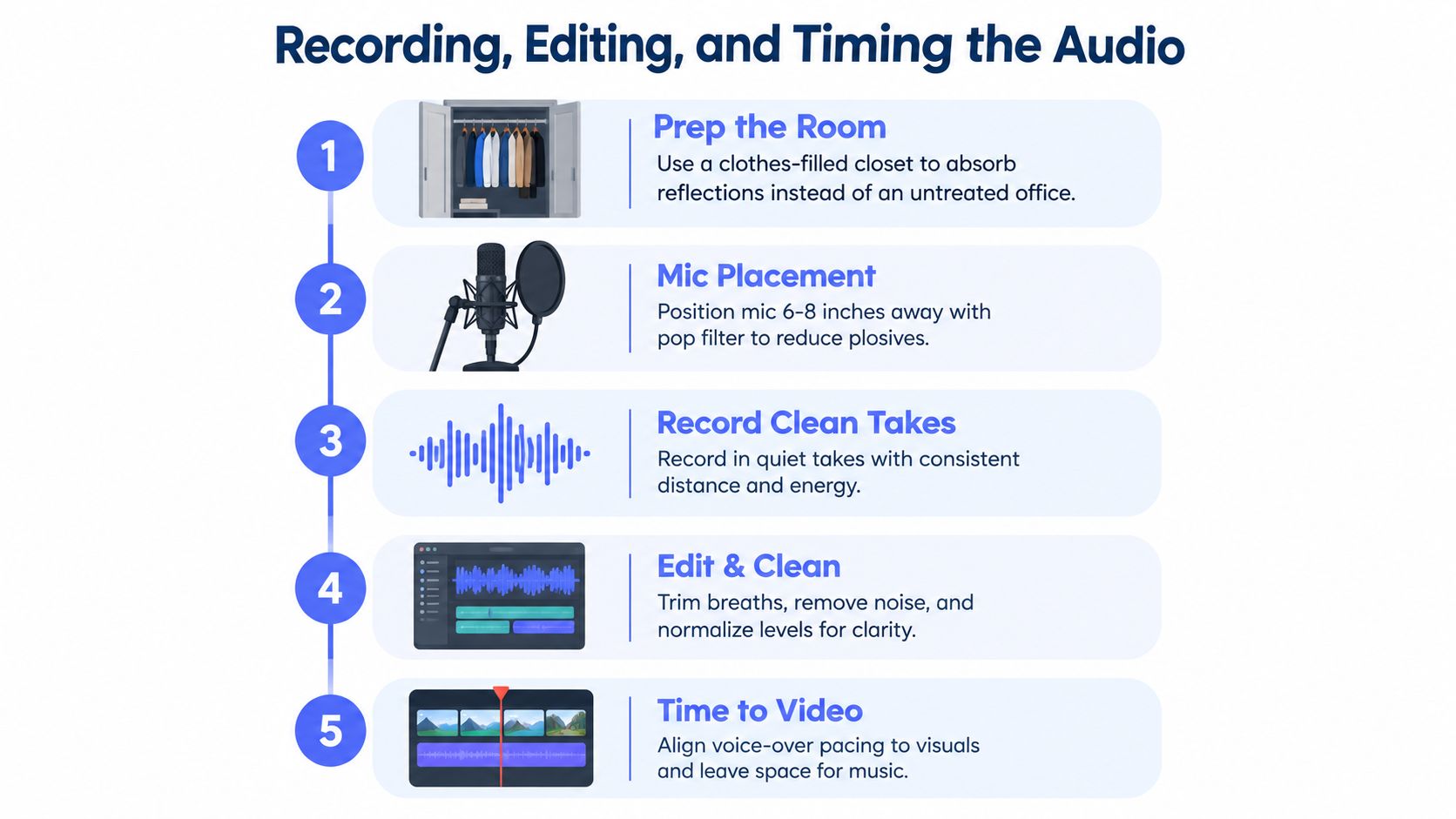
The room matters more than the microphone most of the time. A modest mic in a dead, controlled space will beat an expensive mic in a reflective office.
That's why a clothes-filled closet often outperforms a stylish conference room. Soft materials kill the slap and flutter that make spoken audio sound amateur the moment music drops out.
Set the room before you touch the script
The fastest way to waste a session is to troubleshoot acoustics after the talent is already reading. Do a short ambient capture first. Listen for HVAC rumble, computer fans, hallway bleed, traffic wash, and mouth noise exaggerated by a bright mic chain.
For a clean basic setup:
Use a controlled space: Closet, treated booth, or a soft room with minimal reflective surfaces.
Keep mic distance consistent: Around a hand span from the mic works for many voices, with a pop filter in front.
Run a room tone check: Capture a short silent bed before every session for cleanup and patching.
Monitor with headphones: The engineer should hear plosives, clicks, and clipping immediately.
If your team is experimenting with synthetic performance for interactive formats, tools used in on-demand character voice calls are a useful reminder that believable speech depends on timing discipline as much as voice quality. The same principle applies in branded video. Even a good voice falls apart when timing drifts against picture or the edit sounds stitched together.
Record in passes, not in panic
Professional sessions usually work better in three passes. First, get a full uninterrupted read. Second, capture pickups for obvious misses. Third, record alternates on critical lines so the editor has options.
For script prep, there's a simple runtime rule that still holds up in practice: about 200 words equals roughly 1 minute of finished audio, and scripts should be trimmed to target runtime before recording, with phonetic spellings added for hard terms and test reads done in a quiet space, as outlined in these voice-over best practices.
A few editing habits make a big difference:
Trim for sense, not silence: Don't remove every breath. Remove distracting breaths.
Fix clicks early: iZotope RX is common for this, though Audacity can handle basic cleanup.
Replace bad lines completely: Don't force a damaged phrase to work if the pickup sounds cleaner.
Leave handle room: Small head and tail margins on exported clips help picture editors place lines cleanly.
The broader production workflow matters too. Teams that handle narration inside a more integrated audio and video productions workflow usually avoid the handoff issues that happen when script, edit, and audio timing live in separate silos.
A lot of timing problems don't come from performance. They come from scripts written with no awareness of the cut.
Sync is not a small technical detail
When narration interacts with visible speech, presenter footage, or accessibility-sensitive content, timing tolerance matters. ETSI guidance on speech intelligibility in videotelephony reports that video can significantly improve speech understanding for hearing-impaired users when synchrony and frame rate are controlled, recommending at least 15 frames per second and preferred intelligibility with audio leading or lagging video by no more than 0 to +100 ms, according to ETSI speech intelligibility guidance.
The clip below gives a useful visual reference for how producers think about voice-over flow against edited picture.
If the line has to land on a product reveal, mark that in the script. If legal copy needs space, budget it. If the cut is fast, shorten the sentence. Don't ask the reader to sprint through clumsy copy just because the edit was locked too early.
Licensing, Rights, and AI Consent
A strong read can still become a bad asset if the rights aren't clear. Marketing teams usually focus on getting the line right. Legal and production need to focus on where that line can travel, for how long, and under what permissions.
For human talent, rights discussions usually sit on top of the recording session. For AI, rights begin even earlier, because the system may be generating, cloning, transforming, or localizing a voice that carries identity and consent issues from the start.
The four rights variables that drive real risk
For human voice work, most usage terms come down to four variables:
Media: Website, paid social, broadcast, in-app, events, internal, CTV.
Territory: One country, a region, or global use.
Term: Limited campaign run or broader ongoing use.
Exclusivity: Whether the voice can work for competing brands.
Those points matter more than teams expect. A social ad run, a corporate explainer, and a broad campaign package can all use the same read but require very different rights treatment. That's why session fee and usage fee should never be treated as the same thing.
Scenario | Human Voice Rights | AI Voice Rights |
|---|---|---|
Internal training video | Usually limited internal-use license is sufficient | Confirm platform terms, clone permissions, and whether vendor may retain generated output |
Website explainer | Define public web usage, territory, and term | Confirm commercial usage rights and whether synthetic voice is licensed for brand-facing use |
Paid social campaign | Spell out paid media usage, term, and exclusivity if needed | Confirm ad-use permission, disclosure requirements, and retraining restrictions |
Multilingual localization rollout | Define derivative dubbing and territory expansion | Confirm localization rights, native review process, and clone scope across languages |
Global long-term brand system | Negotiate broad usage and renewal terms carefully | Require explicit consent, model governance, sublicensing limits, and termination rules |
What teams miss with AI voice agreements
Industry commentary for 2026 increasingly points to consent becoming the standard for AI voice use, while separate reporting says the AI-generated voiceover narration market is forecast to grow from about $1.89B in 2025 to $5.08B in 2030, as discussed in this roundup of voiceover trends and AI consent issues. The practical takeaway isn't “AI is coming.” It's that governance can't be improvised anymore.
The clauses marketers most often miss are the ones that affect downstream use:
Sublicensing: Can agencies, distributors, or regional partners reuse the voice asset?
Derivative dubbing: Can the source read be transformed into other languages or styles?
Model training consent: Can the generated session be used to improve the vendor's system?
Voice clone scope: Is the brand licensing a voice, a model, a preset, or a one-time output?
Revocation and takedown: What happens if a permission is withdrawn?
For creative teams working with talent, broader IP guidelines for artists can be a useful reference point because they frame the basic ownership and permission questions many marketers skip under deadline pressure.
If the video includes social proof, testimonials, or customer narration, rights discipline matters even more because the voice and the identity are tied together in a way generic commercial reads aren't. That's one reason testimonial-heavy teams often need tighter approvals than they expect in a customer testimonial video program.
If consent, usage, and derivative rights aren't documented before launch, the asset isn't fully produced. It's only temporarily usable.
Putting It Together for Your Next Video
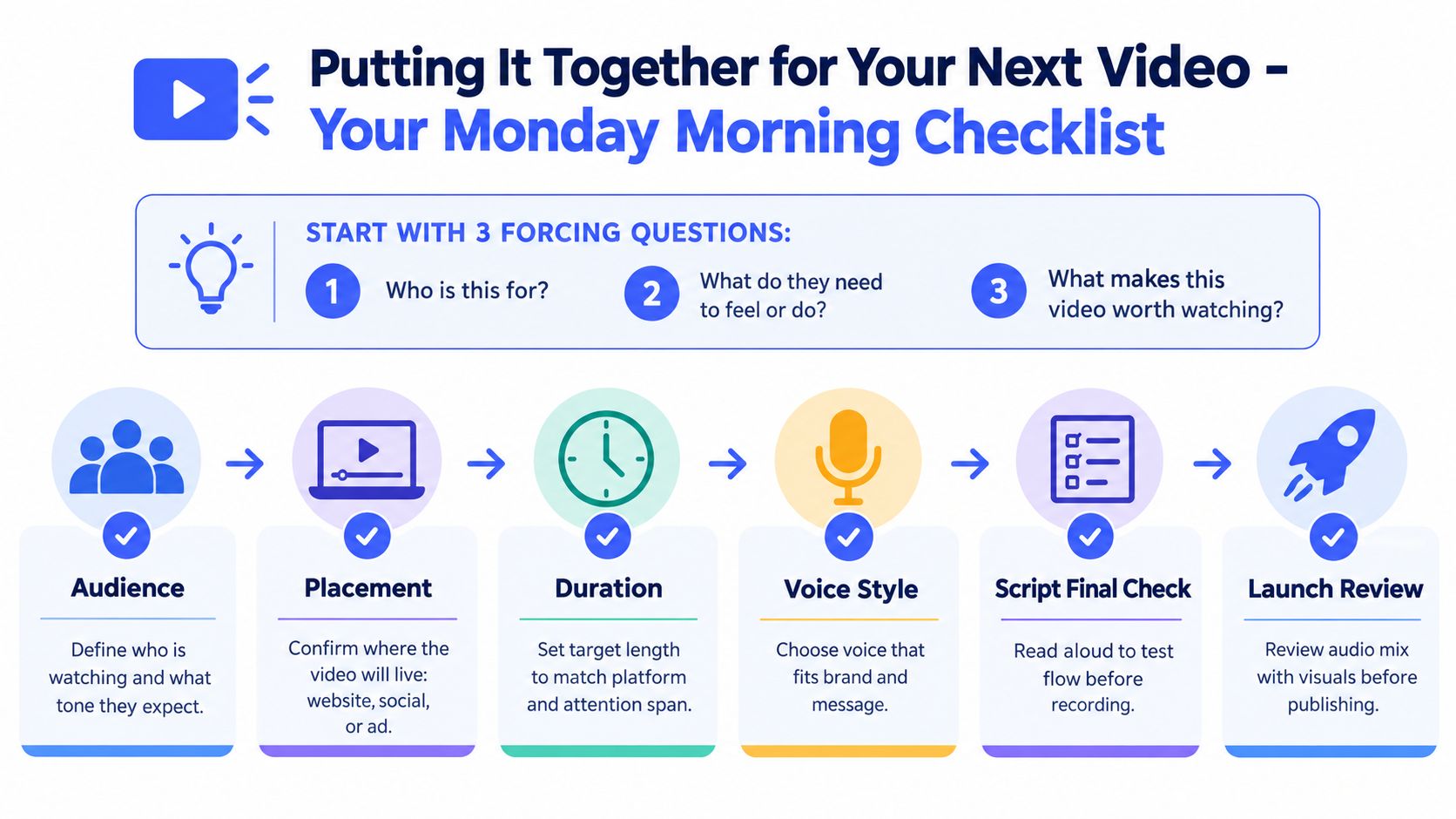
The cleanest production decisions usually come from three early questions. Who is the audience? Where will the video live? How long does it need to run? Those three answers narrow almost everything else.
A skeptical B2B buyer on LinkedIn, a consumer on TikTok, and a viewer on a product page won't tolerate the same pacing, detail level, or performance style. The wrong voice often isn't “bad.” It's mismatched to context.
A Monday-morning decision framework
Use this sequence before the brief is locked:
Audience first: If the audience needs reassurance, lean toward a human read or a tightly supervised hybrid. If they need fast updates at scale, AI may be enough.
Placement second: Paid ads and flagship brand videos deserve more scrutiny on performance and rights than low-risk internal or temporary assets.
Duration third: The longer the script runs, the more performance flaws show. Short spots can hide imperfections. Longer explainers can't.
Then match those answers to your production path.
A practical mapping looks like this:
High-stakes brand launch or category story - Human talent - Live-directed session - Full usage review before record
Explainer or product video with moderate shelf life - Human or hybrid - Tight script timing against rough cut - Pickup window built into schedule
Frequent updates, localization, or internal enablement - AI or hybrid - Native-language review where needed - Clear consent and commercial terms from the vendor
The checklist teams actually need
This is the short list worth carrying into production meetings:
Script readiness: Read it aloud before approval. If a sentence feels awkward in the room, it will sound worse on mic.
Voice shortlist: Don't review dozens of auditions. Compare a focused set against the same script sample.
Room and gear plan: Quiet room, pop filter, monitoring, and a real test recording.
Edit plan: Decide who owns cleanup, pickups, naming, and final exports.
Rights paperwork: Human license terms or AI consent terms must be settled before publishing.
Final QC: Review the mix against picture on desktop, phone, and speakers that aren't studio monitors.
For teams that don't want to manage all of those handoffs across strategy, production, and distribution, a full-service video production agency can centralize the process so voice decisions stay connected to the campaign plan instead of being treated as isolated post work.
Working heuristic: Prototype the voice before you lock the script. And don't let voice-over become the final task on the schedule.
That last point saves money more often than any plugin or platform choice. Re-records rarely happen because the mic was wrong. They happen because the team discovered too late that the script, cut, or usage plan never matched the voice they chose.

Busylike plans, produces, and distributes branded video for teams that need the voice, the edit, and the channel strategy to work together. If you're building explainers, ads, or localized video campaigns and want the voice-over handled as part of a real production system, visit Busylike.


