
Google Ads for YouTube Promotion: Complete Guide

Updated: 47 minutes ago
Your YouTube campaign is live, the view count is climbing, and the dashboard looks healthy. Then the CMO asks the question that matters: did those viewers create new demand, or did the campaign only find people who were already searching for the brand? A second question usually follows just as quickly: should the next budget go into Shorts, skippable in-stream, or a television-friendly asset?
Google Ads for YouTube promotion is easy to launch. Building a system that connects creative, audience strategy, placements, and incrementality is much harder. The difference matters because views can look impressive while failing to improve consideration, qualified traffic, sales, or long-term audience value.

Table of Contents
Why YouTube Has Become a Core Advertising Channel - Scale changes the role of video
Setting Up Google Ads Campaigns for YouTube Promotion - Build the campaign around the business outcome - Don't confuse optimization with proof
Choosing the Right Creative Format for Your Goals - Match the asset to the viewing context - Build a creative system, not isolated cuts
Measuring Impact Beyond View Counts - Use four layers of evidence
Building an Integrated Video Strategy Across Channels - Connect insight, production, and distribution
Common Mistakes That Undermine YouTube Campaigns - The metrics that create false confidence - Audit the campaign before increasing spend
Your Action Plan for Sustained YouTube Growth - A practical operating checklist - Decide what to keep, change, or stop
Why YouTube Has Become a Core Advertising Channel
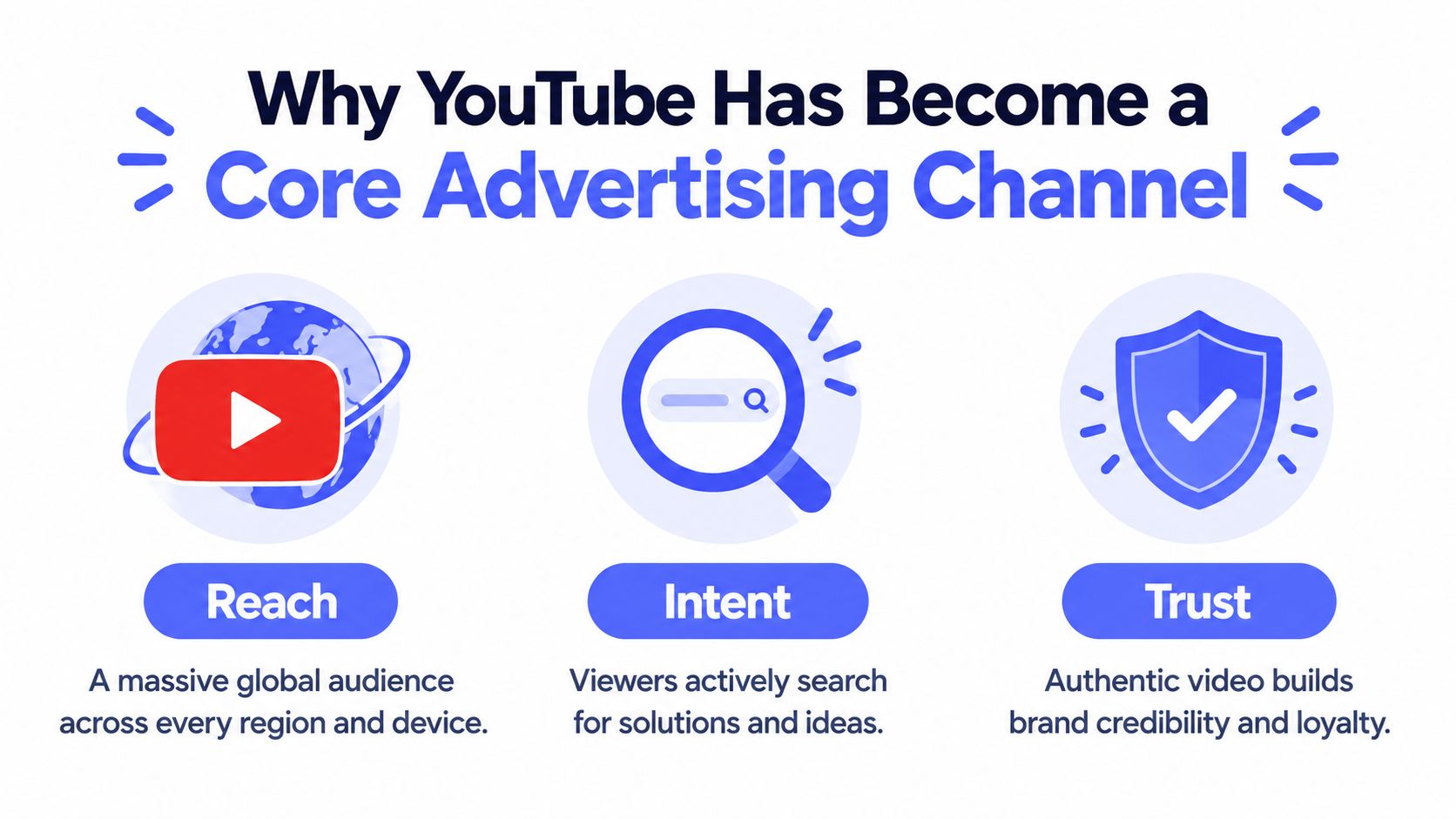
YouTube has moved well beyond its origins as a video-sharing website. Google's planning data shows that YouTube ads reached 2.53 billion users globally in January 2025, equivalent to 30.9% of the world's population and 45.5% of internet users at the time, according to DataReportal's YouTube statistics. That reach gives one well-structured campaign access to audiences across major markets rather than limiting a brand to a narrow video audience.
Scale alone doesn't make a channel effective, but it changes the strategic conversation. YouTube can support broad awareness, product education, consideration, retargeting, and conversion activity within the same media ecosystem. It also combines video storytelling with Google's audience, bidding, and measurement infrastructure.
Scale changes the role of video
YouTube's advertising business shows how far the platform has matured. Industry summaries citing Alphabet earnings place YouTube's 2025 advertising revenue between $36.1 billion and $40.4 billion, compared with $31.5 billion in 2024 in one cited account, as summarized by Digital Applied's platform data coverage. The differing estimates reflect reporting differences, but both point to the same business reality: YouTube is a major paid media environment, not an experimental add-on.
That maturity gives advertisers more than distribution. Google Ads offers campaign objectives, audience signals, view reporting, conversion optimization, and buying controls that support both brand and performance work. The platform can still deliver cheap reach, but experienced teams don't stop at cheap reach.
Practical rule: Treat YouTube views as a delivery signal, not a business result.
A strong campaign assigns every placement a job. A broad in-stream campaign might introduce a category problem. A creator-led asset might make the product credible. A follow-up message might move an engaged viewer toward a product page or sales conversation. YouTube promotion works best when these roles connect rather than compete.
Setting Up Google Ads Campaigns for YouTube Promotion
Start by deciding whether you need a quick video boost or a controlled media program. YouTube's native promotion flow is designed to help a specific video attract engagement. Google's own setup says it selects people “most likely to engage” with the channel and recommends a 10-day duration, while the workflow uses one linked Google Ads account and relatively simple demographic, country, and language controls, as described in Google's YouTube promotion guidance.
That setup can be useful for a focused test, especially when the goal is channel engagement. It doesn't answer whether the campaign created incremental demand, reached new audiences, or converted people who would have acted without exposure.
Build the campaign around the business outcome
In Google Ads, choose the outcome before choosing the audience. A campaign designed to generate qualified website actions needs a different conversion setup from one designed to build channel engagement or establish category awareness.
Use this sequence:
Define the conversion event. Choose the action that represents value, such as a completed lead form, product interaction, qualified visit, or another business event your analytics can reliably record.
Link the YouTube channel and Google Ads account. Confirm that video engagement and downstream actions can be reconciled in reporting.
Separate prospecting from remarketing. New audiences should not share the same interpretation as people who already watched, visited, or interacted with the brand.
Create audience signals from intent. Combine relevant searches, content themes, customer lists, first-party audiences, and contextual signals where appropriate. Demographics alone rarely explain why someone should care.
Set placement and brand-safety controls. Review content suitability, exclusions, language, geography, and device delivery before launch.
Name campaigns for analysis. Include the audience, creative family, objective, and placement in the campaign structure so reporting remains usable later.
Don't confuse optimization with proof
Google's automation can find people likely to complete the selected action. That doesn't prove the action was incremental. A promotion can harvest existing demand from viewers who already know the brand, particularly when the audience is narrow or the creative resembles an organic announcement.
Launch with a measurement plan, not only a budget and a target. If the team can't explain what would have happened without the campaign, it can't confidently describe the campaign's true contribution.
Choosing the Right Creative Format for Your Goals
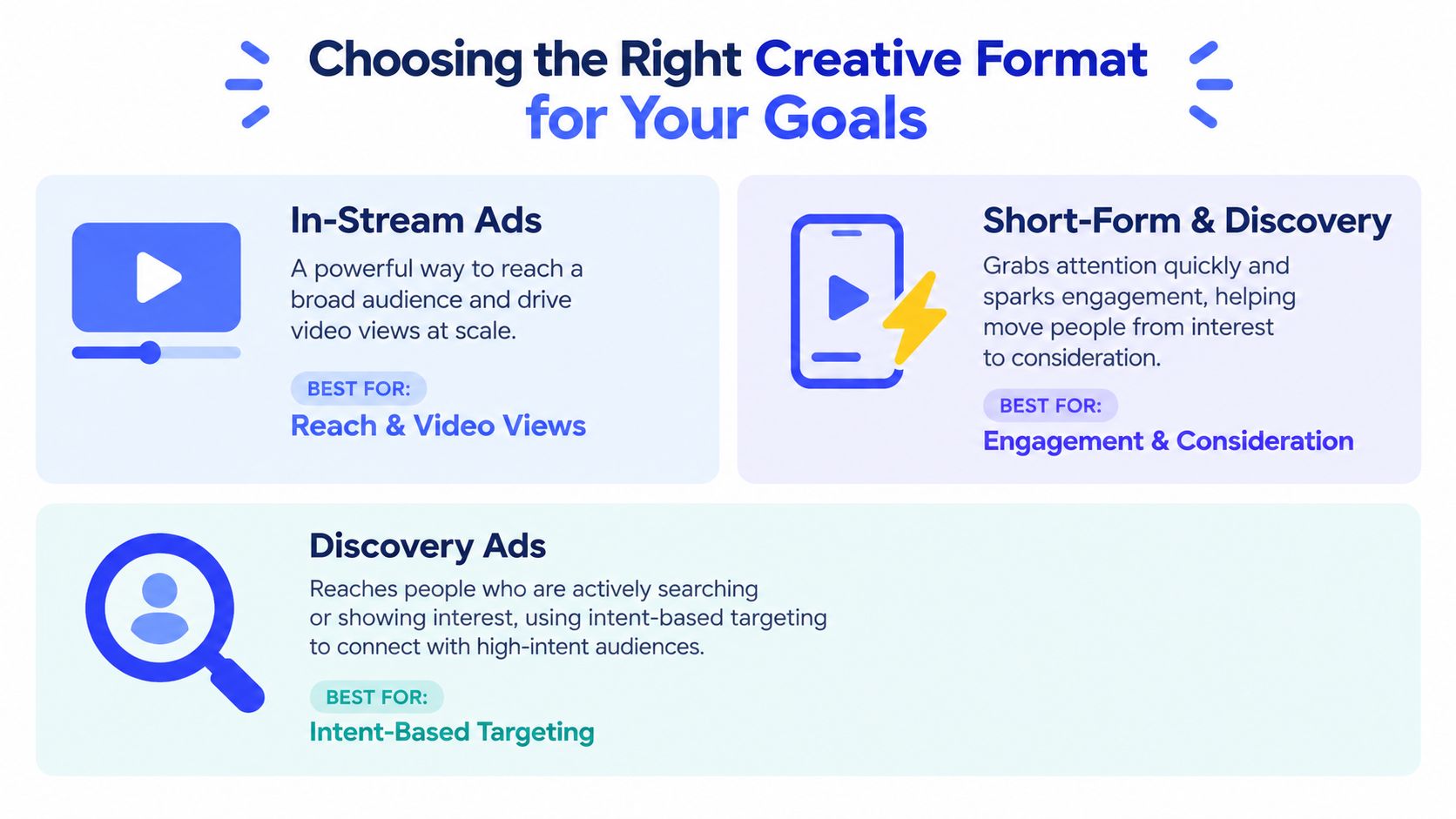
Format selection is a creative decision before it becomes a bidding decision. Shorts, skippable in-stream, and CTV-friendly assets create different viewing conditions, so one cut rarely performs equally well everywhere.
Match the asset to the viewing context
Shorts can work when the message needs immediate recognition, fast visual movement, and a strong opening frame. The vertical environment rewards clarity and pace, but a short runtime doesn't rescue a weak proposition. If the viewer can't identify the problem, product, or reason to continue almost immediately, efficient delivery may only produce efficient skipping.
Skippable in-stream gives the brand more room to establish a situation, demonstrate a product, or build an argument. The first moments still need to earn attention, but the format can support a more complete narrative. It suits consideration campaigns when the viewer needs proof rather than a slogan.
CTV-friendly creative should be built for relaxed, larger-screen viewing. It can use stronger visual composition, clearer audio, and a story that doesn't depend on a tiny mobile interface. This doesn't mean every CTV asset should become a traditional television commercial. It means the edit should respect the viewing environment.
Build a creative system, not isolated cuts
Recent coverage points to YouTube's movement toward Shorts as a performance surface, creator-led ads, AI-based budget allocation, and shoppable CTV, while also describing slower advertising growth and greater competition for attention in Bigeye's YouTube advertising trends analysis. The implication is practical: advertisers need more deliberate creative sequencing as placements multiply.
A useful sequence might look like this:
A short-form asset creates recognition around a specific problem.
An in-stream version demonstrates how the product addresses it.
A creator or customer voice adds credibility.
A CTV-friendly version builds memory and category association.
A follow-up message gives the engaged viewer a clear next step.
The best-performing asset isn't automatically the shortest or cheapest to produce. It's the one that fits the placement and contributes to a sequence. Measure each cut on its assigned role, then judge the system by business outcomes.
Measuring Impact Beyond View Counts
A view count tells you that an ad was delivered and watched according to the platform's definition. It doesn't tell you whether the viewer remembered the brand, changed their preference, visited later through another channel, or would have converted without the ad.
Measurement should begin before launch. First, define the decision the campaign must support. Brand campaigns may need evidence of recall or consideration. Demand campaigns may need qualified visits, pipeline actions, or revenue. Channel-growth campaigns need more than subscriptions, because a new subscriber who never returns may have little long-term value.
Use four layers of evidence
Delivery data shows where the budget went. Review reach, frequency, completed views, view-through behavior, placement, device, and audience distribution.
Engagement data shows how viewers responded. Examine watch patterns, clicks, channel actions, and meaningful site behavior rather than treating every interaction equally.
Conversion data connects exposure with recorded actions. Use consistent conversion definitions and separate view-assisted behavior from direct response.
Incrementality data tests causation. Compare an exposed group with a credible holdout, use geographic or audience-based controls where practical, and evaluate whether outcomes differ after exposure.
Audience overlap deserves particular attention. A prospecting campaign may reach people already included in search, CRM, social, or remarketing programs. Without overlap analysis, several channels can claim the same conversion.
For implementation details, use YouTube video analytics alongside Google Ads reporting, site analytics, and CRM outcomes. No single dashboard provides the complete answer.
Measurement principle: Attribution describes the path people took. Incrementality asks what the campaign changed.
Post-view analysis should also account for delayed action. Someone may watch on a connected television, search later on a mobile device, and convert through a branded result. That path doesn't make every later conversion a YouTube conversion. It does mean teams should assess assisted behavior and controlled lift instead of relying on last-click reporting alone.
Building an Integrated Video Strategy Across Channels
A YouTube campaign shouldn't begin with a media format. It should begin with an audience problem, a message, and a production plan that can travel across placements without becoming generic.
Connect insight, production, and distribution
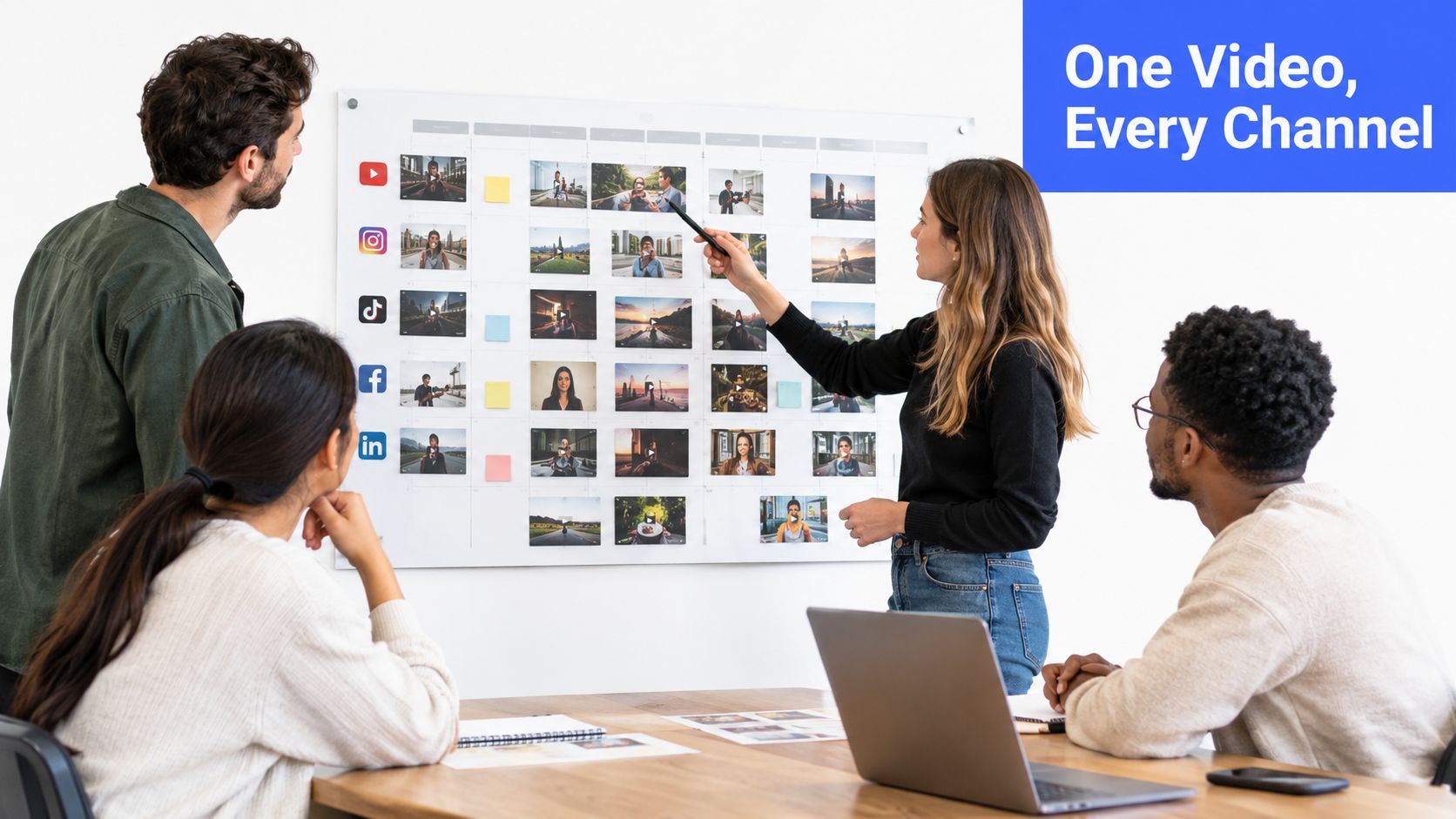
The strongest operating model gives media and creative teams shared responsibility for learning. Media buyers identify which audiences respond to a particular problem or proof point. Producers turn those findings into new openings, demonstrations, creator briefs, and edits. Channel managers then observe which organic viewers continue the story.
That loop prevents a common waste pattern. A brand produces one polished film, cuts it into a few sizes, and expects the media platform to solve the rest. A better process develops a message architecture first, then captures enough footage and testimony to create multiple edits for different viewing contexts.
Owned channels matter in this system. A video that earns attention through YouTube can support product pages, email sequences, sales enablement, social posts, and retargeting. Guidance on video distribution can help teams think beyond the original upload and plan how each asset will reach the next audience.
A practical operating rhythm includes:
Shared briefs: Define audience tension, proof, desired action, and placement requirements before production.
Modular production: Capture multiple hooks, demonstrations, testimonials, and endings during the same shoot.
Weekly signal reviews: Compare creative and audience behavior across YouTube, CTV, social, and owned properties.
Monthly decisions: Pause weak message families, expand useful variations, and update landing experiences.
Quarterly strategy reviews: Reassess the customer journey, audience overlap, and the role of each channel.
The video below illustrates how teams can use structured collaboration to align creative and distribution decisions.
A unified strategy doesn't require identical creative everywhere. It requires a consistent promise, deliberate sequencing, and a clear handoff from one viewing context to the next.
Common Mistakes That Undermine YouTube Campaigns
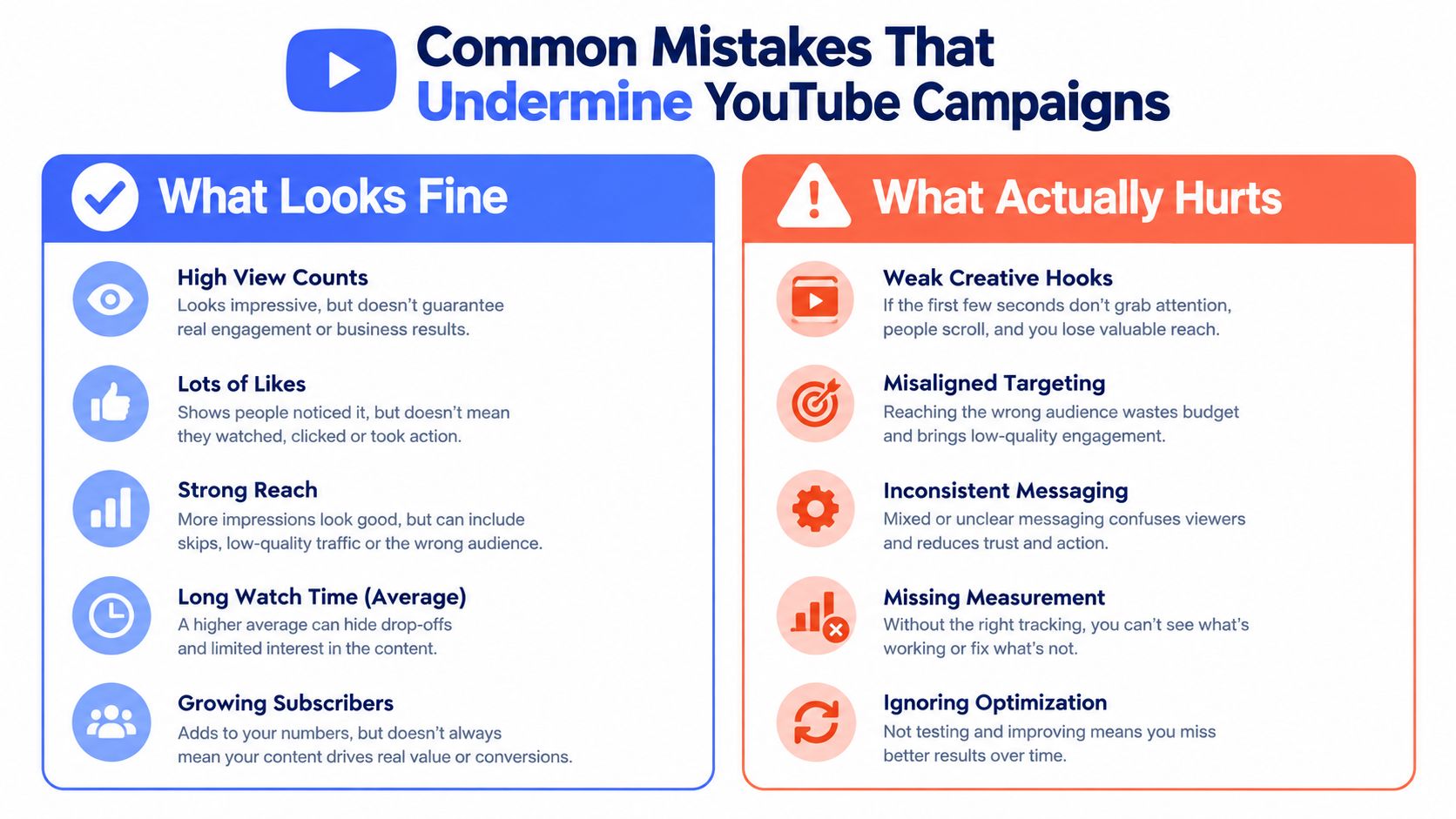
Campaigns often fail while the dashboard appears healthy. A high view count can hide weak attention quality, repeated exposure to existing customers, or creative that earns passive viewing without building preference.
The metrics that create false confidence
Optimizing for views alone is the first trap. Views can be appropriate for an awareness test, but they don't replace qualified actions, consideration, sales conversations, or controlled lift.
Assuming shorter always wins creates another problem. Short-form works when the idea is simple and the opening is decisive. A longer asset can work better when the viewer needs demonstration, trust, or context. The correct question is whether the edit communicates the intended value in the chosen placement.
Treating targeting as the main lever often leads teams to adjust audiences while leaving the creative unchanged. If viewers don't understand the problem or believe the proof, more precise targeting won't repair the message.
Audit the campaign before increasing spend
Look for these warning signs:
Strong delivery, weak downstream behavior: The platform finds viewers, but they don't take meaningful next steps.
High frequency within a narrow audience: The same people see multiple versions while new prospects remain underexposed.
No creative sequencing: Every ad repeats the same promise instead of advancing the story.
Placement mismatch: A mobile-first cut runs in a television-like environment, or a slow product explanation is forced into a fast-scrolling feed.
No holdout or comparison: The team reports attributed conversions without estimating what would have happened naturally.
Teams running affiliate or performance-focused programs can also benefit from practical guidance such as Youtube ad strategies for affiliates, particularly when the temptation is to optimize toward inexpensive traffic rather than durable outcomes.
A campaign deserves more budget when the creative, audience, and measurement evidence agree. If only the view count looks positive, keep testing instead of scaling.
Your Action Plan for Sustained YouTube Growth
Sustained YouTube growth comes from repeatable decisions, not one successful promotion. Start by documenting the audience, business outcome, creative role, conversion event, and test design before any media goes live.
A practical operating checklist
At launch, confirm the channel connection, conversion tracking, geographic and language settings, brand-safety exclusions, audience structure, and creative versions. Keep prospecting and remarketing separate so the reports answer different questions.
During the first optimization cycle, review delivery by placement, audience, device, and creative family. Don't make decisions from a single metric. A low-cost view may be useful for reach but weak for consideration, while a more expensive impression may deliver stronger qualified behavior.
During the next cycle, compare exposed audiences with a control or holdout where the organization can support a credible test. Examine overlap with search, social, CRM, and organic audiences. If YouTube receives credit for actions that already had strong intent elsewhere, the campaign may be harvesting demand rather than creating it.
As the program matures, turn winning insights into production requirements. Capture alternate hooks, demonstrations, creator perspectives, and endings. Update landing pages and owned-channel placements so the viewer's next step matches the promise in the ad.
Use YouTube channel growth tips when the objective includes building an owned audience, but judge channel growth by return engagement and business relevance, not subscriber volume alone.
Decide what to keep, change, or stop
Keep campaigns that show consistent evidence across delivery, engagement, and business outcomes. Change the message when the audience is present but doesn't continue. Change the audience when the creative earns strong response from a clearly defined group that the campaign isn't reaching efficiently. Stop campaigns that generate surface-level activity without a credible path to value.
Teams can manage production, media, and optimization internally, or use a specialist partner that combines those functions. Busylike provides YouTube ads management, paid video advertising, and channel management and optimization, so brands can connect creative production with YouTube, CTV, and social distribution through one operating partner.
Review performance on a regular cadence, but avoid rebuilding the strategy every time the dashboard moves. Sustainable growth comes from accumulating reliable creative and audience knowledge, then applying it across the next campaign.

Busylike plans, produces, and manages branded video campaigns across YouTube, CTV, and social, including paid media optimization and channel strategy. If you need to test whether your YouTube investment is creating demand and build creative that works across placements, visit Busylike to discuss your video growth program.


