
Video Marketing for Healthcare: A Practical 2026 Guide

A healthcare CMO walks into quarterly planning with a familiar problem. The team has strong search campaigns, a growing social presence, and a library of videos that look polished but can't answer a basic finance question: which assets are creating qualified patient actions?
That gap is operational, not creative. Healthcare video marketing performs when production, clinical review, media distribution, privacy controls, and measurement work as one system. Treat video as a collection of isolated shoots, and compliance slows delivery while media teams optimize for views. Treat it as an operating model, and every script, edit, placement, and conversion event has a defined job.
Table of Contents
What Healthcare Video Marketing Actually Does - Education reduces cognitive load - Trust makes the next action feel safer - Conversion gives attention a destination
Regulatory Constraints That Shape Every Decision - Use risk tiers before production
Channel Strategy Across YouTube CTV and Paid Social - YouTube combines intent and interruption - CTV carries the longer story - Paid social rewards clarity
Creative and Production Workflows for Sensitive Topics - Build consent into the brief - Shoot in modules, not one continuous story - Review the finished system
Budgets Timelines and a 90-Day Action Plan - A practical 90-day sequence
Why Healthcare Video Is Now a Performance Channel
Healthcare video has moved beyond the awareness budget because the audience doesn't experience care as a brand impression. Patients watch an explanation, compare providers, evaluate a procedure, ask a caregiver for advice, and then decide whether to call or schedule. A video program that can't connect those steps to business outcomes is incomplete.
The available evidence supports that shift. A healthcare industry roundup reports that health and wellness video ad spend reached $2.2 billion in 2026, up 24% year over year, and that the vertical achieved a 2.70% video-ad click-through rate, the highest among the categories compared in the roundup. It also reports that healthcare video marketing ROI is 49% higher than other content types, while healthcare marketing overall averages a 5.44:1 return. These figures come from the 2026 health and wellness video marketing statistics roundup.
Those signals matter, but spend and clicks aren't enough to justify a channel. The stronger argument is that video can influence comprehension and action at the same time. A study summarized by Patient Films found that 95.1% of patients who watched video content demonstrated better health-education knowledge, compared with 82% who received traditional education. The same summary reports that 74% of patients said video improved their understanding of medical conditions, and satisfaction reached 80.9% with video-based education versus 78.1% without it. Read the patient education findings on video and healthcare engagement.
Strategic implication: Video shouldn't be defended as a softer brand investment. It should be planned beside search, referrals, and CRM programs, with its own qualified-action metrics and testing plan.
The CMO's real decision is whether the organization will build a repeatable video system or keep buying disconnected content. A performance channel needs a production brief tied to intent, a review path that protects claims, distribution designed for the audience, and attribution that respects privacy. Without those connections, a high view count can conceal weak appointment generation. With them, video becomes a practical lever for patient acquisition and experience.
What Healthcare Video Marketing Actually Does
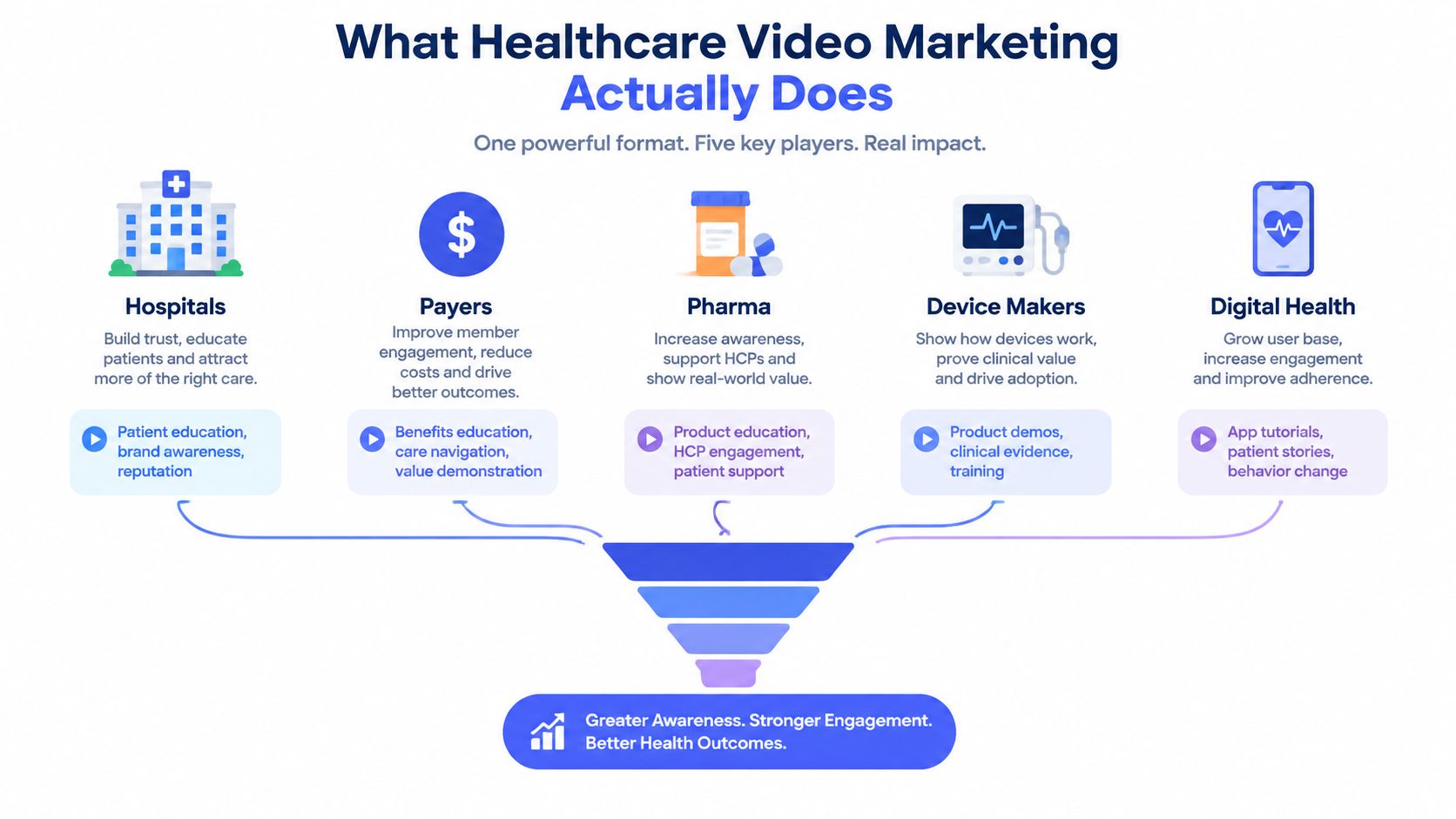
Healthcare video marketing is the planned use of video content and paid distribution by hospitals, payers, pharmaceutical companies, medical-device makers, and digital health businesses. Each asset should target a defined audience and a downstream action, not merely collect attention.
The format has three distinct jobs.
Education reduces cognitive load
Condition explainers, procedure walkthroughs, medication instructions, and mechanism-of-action animations translate technical information into something a patient, caregiver, or clinician can process. The best education videos answer a real question in plain language, show what happens next, and make the boundary between general information and individual medical advice clear.
Education also belongs inside the patient experience. A procedure page with a clear explainer can prepare a patient before a consultation, while a post-visit video can reinforce instructions that are difficult to remember under stress.
Trust makes the next action feel safer
Trust content introduces the people and environment behind the service. Clinician-led explainers show expertise. Patient stories provide emotional context when consent and claims language are handled carefully. Facility tours and “what to expect” videos reduce uncertainty around an unfamiliar visit.
The purpose isn't to manufacture intimacy. It's to make the organization legible. Viewers should understand who provides care, what the process involves, and what the organization can responsibly promise.
Conversion gives attention a destination
Short social ads, landing-page videos, retargeting sequences, and Google Business Profile posts should move a ready prospect toward one action, such as scheduling, calling, starting a form, or requesting information. The CTA must match the viewer's intent. An awareness video shouldn't demand a complex form, and a procedure-specific landing-page visitor shouldn't be sent back to a generic homepage.
A common budget mistake is asking one asset to perform all three jobs. Education needs clarity, trust needs proof and human credibility, and conversion needs focus. Write separate briefs, assign separate KPIs, and connect the assets through a sequence instead of forcing one brand film to carry the entire funnel.
Regulatory Constraints That Shape Every Decision
Healthcare video can't be produced like a consumer ad with a disclaimer added at the end. HIPAA, FDA promotional requirements, FTC truth-in-advertising standards, state privacy laws, and platform policies each change what you can show, say, collect, and retarget.
HIPAA affects patient authorization, identifiable information, filming locations, testimonials, and data flows from landing pages. FDA rules shape promotional claims for pharmaceuticals and devices, including fair balance and risk disclosure. FTC standards require advertising claims to be truthful and adequately supported. YouTube, Meta, and TikTok add their own restrictions around personal-attribute language, sensitive health topics, targeting, and creative approval.
Evidence quality is the clearest warning against casual claims. A JAMA Network Open analysis of video claims examined 309 claims, finding that 62% relied on very little or no evidence, while fewer than 20% were supported by high-quality evidence. The lesson is direct: engagement doesn't validate a medical claim. Every outcome statement needs a source, an owner, and a review decision.
Use risk tiers before production
A practical taxonomy lets teams reserve intensive review for assets that need it while keeping lower-risk work moving.
Asset Type | Risk Tier | Primary Regulations | Required Review |
|---|---|---|---|
General awareness bumper | Lower | FTC standards, platform policies, privacy rules | Brand, privacy, and platform checklist |
Condition explainer | Moderate | FTC standards, HIPAA considerations, platform policies | Clinical fact check, legal review, claims documentation |
Patient testimonial | High | HIPAA, FTC standards, state privacy requirements | Consent and release review, clinical and legal review, final-cut approval |
Product or procedure demonstration | High | FDA rules, FTC standards, platform policies | Medical, legal, regulatory review, risk and indication verification |
HCP promotional education | High | FDA rules, professional standards, privacy requirements | Medical, legal, regulatory review with evidence validation |
Patient stories deserve particular discipline. A useful production reference is this guide to customer testimonial videos, but the operating principle is broader: secure permission for the actual distribution plan, not just the original shoot. Paid amplification, social cutdowns, CTV reuse, name and likeness, condition disclosure, and future edits should be addressed before filming.
Review rule: If a clinical statement sounds like a promise, treat it as a claim that needs evidence, not as creative copy.
Aggressive language may lift an initial click rate, but a single unsupported or off-label claim can trigger a takedown, warning action, litigation, or internal suspension. Compliance isn't a footnote to performance. It's the condition that lets the asset keep running and keep learning.
High-Impact Use Cases and When to Use Each
The four formats that usually deserve serious healthcare video investment are patient stories, HCP education, product or procedure demonstrations, and condition explainers. They aren't interchangeable. Each one solves a different information problem.
Patient stories work when the audience needs reassurance before taking a personal step, especially for elective or emotionally difficult services. The strongest versions focus on experience, process, and properly authorized perspective. They shouldn't imply that one person's result is typical, guaranteed, or appropriate for everyone.
Condition explainers belong earlier in consideration. They answer the questions people ask before choosing a provider, such as what a condition means, what symptoms may warrant attention, and what a consultation involves. Keep the language accessible, include clinical review, and make the next step proportional to the viewer's knowledge.
Product and procedure demonstrations earn budget when the visual action carries information that copy can't. A device maker can show setup, workflow, or use conditions. A digital health company can demonstrate navigation and support features. A clinic can show the patient journey without exposing identifiable information or implying an assured outcome.
HCP education is a different product entirely. Clinicians need mechanism, evidence, procedural detail, and appropriate context. Put that material in professional environments, gated resources, conference follow-up, or targeted distribution rather than cutting it down until it becomes vague social content.
Use Case | Funnel Stage | Primary Job | Best Channel | Compliance Risk |
|---|---|---|---|---|
Patient story | Awareness and consideration | Build trust and reduce anxiety | Website, YouTube, paid social, CTV | High |
Condition explainer | Consideration | Answer search-driven questions | Search video, service pages, YouTube | Moderate to high |
Product or procedure demo | Evaluation | Show how the solution works | Landing page, YouTube, HCP or buyer channels | High |
HCP education | Adoption | Support professional understanding and use | Gated portal, professional media, events | High |
A healthcare video benchmark on hospital and clinic brands reports that patient-testimonial videos under 90 seconds are the highest-converting format for hospital landing pages and Google Business Profile posts. It also reports that condition-specific education videos can reach a 5.5% conversion rate, compared with a 4.5% industry median. Those benchmarks support a simple allocation rule: patient stories for trust, explainers for consideration, demos for evaluation, and HCP content for adoption.
Don't approve a production concept until the team can name the audience, funnel stage, single action, and review owner.
Channel Strategy Across YouTube CTV and Paid Social
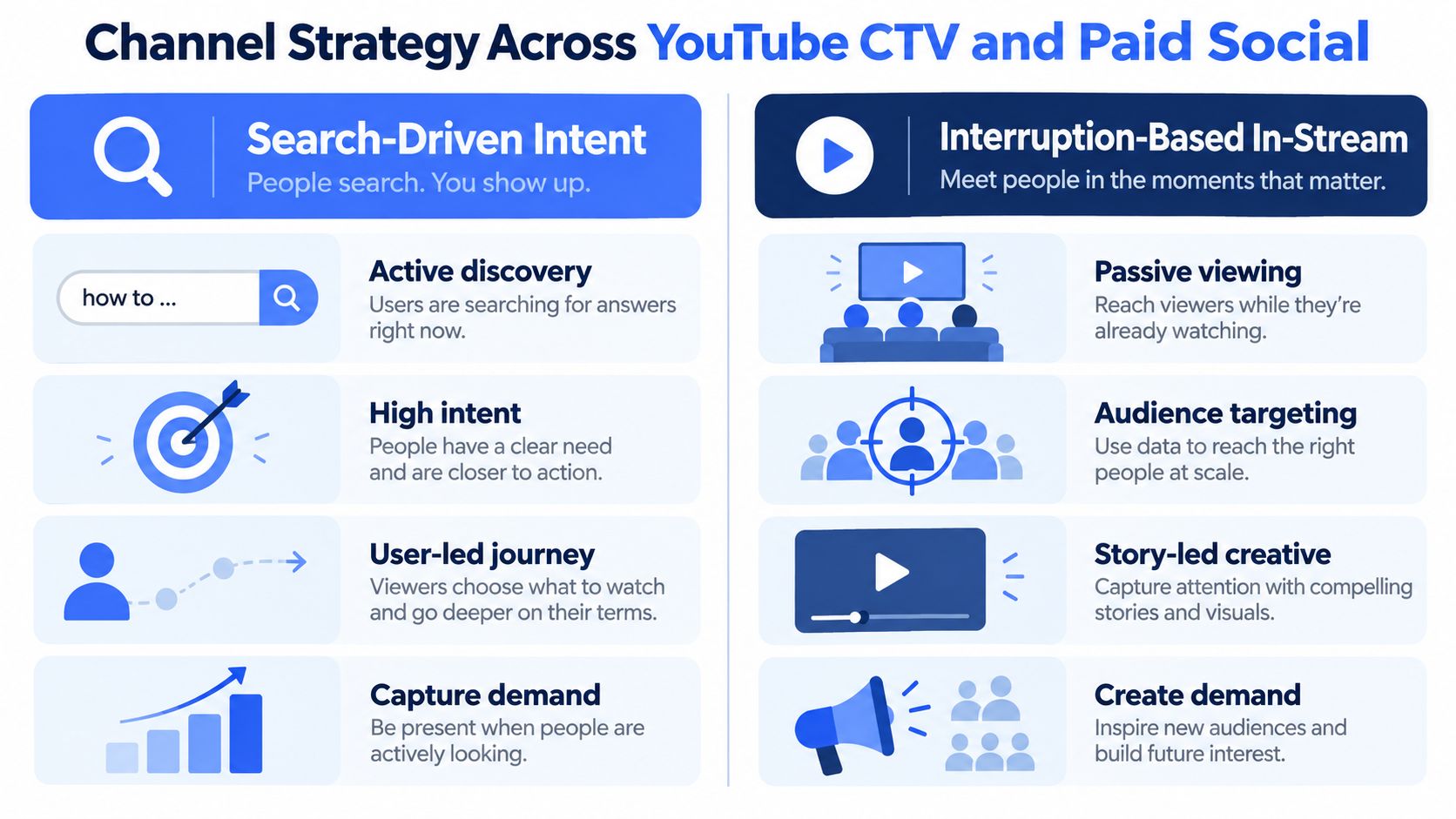
Channel selection should follow intent, not internal preference. YouTube can capture active searches and deliver in-stream interruption. CTV creates a larger-screen storytelling environment. Paid social gives teams fast feedback on short educational creative and landing-page response.
YouTube combines intent and interruption
Treat YouTube as two products. Search-aligned campaigns can meet people looking for condition or procedure information. In-stream placements can introduce a service before the viewer actively searches. Use clinician-led explainers and patient stories when credibility matters, then build cutdowns that retain the same approved claim language.
Creator partnerships can add a human layer in sensitive areas such as oncology, fertility, and mental health, but the creator's audience and disclosures need review. A creator's personal tone doesn't remove healthcare advertising obligations.
CTV carries the longer story
CTV suits brand launches, condition awareness, and service-line narratives that need more room than a social placement. It can complement digital campaigns without relying on the same creative length or audience behavior. Privacy-safe planning matters, especially when marketers combine media exposure with external audience data. Don't use patient-level assumptions where household or aggregated reporting is the available signal.
Paid social rewards clarity
Meta and TikTok are useful for short educational clips, provider introductions, and direct-response variations. Lead with the question the viewer is trying to answer, use captions, and make the landing page match the promise of the ad. Avoid language that suggests the platform knows a user's diagnosis or personal condition.
A starting media mix can be useful for planning, but it isn't a rule. Test channel roles against qualified leads, appointment starts, call actions, or HCP inquiries, then shift investment toward the placements that produce valuable actions. Teams can use video distribution planning across paid and owned channels to define where each cutdown belongs before production begins.
Every pre-roll and CTV asset should complete medical, legal, and regulatory review before flighting. Speed comes from approved modular systems, not from skipping the review queue.
Creative and Production Workflows for Sensitive Topics
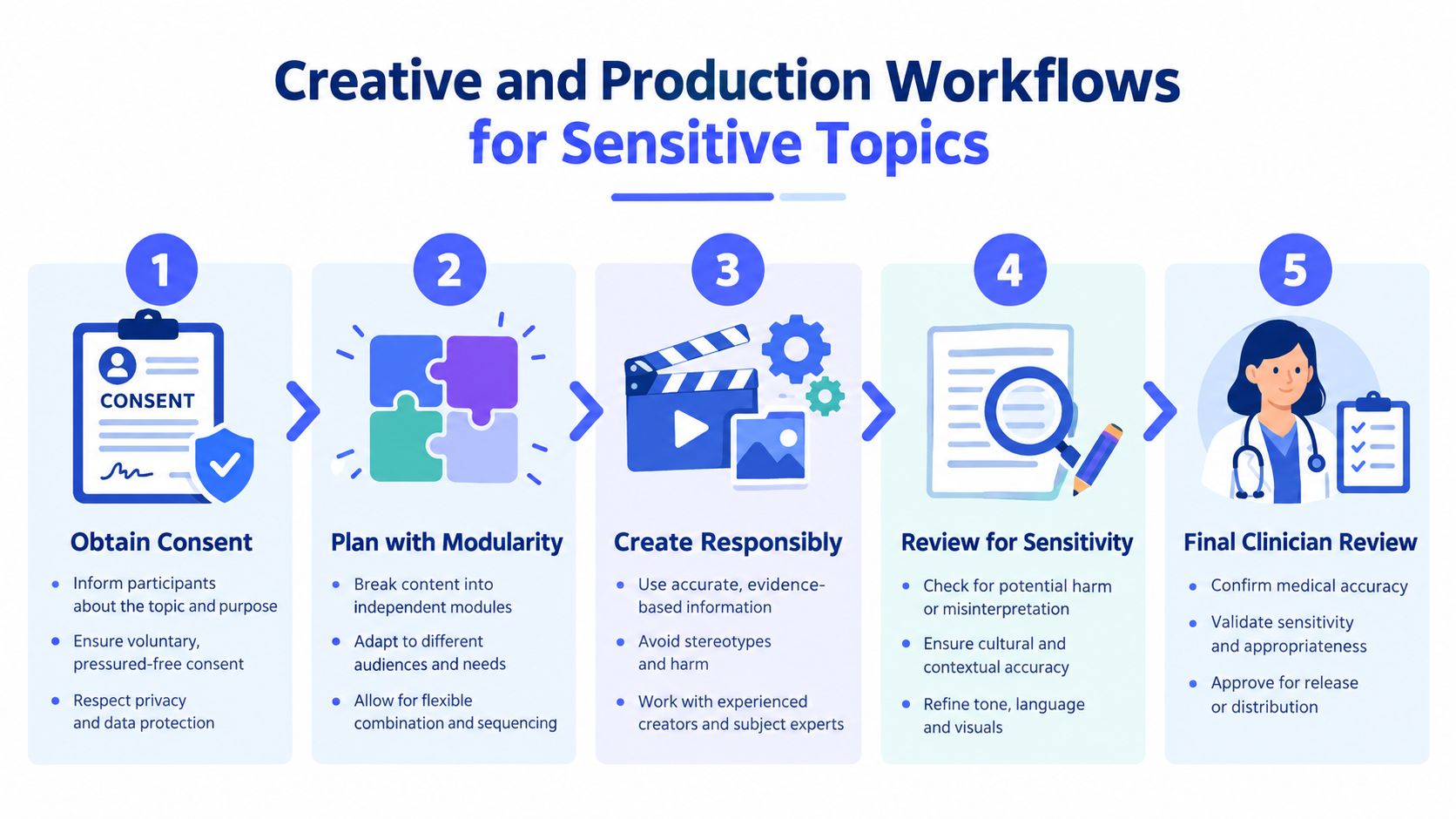
A sensitive healthcare shoot begins before the camera arrives. The producer, strategist, clinician, and reviewer should start with a written treatment that lists every clinical statement, implied outcome, visual cue, testimonial assertion, and CTA. If a line could be interpreted as a promise, mark it before the script reaches talent.
Build consent into the brief
A release should cover the participant's name, likeness, condition disclosure, distribution channels, paid amplification, CTV use, and future cutdowns. A verbal agreement or narrow shoot-day release creates problems when a successful asset needs to move into a new placement.
For patient footage, decide what must be de-identified and what the organization is authorized to show. Check signage, monitors, documents, room numbers, staff badges, and background conversations. A clean production environment protects the patient and prevents avoidable post-production work.
Shoot in modules, not one continuous story
Capture each major claim as a standalone scene. Record alternate openings, shorter explanations, CTA variations, and neutral transitions. Modular footage lets the team replace one sentence after review without discarding the entire edit.
Use b-roll that communicates the experience without creating a privacy problem. Hands, equipment, approved spaces, preparation steps, and abstract clinical animation can often carry the story more safely than identifiable interiors or incidental patient activity.
Review the finished system
The final-cut review must include the master film and every planned variation for YouTube, CTV, paid social, landing pages, and search placements. Check captions, supers, risk language, source references, thumbnails, descriptions, and landing-page continuity. Store the approved version, review notes, expiration conditions, and claim substantiation in one accessible location.
Production principle: Shoot for the edits you expect to need, not only the film you want to launch.
This workflow trades a little front-loaded planning for a longer asset life. It also makes optimization safer because the team has approved components ready to test. AI tools can help with transcripts, versioning, and rough cuts, but a human clinician and accountable compliance owner still need to judge the final claims and context.
Measurement Attribution and ROI in Restricted Environments
Healthcare measurement fails when teams ask platform dashboards to answer business questions they weren't designed to answer. View-through rate, completion, and click-through rate describe media behavior. They don't prove that a patient scheduled, a referral qualified, or an HCP adopted a product.
Start with a KPI hierarchy:
Awareness: reach, completed views, branded-search movement, and qualified engagement.
Consideration: service-page visits, provider-page depth, call-button taps, and form starts.
Conversion: appointment requests, scheduled visits, qualified referrals, prescription-related actions where permitted, or HCP inquiries.
Business value: attended appointments, downstream revenue, procedure volume, or other approved financial outcomes.
The measurement design should match the privacy environment. Use consent-aware first-party events, CRM-matched scheduling outcomes where permitted, aggregated platform reporting, and server-side conversion methods that don't transmit unnecessary protected information. For CTV, geo-based lift tests and controlled market comparisons can be more defensible than pretending household-level attribution is exact.
A practical operating setup separates platform reporting from business reporting. Media teams own delivery and engagement metrics. Growth and analytics teams reconcile approved conversion events. Finance receives an incremental business result, not a blended dashboard total.
Funnel Stage | Platform Metric | Business Metric | Measurement Method |
|---|---|---|---|
Awareness | Reach, completion, branded-search movement | Qualified audience growth | Aggregated platform reporting and search analysis |
Consideration | Clicks, landing-page engagement, video completion | Form starts, call actions, referral quality | Consent-aware analytics and CRM reconciliation |
Conversion | Conversion events, assisted interactions | Scheduled or attended appointments | Approved first-party events and deterministic matching |
Business value | Channel-assisted actions | Revenue or approved downstream outcome | Finance-approved attribution and incrementality testing |
Teams that need deeper YouTube reporting can use YouTube video analytics to distinguish delivery signals from audience behavior. The CFO-facing formula should stay simple:
Incremental ROI = (Incremental approved business value minus production and media cost) divided by production and media cost.
Define “incremental” before launch. If the team can't agree on the business outcome, comparison group, consent boundary, and reporting window, it isn't ready to claim ROI.
Budgets Timelines and a 90-Day Action Plan
Healthcare organizations often ask for a production budget before deciding what the video system must accomplish. Reverse that order. Select the service line, audience, funnel job, channel mix, review depth, and measurement method first. Only then can a production estimate mean anything.
The supplied planning brief calls for budget ranges, but it provides no verified dollar amounts for production, media, patient-story libraries, HCP series, or CTV pilots. Those figures shouldn't be invented. Build the internal request as separate lines for strategy, production, post-production, MLR review, accessibility, localization, media, measurement, and optimization. Obtain vendor estimates against a defined deliverable list rather than using a generic “video budget.”
The same discipline applies to timing. The brief identifies a four-to-six-week production-plus-approval cycle as a common planning assumption, but no source link is supplied for that figure. Use it as an internal planning baseline, then validate it with your legal, clinical, regulatory, and procurement owners before committing to a launch date.
A practical 90-day sequence
Days 1 to 30, audit and select. Review existing footage, claims libraries, consent records, landing pages, channel performance, and appointment events. Choose one priority use case and define the single conversion action. Create the risk-tier checklist and name the final MLR approver.
Days 31 to 60, produce and review. Write the treatment, document claims, secure releases, shoot modular footage, create captions, and prepare the master plus cutdowns. Route the script and final edits through the agreed clinical, legal, and regulatory process.
Days 61 to 90, launch and optimize. Launch on the channel matched to intent, monitor delivery and approved business events, and compare creative by qualified action rather than views alone. Record what passed review, what generated useful signals, and which components can be reused in the next production cycle.
The three decisions for this quarter are straightforward: choose the priority service line, approve the operating workflow, and fund measurement alongside creative and media. Busylike provides branded video production, paid video advertising, and channel management across YouTube, CTV, and social, including explainer, testimonial, case study, and ad formats for healthcare and wellness brands. Visit Busylike to discuss a healthcare video program that connects compliant production with distribution and performance measurement.


