
Top Video Production Companies in New York City

Updated: 4 days ago
New York City has 2,640 video production services, and 2,326 of them, or 88.11%, are single-owner operations. The right choice isn't the company with the most impressive reel. It's the partner whose creative specialty, production scale, and distribution model match the campaign.
That distinction matters in a market this fragmented. A famous reel can prove that a team makes beautiful work, but it won't tell you whether the company can build paid-social variations, manage YouTube distribution, coordinate a VFX pipeline, or deliver a documentary series through a complex approval process. NYC's production economy includes boutique operators, specialist studios, global creative networks, and agencies that connect production directly to media performance.

This roundup organizes New York City video production companies by the production problem each is best equipped to solve: integrated performance video, VFX-heavy campaigns, animation, experimental mixed media, culture-led launches, agile brand production, and documentary storytelling. It also weighs operating model, likely trade-offs, sample-work signals supplied in the brief, and the questions worth asking before requesting a quote.
Before contacting a shortlist, define the objective, audience, deliverables, channels, locations, schedule, approval process, and budget range. A practical visual storytelling guide from Gainsty can help clarify the narrative approach, but the production brief still needs to explain how the finished assets will be used.
The most recognized studio in New York isn't automatically the right answer. A strong video production agency New York search should start with the brief, not the logo, because the key question is whether a partner matches your creative style, production scale, post-production needs, and distribution model. New York's film and TV ecosystem is large and specialized, with 185,000 total jobs and $81.6 billion in total economic output in 2019, while the motion picture and video production sector alone accounted for 46,700 direct jobs and 47% of direct industry employment (NYC film and TV industry study). That scale explains why the city has everything from boutique directors to full-funnel video marketing teams, and why buyers should compare working models, not just reels.
Table of Contents
1. Busylike for integrated performance video - Where the operating model helps - Trade-offs buyers should surface
2. Alkemy X for VFX-heavy campaigns - Why scale matters - Where it may be too much
3. Hornet for animation-led brand storytelling - The craft advantage - Questions for the brief
4. 1stAveMachine for experimental mixed media - Creative ambition versus operational certainty - Best use case
5. m ss ng p eces for culture-led launches - What to test before hiring - The cost of demand
6. Bindery for agile brand production - Where agility helps - The limitation
7. Blue Chalk Media for documentary storytelling - Why nonfiction changes the schedule - What the buyer should clarify
1. Busylike for integrated performance video
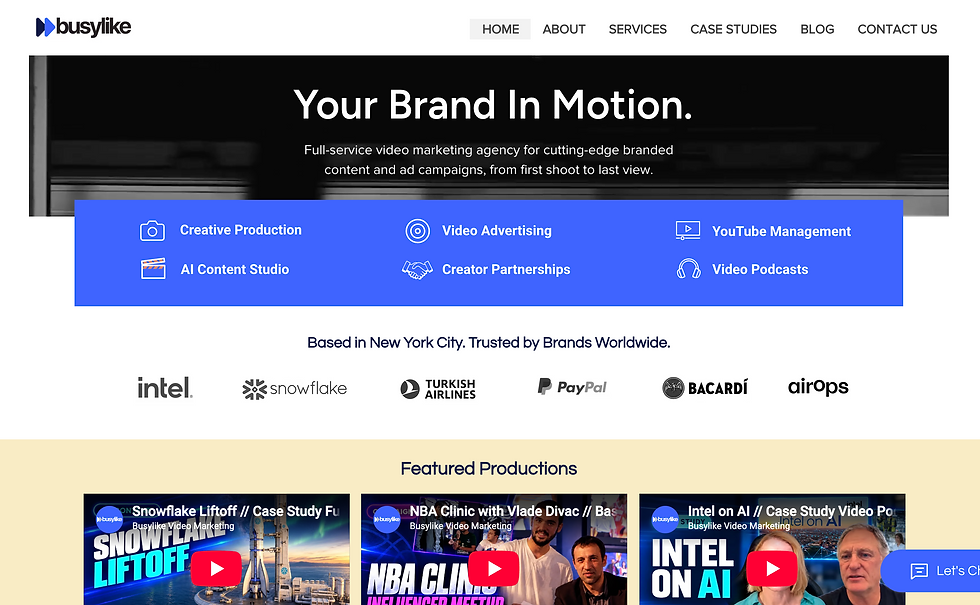
Busylike is the strongest fit here for teams that don't want production to stop at final delivery. The New York City-based, full-service video marketing agency connects creative production with paid video advertising and channel management, supporting campaigns across YouTube, CTV, TikTok, Meta, Instagram, LinkedIn, and podcast advertising.
That integrated model changes the briefing conversation. Instead of ordering one hero film and figuring out distribution later, a marketing team can plan the campaign around audience insight, creative concepts, media placements, and the versions each channel needs. Busylike produces brand films, explainer videos, short-form ads, creator partnerships, and branded content through remote, onsite, and in-studio workflows.
Where the operating model helps
The main advantage is fewer handoffs between the production team, media buyer, and channel manager. Busylike is YouTube-certified and works with both B2B and B2C brands, including SaaS, retail, consumer electronics, and healthcare. Its AI Content Studio supports scalable formats, while creator and influencer activations can add third-party credibility to a campaign that would otherwise rely only on brand-owned assets.
The engagement can be production-only, media-only, or an end-to-end monthly program. That flexibility suits an in-house team that has strong creative direction but needs execution support, as well as a growth team that needs one partner to manage concept, production, paid placement, and optimization.
Practical rule: If the campaign will be judged by qualified reach, consideration, conversions, or channel growth, ask the production partner to explain how the edit will change for each placement before you approve the shoot.
Trade-offs buyers should surface
Busylike doesn't publish standard pricing, so prospective clients need a consultation and custom quote. That's reasonable for work spanning production, paid media, creators, and channel management, but it can make early budget screening harder for smaller teams. The agency is based in Chelsea and supports remote production, while brands seeking exclusively local production outside the NYC metro area should confirm logistics and travel costs.
The best briefing question is not, “What will the video cost?” Ask for the labor, production, post-production, media, creator, and versioning assumptions separately. NYC is a premium market, with typical 2 to 3 minute corporate videos commonly placed around $7,500 to $22,000 in 2026 pricing guides, while more extensive projects can reach $10,000 to $50,000, depending on crew, permits, studio use, and post-production scope, as detailed in this 2026 NYC video production cost guide. Busylike is worth serious consideration when those production assets need to work as part of a measurable distribution system.
Busylike is the clearest fit for teams that need production and distribution under one roof. The agency is built for brands that don't just want footage, they want video that can live on YouTube, CTV, TikTok, Instagram, LinkedIn, and podcasts while still serving a performance goal. That matters in a market where YouTube has become a major CTV surface, with Nielsen-reported viewing reaching 13.5% of all U.S. TV usage in March 2026, and agency research finding 75% of brand and agency respondents already placing ads on YouTube in Q1 2026
Website: Busylike
2. Alkemy X for VFX-heavy campaigns
Alkemy X is better suited to a campaign where live action is only the beginning. Its New York office sits within a broader creative production network spanning live action, design, animation, editorial, finishing, and heavyweight VFX. That combination is useful when the concept depends on visual effects, compositing, title design, or a polished finishing pipeline that a small local crew may need to outsource.
The company works across commercial, entertainment, network, agency, and major-brand assignments. Its multi-city and international footprint can also give production teams more options when the brief calls for specialized talent, different locations, or scheduling flexibility.

Why scale matters
A VFX-heavy campaign needs more than a director and camera crew. Production design, plates, tracking, cleanup, compositing, editorial, color, sound, and approvals all affect the final result. A partner with those capabilities connected through one production structure can reduce the risk of an ambitious concept being weakened by fragmented post-production.
Alkemy X also understands regional production economics and incentive structures across New York, California, and Canada. That doesn't automatically make a project inexpensive, but it gives enterprise buyers a stronger basis for evaluating where crews, stages, and post-production should sit.
Where it may be too much
The same infrastructure can be excessive for quick-turn social work, simple interviews, or a small set of platform cutdowns. A large partner may introduce more layers of bidding, creative review, and scheduling than a lean campaign needs. Buyers should ask whether the proposed team is built around the actual complexity of the brief or around the company's largest available capability.
Pricing is custom, and there isn't public rate transparency. For a complex campaign, request a bid that separates pre-production, principal photography, VFX, editorial, finishing, music, usage, and versioning. Compare the assumptions rather than comparing only the headline fee.
Website: Alkemy X
3. Hornet for animation-led brand storytelling
Hornet is a strong choice when the visual identity depends on animation, motion design, or a hybrid approach rather than conventional live action. The SoHo studio has a design-forward profile, a deep roster of directors, and experience creating brand films, campaign assets, and mixed-media work for clients such as Apple, Adobe, Spotify, and Tiffany.
That profile makes Hornet particularly relevant for product storytelling, launch films, brand IDs, and concepts that need an art-directed visual system. Animation can make an abstract service, technical product, or brand world easier to control than a location shoot, especially when the campaign requires visual consistency across multiple scenes and formats.
The craft advantage
A specialist animation studio brings more than software capability. It can shape a visual language, manage character or object design, develop motion principles, and maintain consistency from storyboard through final composite. Hornet's awards momentum, including a 2026 Clio Music Gold for Craft in Animation, is a useful signal of recognition for creative execution, as described in the supplied company profile.
The trade-off is that craft-led work usually needs more development before production begins. Storyboards, style frames, animatics, design approvals, voiceover, sound, and revisions all influence the schedule. A buyer who wants animation quality but approves concepts slowly can create avoidable pressure late in the process.
Animation isn't a shortcut around production planning. It moves more of the planning into design, storyboarding, and approval.
Questions for the brief
Ask whether the company will deliver editable design systems, alternate aspect ratios, short cutdowns, still frames, captions, and platform-specific versions. Also clarify who owns the source files and whether changes after animation begins are priced as revisions or as new work.
Hornet may be less focused on paid media optimization than a hybrid production and marketing firm. If the campaign needs serious testing across YouTube, CTV, and paid social, pair the creative brief with a distribution partner or confirm that media strategy is included. If the priority is a distinctive visual world and high craft, Hornet belongs near the top of the shortlist.
Website: Hornet
4. 1stAveMachine for experimental mixed media
1stAveMachine is built for brands that need a concept to feel new, not merely well executed. The Brooklyn-based production company combines live action, mixed media, animation, digital, experiential work, and an AI & Digital practice. Its global footprint across NYC, Los Angeles, London, and Buenos Aires gives it access to varied directors, production resources, and creative approaches.
That range is valuable for technology, product, and culture-facing campaigns where the idea may move between physical production, animation, interactive elements, and emerging tools. The company can be a good match when a conventional commercial treatment would make the campaign look interchangeable with everything else in the category.

Creative ambition versus operational certainty
Experimental work can perform well in social feeds and earned media because it creates a reason to discuss the asset. But experimentation also increases the number of decisions that need alignment. The brand team must agree on what the audience should understand, what can remain surprising, and which technical choices are essential to the idea rather than decorative.
Use the New York video production agency guide as a reminder that production choice should connect to the intended distribution model, not only to the visual treatment. For 1stAveMachine, ask for a development plan that shows how the concept will move from treatment to prototype, shoot, post, and platform-ready delivery.
Best use case
The company is a compelling option for a product launch, experimental brand film, experiential activation, or social campaign that needs a mixed-technique execution under one roof. It may be less suitable when the brief is already locked, the schedule is very short, or the buyer needs a predictable template of simple assets.
Pricing is project-based and not published. Request separate assumptions for development, technology or AI work, live action, animation, experiential production, post-production, and deliverables. That breakdown will show whether the budget reflects genuine complexity or the premium attached to an ambitious creative label.
Website: 1stAveMachine
5. m ss ng p eces for culture-led launches
m ss ng p eces is the most natural fit for a campaign that needs to understand culture before it tries to borrow from it. The Greenpoint, Brooklyn production and entertainment partner works across commercial campaigns, brand films, experiential activations, and social-first content, with a director roster suited to launch moments and culturally resonant creative.
Its recognition on the Ad Age A-List and as Webby Production Company of the Year in 2025, according to the supplied company profile, supports a positioning built around polished work with cultural relevance. For brands launching products, entering conversations, or building a hero film with social cutdowns, that combination can be more useful than a purely technical production partner.
What to test before hiring
A culture-led campaign needs a clear distinction between a compelling reference and a credible audience insight. Ask the team to explain who the work is for, what behavior or conversation the campaign should create, and how the hero asset will be adapted for platforms where viewers encounter it without context.
The production company can support a polished central asset and social extensions, but buyers should confirm how many cutdowns, aspect ratios, captions, creator integrations, and usage territories are included. A campaign may look complete in a reel while still requiring substantial post-production to become a usable distribution package. For a broader view of the decisions involved in digital video production, see this digital video production resource.
The cost of demand
Top creative rosters can be difficult to schedule, particularly when a launch has a fixed date. Start with director availability, location requirements, talent, music, rights, and approvals rather than assuming the preferred treatment can fit the calendar. The premium creative positioning also suggests that this is unlikely to be the right partner for a low-cost batch of routine social edits.
m ss ng p eces has NYC and Los Angeles bases, which helps with bi-coastal work. It remains a bespoke production partner, so buyers should request a detailed scope and identify the point at which concept development becomes billable production.
Website: m ss ng p eces
6. Bindery for agile brand production
Bindery is a practical option for brands that want creative, production, and finishing handled by a compact NYC team. The Chelsea-based independent creative agency and production studio works across brand campaigns, commercials, and documentary-style content, with in-house post-production plus motion, animation, audio, sonic branding, and stills.
That combination suits a marketing team that needs a partner capable of moving from concept to production without assembling a separate network for every finishing requirement. It also fits campaigns that need both a polished brand film and performance-oriented advertising assets, provided the team agrees on the distribution requirements at the start.
Where agility helps
A local team can make pre-production, client reviews, and revisions easier to coordinate. That matters for brands working with changing product details, fast approvals, or a narrow launch window. Local access to NYC talent, studios, and clients can also simplify meetings and location planning.
Bindery's in-house motion and audio capabilities are useful when the campaign needs more than picture editing. A sonic identity, animated titles, social graphics, stills, and short-form versions can be planned alongside the main film instead of added as disconnected deliverables.
Scope check: Ask for the complete delivery list before approving the shoot. A “brand film” may not include the cutdowns, captions, stills, audio stems, or platform versions your media plan requires.
The limitation
Bindery may not offer the same high-end VFX depth as a specialist house. If the concept depends on complex effects, extensive digital environments, or unusually demanding compositing, ask whether those capabilities are internal or partner-led. Outsourcing isn't automatically a problem, but the bid should show who owns the schedule, creative supervision, and final quality control.
Pricing isn't published, so enterprise buyers need a project-specific estimate. Compare the post-production plan closely. Fast revisions are valuable only when the scope defines the number of review rounds, the decision-makers, and the material changes that trigger a new estimate.
Website: Bindery
7. Blue Chalk Media for documentary storytelling
Blue Chalk Media is the clearest fit for brands that need trust, access, and lived experience rather than a heavily scripted commercial. The DUMBO-based production company and creative agency specializes in cinematic nonfiction and documentary-style storytelling for brands, media companies, nonprofits, healthcare organizations, advocacy groups, and editorial partners.
Its background includes more than 1,200 projects and 230 honors, according to the supplied company profile. Those figures describe the company's stated production and recognition history, but buyers should still evaluate the specific team proposed for the assignment, the relevant subject-matter experience, and the distribution plan for the finished work.

Why nonfiction changes the schedule
Documentary production depends on research, access, contributor trust, field logistics, editorial judgment, and the discovery of a coherent story during production. That cadence differs from a scripted spot, where the team can control the action, dialogue, and visual outcome more tightly. A brand should expect the brief to address consent, releases, sensitive subjects, fact-checking, editorial standards, and contingency plans.
Blue Chalk's experience with editorial partnerships, series work, broadcast standards, and global field production makes it relevant for thought leadership, corporate responsibility, healthcare storytelling, and multi-episode projects. Its acquisition by the Auspicious Group in 2024 also expanded the company's international resources, as stated in the supplied profile.
The video production agency overview is useful context for distinguishing a production partner from a broader marketing partner. Blue Chalk is strongest when the story itself is the strategic asset. It may be less efficient for a rapid scripted ad package or a high-volume set of short paid-social variants.
What the buyer should clarify
Ask who owns research and editorial development, how contributors are selected, how many production days are assumed, and what happens if access changes. Also define whether the project includes a hero film, series episodes, short excerpts, still photography, transcripts, captions, and platform-specific versions.
Pricing is project-based and not publicly listed. Documentary crews can scale substantially with research, travel, access, field production, and editorial scope, so the estimate should explain those drivers rather than hide them inside a single production fee.
Website: Blue Chalk Media
8. Indigo Productions
Indigo Productions fits briefs that need scale, reliability, and a broad crew network more than a narrow creative signature. Its public positioning spans concept, scripting, production, and post, so it can handle corporate shoots, commercials, social content, and virtual events. That breadth matters in New York, where the market can support many specialized vendors, but buyers still pay for capabilities they may not need. For a useful benchmark on the local market, review the New York State movie and video production industry overview, then compare it with the agency's own digital video production approach and see which model matches the brief.
Best use case for Indigo
Choose Indigo when you need a dependable vendor that can handle end-to-end production and post-production without forcing you to stitch together separate teams. That usually suits internal comms groups, B2B marketers, and companies with recurring needs such as executive interviews, product explainers, training content, or event coverage. The value is operational coverage, not a strong visual stamp.
For teams comparing it with a more strategy-led agency, the question is simple. Do you need someone to execute a defined brief, or do you also need help shaping distribution? Indigo is the safer answer when the brief is already clear and the job is to deliver cleanly.
A practical production lead matters more than a flashy reel when the scope is straightforward.
What to ask in the pitch
Ask for relevant work samples: Request case studies for the exact format you need, not a general montage.
Clarify post scope: Editing, motion graphics, 3D, VFX, color, and sound should be spelled out.
Check crew access: If your timeline is tight, ask how they staff shoots and how quickly they can scale.
Separate production from distribution: If you need media buying or optimization, confirm those services are not assumed.
Indigo is useful for organizations that want one accountable vendor. It is less compelling if you need a partner to interpret performance data, build platform variants, or manage channel growth after the cut is finished.
9. Dress Code
Dress Code is a strong option for brands that want design, animation, and live action to feel like one integrated system. The Lower East Side studio is useful for product stories, branded content, and projects where visual expression is part of the message, not decoration. Its appeal is in the blend, not the single discipline.
Why teams bring Dress Code into the pitch
A lot of video production agencies can shoot footage. Fewer can make the design language and the production language feel like they were built together. Dress Code's hybrid model is especially useful for product launches, explainers, and culture-forward brand pieces where motion graphics need to support the narrative instead of sitting on top of it.
That makes the briefing process important. If you want the studio to nail the result, you need to show them the actual content problem, not just the aesthetic references. Give them the product, the audience, and the exact decision you want the viewer to make.
What can limit the fit
Dress Code's boutique scale is part of the appeal, but it can become a constraint if you need very large simultaneous series production. It's a better fit for carefully made projects than for volume-heavy monthly output. The studio also isn't positioned publicly as a performance-media or channel-operations partner, so buyers should not assume post-launch support is included.
For teams comparing vendors, Dress Code sits in a useful middle ground. It's more creatively integrated than a pure production house, but less channel-centric than a video marketing agency. That makes it especially useful when the deliverable is a visually strong asset and the distribution plan already exists.
10. Sibling Rivalry
Sibling Rivalry is worth a close look when a brand wants concept development and production execution handled together. The New York office and the combination of creative studio plus director roster make it a good fit for campaigns that need continuity from strategy and design into the finished film. That continuity can save time and reduce the handoff friction that often shows up when separate shops own concept and production.
The advantage of one creative chain
When one team shapes the idea and then produces it, the final piece usually feels more coherent. That's the core advantage here. Sibling Rivalry is strongest for filmic brand storytelling, identity-led campaigns, and experiential work where the production is part of a larger brand system.
That structure is especially helpful for marketing teams that want fewer vendors in the room. You get a cleaner path from concept to execution, which can be valuable when approvals are already slow internally.
What to press them on
The main trade-off is that a brand and creative-heavy shop may prioritize craft over rapid iteration. If your campaign depends on frequent versioning, testing, or performance optimization, ask how they handle post-production rounds and asset adaptation. Also ask which director will lead the work, because availability can change quickly during busy periods.
For teams bringing a broad campaign brief, the comparison becomes practical here. If the job is to create a unified brand story, Sibling Rivalry is compelling. If the job is to support a channel engine with constant output, a more performance-oriented partner may be the better fit.
11. Fame Crew
Fame Crew fits briefs where the creative is already decided, and the need is fast, vetted execution. Rather than bundling concept, strategy, and production into one retainer, Fame Crew connects B2B brands directly with a vetted network of NYC directors, cinematographers, sound engineers, and editors on a day-rate basis, cutting out the overhead of a full-scale agency engagement.
Where Fame Crew is strongest
This is the practical choice for marketing teams that already have a clear brief and just need a dependable crew, fast. It's built for corporate interviews, event coverage, client testimonials, and social content, formats where speed and reliability matter more than a singular creative point of view. The on-demand booking model means a professional crew can typically be secured in days, not weeks, with transparent, predictable day-rate pricing instead of a bundled agency fee.
Practical rule: if you already know what you want to make and just need hands on the ground in NYC, brief Fame Crew directly with shoot dates, location, and required roles. You'll get a fixed quote back fast.
Watch-outs before you sign
Fame Crew is an execution partner, not a creative or strategy shop. If you need concept development, campaign direction, or channel/distribution planning, pair it with a strategist or expect to own that part in-house. It's the right call when the brief is set, and the job is to get it shot well and delivered fast.
NYC Video Production Companies, 7-Point Comparison
Company | Implementation Complexity 🔄 | Resource Requirements ⚡ | Expected Outcomes 📊 | Ideal Use Cases 💡 | Key Advantages ⭐ |
|---|---|---|---|---|---|
Busylike | Moderate–High, integrated strategy + media ops 🔄 | Medium, production, paid media budgets, creator ops ⚡ | Measurable lifts in recall, consideration, conversions; ROI-focused 📊 | Mid-market & enterprise needing unified video + paid strategy 💡 | End-to-end service; YouTube-certified; creator activations ⭐ |
Alkemy X | High, enterprise live action + heavy VFX pipelines 🔄 | Extensive, in-house VFX, multi-city crews, tax-incentive logistics ⚡ | Broadcast/high-polish commercial and entertainment assets 📊 | Large-scale commercials, cinematic spots, VFX-heavy projects 💡 | Robust VFX/finishing; global footprint; incentive expertise ⭐ |
Hornet | Medium, animation/motion-design centric workflows 🔄 | Medium, specialist directors and craft resources ⚡ | Visually distinctive brand films and crafted campaign assets 📊 | Animation-first campaigns, product storytelling, brand ID work 💡 | Strong craft pedigree; award-winning animation and directors ⭐ |
1stAveMachine | High, experimental, mixed-media + tech integration 🔄 | Medium–High, cross-disciplinary teams, AI & digital practice, global ops ⚡ | Conversation-driving creative that performs on social and earned media 📊 | Tech-inflected, experiential, and standout social campaigns 💡 | Experimental storytelling; dedicated AI & digital team; global scale ⭐ |
m ss ng p eces | Medium–High, culture-driven commercial + experiential work 🔄 | High, premium directors, bi-coastal production capacity ⚡ | Culturally resonant launches with polished hero assets + social cutdowns 📊 | Launch moments, culture-led brand campaigns, immersive experiences 💡 | Strong cultural credentials; industry recognition; bi-coastal support ⭐ |
Bindery | Low–Medium, streamlined end-to-end production workflows 🔄 | Medium, in-house post, motion, audio, and stills ⚡ | Reliable brand campaigns and fast revision cycles; delivery-ready 📊 | Brands seeking one partner for creative → delivery with quick NYC turnaround 💡 | Practical end-to-end capabilities; agile pre-pro and in-house finishing ⭐ |
Blue Chalk Media | Medium, documentary/nonfiction production cadence 🔄 | Medium–High, research, field crews, episodic resources ⚡ | Authentic, cinematic nonfiction films and series; broadcast-ready impact 📊 | CSR, advocacy, thought-leadership films, multi-episode documentary work 💡 | Deep nonfiction expertise; extensive honors and broadcast experience ⭐ |
Video Production Company vs. Video Marketing Agency: Which Do You Need?
The most expensive mistake marketing directors make with video usually happens before any company is shortlisted: hiring the wrong type of partner. A production company is built to make the asset. It handles concept, crew, shoot, and post, and it delivers a finished film. A video marketing agency is built to make the asset perform. It plans the content around channels, produces versions for each placement, runs paid distribution on YouTube, CTV, and social, and uses the results to shape the next round of creative. Neither is better in general, but they solve different problems.
If your team already has media buying, channel management, and analytics in-house, a production company with strong craft is often the most efficient choice. If your team is judged on pipeline, conversions, or channel growth and nobody owns what happens after the final cut, a production-only partner leaves the most important part of the work unassigned.
A simple test is to look at what happens the week after delivery. If the video goes to an internal team that already knows where it will run, how it will be tested, and what counts as success, hire for production quality. If the honest answer is "we'll figure out distribution later," you need a partner that plans distribution before the shoot, because formats, hooks, aspect ratios, and cutdowns all have to be captured on set.
Many NYC brands end up with a hybrid: a specialist production company for flagship brand films and a video marketing agency for always-on performance content. Whichever model you choose, write it into the brief explicitly. Proposals from production companies and marketing agencies look similar on paper, but they are pricing very different scopes of work.
Turn the Shortlist Into a Better Brief
The shortlist should end with two or three companies whose specialty matches the campaign, not with a winner selected from a reel. A VFX-heavy concept needs a different partner from a documentary profile. A culture-led launch needs different development and approval conversations from an always-on paid-video program. Start by identifying the production problem, then test which company has the operating model to solve it.
Send the same brief to every finalist. Include the objective, audience, channels, deliverables, runtime, aspect-ratio requirements, locations, talent or creator needs, timeline, approval process, usage expectations, and budget range. If you want a hero film plus social and CTV assets, state that at the outset. If the project needs YouTube channel management or paid media optimization, include those requirements rather than treating them as an optional discussion after production.
NYC pricing makes this discipline important. Clutch's New York video-production listings show agencies concentrated in the $100 to $149 hourly band with $5,000 and higher minimum project sizes, indicating that many buyers are purchasing packaged campaigns or strategic production engagements rather than inexpensive edits, as shown in Clutch's New York video production listings. Independent cost guides also place short-form social and corporate projects around $4,000 to $12,000, with projects scaling to $25,000 or more when scripting, multi-day shoots, motion graphics, or multi-platform versioning are involved, according to the same supplied NYC pricing research. Treat those figures as planning benchmarks, not quotes.
Compare more than reel quality:
Strategic input: Does the company improve the audience and distribution strategy, or only execute an approved treatment?
Production approach: Is the proposed crew appropriate for the concept, location, talent, and schedule?
Post-production ownership: Who controls editorial, color, sound, motion, animation, VFX, captions, and final masters?
Revision limits: How many review rounds are included, and what counts as a scope change?
Distribution expertise: Can the team adapt creative for YouTube, CTV, paid social, and owned channels?
Measurement plan: What will the team track, and how will those results influence later creative?
Schedule realism: Does the timeline include development, casting, permits, production, post, legal review, and approvals?
Scope assumptions: Are music, talent, location, usage, travel, versioning, and source files clearly listed?
The broader market is large and fragmented. One independent listing counts 7,172 movie and video production businesses, 11,798 employees, and a $4.8 billion market size in 2026, making it difficult to benchmark vendors from portfolios alone, as reported in this New York film and TV forecast. The buyer's job is to make the comparison concrete.
Busylike is worth considering when a New York team needs creative production connected to paid video and channel management. Specialist partners may be better for VFX-heavy campaigns, animation-led storytelling, culture-driven launches, experimental mixed media, agile local production, or documentary-first assignments. The strongest choice is the one that can explain how the brief becomes a finished asset, a distribution plan, and a realistic production schedule.

Busylike offers New York video production alongside paid video advertising and channel management across YouTube, CTV, and social. If you need a partner that connects creative execution with distribution and optimization, visit Busylike to request a consultation and agency deck.

