
TikTok Spark Ads: Creator Deals and Campaign Setup

The most common advice about TikTok Spark Ads is to find a creator, get an authorization code, and boost the post. That's the easy part. The harder decisions are what that permission covers, who controls the post during the campaign, and whether the reported results represent additional demand rather than paid engagement added to an organic counter.
Treat Spark Ads as a governance and measurement problem, not a licensing shortcut. A promising video can still become an unreliable media asset if the rights expire, the comments go unmanaged, or the reporting confuses visibility with business impact.
Table of Contents
What Spark Ads Actually Change - You're promoting the surrounding context too
Choosing and Treating the Creative - Preserve what made the post worth selecting
How to Authorize a Post Step by Step - Generate and apply the video code - Match the route to the commercial scope
Structuring Creator Deals Around Spark Ads - Clauses that prevent campaign disputes - Keep an auditable rights register
Setting Up and Launching the Campaign - Work in buying order - Make launch approval explicit
Measuring Spark Ads Without Fooling Yourself - Separate visibility from business impact - Treat benchmarks as hypotheses
Where Spark Ads Fit and Where They Do Not - Choose the format around the job
What Spark Ads Actually Change
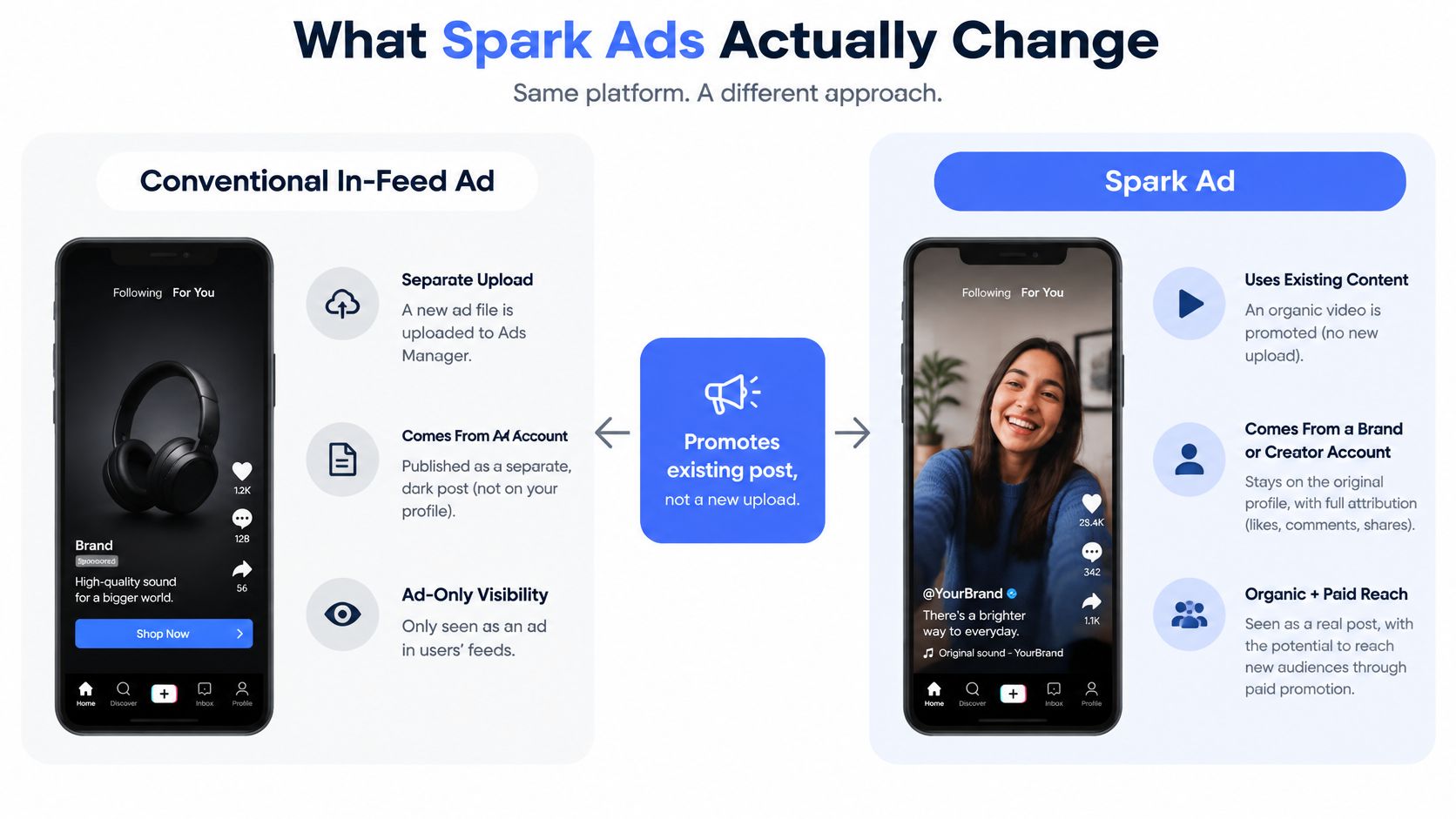
A conventional TikTok in-feed ad starts as a separate creative file, often called a dark post. A Spark Ad starts with an existing organic video from a brand or creator account. You're buying distribution for a public post, not uploading an asset.
TikTok's Spark Ads documentation dates the format's global launch to July 20, 2021, and describes support for video views, engagement, traffic, and conversions. The promoted post retains its original account identity, captions, music, comments, likes, and shares. Viewers can visit the profile and interact with the content rather than encountering an ad detached from its organic context.
The comparison below shows the operational difference.
You're promoting the surrounding context too
Say a creator demonstrates a kitchen appliance. A viewer can watch the demonstration, inspect the creator's profile, read questions about cleaning, and see the creator's replies. Those interactions form part of the buying experience, even when your media team only intended to drive product-page visits.
That context can help or hurt. Useful answers can support the offer; unresolved complaints or exaggerated claims can undermine it. Creative approval therefore needs to include the caption, account context, and existing discussion, not just the video.
Brand team: Approve claims, disclosures, destinations, and the boundaries of paid usage.
Creator: Maintain the agreed source post and understand how the campaign uses their identity.
Media team: Connect authorization, delivery, moderation, and reporting before committing spend.
Practical rule: Approve the post as a living public asset, not as a finished video file.
For a 2026 media plan, this changes the order of work. The creator agreement needs to be settled before the media plan is locked, because the available rights and access determine what the buyer can run. Spark is a three-party operation between brand, creator, and media team, even when an agency coordinates all of them.
Choosing and Treating the Creative
Start with selection, not production polish. Look for posts with sustained attention, specific product questions, and comments that show viewers understood the benefit. A large engagement count without relevant discussion is a weaker signal than a smaller audience asking how the product works.
Spark's technical flexibility isn't permission to ignore presentation. The Benchmarketing Spark Ads benchmark page describes broad flexibility across video ratio, resolution, file type, bitrate, and file size, while noting a 10-minute cap. Use the TikTok ad specifications guide to separate eligibility checks from creative decisions.
Preserve what made the post worth selecting
Keep native vertical framing, readable captions, and the creator's delivery. Protect the opening, particularly the first one to two seconds, rather than replacing it with a logo animation. Captions should make the message understandable without requiring sound.
For new creator briefs, ShipTeaser's guidance on how to write a three-second opening hook is useful for making the opening concrete. Apply that thinking before publication rather than assuming the original sparked post can be rebuilt during ad setup.
Build a test mix around distinct questions:
Creator posts: Does a demonstration or personal explanation make the offer more persuasive?
Brand posts: Does direct product expertise communicate the benefit more clearly?
Dark ads: Does a purpose-built response ad produce better acquisition economics?
There's no universal creative count. Use a manageable set that lets each candidate receive meaningful delivery rather than dividing the budget into inconclusive fragments. Third-party benchmarks place creator-proof posts above the overall Spark median for click-through, making proof-led demonstrations a sensible starting hypothesis, not a guaranteed winner.
Avoid heavy overlays across the creator's face, unnecessary replacement of the opening frame, and captions with unresolved claims. If substantial changes are necessary, commission a new approved post or test a separately licensed dark-ad version. Don't remove the creator's voice while paying to advertise through their identity.
How to Authorize a Post Step by Step
Choose the authorization scope before asking the creator to click anything. A campaign using a named deliverable generally needs post-level permission. An ongoing creator relationship may justify account access, but convenience alone doesn't justify broader permission.
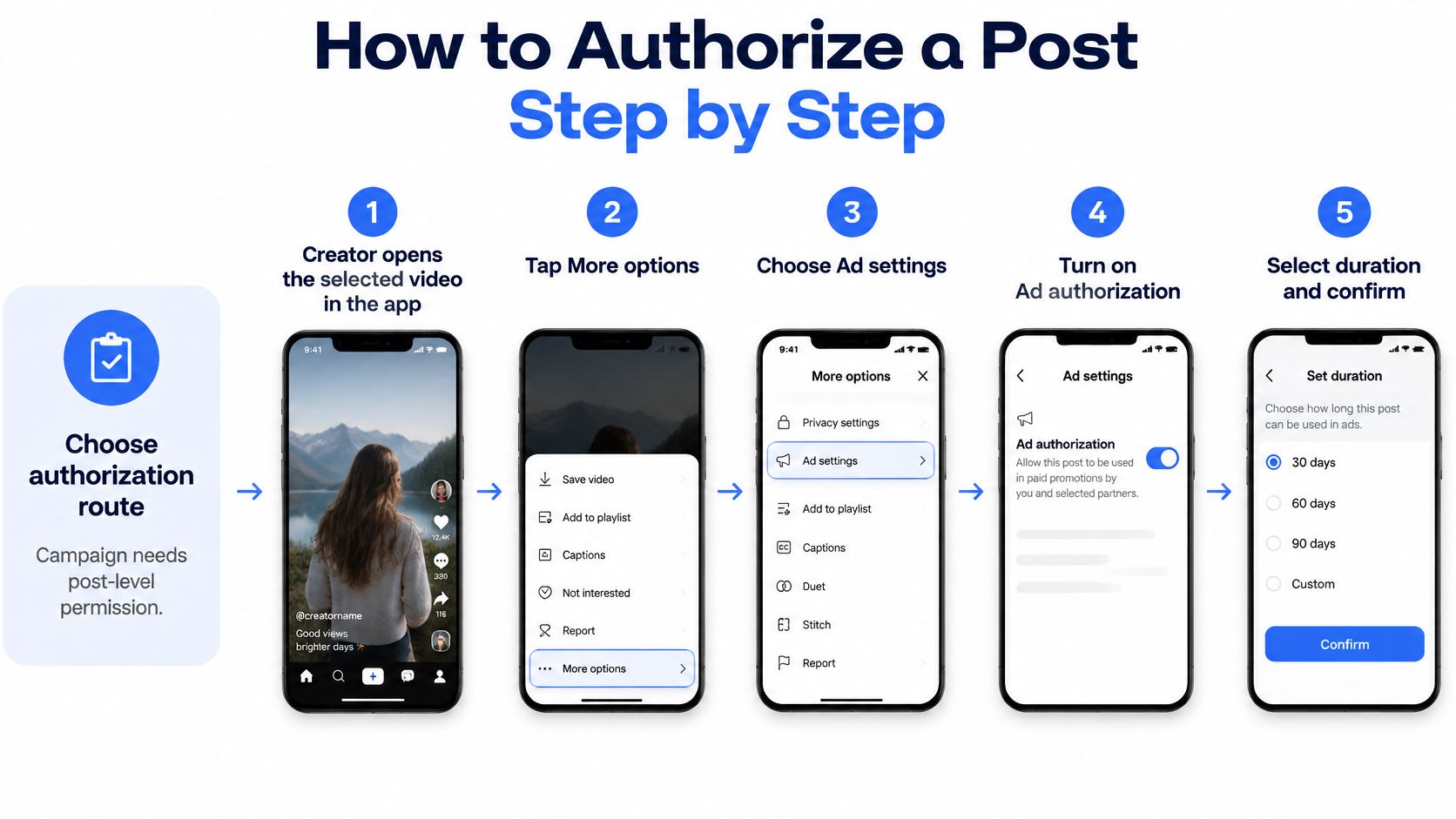
Use this visual as an orientation, then follow the exact-post procedure below.
Generate and apply the video code
TikTok's video-code authorization guide specifies 7, 30, 60, or 365 days and the following post-level workflow.
The creator opens the selected video in the TikTok app.
They tap the three-dot menu and choose Ad settings.
They tap Generate to create the video authorization code.
They select an authorization period from the available options.
They tap Copy Code and send it to the advertiser.
The advertiser enters the code in TikTok Ads Manager when selecting the Spark Ads creative.
The ad runs only within the selected authorization window and stops when it expires. An extension must be arranged before the code expires, so assign an expiry owner and an extension-request owner in the agreement.
For a visual walkthrough of the setup, use this demonstration.
Match the route to the commercial scope
Business Center authorization uses a QR code generated by the brand and scanned by the account owner; linked business accounts provide another route to selecting posts. TikTok's Content Suite collaboration guidance distinguishes 365-day video-level authorization from account-level permission lasting until the creator turns it off.
Separately, TikTok's brand-partner tag guidance establishes 60-day default Spark pre-authorization for tagged content. That's a platform permission window, not a negotiated usage license.
Spark Ads authorization routes compared
Route | Scope | How access is granted | Duration |
|---|---|---|---|
Individual video code | One named post | Creator generates a code in Ad settings and sends it | 7, 30, 60 or 365 days, chosen by creator |
Business Center account authorization | All eligible posts on the authorized account | Brand generates a QR code and the account owner scans it | Governed by the account authorization and active permissions |
Linked TikTok Business account | Posts on the linked account | Advertiser links the business account and selects posts | Governed by the active account link and permissions |
Content Suite video-level invitation | One specific video | Brand sends invitation and creator accepts | 365 days |
Content Suite account-level invitation | Ongoing use of the account | Brand sends invitation and creator accepts | Until the creator turns it off |
Brand-partner tag default | Posts tagged with the brand partner | Creator applies the content-disclosure tag | 60 days by default, a platform window only |
If a code is rejected, confirm it belongs to the exact approved post and ask the creator to regenerate it. Check visibility before entry: private content may become public unless TikTok Ads Only Mode is enabled. Route takedown requests through Spark unauthorization before attempting deletion.
Grant the shortest commercially workable scope, not the broadest access the interface offers.
Structuring Creator Deals Around Spark Ads
Platform permission and contractual usage rights are different things. A functioning code tells the buyer that TikTok permits access. It doesn't settle whether the brand can use the creator's likeness in a particular market, edit the footage, or keep amplifying after the paid-usage term ends.
Treat the contract as the campaign's risk control. The same distinction matters when commissioning UGC ads: paying for production doesn't automatically answer every question about distribution.
Use the contract review to align the creator's promise with the buyer's planned use.
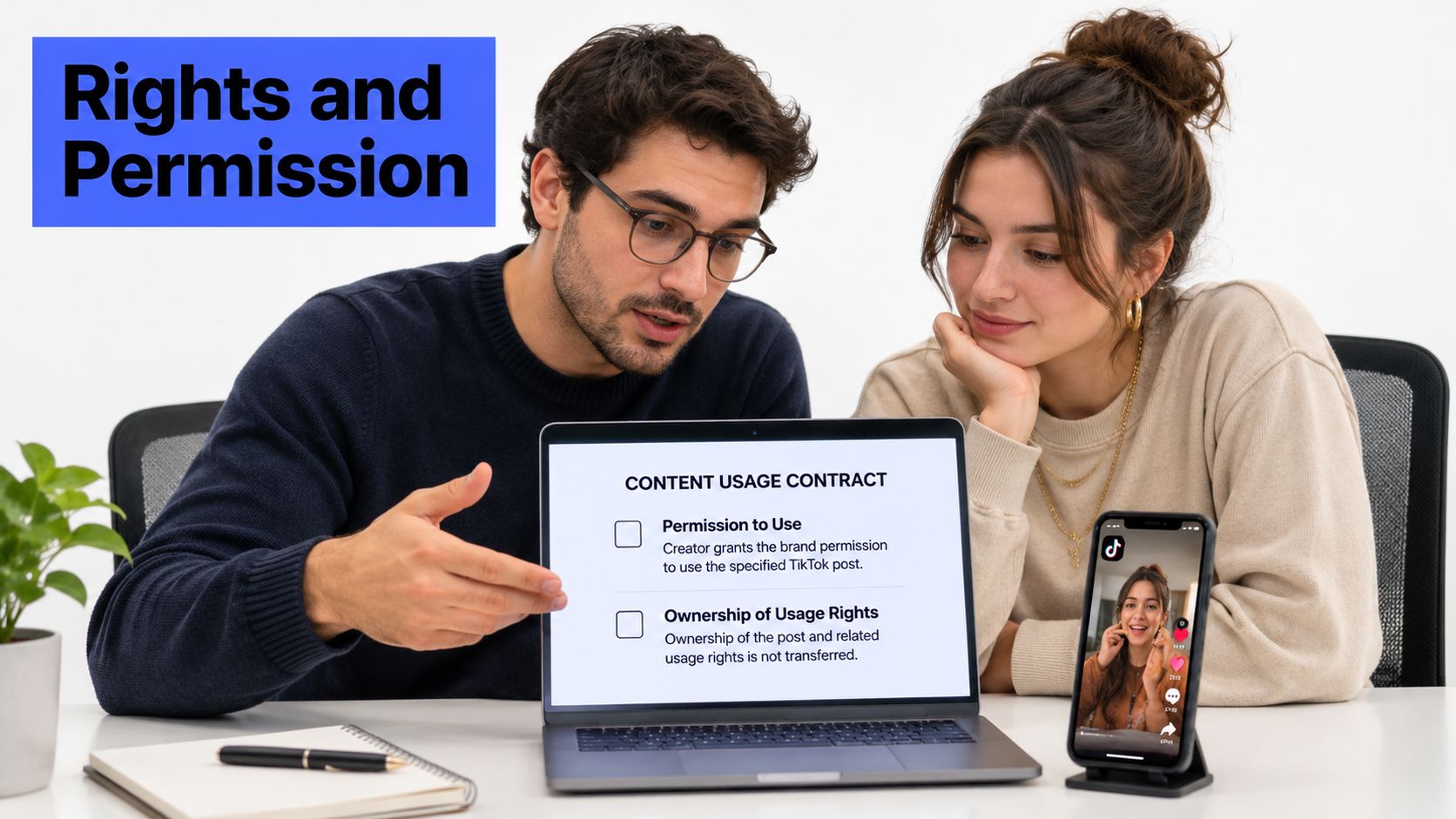
Clauses that prevent campaign disputes
Approved asset and identity: Name the exact video or authorized account. This prevents broad access from being mistaken for approval of every eligible post.
Paid-media term and renewal: Specify campaign dates, renewal fees, and whether renewal requires written approval. Don't let platform access imply automatic commercial renewal.
Amplification ceiling: Agree on spend, impressions, or a defined flight. A limited creator collaboration shouldn't become unrestricted distribution.
Rights and territories: Address likeness, music, substantiation of claims, derivative edits, placements, and geographic markets separately from the authorization mechanism.
Comment ownership: Name who monitors, who answers product questions, and who escalates safety complaints or disputed claims.
Continuity and takedown: Define the response to an edit request, privacy change, revocation, expiry, or urgent removal. Include who pauses media and supplies an alternative.
TikTok's Spark Ads creation guidance identifies important lifecycle constraints: private videos may become public unless Ads Only Mode is enabled, and promoted posts must be unauthorized before deletion. Make those consequences explicit rather than discovering them during a disagreement.
Keep an auditable rights register
Maintain a creator-by-creative rights register containing the post identifier, agreement, authorized accounts, approved markets, paid-usage dates, access holders, and renewal owner. Agencies and regional teams should work from the same record rather than separate message threads.
For example, a regional buyer might have technical access to a creator's account but no contractual right to use that creator's likeness in their territory. The register should make that mismatch visible before launch.
A longer authorization window isn't a substitute for a better agreement.
Use the shortest window that supports testing, scaling, and an orderly wind-down. For healthcare and financial services, have the relevant reviewers assess the claims, disclosures, comments, and regional distribution throughout the authorized use, not just the original upload.
Setting Up and Launching the Campaign
Build the campaign around the intended outcome, then connect the approved post. Starting with whatever code happens to arrive first can leave the buyer optimizing content that was never suited to the business goal.
Work in buying order
Choose the objective. Match video views, engagement, traffic, or conversions to the actual brief. Select the corresponding optimization event and bidding approach rather than treating cheap views as a proxy for sales.
Select the Spark creative source. Use the authorized post or linked account instead of uploading a separate dark-post file. Verify the account identity and video against the signed approval.
Check visibility and eligibility. Resolve the post's public status and Ads Only Mode decision before launch. Don't leave those choices to whoever happens to finish setup.
Complete delivery and destination settings. Configure audience, placement, budget, flight, call to action, landing page, and tracking. Check that the destination delivers what the creator promises.
Protect the comparison. If dark ads are the control, align audience, objective, attribution window, and placement. Record intentional differences so the analysis doesn't attribute every result to Spark.
Creator production and distribution need to connect operationally. At Busylike, we source and manage creators, align their content with client brand guidelines, and turn creator footage into paid ads, TikTok Shop videos, and product page content; we also build and test video ads and UGC-style content for Meta, TikTok, and YouTube.
Make launch approval explicit
Before spending, require confirmation of these items:
Flight coverage: Authorization covers delivery and an agreed operational buffer.
Commercial rights: The usage agreement exists independently of the platform permission.
Source-post stability: The creator hasn't scheduled an unapproved change.
Moderation ownership: A named person can respond and escalate while media is live.
Set a daily expiry check and a calendar reminder early enough to request an extension. Test the destination and conversion tracking with the same care as the creative preview.
At launch, create separate reporting lines for post totals, paid metrics, and platform conversions. Add a holdout where feasible before delivery starts, since it's much harder to reconstruct a credible control group afterward.
Measuring Spark Ads Without Fooling Yourself
The structural problem is that paid and organic histories become intertwined. TikTok's Spark Ads reporting guidance attributes paid views, likes, shares, comments, follows, and other engagement to the original post, while providing separate paid metrics with differing attribution windows, including some engagement counted within one day of an ad view.
That supports visible social proof. It doesn't prove incremental demand.
Separate visibility from business impact
Build the reporting stack with distinct meanings:
Post-level totals: Describe the public asset's accumulated engagement.
Paid metrics: Track paid clicks, followers, profile visits, and engagement using their actual definitions.
Platform conversions: Report attributed outcomes without relabeling them as incremental.
Business outcomes: Reconcile qualified leads, customers, revenue, and acquisition cost with business records.
Use holdouts or geo tests where feasible. For the format comparison, match audience, objective, attribution window, and placement; separately test creator posts against brand posts at comparable CPM. Avoid changing creator, offer, targeting, and format simultaneously and then declaring Spark the winner.
The Polish guide to testing errors provides useful context for avoiding both premature winner declarations and the rejection of potentially useful creative.
Treat benchmarks as hypotheses
TikTok's published Spark comparison reports 30% higher completion, 142% higher engagement, 43% higher conversion, and 4% lower CPM, plus 157% higher six-second view-through in a separate internal brand-auction test. These are platform-reported comparisons, not independent guarantees across categories and markets.
Reported Spark Ads performance versus non-Spark in-feed ads
Metric | Reported difference | Source type | How to use it |
|---|---|---|---|
Video completion rate | +30% vs non-Spark | TikTok-reported internal data | Set a completion target for your own A/B test, not a planning assumption |
Engagement rate | +142% vs non-Spark | TikTok-reported internal data | Test for engagement lift; don't equate it with incremental demand |
Conversion rate | +43% vs non-Spark | TikTok-reported internal data | Validate platform conversions with a holdout |
CPM | 4% lower than non-Spark | TikTok-reported internal data | Budget for broadly comparable CPM |
Six-second view-through rate | +157% vs non-Spark | TikTok internal brand-auction test | Inform upper-funnel creative hypotheses |
Click-through rate | 1.18% median, 1.30% for creator-proof posts | Third-party benchmark page | Directional target only, not an official TikTok standard |
CPM | $8.60 median | Third-party benchmark page | Directional budget input; market and objective affect applicability |
The third-party figures come from the Benchmarketing page identified in the creative-selection discussion. Neither benchmark set should replace your own baseline.
Decision standard: Scale when the business result improves at an acceptable acquisition cost, not simply when the public engagement counter rises.
Where Spark Ads Fit and Where They Do Not
Spark Ads fit campaigns where the source account and public discussion add value. They're less useful when the team needs complete message control, frequent revisions, or a creative asset that should remain separate from an organic presence.
The distinction is practical, not ideological.
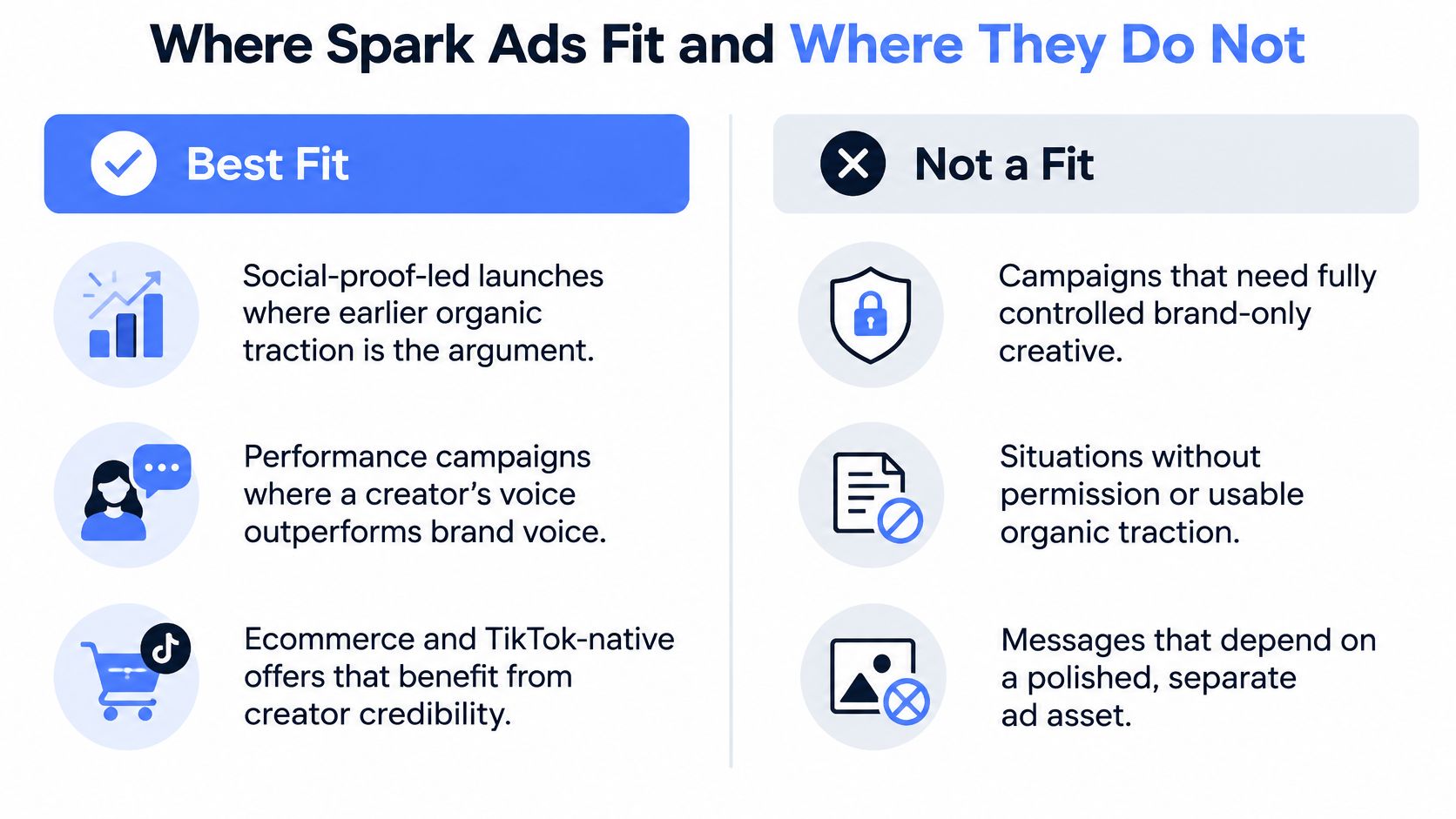
Choose the format around the job
Social-proof-led launches: Earlier organic traction can support the product's introduction, particularly when useful questions already appear beneath the post.
Creator-led performance: Test Spark when a creator's explanation may persuade more effectively than brand narration.
Ecommerce and TikTok Shop: Demonstrations, unboxings, and product-in-use content provide concrete reasons to consider an offer.
Expert-led consideration: For B2B brands using TikTok, a credible practitioner explaining a workflow may be a better starting point than a polished corporate message.
Choose dark ads when frequent offer changes or tightly controlled messaging matter more than accumulated public engagement. Spark adds dependencies: access can end during a flight, source-post changes require coordination, and somebody must manage the discussion.
Account-wide permission can also exceed what a short campaign needs. A cautious buyer should distinguish operational convenience from necessary access.
For a 2026 budget, run Spark as a test lane beside dark ads, not as their automatic replacement. Preserve a controlled alternative so a creator-related interruption doesn't leave the campaign without usable creative.
Brands without creator relationships can handle sourcing, creator-aligned production, and paid social management across TikTok, Meta, and YouTube in-house or through an agency partner. Apply the same authorization scope, usage-rights, and measurement standards either way.
Busylike sources and manages creators, turns their footage into paid-ready content, and builds and tests video ads across TikTok, Meta, and YouTube. Visit Busylike to discuss a Spark Ads program that connects creator production with a clearly defined authorization, usage-rights, and measurement plan.

