
UGC Ads: What They Are and How to Make Them Convert

A 2025 analysis of 84 campaigns from 2024 to 2025 in the UGCera white paper reported a 21% average conversion-rate increase and 17% lower cost per acquisition for UGC ads compared with conventional brand creative, with the strongest gains among Gen Z audiences. The same report notes that directed consumer-generated content, meaning creator or customer videos shaped by a structured brand brief, outperformed traditional brand-produced social ads on conversion rate, total conversions, and return on ad spend in field experiments.
Most paid-social teams still treat authenticity and conversion discipline as opposites. They hand a creator a free product, ask for an honest review, and hope the resulting clip survives a cold-traffic auction. When it stalls after two days of spend, they assume user-generated creative doesn't work for their category.
The problem isn't the format. It's the absence of direction. Directed UGC solves that trade-off by locking down the four elements that drive conversions, specifically the claim, the hook, the on-camera proof, and the call to action, while leaving delivery, setting, and natural phrasing to the creator. Once those clips go live, disciplined media buyers separate the creator effect from the creative effect so budget scales repeatable messaging rather than one charismatic spokesperson.
Building that system takes four production pillars: an eight-part creator brief, transparent budgeting for usage rights, a five-hook testing matrix per concept, and sequential metric evaluation.
Table of Contents
What UGC Ads Are and Why Audiences Trust Them - How Peer Proof Moves Viewers Through the Funnel
UGC Ad Formats Compared Side by Side - Top-of-Funnel Formats for Cold Traffic - Mid-Funnel and Bottom-Funnel Conversion Formats
Platform Specs and Partnership Ads by Placement - Aspect Ratios, Safe Margins, and Cut Strategy - Choosing Between Brand Accounts and Partnership Tools
How to Brief Creators for Ads That Convert - Eight Steps to a High-Converting Creator Brief - Pre-Shoot Sign-Off Checklist
Creator Rates and Usage Rights to Budget - How Licensing Modifiers Stack on a Real Budget - Vetting Creators Before You Request Quotes
Build Five Hook Variants for Each Concept - Designing a Ten-Variant Hook Matrix - Worked Example for a Kitchen Herb Keeper - Editing Discipline and Hook Retirement
How to Test Hooks Without Fooling Yourself - Reading Performance Metrics in Sequence - Three Testing Errors That Corrupt Your Read - Separating the Creator Effect From the Creative Effect
Compliance and Pitfalls That Stall UGC Campaigns - Six Operational Pitfalls and How to Fix Them - Localizing Governance for Global Campaigns
Launch Your First Five-Hook UGC Test - Six-Step Launch Sequence - Scaling Production Without Burning Out Your Team
What UGC Ads Are and Why Audiences Trust Them
A UGC ad is a paid advertisement built from footage shot by customers, commissioned creators, or employees rather than a brand's in-house studio. Put two skincare clips side by side in an Instagram Reels feed to see the difference. A polished brand film shows studio lighting, slow-motion water droplets, and a voiceover promising clearer skin in seven days. Its underlying message is trust us. A creator holding a phone at a bathroom sink, rubbing serum onto dry cheeks after a red-eye flight, sends a different signal: here is what happened to me.
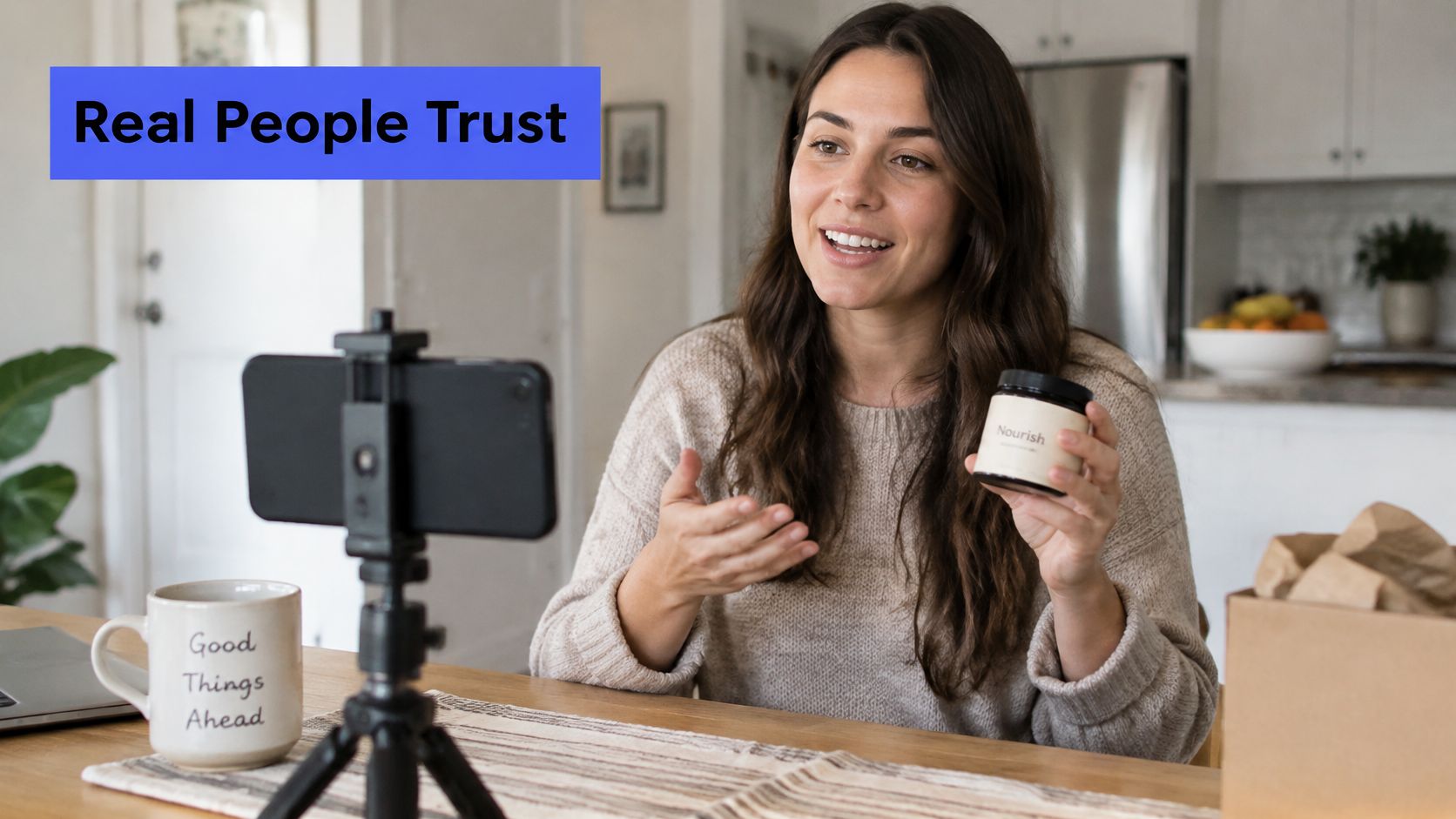
Viewers respond to that peer framing because of how buyers evaluate risk. In Nielsen's 2021 global study compiled by GrowthSpurt, covering more than 40,000 respondents, 88% of people trusted recommendations from people they knew more than any other advertising channel. That figure measures word-of-mouth from friends and family rather than every online ad featuring a stranger, so it shouldn't be mistaken for a guaranteed paid-social benchmark. Still, it captures the behavioral engine behind peer-led video. Additional research compiled on the same page reports that 79% of people say UGC highly influences purchasing decisions, versus 13% for brand-created content and 8% for influencer content, though those figures draw from separate studies with different samples and definitions rather than one standardized industry baseline.
Broader retail data reinforces the same buying habit. According to Bazaarvoice's Shopper Experience Index Volume 18, cited by Christoph Olivier Consulting, 65% of global shoppers relied on ratings, reviews, photos, or videos from other consumers when making purchase decisions in 2024.
How Peer Proof Moves Viewers Through the Funnel
The persuasion mechanism unfolds in three fast beats. First, the viewer spots someone who looks and speaks like a peer, which lowers the ad-filtering reflex triggered by slick studio openings. Second, the speaker names a specific, recognizable frustration, such as sunscreen pilling under makeup or a carry-on zipper jamming on a weekend trip. Third, the viewer watches the product resolve that frustration in an ordinary room without studio tricks.
Because those three beats work at multiple buying stages, UGC ads don't live exclusively at the bottom of the funnel. On cold TikTok and Reels feeds, a relatable problem-led video earns attention and qualifies viewers at low friction. Mid-funnel retargeting pools use hands-on demonstrations to answer practical doubts about texture, size, or durability. On ecommerce product detail pages, customer clips supply final reassurance right next to the add-to-cart button.
Practical rule: Treat UGC ads as performance creative that works alongside professional brand production, not as a blanket replacement for it. High-craft studio work still carries brand equity, product detail, and visual identity; peer video carries credibility and objection handling.
Before putting ad spend behind any clip in your existing library, run a five-second sound check. Play the opening without looking at your media plan and ask one question: does this sound like someone who bought and used the product, or like a marketing manager reading positioning copy through a stranger's mouth? If it sounds like the brand talking about itself, recut or rebrief it before launch.
UGC Ad Formats Compared Side by Side
Choosing the right visual structure matters as much as picking the right spokesperson. Different formats solve different buyer doubts, and testing six unrelated formats simultaneously burns budget before you learn what moved the viewer.
Format | What It Looks Like | Best Used For |
|---|---|---|
Customer testimonial | Real buyer describes the problem and the result | Trust and consideration |
Unboxing or first use | Hands-on reveal in the first minute of the video | Product-led and ecommerce ads |
Creator demo | Creator shows one feature solving one task | Feature-led conversion ads |
Problem-solution story | Creator opens on a frustration, then shows the fix | Cold traffic on short-form feeds |
Review or comparison | Creator rates the product against a habit or alternative | Bottom-funnel decisions |
Street or POV interview | Creator asks strangers or answers camera questions | Awareness and lifestyle ads |
Top-of-Funnel Formats for Cold Traffic
Cold audiences don't know your brand name and aren't searching for a product tour. Problem-solution stories work well here because the opening second anchors on an annoyance the viewer already feels, pulling them into the fix before they realize an ad is running. The trade-off is script sensitivity: if the opening problem feels exaggerated or scripted, viewers swipe immediately.
Street or POV interviews also excel in cold feeds, especially for lifestyle, food, beverage, and apparel categories. Watching a passerby react on a city sidewalk or seeing a creator respond to an on-screen viewer question feels unforced and travels well across social channels. The catch is that POV concepts live or die on the first two seconds; a weak question or sluggish pacing kills retention before the product ever enters the frame.
Mid-Funnel and Bottom-Funnel Conversion Formats
Once a viewer understands the problem, they want to see the product in action. Creator demos isolate one feature solving one clear task, such as a stain remover lifting coffee from a white sleeve or a travel organizer compressing five days of clothes. Demos are the easiest format to brief tightly, though their weakness is polish creep: too many tidy transitions make the clip look like a standard commercial. Unboxing or first-use clips serve product-led ecommerce brands where packaging, tactile quality, or scale drives desire, though they fall flat if the box looks generic or the reveal drags.
Customer testimonials anchor mid-funnel trust by pairing a buyer's past skepticism with a concrete outcome. They carry strong credibility, yet they're harder to direct without flattening the speaker's natural cadence. At the bottom of the funnel, reviews and comparisons pit your product directly against an older habit or competing category option, giving hesitant shoppers permission to switch. Their main trade-off is audience scope: comparisons convert warm prospects efficiently but narrow reach among cold viewers who don't yet recognize the alternative.
Before filming your own variations, study which formats survive long periods of paid spend in your niche. You can find UGC ads in Meta using AdLibrarySpy's breakdown of active ad-library patterns, focusing on long-running creatives rather than one-off viral posts.
Remember that format and platform aren't the same decision. One well-framed demo can run across TikTok, Meta, and YouTube using length cuts suited to each platform. For a new product launch, resist testing all six formats at once. Start with one creator demo tested across two distinct hooks so your data stays readable. If your category relies on visual transformation, such as cleaning tools, beauty, or kitchen gear, test the creator demo first; if you sell consumables or supplements where buyers hesitate over taste or trust, start with a problem-solution story backed by a real customer testimonial.
Platform Specs and Partnership Ads by Placement
A creator shoot loses half its value when an editor tries to force one exported master file into every ad placement. Aspect ratios, safe zones, audio habits, and account-level distribution tools change how the exact same footage performs across channels. Mapping every cut to its destination before the camera rolls protects framing and keeps test data clean.
Aspect Ratios, Safe Margins, and Cut Strategy
Short-form vertical feeds demand native framing from the first frame. Plan 9:16 vertical cuts running 15 to 30 seconds for TikTok, Instagram Reels, and YouTube Shorts, placing the visual and spoken hook inside the first three seconds. Many social viewers scroll with sound off, so burn clean native-style captions directly into the video to carry the core claim visually. Keep all captions, stickers, and product close-ups clear of the bottom third of the frame, where platform usernames, captions, and action buttons cover your message. For exact resolution, file size, and safe-zone boundaries on ByteDance's feed, check our breakdown of TikTok ad specs before locking your edit template.
Meta feed placements frequently favor 4:5 vertical or 1:1 square framing to maximize screen real estate without awkward cropping. Instruct creators to step back slightly during product demonstrations and keep their hands and the product centered inside generous safe margins. That single filming instruction lets your editor export crisp 9:16, 4:5, and 1:1 deliverables from one raw recording without slicing off labels or faces.
Cold-Traffic Cuts: Open immediately on the viewer's frustration or curiosity trigger, introduce the product by second five, and close on one clear action.
Retargeting Cuts: Skip the problem setup, open directly on the finished result or top objection, and move straight into proof and offer details.
Per-Platform Exports: Render separate length cuts for TikTok, Reels, Shorts, and Meta Feeds from the same raw footage rather than uploading one generic file everywhere.
Placement Naming Logs: Tag every file with its concept ID, hook number, length, and target placement (for example, ) so media buyers can compare creative performance without mixing up placements.
Choosing Between Brand Accounts and Partnership Tools
How an ad appears in the feed affects stopping power just as much as the edit itself. Running creator footage from your brand's ad account works fine for rapid hook iteration and full creative control, yet creator-handle distribution often preserves more social proof.
On TikTok, Spark Ads let you put paid budget behind an existing organic post published on the creator's own profile. The ad retains the creator's username, likes, and comment thread, which fits naturally into the For You feed. On Instagram and Facebook, Meta Partnership Ads operate on a parallel principle, delivering the creator's post as a paid placement through their account handle after they grant account-level ad permissions. Because both formats tie ad delivery to the creator's identity, secure authorization codes and permission windows before launch.
Once those placement-specific cuts are live, standardize how you evaluate watch time and drop-off across vertical feeds. Exerta's guide to measuring short form ad performance outlines practical ways to read retention curves alongside conversion metrics so platform nuances don't distort your creative decisions.
How to Brief Creators for Ads That Convert
Unstructured briefs produce rambling videos. Over-scripted briefs produce stiff infomercials. Directed UGC sits cleanly between those two failures: your team scripts the claim, hook, proof, and call to action, while the creator improvises the delivery, physical setting, phrasing, and small conversational objections in their own voice.
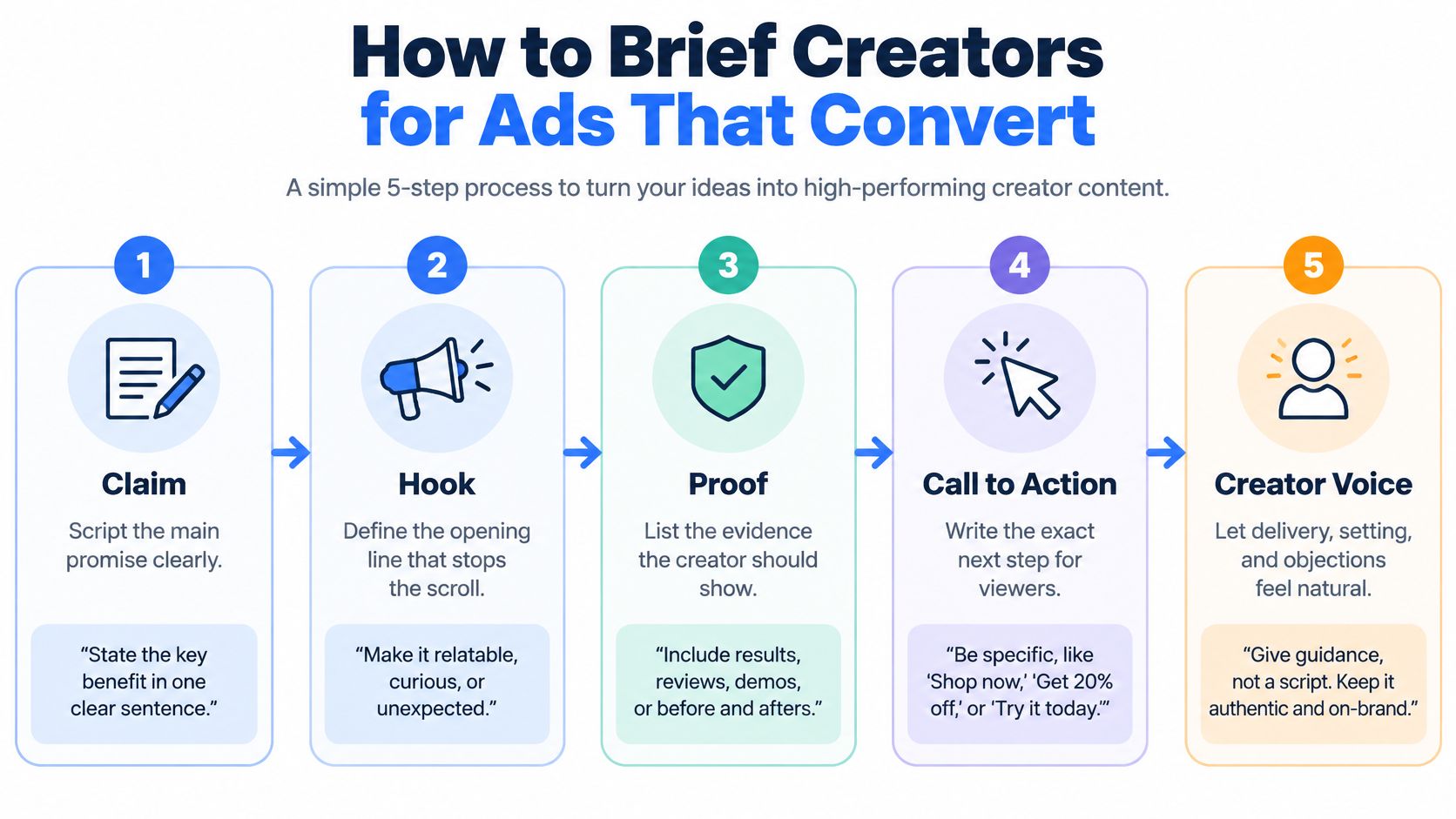
A tight production brief removes guesswork for the creator and prevents expensive reshoots for your brand. Build every creator assignment using these eight steps in sequence.
Eight Steps to a High-Converting Creator Brief
Write the one-line claim the ad must prove. Every high-converting clip argues one clear point, such as this travel steam iron removes linen wrinkles in 30 seconds without an ironing board. Anchoring on one claim stops the creator from reciting five product-page bullet points that blur together. Teams regularly slip here by asking for a natural, authentic video without naming the single fact that must land on camera.
Specify the required on-camera proof. Tell the creator exactly what physical demonstration validates the claim, and mark that shot as mandatory. If the claim is fast wrinkle removal, the brief must require an unbroken shot of a crumpled shirt smoothing out under steam. Leaving proof optional usually yields 25 seconds of talking-head praise that viewers don't believe.
Supply five labeled hook openings. Don't expect a creator to invent your split-test matrix. Provide five distinct opening lines labeled Hook A through Hook E, pairing each line with the emotional tone you want (skeptical, relieved, surprised, blunt, or curious) and inviting the creator to tweak small words so the line fits their mouth. Skipping hook options leaves your editor with one weak intro and no testing room.
Confirm target platforms and framing rules. List the exact channels and aspect ratios required for the shoot, noting whether the footage will serve vertical short-form feeds, square feed placements, or both. Stating this upfront keeps the creator from filming in horizontal mode or placing the product right against the frame edge where overlays will block it.
Define the target runtime and edit cut points. Give a clear length window, such as 15 to 30 seconds for the finished cut, and ask the creator to leave a one-second pause between distinct beats (hook, demo, proof, close). Those tiny pauses give editors clean audio cuts without chopping syllables. A common mistake is letting creators rush through all four beats in one breathless take, making modular hook swaps impossible.
Spell out compliance language and red lines. Put mandatory disclosure phrasing, prohibited claims, and accurate product terminology in a dedicated callout box. If a skincare serum hydrates dry skin rather than curing eczema, state that boundary explicitly so the creator doesn't improvise an illegal claim that forces you to scrap an otherwise strong take.
Lock down usage rights and handle permissions. State whether the deliverables cover organic reposting, paid social whitelisting, specific license durations, and renewal options before filming starts. Burying licensing inside vague email threads causes painful disputes the moment an ad turns profitable and needs more spend.
Set file-delivery specs and review deadlines. Specify whether you need clean raw camera clips alongside an edited cut, require simple filenames matching your hook labels, and set a concrete draft-review date with room for one revision round. Forgetting to ask for clean, uncaptioned raw footage traps your editors with baked-in fonts they can't adjust for other channels.
Pre-Shoot Sign-Off Checklist
Before shipping product or releasing a deposit, confirm five items in writing with the creator:
Core Claim and Proof Shot: Both sides agree on the single promise and the exact visual demonstration required.
Five Labeled Hooks: The creator confirms they'll record all five openings separately with brief pauses before the shared body.
Technical Framing: Lighting, vertical orientation, safe margins, and clean audio without background music are verified.
Compliance Boundaries: Required disclosures and off-limits wording are acknowledged.
Rights and Deadlines: License scope, raw-file delivery, and submission date are signed off.
Never pay a deposit on a brief that doesn't list the exact visual proof shot. Talk is cheap in paid social; demonstration is what converts.
Creator Rates and Usage Rights to Budget
Marketing leads often budget UGC ads as if a creator's initial quote buys an ad ready for unlimited spend. It doesn't. A base rate covers production of one short-form video deliverable and nothing else. Running that video behind paid media, publishing it through the creator's handle, requesting unedited source files, or restricting the creator from filming for rivals are separate licensing items that stack onto the base fee.
According to CollabScene's 2026 UGC creator rate benchmark, a practical base rate runs $150 to $300 per short-form video before licensing, with usage and source-file modifiers structured as follows:
Line Item | Typical Price | What It Covers |
|---|---|---|
Base short-form video fee | $150 to $300 per video | The deliverable before any licensing |
Paid social rights, 6 to 12 months | 30% to 100% above base fee | Brand runs the video as a paid ad |
Whitelisting or Spark/Partnership Ads | About 30% per month, or $200 to $500 per month flat | Ads run through the creator's own handle |
Raw footage delivery | 30% to 50% above base fee | Source files for editing |
Category exclusivity | 20% to 50% above base fee | Creator cannot work with competing brands |
Perpetual buyout | 100% to 150% above base fee | Rights with no end date |
Benchmarks vary noticeably by license window and creator tier. For shorter test windows, Reliable PR's usage-rights guide places paid-ad usage at an additional 20% to 50% of the base video fee for a defined 30-, 60-, or 90-day license, while putting whitelisting at a 50% to 100% premium or a recurring $500 to $2,000 monthly fee. Always quote the exact term you need and confirm the uplift percentage in writing before production begins.
How Licensing Modifiers Stack on a Real Budget
Teams most often overlook usage fees in a predictable order. Paid social rights come first, because many buyers assume purchasing a video automatically grants advertising rights. Whitelisting comes second, catching teams off guard when they decide mid-campaign to test creator-handle ads and face a monthly access fee. Raw footage is the third blind spot: without source files, your editors can't splice new hooks or cut shorter retargeting edits. Category exclusivity and perpetual buyouts follow, and neither should ever be assumed without explicit line-item pricing.
Consider a simple worked example to see unit cost. Suppose you book a creator at a $200 base fee for one short-form video. Adding six-month paid social rights at a 50% uplift adds $100, bringing the subtotal to $300. Adding raw footage delivery at 30% of the base fee adds another $60, putting your all-in production cost at $360 before media spend. If you later add whitelisting for two months at $250 per month, the asset's total cost climbs to $860.
Separating every rights line on both the brief and the invoice keeps renewal and expiration dates visible to finance and media buyers alike. When you run creator partnerships across video ecosystems such as Meta, TikTok, and YouTube, understanding structured platform programs like YouTube BrandConnect also helps you anticipate how creator licensing integrates with channel-native ad formats.
Vetting Creators Before You Request Quotes
Smart sourcing protects your budget before negotiations start. Shortlist creators based on audience fit, on-camera pacing, and past paid-ad track records rather than follower counts. Before asking for a formal quote, vet each candidate on two operational checks: review their past sponsored posts to verify clean brand disclosures, and confirm they accept itemized usage rights and raw-footage licensing.
Finish every budget plan with one sanity check. List only the modifiers your campaign requires right now (don't pay for a perpetual buyout on an untested concept), total the asset cost, and judge that all-in figure against your target cost per result rather than comparing creators on base fee alone.
Build Five Hook Variants for Each Concept
A hook is the opening two to three seconds of video that decides whether a viewer stops scrolling or swipes past. Most ad accounts bleed creative budget because they film five completely different videos when they only needed one strong product demonstration paired with five distinct entry points.
Using a structured hook matrix, outlined in ChatterBuzz Media's ad creative testing guide, you can cross five hook formulas with two creative angles to generate ten testable variants from a single concept shoot. The mechanic stays simple: hold the core product demonstration constant, instruct the creator to record that shared body once, and have them film five clearly labeled openings so editors can stitch comparable cuts together in minutes.
Designing a Ten-Variant Hook Matrix
Start by selecting two buyer motivations that matter for your product, such as saving money and saving time. Next, map five proven opening structures across those two angles:
Hook Formula | Price Angle Focus | Convenience Angle Focus |
|---|---|---|
Bold claim | Stopping a recurring expense | Cutting a daily chore in half |
Direct question | Calling out wasted spend | Calling out a recurring frustration |
Before and after | Comparing monthly bills | Showing messy setup versus clean fix |
Surprising fact | Highlighting hidden cost per use | Highlighting time lost each week |
Direct comparison | Pitting product against store-bought option | Pitting product against an older tool |
Because the shared body never changes, the creator shoots one clean 20-second demonstration and five separate three-second intros per angle. Production time barely increases, yet your media buyer walks away with a full testing batch instead of a single gamble.
Worked Example for a Kitchen Herb Keeper
Picture a hypothetical DTC brand testing a countertop herb and greens keeper using one shared 20-second demo showing crisp cilantro and washed romaine staying fresh after ten days in the fridge. Under the convenience and waste-reduction angle, the creator records five labeled openings that all cut straight into that identical demo:
Opening 1 (Bold Claim): I stopped buying bagged salad the week I put this on my fridge shelf. Strong declarative openings hook viewers who want an immediate payoff.
Opening 2 (Question): Why does your herb keeper still turn cilantro into slime by Thursday? Questions trigger self-recognition among buyers already annoyed by spoiled produce.
Opening 3 (Before and After): Hold up a wilted bag of brown spinach in frame one, snap-cut to crisp green leaves in frame two, and say same grocery run, ten days later. Visual contrast carries the hook even with sound muted.
Opening 4 (Surprising Fact): People throw away two bags of greens a month before opening them, and it's usually because of trapped water. Leading with a concrete insight positions the creator as helpful rather than pushy.
Opening 5 (Direct Comparison): Place a damp paper towel beside the keeper and say wrapping herbs in paper towels buys you two days; this bought me two weeks. Comparisons pull in shoppers already trying DIY fixes.
Editing Discipline and Hook Retirement
Strict post-production discipline makes the matrix readable. Keep caption font, text placement, background audio level, color tone, and end-card call to action completely identical across all five edits. If an editor sneaks faster jump cuts or upbeat music into Opening 3, you're no longer testing hooks; you're testing editing styles.
Know when to retire an opening without throwing away a winning concept. Track each hook's three-second retention across refresh cycles. When a winning hook's hold rate drops across two consecutive creative refreshes while conversion efficiency softens, replace only the opening three seconds with a fresh batch of hooks and keep the proven 20-second product demo working.
How to Test Hooks Without Fooling Yourself
Running five hook variants at once only teaches you something if your test isolates the hook and your team reads the metrics in the right order. Reading clicks or return on ad spend in isolation creates false winners that collapse the moment you raise daily spend.
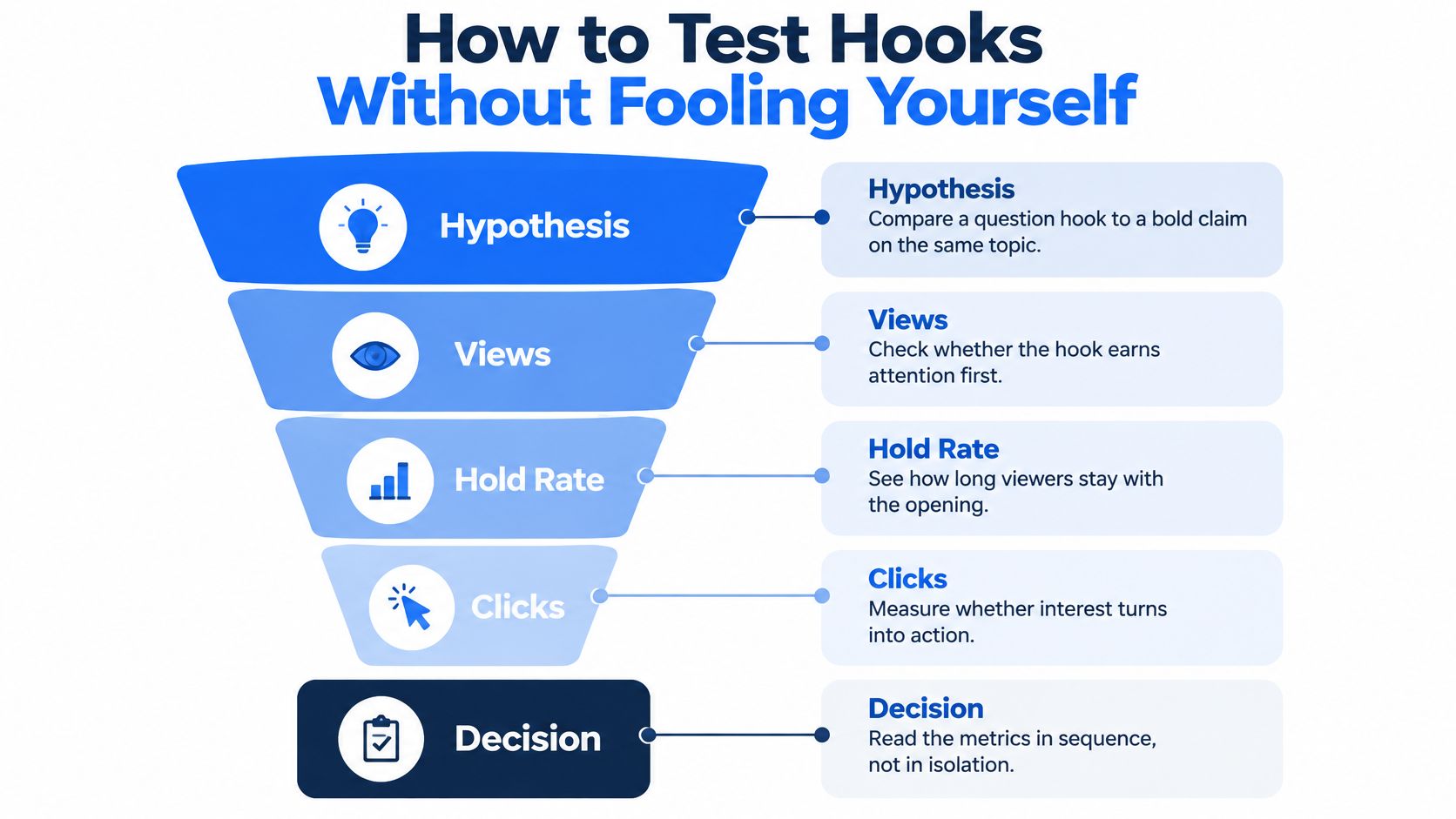
As detailed in ReUGC's controlled creative testing framework, every hook test starts with a one-line hypothesis written before launch, such as a direct question hook will hold cold viewers longer than a bold claim for this herb keeper. Launch a batch of three to five variants simultaneously against an active control ad, hold the product demonstration and targeting steady, and lock in your evaluation window or spend threshold before the first dollar spends.
Reading Performance Metrics in Sequence
Evaluate every test batch strictly from top to bottom of the viewer journey so each metric diagnoses a distinct layer of the creative.
Start with hold rate (the share of impressions that stay past the opening seconds). Hold rate tells you whether the hook did its job and stopped the scroll. Next, check click-through rate to see whether the viewers you held found the promise compelling enough to visit your landing page. A sky-high hold rate paired with a weak click-through rate usually means the opening used clickbait or curiosity disconnected from the product demo.
Move third to conversion rate, which tests whether those clicks turned into real buyers or qualified leads. High clicks paired with flat conversions signal a mismatch between the hook's promise and your product page or offer. Finally, inspect cost per result to determine whether the variant generates profitable acquisitions at a price worth scaling.
Testing discipline: Never judge a hook by cheap clicks alone. Curiosity traps produce low cost-per-click numbers all week while quietly driving up your cost per acquisition.
Three Testing Errors That Corrupt Your Read
Even experienced growth teams sabotage hook tests with three avoidable slips. First, they tweak multiple variables at once, swapping the landing page offer, tightening mid-video edits, or shifting audience targeting on one variant while leaving others untouched. Once two variables move, you can't tell what caused the lift; fix this by freezing the body edit, offer, and audience so only the hook changes.
Second, media buyers get impatient and declare a winner after one strong day of spend. Platform algorithms fluctuate wildly during initial delivery, and one early conversion can make a weak ad look like a breakout hit. Fix this by holding the full predefined evaluation window or spend threshold before making scale-or-kill calls.
Third, teams promote whichever ad wins the cheapest click or highest view rate, ignoring downstream sales. Fix this by requiring conversion rate and cost per result to confirm the upper-funnel signal before moving budget into your scaling campaign.
Separating the Creator Effect From the Creative Effect
One of the sharpest insights in paid-social testing happens when a single creator outperforms the control across every hook they record, even weak ones. When that occurs, your test isn't measuring the opening line; it's measuring the creator effect, meaning that person's voice, warmth, or on-camera credibility carried the ad. Conversely, the creative effect shows up when one specific hook structure wins across multiple faces.
To separate the two, take your top-performing hook from a breakout creator and hand that exact opening line and demo structure to a second creator in your next sprint. If the second creator also beats the control, you've found a scalable creative angle you can replicate across your roster. If only the original creator wins, double down on booking that spokesperson for fresh concepts instead of over-investing in the script.
Apply one simple winner rule at the close of every test: scale only a variant that beats the live control on both hold rate and cost per result across the full evaluation window.
Compliance and Pitfalls That Stall UGC Campaigns
UGC ads fail for boring reasons. A creator says the right line, the product looks good, the edit moves, then legal or platform rules force a rebuild. Worse, the ad runs as intended and damages trust because the audience later learns the relationship was paid or the claim was overstated.
Under Federal Trade Commission (FTC) endorsement guidance, cited in Tubefilter's creator disclosure trust report, brands and endorsers must clearly disclose any material connection, including financial payment, free products, employment, or personal and family relationships. A 2026 survey cited in the same Tubefilter report found that only one in four U.S. adults believed creators consistently disclose brand relationships. That number matters because disclosure is part of the creative, not paperwork attached after the edit. If viewers already suspect paid influence, a vague hashtag buried under a caption gives them another reason to discount the ad.
Synthetic media adds another layer. Industry data in the Tubefilter report noted that more than half of Gen Z and Millennial consumers want advertisers to disclose fully AI-generated ads or AI-generated visuals, and nearly half want disclosure for AI voices or avatars. For UGC-style advertising, that creates a practical line: script the claim, hook, and proof, keep delivery improvised, but label anything synthetic that could be mistaken for a real buyer or real creator.
Six Operational Pitfalls and How to Fix Them
Compliance failures rarely come from bad intent. They happen when creative teams move faster than the rules for paid content, testimonials, usage rights, and AI assets. Review the influencer disclosure rules for brands summarized in a third-party guide, then lock down these six failure points before any asset enters your ad manager.
Undisclosed Paid, Gifted, Employee, or Family Creators: Paying a creator, mailing complimentary product, filming an employee, or putting a founder's relative on camera all trigger disclosure requirements. The fix: bake a clear, plain-English disclosure, such as Paid partnership or Brand ambassador, into the first frame's caption or opening overlay, and enable native platform disclosure toggles rather than hiding tiny hashtags below the fold.
Unsubstantiated Customer Testimonials: Quoting dramatic customer outcomes that are not typical or cannot be verified turns social proof into a liability. The fix: maintain a written consent log pairing every customer clip with the result the customer experienced and standard performance context, following clean production practices for customer testimonial videos.
Overreaching Health and Supplement Claims: Creators frequently improvise disease-treatment or medical claims when talking passionately about wellness products. The fix: require human compliance review of scripts and raw cuts before editing. At Busylike, we keep supplement ad claims within FTC and FDA guidelines.
AI Voices, Avatars, or Faces Posing as Real Buyers: Synthetic presenters without clear labeling alienate skeptical viewers and conflict with platform transparency expectations. The fix: keep a clear creative taxonomy separating authentic customer video, paid creator endorsements, employee content, and synthetic assets, and apply required AI provenance labels whenever synthetic voices or visuals appear.
Product Footage Recycled Under a New Voiceover: Editors racing to hit weekly volume sometimes reuse visual demos from an older formula or different SKU underneath new audio claiming updated benefits. The fix: lock raw footage folders by exact SKU and formula date, and run a mandatory visual-to-audio accuracy check during final QA.
Active Ads Running Past License Expiry: Scaling a winning ad after a 90-day paid-usage license ends triggers breach-of-contract invoices and abrupt ad-account takedowns. The fix: track every creator asset in a shared rights calendar with automated 14-day renewal alerts so media buyers either extend the license or pause the ad on time.
The operational trade-off is speed versus control. A creator workflow with clear claim boundaries, consent records, disclosure rules, and rights tracking takes longer at the start. It also prevents the expensive version of the problem: stopping spend, re-cutting the asset, renegotiating usage, and losing the learning window. That is especially relevant for directed UGC, where the brand controls the message while the creator controls delivery. Keep the creator's natural cadence, but document what they may say, show, or imply.
Localizing Governance for Global Campaigns
Disclosure norms do not stop at U.S. borders. Labeling phrasing, comparative advertising limits, healthcare substantiation standards, and platform AI tags vary substantially across the UK, European Union, Canada, and Asia-Pacific markets. Before duplicating a winning U.S. ad into international ad accounts, run a local regulatory review on the disclosure wording, product claims, and platform-native tags required in each target country.
For global UGC programs, keep one master version of the concept and localize the compliance layer around it. That means matching the disclosure to local expectations, checking whether the testimonial context still holds, and confirming that any synthetic voice, avatar, or visual treatment is labeled in the required format. The hook and proof script can stay consistent. The legal and platform wrapper cannot be copied blindly.
Launch Your First Five-Hook UGC Test
Reading production frameworks doesn't lower your cost per acquisition; shipping a clean first test does. Before filming begins, lock your team into a short, disciplined launch sequence rather than trying to overhaul your entire creative library in one sprint.
Here is how a clean five-hook test comes together from concept selection to scale decision.
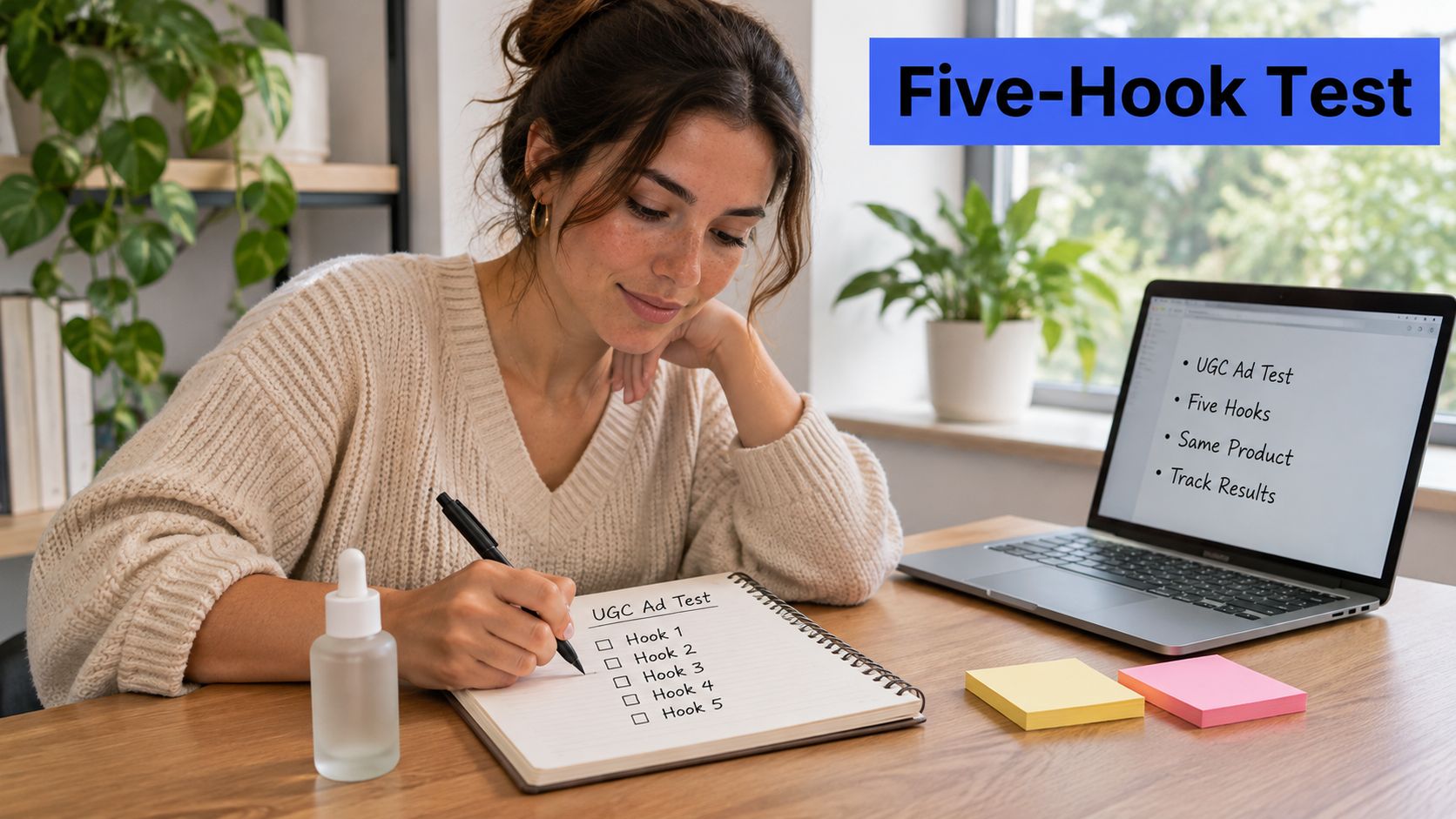
Six-Step Launch Sequence
Select one hero product and one claim. Choose the single promise that addresses the biggest buyer objection, leaving secondary features for future sprints.
Match one format to one funnel stage and placement. Pick the visual format that fits your buyer's current awareness level and confirm the exact aspect ratios and partnership permissions before booking talent.
Issue the eight-part brief with five labeled hooks. Script the claim, proof shot, five hook openings, compliance boundaries, and usage terms, leaving delivery and environment to the creator.
Price the full licensed unit cost. Tally the base fee, required paid-social rights, and a raw-footage contingency, then sanity-check that total against your target cost per result.
Launch three to five variants against your live control. Write your one-line hypothesis, freeze every variable outside the opening three seconds, and commit to a fixed evaluation window or spend cap.
Evaluate sequentially and iterate. Read hold rate, click-through rate, conversion rate, and cost per result in order, scale any variant that beats the control on both hold rate and cost per result, and replace only the weakest opening in round two.
Treat this opening sprint as a learning budget, not a lottery ticket. Judge its success on whether one structured hook reliably outperforms your existing control ad across the full test window, not on whether a single clip goes viral overnight.
Watch how structured creative production turns repeatable hooks and testing cadence into consistent paid-social performance.
Scaling Production Without Burning Out Your Team
Once your first test validates a winning claim and format, volume and refresh cadence become the bottleneck. At Busylike, we build and test video ads and UGC-style content for Meta, TikTok, and YouTube, producing ecommerce video ranging from product page videos and Amazon A+ content to UGC-style ads, unboxing and review videos, how-to and demo videos, launch campaigns, and social commerce content. For each ad concept, we produce multiple hooks, lengths, and formats, and refresh creative regularly to prevent ad fatigue.
Whether you run production in-house or with a partner, gather your marketing lead, editor, and creator before a single frame is recorded and answer one sharp question: which single claim must the viewer believe after the first ten seconds?
If your paid-social team wants structured UGC creative built for measurable conversion lifts rather than guesswork, our studio handles creator sourcing, directed scripting, multi-hook production, and ongoing creative refreshes across Meta, TikTok, and YouTube. Explore how we build and test high-converting ecommerce video campaigns by visiting Busylike and sharing your target goals.

