
We Were Inside OpenAI's New York Office — Here's What Happened

Updated: Sep 25
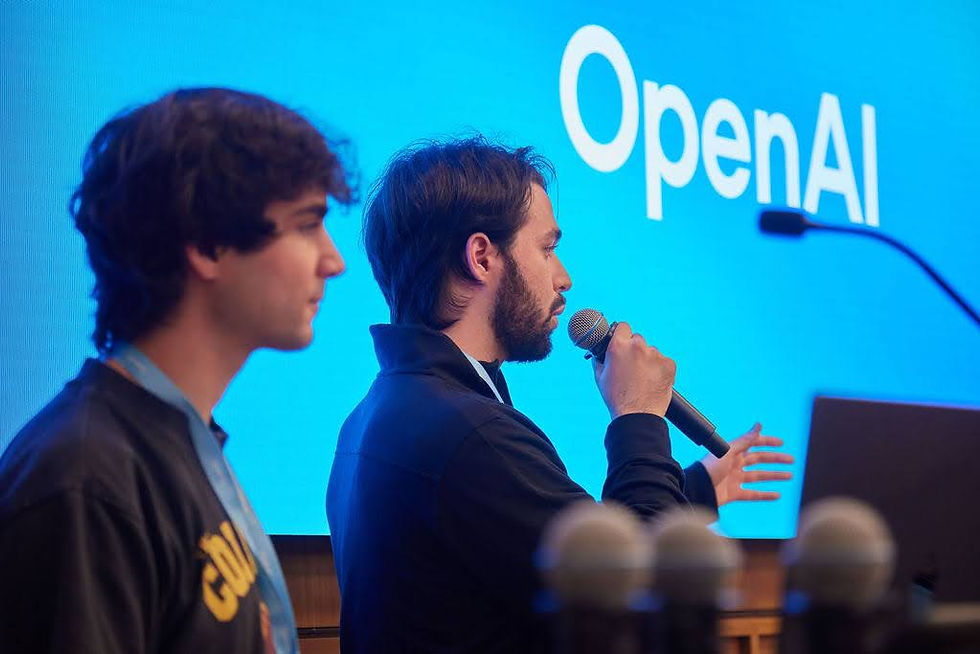
Last week, Busylike participated in the OpenAI Builder Lounge at NY Tech Week 2026. In a single afternoon, we built a working AI-powered brand identity audit tool from scratch, collaborated side-by-side with OpenAI's Engineering and Startup teams — and walked out with access to the ChatGPT Ads Manager platform. Here's the full story.

A Room Full of Builders, Inside OpenAI's New York HQ
New York Tech Week runs every June, and in 2026 it cemented the city's position as the applied-AI capital of the world. Hundreds of events spread across Manhattan, but one stood apart from every panel and networking happy hour: the OpenAI Builder Lounge x NYTW.
The event was not a conference. There were no keynotes, no sponsor booths, no general-admission tickets. RSVPs were filtered deliberately — OpenAI wanted builders in the room, not spectators. Sarah Urbonas, Head of Startup Marketing at OpenAI, opened the session and set the tone immediately: this was a working afternoon. Laptops out. Ideas into code.
Busylike was invited to participate, and we showed up ready to build.
The venue itself signals how seriously OpenAI is investing in New York. The company has leased roughly 90,000 square feet in SoHo's landmark Puck Building, part of a broader AI-driven surge that added close to a million square feet of Manhattan office space to AI companies through 2025 and into 2026. OpenAI isn't visiting New York anymore — it has planted a flag here.

What the OpenAI Builder Lounge Actually Is
The Builder Lounge is OpenAI's recurring format for bringing high-signal startup founders and developers into a room with its own engineering and startup teams. The format strips away the theater of traditional tech events. There are no slides about what's possible in AI. Instead, participants are given access to tools — including unlimited Codex access during the session — and encouraged to build something real.
Previous editions have run in London and San Francisco. The NY Tech Week edition, held at OpenAI's New York office, is positioned as the flagship event for the East Coast builder community. The team behind it — OpenAI for Startups and the core OpenAI Engineering team — runs Q&A throughout the afternoon, making senior technical staff directly accessible in a way that almost never happens at public events.
For Busylike, this was the right room at the right time.

Building a Brand Identity Audit Tool in Under Three Hours
Here's the part that still feels remarkable to us: in less than three hours, working side-by-side with OpenAI's Engineering and OpenAI for Startups teams, we built a functional AI-powered brand identity guideline audit tool.
The application was developed using OpenAI Codex — and the experience illustrated exactly why Codex has grown to over two million weekly active users since it reached general availability in late 2025.
Codex is not a chatbot that writes code snippets on request. It is an AI software engineering agent that operates in a sandboxed cloud environment, reads and edits files, runs tests, and returns results with full logs for review. Each task runs independently, meaning the agent can work on a meaningful engineering problem — not just autocomplete a function — and come back with something you can actually deploy.
What we built: A brand identity audit tool that analyzes a company's brand guidelines and surfaces gaps, inconsistencies, and opportunities — outputting structured, actionable recommendations. The kind of tool that would normally take a development sprint to prototype. We had a working version in a single afternoon.
What we built isn't just a prototype; it's a proprietary framework we’ve now integrated directly into our client workflows. If your brand guidelines were built for a traditional search era, LLMs and AI search engines like ChatGPT and Google AI Overviews may be misinterpreting your core messaging. Through our Video SEO for AI & GEO and brand positioning services, we now use these exact AI-native diagnostic workflows to audit how enterprise brands appear in generative recommendations.

The speed wasn't just about Codex. It was about having OpenAI's own engineers in the room while we built. The ability to ask a direct question, get an immediate answer from someone who built the underlying system, and apply it in real time — that's an advantage that no documentation or tutorial can replicate. It compressed weeks of trial and error into hours of progress.
What we came away with is a proprietary internal tool that sits at the heart of our brand audit process — built on the same infrastructure that OpenAI is positioning as its enterprise agent platform for the years ahead.

What OpenAI for Startups Means in Practice
The collaboration at the Builder Lounge happened through OpenAI for Startups — OpenAI's dedicated program for founders building on its platform. If you haven't explored it, the program is more substantive than most people realize.
Eligible startups gain access to free API credits, upgraded rate limits, and direct time with OpenAI's solutions engineers and technical staff. There are live virtual build sessions, curated developer resources, and — critically — invitations to in-person events exactly like the Builder Lounge. The program also provides a direct line to the OpenAI Startup team, which is a different quality of support than filing a support ticket or reading documentation alone.
The underlying philosophy is hands-on. OpenAI runs what it calls Build Hours — live technical deep dives and demos designed to help founders work through the APIs and models they're actually using, not theoretical use cases. The program was designed, according to OpenAI, by people who are themselves founders, investors, and operators. It shows.
For Busylike, the relationship with the OpenAI for Startups team has been one of the more valuable professional relationships we've built in 2026. Having a direct line to people who understand the platform at a technical level changes how fast you can move.
For our clients, this means the AI content and campaigns we produce are built by a team that works with these tools at the source, not one that learned them from tutorials. See how we use generative AI in client work on our AI Content Production page.
Need to future-proof your brand for the AI era? OpenAI's shift toward conversational search and agentic platforms changes everything about how customers discover products. At Busylike, we help brands adapt through Full-Service Video Marketing, 9:16 vertical video strategies, and Generative Engine Optimization. Don't leave your AI visibility to chance. Explore Our Agency Services →
The Day We Got ChatGPT Ads Manager Access
The Builder Lounge already would have been a milestone day. Then the email arrived.
On the same day as the event, Busylike received access to the ChatGPT Ads Manager — OpenAI's self-serve advertising platform, launched in beta on May 5, 2026. Getting this access on the same day we were building inside OpenAI's offices felt like a full-circle moment that captured exactly what this partnership means for us.
Let's be direct about why this matters. ChatGPT Ads Manager is not simply another ad platform. It is a fundamentally new kind of advertising surface — one built inside conversations, not alongside them.
The platform processes 2.5 billion prompts daily. ChatGPT accounts for 82.6% of all generative AI traffic. The people using it are actively engaged in research, decision-making, and problem-solving — not passively scrolling. When someone asks ChatGPT for a recommendation and your brand appears in that moment, the context is categorically different from a banner ad or a sponsored post.
"In just 86 days, OpenAI moved from an invite-only enterprise pilot with a $200,000 minimum to an open self-serve platform accessible to any U.S. advertiser. That is not a gradual rollout — it's a signal of confidence."
The mechanics of the platform are worth understanding. Campaigns run through a three-tier structure — campaign, ad group, ad — with targeting based on conversational context rather than keywords or demographic segments. Bidding works on a CPC or CPM basis through a relevance-weighted second-price auction. OpenAI launched conversion tracking via pixel and Conversions API, so advertisers can measure what happens after engagement: purchases, sign-ups, leads. Cost-per-action bidding is now in early access as of June 2026.
Industry analysts project U.S. AI-driven search advertising will grow from $1.1 billion in 2025 to $26 billion by 2029. OpenAI itself is targeting $25 billion in ad revenue by 2028. These are not the projections of a platform testing the waters — they are the projections of a platform that believes advertising inside AI conversations will become one of the primary channels for brand discovery in the next five years.
As an AI marketing agency, Busylike was built for exactly this moment. Our core work is helping brands become visible and recommended inside AI platforms — ChatGPT, Google AI Overviews, Perplexity, Gemini. ChatGPT Ads Manager is the performance advertising layer that sits on top of that organic presence. Now we can run both.

Why This Partnership Matters for Busylike's Clients
Our job at Busylike is to solve one fundamental problem: brands built their visibility strategies for a world where Google was the front door to the internet. That world has changed. The front door is increasingly a conversation — and the brands that show up inside that conversation, credibly and consistently, are the brands that win the next decade of customer discovery.
The week at OpenAI's New York office brought together everything that makes our position unique:
We now have a proprietary AI audit tool built in collaboration with OpenAI Engineering that can analyze brand identity guidelines and surface actionable improvements at a depth and speed no manual process can match.
We have direct access to ChatGPT Ads Manager, meaning we can manage paid visibility inside the world's most-used AI platform on behalf of our clients — with full campaign management, bidding flexibility, and conversion tracking.
We have a working relationship with the OpenAI for Startups and Engineering teams, which gives us early access to platform developments, technical support, and the kind of institutional knowledge that only comes from being inside the room.
We operate at the intersection of organic AI visibility and paid AI advertising — combining GEO (Generative Engine Optimization), AI-native media strategy, and now ChatGPT Ads to build complete discovery strategies across AI platforms.
This is not a vendor relationship. It is a builder relationship — and after last week, it has become significantly deeper.
What's Coming Next
The brand identity audit tool we built at the OpenAI Builder Lounge is moving into our client workflow now. It is designed to analyze how a brand's existing guidelines translate — or fail to translate — across AI-generated content, LLM recommendations, and generative media. Brands that have strong, consistent identity signals tend to be cited and recommended more accurately by AI systems. Brands that don't leave that to chance.
On the advertising side, we are actively setting up ChatGPT Ads Manager campaigns for clients who qualify — B2B SaaS, professional services, and high-consideration consumer brands that benefit most from reaching users at the exact moment they are actively researching and deciding.
If you want to understand how your brand appears across AI platforms today, we offer a free AI Visibility Audit. It maps where you appear, where you don't, and what it would take to change that. Given what we now know — and who we now have access to — this is the right time to start that conversation.
Make video part of your AI strategy. YouTube content is one of the sources AI systems pull from most heavily (YouTube Management).
