
Motion Design Service: A Practical Buyer's Guide

You've approved a polished hero animation for a campaign, and the launch team is already asking for vertical cutdowns, short pre-rolls, a CTV version, a product-page loop, and editable files for sales. The studio delivered one beautiful film, but the exports don't match the platforms, the text sits outside safe areas, and every new version requires another round of production.
That situation is common because buyers still treat motion as a single deliverable. A useful motion design service should work more like a reusable creative system, with channel-specific compositions, modular assets, clear versioning rules, and production files that support future campaigns. The question isn't only whether a vendor can animate. It's whether the vendor can turn one message into a dependable set of assets for YouTube, CTV, short-form social, product experiences, and owned channels.
Table of Contents
The Marketer's Problem With Motion Right Now - The variant grid is the real brief
What a Motion Design Service Actually Is - The people behind the deliverable
Why Motion Design Moves Business Metrics - Comprehension is the strongest use case - Measure the business connection
Deliverables Buyers Should Expect - A practical scope comparison
How Motion Design Projects Are Produced - Five phases, five approval decisions
Where Motion Design Performs Best in Market - Match the treatment to the environment - Use motion beyond paid media
KPIs, Vendor Selection, and Common Red Flags - What to check before hiring - Red flags that deserve attention
The Marketer's Problem With Motion Right Now
Most in-house teams can manage static social tiles, presentation graphics, and an occasional brand film. Their difficulty starts when motion demand becomes continuous and platform-shaped. Reels, TikTok, and YouTube Shorts need vertical compositions with fast visual entry points. CTV needs restrained layouts, readable text, and end cards that work from a viewing distance. YouTube requires versions that respect different durations, playback contexts, and placement specifications.
A single hero asset rarely survives those requirements unchanged. A horizontal composition may crop badly in a vertical feed. A carefully timed title sequence may bury the product benefit when shortened. A product walkthrough that works as a linear edit may fail as a loop because the opening and closing frames don't connect.
The variant grid is the real brief
The strongest briefs start with the variant grid, not the hero film. It names every planned combination of message, aspect ratio, duration, platform, language, and call to action. That grid lets the producer identify which components can be reused and which scenes must be rebuilt.
A practical grid might separate:
Core message: The primary promise, proof point, or product action.
Platform format: YouTube, CTV, paid social, product pages, or internal presentations.
Composition: Horizontal, vertical, square, or responsive interface layout.
Version logic: Different hooks, offers, products, audiences, or end cards.
Delivery requirements: Codec, frame rate, audio treatment, captions, source files, and naming conventions.
Practical rule: Approve the system before approving the polish. A visually impressive master that can't produce useful variants is an expensive starting point.
This shift also changes vendor evaluation. A portfolio can show taste, but it doesn't prove operational fluency. Ask to see how the team handles alternate openings, safe-area adjustments, captioned versions, editable templates, and late-stage copy changes. A good motion design service protects the idea while adapting the execution to where the audience sees it.
What a Motion Design Service Actually Is
Motion design applies movement to graphic elements so information, identity, or interaction becomes easier to follow. The materials may include animated type, icons, diagrams, logos, interface screens, illustrations, transitions, and three-dimensional objects. The work differs from live-action production, which captures footage, and from static graphic design, which fixes the composition in a single frame.
A useful comparison is a sign shop versus a printer. A general video studio may film interviews, capture product footage, and edit recorded material. A motion design service often designs and engineers the visual sequence from the ground up, using tools such as Adobe After Effects, Cinema 4D, Blender, or Rive. Live footage may appear, but it isn't required.
The people behind the deliverable
A mature team usually combines several disciplines:
Motion designers establish timing, transitions, typography, composition, and visual rhythm.
Animators handle character performance, 3D movement, rigging, simulations, or technically complex interactions.
Producers manage scripts, approvals, specifications, versioning, schedules, licensing, and handoff.
Those roles matter because motion projects fail as often in coordination as they do in animation. A designer may create a strong sequence that can't be resized cleanly. An editor may deliver the right duration but omit captions or source assets. A producer keeps the creative decision connected to the delivery environment.
The service can produce a one-off explainer, but that shouldn't be its only definition. The more valuable model is a repeatable library of animated assets, including logo behavior, transitions, typography treatments, icon systems, UI components, end cards, and templates. The team can then assemble new versions without rebuilding every visual from the beginning.
That system is especially useful for brands managing multiple channels. The motion design trends coverage from Envato describes why one asset no longer fits every platform, with Reels, TikTok, YouTube Shorts, and LinkedIn creating different expectations around aspect ratio and pacing. Buyers should therefore ask what remains reusable after final delivery, not just what appears in the exported movie.
Why Motion Design Moves Business Metrics
Motion doesn't automatically improve performance. It changes how viewers receive information, and that change can support a business metric when the creative, placement, offer, and media plan are aligned.
At the awareness stage, movement can create an earlier visual entry point. Animated type, a product transformation, or a clear diagram can communicate the category and promise before a viewer has processed a spoken explanation. On YouTube and CTV, that can make the opening easier to recognize and the brand easier to remember, but only if the first visual has a job. Decorative movement that delays the message wastes the most valuable part of the edit.
Comprehension is the strongest use case
Motion is particularly effective when the product is abstract, technical, or sequential. A kinetic diagram can show how data moves through a system. An animated interface can demonstrate a workflow. A product visualization can reveal a mechanism that photography can't expose.
That helps teams evaluate motion through comprehension speed, not vague claims about engagement. Useful questions include:
Can a viewer identify the product without sound?
Can the viewer explain the main action after watching once?
Does each transition clarify a relationship or merely add energy?
Does the call to action arrive after the viewer understands the offer?
At conversion, motion can reduce the mental effort required to interpret a product page, ad, or interface. An animated state change can show what happens after a click. A short UI loop can make a feature feel tangible. It still won't fix a weak offer, slow landing page, poor targeting, or unclear pricing.
Measure the business connection
Tie the creative to a metric that sits close to the intended outcome. Awareness work may use completed views, qualified reach, or branded search behavior. Consideration work may examine product-page interaction and progression to a meaningful action. Conversion work should connect the asset to clicks, qualified leads, purchases, or another defined business event.
For a broader framework on connecting marketing activity to leadership-level outcomes, use this guide to proving marketing ROI. The practical lesson is simple: document the hypothesis before production, then compare the motion treatment with a suitable creative alternative rather than claiming that motion alone caused the result.
Deliverables Buyers Should Expect
A motion design service should provide a deliverable map that matches the campaign's actual distribution plan. The master video is only one item. Depending on the brief, the package may include platform cuts, alternate hooks, end-card variations, captioned files, animated logos, lower thirds, kinetic typography, product loops, and editable source projects.
Format details need to be explicit. Confirm aspect ratio, dimensions, duration, frame rate, codec, audio settings, caption treatment, transparency requirements, naming conventions, and delivery location. If the brand's internal team will make future changes, confirm whether the layered project is included, whether linked assets are packaged, and which software versions are supported.
A practical scope comparison
Deliverable Category | Typically In Scope | Usually Out of Scope, Add-On |
|---|---|---|
Campaign video | Master animation, structured edit, brand treatment | Live-action filming or location production |
Platform versions | Horizontal, vertical, square, short-form, bumper, and end-card variants | Paid media buying or campaign management |
Brand assets | Animated logo, lower thirds, transitions, typography system | Full brand identity development |
Product motion | UI walkthroughs, feature loops, product visualization | Product engineering or production app integration |
Interactive files | Lottie or Rive files for UX and onboarding, when offered by the studio | Front-end implementation and QA across every device |
Post-production | Sound design, basic music integration, captions, exports | Original music composition or extensive voiceover casting |
Handoff | Packaged source project and asset library, if contracted | Unlimited future edits without a maintenance agreement |
The out-of-scope column isn't a criticism. Live-action, voiceover casting, music licensing, media strategy, and interactive implementation are legitimate services that often require different specialists. The problem occurs when the brief assumes they're included and the vendor assumes they're not.
Put every requested version into the contract. A late request for a new aspect ratio may require a composition rebuild, not a simple export. A clear list of revisions also protects both sides from an approval process that never closes.
How Motion Design Projects Are Produced
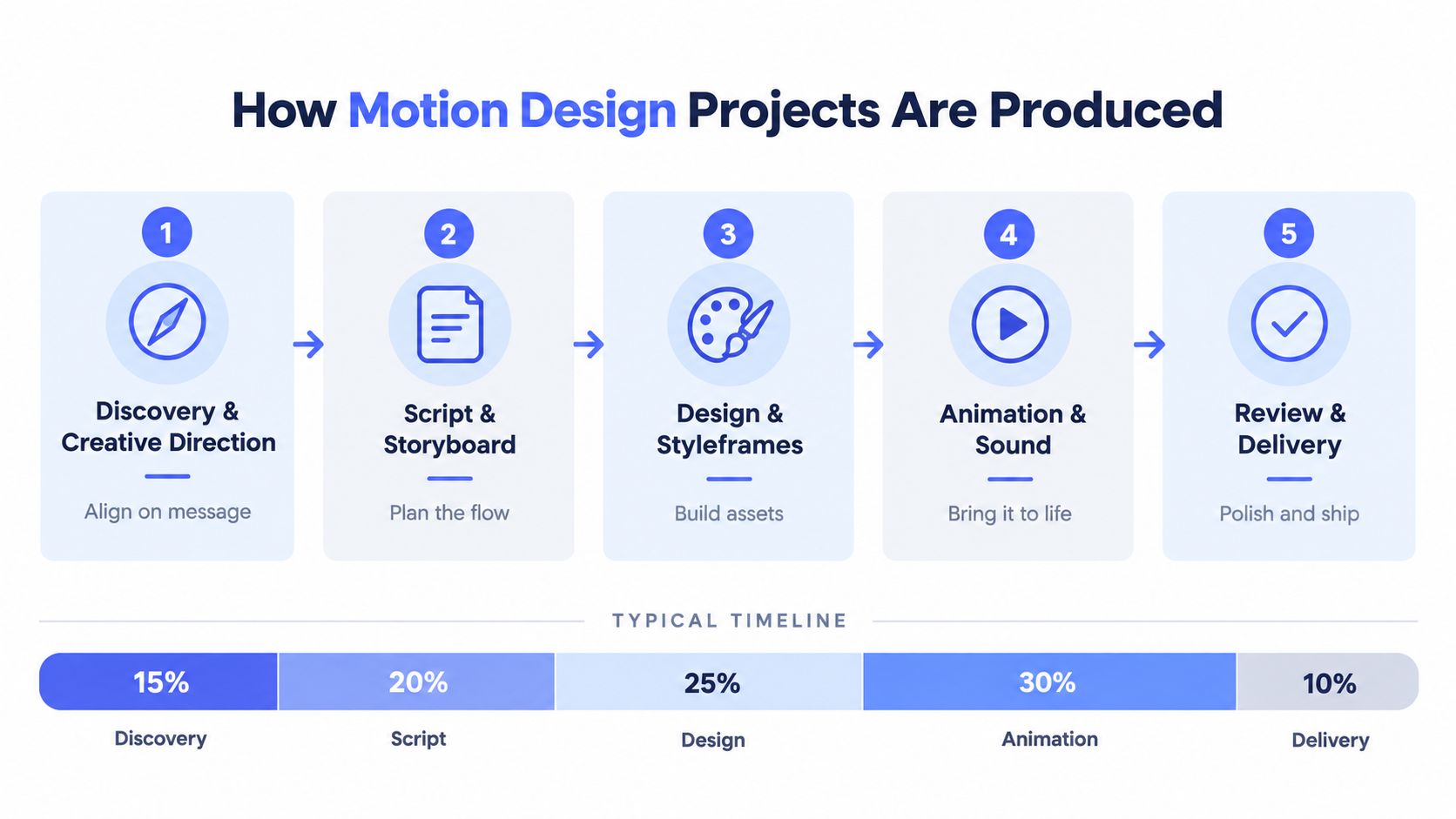
The production process works best when each phase resolves a different kind of uncertainty. Discovery resolves the business problem. Storyboarding resolves the narrative. Style frames resolve the visual language. Animation resolves timing and movement. Delivery resolves technical compliance and reuse.
Five phases, five approval decisions
Discovery and creative direction aligns the audience, message, brand rules, platform requirements, reference cuts, and success metric. If stakeholders can't agree on the intended action here, animation won't solve the disagreement later.
Script and storyboard establishes the words, beats, scenes, and visual order. A storyboard doesn't need finished art, but it should make the message and transitions understandable. The producer checks whether the concept can produce the required variants.
Design and style frames defines the look through selected frames, typography, color, illustration, UI treatment, and composition. Custom illustration creates more ownership and distinction, while templates or existing brand assets can shorten the build and reduce cost.
Animation and sound brings the approved system to life. The team builds assets, animates transitions, integrates voiceover, adds sound design, and checks pacing. Kinetic typography is usually simpler to control than character rigging or complex 3D work, but the right choice depends on the message.
Review and delivery covers feedback rounds, accessibility checks, exports, versioning, source handoff, and documentation. Assign one internal review owner and define turnaround expectations before production starts. Too many reviewers produce contradictory notes and slow the calendar.
A structured production workflow also makes catalog-driven creative easier to manage. Teams exploring Facebook catalog ad videos should still define the source fields, visual rules, fallback behavior, and approval process before automation or batch production begins. For broader context on how video fits into agency production models, see this advertising agency video resource.
Accessibility belongs in production, not as a final patch. WCAG 2.2 requires automatically moving, blinking, or scrolling content that lasts more than 5 seconds and appears alongside other content to be pausable, stoppable, or hideable. Interaction-triggered motion must also be disableable unless it is essential, so every motion design service should plan a reduced-motion fallback for interfaces and animated experiences.
The technical review should also check flashing. Accessibility guidance says flashing content should not exceed 3 flashes per second and advises avoiding saturated red flashes and unsafe flashing areas, as described in motion accessibility guidance from Willamette. Document each animation's purpose, duration, and reduced-motion behavior before the final render.
Pricing Models and What Drives Cost
Motion pricing becomes easier to interpret when the quote reflects the production system rather than only the finished runtime. A short animation can require substantial design, illustration, compositing, sound, and versioning. A longer piece built from approved templates may require less original work.
Four commercial structures appear frequently:
Flat project fee: Best for a defined brief with agreed deliverables, revisions, rights, and schedule. It gives the buyer budget clarity, but a vague scope creates change-order risk.
Day or hourly rate: Useful when the work is exploratory, ongoing, or difficult to define in advance. The buyer gets flexibility, but must manage priorities and approvals closely.
Retainer: Suits brands producing continuous paid social, YouTube, or CTV creative. It reserves capacity and supports a reusable library, but unused capacity and unclear request limits can create friction.
Value-based scope: Ties the fee to the campaign's strategic importance or distribution plan. It can fit high-stakes launches, but the buyer should still receive an itemized production plan.
Pricing Model | Best For | Main Cost Drivers |
|---|---|---|
Flat project fee | Defined campaign packages | Unique concepts, asset count, revisions, licensing |
Day or hourly rate | Flexible production support | Team seniority, feedback speed, technical complexity |
Retainer | Ongoing creative testing | Reserved capacity, response time, monthly scope |
Value-based scope | Strategic launches | Distribution importance, audience complexity, rights, risk |
The largest cost drivers are usually the number of unique style directions, custom illustration, animation complexity, voiceover, music licensing, turnaround, and revision rounds. Character rigging and 3D work generally require a different production setup from kinetic typography, while a responsive Rive experience has implementation considerations beyond a rendered video.
Rush work can carry a surcharge, but don't accept a vague premium without an explanation of what changes. Ask the vendor to separate creative development, production, versioning, licensing, and project management. A buyer comparing the best editing approach with revid should make the same distinction, because automated tools and professional editors solve different problems around consistency, judgment, and finishing.
A detailed quote should state the revision count, review windows, source-file ownership, music rights, usage territory, and cancellation terms. For related planning considerations, see this resource on animated advertising videos. The goal isn't to force every project into one pricing model. It's to make the assumptions visible before the first frame is built.
Where Motion Design Performs Best in Market
Motion works best when its technique matches the platform's viewing behavior. A YouTube pre-roll, a CTV spot, a vertical social cut, and a product onboarding animation may share a brand system, but they shouldn't share identical pacing or composition.
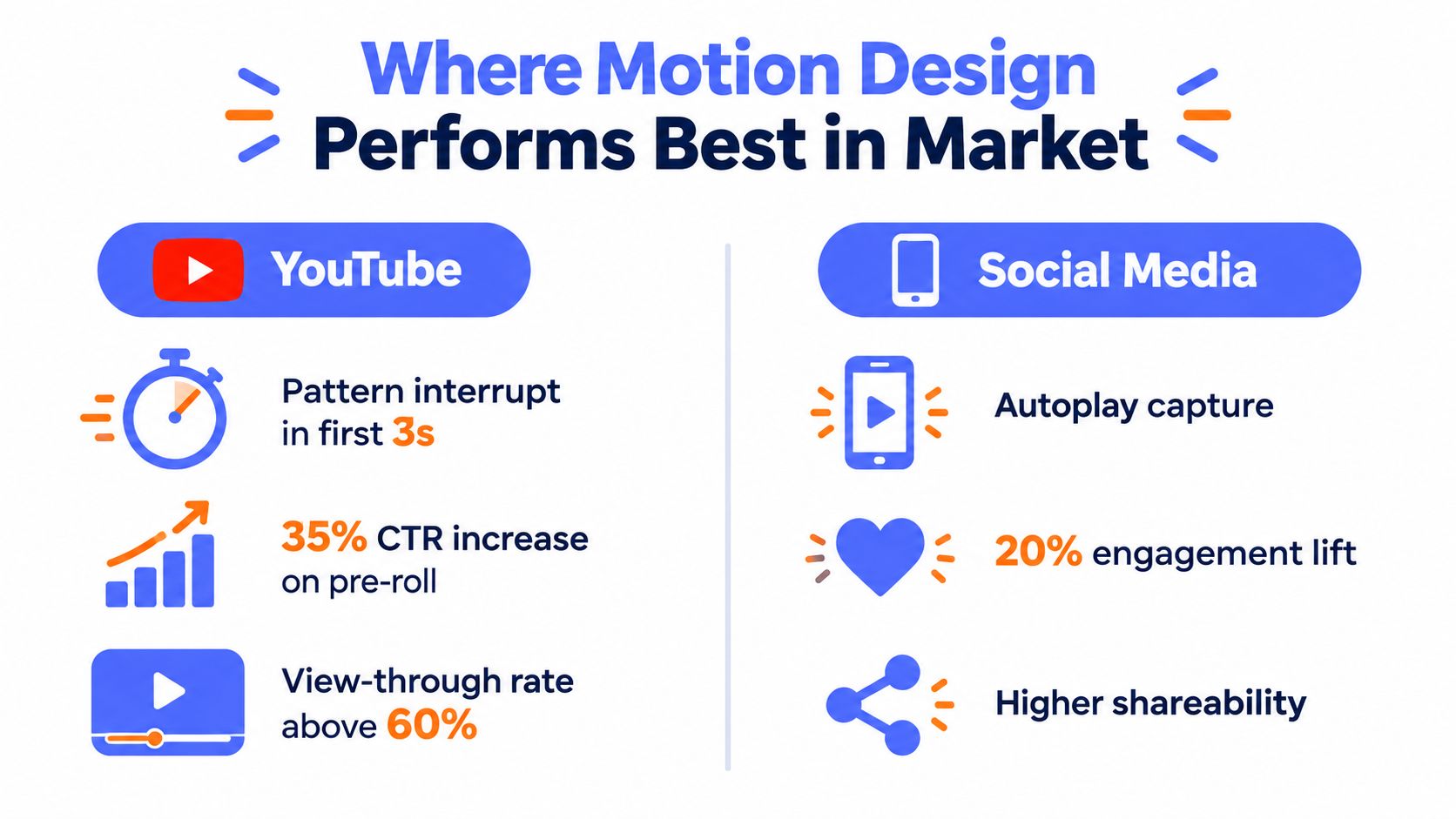
On YouTube, the opening needs to identify the problem, product, or visual tension quickly. A pattern interrupt can be a bold typographic change, a product transformation, a sudden diagram build, or a human action entering the frame. The technique only helps when it leads directly to the value proposition. Rapid movement without meaning creates activity, not attention.
Match the treatment to the environment
CTV and OTT reward legibility and brand recognition. Viewers may be sitting farther from the screen, using a remote, or watching in a lean-back context. Large type, clear contrast, deliberate logo timing, and a strong end card usually outperform intricate details that disappear at distance.
Short-form social has a different constraint. The video often starts muted, competes with a dense feed, and needs to work in vertical composition. Kinetic captions, immediate product context, visual resets, and alternate hooks help the same campaign idea survive different scroll patterns. A horizontal master shouldn't be cropped. Recompose the text, subject, and action for the vertical frame.
Inside a product, motion should explain state and response. Onboarding transitions can show where a user is going. Empty states can clarify the next action. A feature reveal can demonstrate a relationship that static UI leaves ambiguous. Keep the animation subordinate to the task, especially when users can enable reduced-motion preferences.
Use motion beyond paid media
Sales and internal teams can use animated diagrams, feature walkthroughs, and presentation sequences to make technical material easier to explain. The same asset library can support a product page, a sales deck, a webinar, and a paid campaign when the source components are organized and licensed appropriately.
The motion graphics market has been forecast to reach US$110.0 billion in 2026 and US$230.0 billion by 2033, with a projected 11.1% CAGR during 2026 to 2033, according to Persistence Market Research's motion graphics market forecast. That projection supports a practical conclusion for buyers. Motion is becoming a core communication format, so teams need systems that can serve several placements rather than isolated showpieces.
KPIs, Vendor Selection, and Common Red Flags
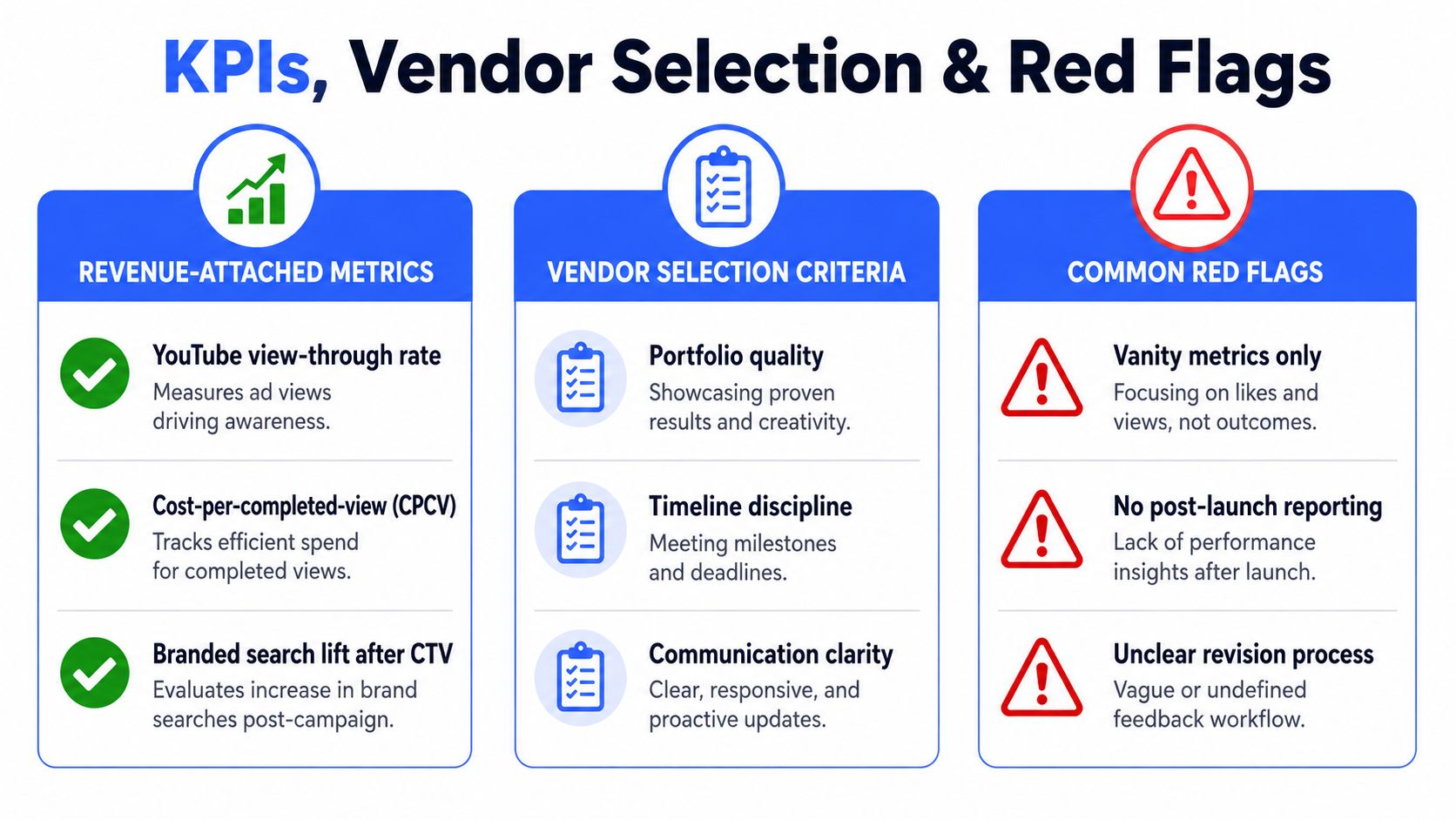
A vendor should help define what success means before the storyboard is approved. Raw views, impressions, and likes can describe distribution, but they rarely explain whether the creative moved a commercial outcome. The right KPI depends on the placement and the job assigned to the asset.
For YouTube, review view-through rate, cost per completed view, qualified action, and the relationship between the opening hook and retention. For CTV, connect the flight to branded search behavior, direct traffic, or another agreed signal, while acknowledging that attribution may be directional. For social, examine early hook behavior, completion, saves, shares, and downstream conversions rather than treating follower growth as the main verdict.
What to check before hiring
Platform portfolio: Ask for work that resembles your actual channel, not only polished title sequences or award-style reels.
Named project lead: Confirm who owns production decisions, approvals, versioning, and delivery.
Technical fluency: Test the vendor's understanding of frame rates, codecs, captions, safe areas, audio, and source-file handoff.
Reusable architecture: Ask how the team will organize templates, components, alternate hooks, end cards, and future edits.
Pilot option: A focused first engagement can reveal communication quality and production discipline before a longer commitment.
Reporting plan: Establish which creative variables will be tracked after launch and who will interpret the results.
The video production agency resource can help frame the wider distinction between production capability and campaign support. A motion design service may be excellent at animation but not equipped to buy media, manage a channel, or report on performance. Make that boundary explicit.
Red flags that deserve attention
Be cautious when a studio shows only a showreel, quotes by runtime without listing versions, refuses to introduce the producer, treats revisions as unlimited, or can't explain who owns the working files. A vendor that discusses visual style but ignores platform specifications may create attractive assets that media teams can't use.
Your brief should state the objective, audience, platform, specifications, reference cuts, success metric, timeline, rights window, required versions, revision process, source-file terms, music licensing, and cancellation or kill-fee conditions. Busylike offers motion design and explainer video production that covers scripting, storyboarding, style frames, illustration, animation, sound design, and final delivery, making it one option for teams that need production connected to YouTube, CTV, and social distribution.
If your team needs motion assets that are planned as a reusable, platform-specific system, visit Busylike to discuss the brief. Share your target channels, required variants, and success metrics, and the team can help scope the production, paid video, and channel requirements around the campaign.


